- 216 pages
- English
- ePUB (mobile friendly)
- Available on iOS & Android
eBook - ePub
About this book
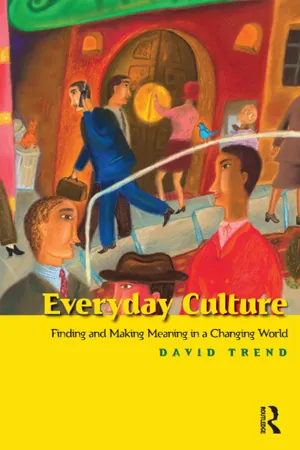
Everyday Culture examines the confluence of cultural and material possibility--the bringing together of thought and action in daily life. David Trend argues that an informed and invigorated citizenry can help reverse patterns of dehumanization and social control. The impetus for Everyday Culture can be described in the observation by Raymond Williams that the "culture is ordinary," and that the fabric of meanings that inform and organize everyday life often go undervalued and unexamined. Everyday Culture shares with thinkers like Williams the conviction that it is precisely the ordinariness of culture that makes it extraordinarily important. The ubiquity of everyday culture means that it affects all aspects of contemporary economic, social, and political life.
Information

CHAPTER ONE
BEGINNING
AN INTRODUCTION
We begin with what we know. In the classic study, The Practice of Everyday Life, which was published in English in 1984, Michel de Certeau draws a distinction between the acquisition and the use of knowledge. A great believer in the intellectual capacities of ordinary people, de Certeau recognized that individuals had skills for critical thinking and understanding the world around them. Yet de Certeau wondered why groups living in poor conditions or under the authority of unreasonable leaders would continue to do so without complaint. The answer, he speculated, had something to do with a disconnection between knowledge of these poor conditions and the act of doing something to change them. De Certeau and many political theorists of his generation concluded that people could benefit from education about the practical skills and strategies needed to change their lives. To that end, de Certeau wrote that “we must determine the procedures, bases, effects, and possibilities of this collective activity.”1
Everyday Culture: Finding Meaning in a Changing World is about this ongoing quest for solutions to social problems and strategies for positive social change. The book addresses key themes in the study of contemporary communications: the relationships among media, art, and culture; concepts of audience; differing functions of mass communication forms; new information technologies; education and democracy; and issues of identity, difference, and globalization. Often the general public thinks that mass media are all-powerful and that “art” exists only in museums and has little to do with their personal interests. This book challenges these assumptions by examining media and art in the broader contexts of culture and everyday life. Addressing the many institutions and interests that shape what people listen to, watch on TV, or play on their computers, Everyday Culture puts culture in familiar terms by talking about life at work, at school, and at home. In doing this, discussions in the book center around the role of media culture in our understandings of who we are, how we got here, the kind of world we’d like to inhabit, and how we might get to that place.
Everyday Culture asserts that we live in a time in which the everyday cultural activities that fill our lives are largely undervalued and ignored. The things that occupy our time, give us enjoyment, and dominate much of our thinking—reading books, pursuing hobbies, listening to music, watching television, sending e-mail, talking with friends, or sharing meals—are considered by most of us to have little to do with the larger economic circumstances that influence our standard of living, the political forces that determine our rights and our codes of behavior, or the global interests that influence foreign policy, war, and peace. But these things that occupy most of our time and thoughts may also include the daily rituals of school, work, religious observances, commuting, shopping, running errands, and executing household chores.
Everyday Culture takes a critical look at why most people feel powerless and cut off from the “bigger” forces that govern our lives. At no other time in recent decades have people felt more disconnected from government, large institutions, and the media conglomerates. Multinational manufacturers and retail chains limit choice and diversity in what we eat, wear, and consume. Educational authorities and media experts deplore the activities and entertainment that most people enjoy. Bureaucrats and government officials waste tax revenues, enact frivolous legislation, and declare unwanted wars. In the face of powerlessness and detachment from public life, large segments of the population have become alienated from politics, disillusioned with the democratic process, and absorbed with self-interest and private concerns.
History and the “Everyday”
These perceptions of omniscient authority aren’t especially new. Many of them originated with the social reorganization of the modern enlightenment beginning in the 1500s. The era and its ethos of human “progress” celebrated objectivity, reason, and rigidly structured living over the subjectivity, intuitiveness, and organic societies that preceded it in the Middle Ages. The new era brought with it the categorization of ideas into disciplines of intellectual specialization such as science, history, and mathematics, as well as distinctions between high and low culture. The enlightenment also coincided with the development of trade and capitalism, which brought with them the commodification of goods and human labor. The transformation of craft labor into factory work under capitalism meant that things like shoes and crops were no longer simply produced for their use or enjoyment but for their exchange value for other goods. Work drained of its creative spirit became something one sold. With the rise of industry in the late modern era, control became more mechanized. The repetition inherent to industrial production made work boring. Describing work on the assembly line, Karl Marx wrote in 1867, “Here is the movement of the machine he must follow.”2 The ethos of control—what Max Weber called the “iron cage” of bureaucratic rationality—extended outside the workplace and into all aspects of life.3
As more and more parts of life fell subject to bureaucratic organization, time became something people measured and worried about. New technologies of time played a role in this process, such as the development of clocks in the fourteenth century. The growing mechanization of time measurement resulted in an abstraction of its duration—no longer tying it to external events like waking or sunrise. The ability to measure time allowed people to become more conscious of it, calling attention to how much time was spent at work, school, church, or in leisure activities. Time also became geographically synchronized as never before. Prior to the nineteenth century, people reset their pocket watches when traveling according to local time standards, which varied from place to place. The growth of railroad travel and the near-instantaneous communication of the telegraph allowed the synchronization of time between towns and cites.
The standardization of time and its growing presence in people’s lives contributed to new means of control and the standardization of identity itself. Eventually, the objectification of work and leisure began to influence the way people perceived themselves. Rather than identifying themselves as autonomous subjects who acted upon the world and made it their own, people saw themselves as passive objects. Work became time that one “owed” to someone else, or work was a way a person “marked” time. Time off the job and not well “spent” became “wasted time.” As a highly structured and manipulated experience, leisure time became a site of pseudoenjoyment, or what one writer termed “organized passivity.”4
The pessimism of this perspective was codified in the 1930s and 1940s by the Marxist thinkers of the Frankfurt School, who wrote of the manipulation of the “masses.” Writers Max Horkheimer and Theodor Adorno asserted that people were powerless to resist the overwhelming forces of capitalism, its seductive ideology of consumption, and the continuous desire for more material goods.5 Within this logic, people became ensnared by an endless cycle of working and spending. To the Frankfurt School, the mass media played a central role in convincing people to accept the “false consciousness” that made them passively accept their oppressive lives.
This negative view does not end the story. Other groups of intellectuals argued that the grasp of ideology could never be so absolute and that people always retained critical capacities to question and contest false consciousness. To the Situationists, this liberating consciousness lay embedded within everyday experience that no authority could ever completely control. Intellectuals Henri Lefebvre and Guy Debord argued that the very quality of the “everyday” could rescue people from mass oppression due to the individualistic ways that people experience life.6 People are too different and complex to be manipulated uniformly by monolithic institutions and discourses. Summarizing the sentiments of these writers, Michael E. Gardiner wrote that although it remains possible that the “complexity, the depth of experience, and intensity of interpersonal relationships located within everyday life will be impoverished, this sphere also contains resistant or counterhegemonic qualities that point toward the possibility of radical disalienation and full humanization of social life.”7
But how do we work toward a society that is more geared toward connectivity and engagement? Throughout the twentieth century, artists have sought to recapture everyday experience by drawing attention to its overlooked aspects or by portraying the everyday in unusual ways. Avant-gardists in Europe and the United States used various techniques to identify details, objects, or experiences from daily life that could convey extraordinary or transcendental value, or that simply would remind viewers of the intrinsic aesthetics of common experience. Some artists made artworks from “found objects” ranging from household utensils to industrial machines in assemblage sculptures. Surrealists of the early 1900s used bits of text and imagery from newspapers and magazines in collages. Members of the French Lettrist movement took these impulses even further in their fragmentation of words, recontextuallization of alphabetic symbols, and experiments with typography and numerology. Radical performers enacted plays, “happenings,” or other events in the streets to break down conventional understandings of what art was and where it was seen.
Many of these ideas were brought together in the writings of Michel de Certeau, who believed strongly in the liberating potential inherent in everyday activities. Unlike many of his generation who argued that consumer culture held a tyrannizing grip on the public, de Certeau encouraged people to appropriate and reuse materials around them for their own purposes. Rather than giving in to the mandates and rules of bureaucratic authority and mind-numbing conformity, de Certeau urged people to find ways to subvert the given order—a resistant impulse he believed was inherent in everyday existence. Commercial culture was not something to be feared. Besides, de Certeau argued, it was beyond escape. Instead, de Certeau recommended finding “ways of using the products imposed by the dominant economic order.”8 “Creativity is the act of reusing and recombining heterogeneous materials,” he wrote.9
In contrast to many of his leftist contemporaries, de Certeau argued that resistance was not limited to direct action and economic struggle. Politics also resided in cultural works and forms of expression. Although de Certeau never abandoned material causes, he argued that the separation of the text from materiality was a false distinction. Production and consumption should not be seen as separate realms any more than reading and writing. He wrote, “We have to quit thinking that a qualitative gap exists between the acts of reading and writing. The first is a silent creativity invested in what the reader does with the text; the second is the very creativity, but made more explicit in the production of a new text.”10
As de Certeau’s thinking on appropriation and language might suggest, he saw great potential for resistance in modest everyday moments. To him, power was not only exerted upon people in many aspects of their lives—it also could be resisted in even the smallest activity. This was the basis for de Certeau’s famous distinction between a “strategy” enacted as a general rule, typically from an authoritarian body, and a “tactic” issued as localized struggle from a subordinated entity. The importance of de Certeau’s work for Everyday Culture lies in the encouragement it gives in a world where people often feel alienated and removed from the forces that govern their lives. Government, the legislature, huge corporations, and educational institutions may seem beyond the reach of individuals. But to de Certeau, revolution can begin in small places. The desire for change is what is most important. The program for that change begins with something as simple as a conversation with a friend or an action taken by a small group.
Everyday Culture: Finding Meaning in a Changing World begins with a discussion about everyday life, providing readers a fuller understanding of how underexamined aspects of daily existence can provide insights into larger issues that affect who we are, the groups to which we belong, the social circumstances in which we find ourselves, and the economic and political circumstances that determine what we can do and who we can become. Then, the book explores more specific aspects of empowerment within these groups, situations, and organizations.
One key strategy of exploring empowerment is to engage, more critically, all those things that work against people’s ability to see themselves as subjects. For this reason, Everyday Culture spends a great deal of time looking at ways of interpreting media and “reading” the world of advertising, entertainment, news, and consumerism that so influences how we think and feel. Next comes a consideration of the moral and political implications of this inquiry. This means asking how ideas and actions affect other people and how those ideas and actions form structures and policies that perpetuate their effects. Such a spirit of ethical concern stems from the recognition of the connectedness between all people and the realization that an injury to one person is an injury to all humanity. This is an important counterpoint to the critical individualism that a focus on the everyday can sometimes imply. But this ethical approach to living should not be confused with a unifying moral or religious program. It is a morality that reflects the diverse and complex histories of all peoples. Its only unifying principle is the concern for others and the respect it generates for difference and egalitarianism.
How the Book Is Organized
Everyday Culture is designed to function primarily as a practical guide and resource for an enlivened and critically informed experience of the everyday. The book offers a variety of approaches to different aspects of the everyday experience. Everyday Culture includes discussions of prominent thinkers about everyday life, considerations of activities that make up daily life, and examinations of topics in popular culture, media, and consumption. Everyday Culture is divided into five chapters, each of which addresses major themes: “Asking,” “Reading,” “Finding,” “Joining,” and “Building.”
Each chapter contains several essays on topics relevant to that particular theme but not intended to exhaust it. For example, Chapter 2, “Asking: Questioning Culture and Consumption,” contains an essay entitled “Everyday Culture,” which examines different definitions and types of culture. Another essay, “But Is It Art?” looks at fine art as a specia...
Table of contents
- Cover
- Half Title
- Title Page
- Copyright Page
- Table of Contents
- Preface: Everyday Culture vii
- 1 Beginning: An Introduction
- 2 Asking: Questioning Culture and Consumption
- 3 Reading: Language, Communication, and New Media
- 4 Finding: Self and Identity
- 5 Joining: Communities and Publics
- 6 Building: Globalization and Democracy
- Index
- About the Author
Trusted by 375,005 students
Access to over 1.5 million titles for a fair monthly price.
Study more efficiently using our study tools.
Frequently asked questions
Yes, you can cancel anytime from the Subscription tab in your account settings on the Perlego website. Your subscription will stay active until the end of your current billing period. Learn how to cancel your subscription
No, books cannot be downloaded as external files, such as PDFs, for use outside of Perlego. However, you can download books within the Perlego app for offline reading on mobile or tablet. Learn how to download books offline
Perlego offers two plans: Essential and Complete
- Essential is ideal for learners and professionals who enjoy exploring a wide range of subjects. Access the Essential Library with 800,000+ trusted titles and best-sellers across business, personal growth, and the humanities. Includes unlimited reading time and Standard Read Aloud voice.
- Complete: Perfect for advanced learners and researchers needing full, unrestricted access. Unlock 1.5M+ books across hundreds of subjects, including academic and specialized titles. The Complete Plan also includes advanced features like Premium Read Aloud and Research Assistant.
We are an online textbook subscription service, where you can get access to an entire online library for less than the price of a single book per month. With over 1.5 million books across 990+ topics, we’ve got you covered! Learn about our mission
Look out for the read-aloud symbol on your next book to see if you can listen to it. The read-aloud tool reads text aloud for you, highlighting the text as it is being read. You can pause it, speed it up and slow it down. Learn more about Read Aloud
Yes! You can use the Perlego app on both iOS and Android devices to read anytime, anywhere — even offline. Perfect for commutes or when you’re on the go.
Please note we cannot support devices running on iOS 13 and Android 7 or earlier. Learn more about using the app
Please note we cannot support devices running on iOS 13 and Android 7 or earlier. Learn more about using the app
Yes, you can access Everyday Culture by David Trend in PDF and/or ePUB format, as well as other popular books in Social Sciences & Cultural & Social Anthropology. We have over 1.5 million books available in our catalogue for you to explore.