- 157 pages
- English
- ePUB (mobile friendly)
- Available on iOS & Android
eBook - ePub
Chinese Export Porcelains
About this book
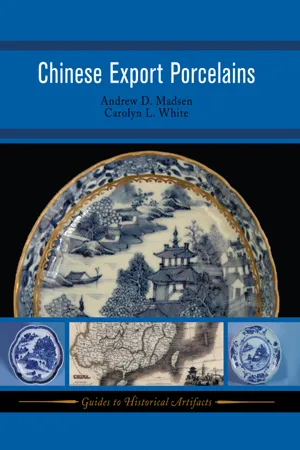
The blue and white porcelain exported by China in the eighteenth and early nineteenth centuries is an important category of artifacts and antiques, a fashion-sensitive commodity that was affected by the ebbs and flows of style and consumer demand. In this copiously illustrated, comprehensive guide to Chinese export porcelain, Andrew Madsen offers both a broad overview and detailed identification and context information for the most common styles and motifs. His focus on the determination of manufacture dates, which are based primarily on data collected from armorial decorated export wares, porcelain cargoes from dated shipwrecks, and tightly dated archaeological contexts, will allow students, scholars, and collectors to refine associations with Chinese export porcelain, revealing the untapped quantity of information that mass-produced Chinese export porcelain has to offer.
Information
CHAPTER 1
Background and Overview
Our ships began to penetrate to the most distant seas, and to bring home with them the produce of every clime.1
—Uriah Hunt, 1837
Eighteenth Century Politics, Increasing Commerce, and the Appeal of Chinese Goods
The late seventeenth to eighteenth centuries in Europe were a period of transformative technological, cultural, and political change that set the stage for the commercialization of and desire for Chinese trade goods in Europe and European colonies across the globe. Caught up in a whirlwind of technological innovation, increased maritime trade, newly developed marketing strategies, and socio-political and economic changes, Europe was hurled into the modern era of commerce, political thought, and scientific inquiry.
The eighteenth century brought with it an ever-increasing thirst for scientific knowledge and a burgeoning curiosity and interest in exotic places and things. The domination of Britain as the leading sea power of the age brought commodities of the world to Britain and within reach of an expanding middle class eager to experience a taste of the exotic. Growing numbers of illustrated publications describing the travels of Europeans across the globe fueled the public’s interest in foreign locales. The British, along with other Europeans, reaped commercial benefits from the maritime economy by bringing home commodities from foreign lands such as China. Possessing exotic items served to link oneself to these places and to signal to others a level of gentility and refinement in an age of expanding worldwide trade. Chinese porcelains were among many objects that brokered this status.
Political and intellectual thought during this period served to fuel the passions of the middling sort, and focused increasing attention on ideals of individual liberty and the place of the individual within society. A burgeoning group of manufacturers, and a progressively more consumer-oriented middle and trade class increasingly sought to acquire material goods, a practice previously dominated by the upper classes. The growing numbers of persons engaged in the acquisition of fashionable and luxury goods greatly expanded the market for these goods.
In England, sumptuary laws that forbade the ownership of luxury goods by the lower and middling classes are said to have been “repealed or withered away” by the seventeenth century.2 The reduction of legal and social prohibitions on the ownership of luxury goods combined with the growth of the manufacturing and trade classes in Great Britain in part served to increase interest in shopping among the trade and middle class. The result was an increasingly large segment of society participating in market commerce, and the acquisition of at least a few items that were previously the domain of only the wealthiest.
Freed from the ideal that the place of the populace was to serve the king, individuals expanded their horizons, engaged in new commercial and scientific endeavors, and began to accumulate an increasing amount of disposable income to spend on luxury goods. The eighteenth century was a period of intensified scientific inquiry, travel, and the commercialization of stories of the Far East, which served to excite public passion in things exotic, including Chinese export wares. Additionally, an ever-increasing volume of books and newspapers introduced a growing segment of the general public to stories of “Cathay,” a land we know as China, imbued with romance and mystery. It was then natural that the tangible goods brought back as part of the China trade served to represent a link with the exotic—a chance to enjoy some of the fruits of exploration without leaving Europe. An increasing market for Chinese-produced ceramic wares, most notably Chinese export porcelain, developed against the backdrop of interest in the exotic and an increasing appetite for fashion and the products of the trade with China. For centuries, the few pieces of Chinese porcelain that reached Europe from China or the Middle East were only within reach of royalty and the nobility. The increasing imports of Chinese wares to Europe during the eighteenth century brought these wares within reach of the middling ranks of society.
The trade with China included the purchase and use of a wide array of goods in addition to porcelains, including tea, silks, spices, fans, and lacquered ware. The porcelains are one of the few of these items that survive in any great quantity within archaeological contexts from which we can study the trade with China, the influence of Chinese goods on the West, and the ways in which urban and country folk integrated themselves into the worldwide market economy of the period. Chinese porcelains have been passed down through generations. Consequently, these wares are the most widely surviving material commodity of the export trade. Porcelains are the single commodity commonly recovered from archaeological contexts that afford a glimpse into the worldwide influence of the China trade.
Only within the last thirty years or so have ceramicists devoted serious attention to the interpretation, identification, and analysis of common varieties of Chinese export wares. Previous scholarship focused on the unique, special-ordered wares known as Chine-de-Commande, studied by art historians.3 In the last years of the twentieth century, scholars began to pay attention to common wares, catalyzed by a shift in recognition of their cultural and historical significance and the documentation, recovery, and commercial sale of shipwreck cargoes of mass-produced Chinese export wares.4 While we do strongly oppose the commercial dissemination of archaeological materials, the information contained in these vessels is valuable and we employ the materials in the pages that follow.
Archaeologists conducting additional research have discovered a need for interpretive publications. Previous works on Chinese export wares, while contributing significantly to our knowledge of these wares, have tended to focus on the documentation of a specific cargo of recovered Chinese wares from an individual shipwreck, or elite, special order wares in the absence of a pictorial discussion of the changing styles of wares through time. Our work seeks to present a usable chronology of many of the most popular styles of Chinese export wares dating from the late seventeenth through early nineteenth centuries. In contrast with many earlier works on Chinese export wares, this chronology is less concerned with unusual, extravagant pieces, special order, and imperial porcelains of the period, and instead concentrates on the common wares which were purchased in bulk by the European East India Companies and which are commonly recovered from archaeological sites across the globe.
The primary objective of this book is to detail the major styles of Chinese export wares that formed the bulk of the porcelains exported to Europe from c. 1680–1850. These styles are the most common ones of the eighteenth and early nineteenth century blue and white and overglaze-enameled Chinese export wares. This volume illustrates, dates, and discusses many of the most popular color palettes and motifs of commercially available Chinese export wares of the period. The refined date ranges for Chinese export porcelain will allow historical archaeologists to firmly date archaeo-logical contexts. Given that chronological refinement forms the basis of all analysis of culture change through time, this study illustrates the vast untapped quantity of chronological information that mass-produced Chinese export porcelain has to offer. In addition, the volume explores Chinese export porcelain as a trend-sensitive commodity that changed with the ebbs and flows of fashion and consumer demand.
The manufacture dates for the Chinese export porcelain styles are based primarily on data collected from armorial decorated export wares, porcelain cargoes from dated shipwrecks, and tightly dated archaeological contexts. Archaeo-logical collections from Virginia offer representative Chinese wares from the colony and illustrate the importance and volume of the trade between Britain and the Chesapeake region during the eighteenth century. In 1769, for example, more than twice as many British ships were trading with the colonies of Virginia and Maryland compared to any other of the American colonies.5 The number of British ships trading with the Chesapeake in this year was nearly threefold greater than the number of British vessels trading in the New England colonies (Massachusetts, Rhode Island, Connecticut, and New Hampshire), New York, and Pennsylvania combined.
A cultural and historic background frames the evaluation of chronological changes in decorative composition and export porcelain quality. Chinese and western history are inextricably linked to the development of Chinese export wares, and key events are detailed here. Historic events in China relate directly to both interruptions in export porcelain manufacture and changes in the quality of export porcelains produced. Late seventeenth century cultural changes in the West were crucial in providing the framework that moved Europe into the modern age and fueled the consumer revolution.
An understanding of the development and dating of export wares hinges on understanding the chronological changes seen in production. Scholars from the fields of material culture, archaeology, history, and decorative arts as well as connoisseurs of these objects have identified trends and changes in Chinese export porcelain. Archaeologists use the date ranges associated with specific ceramics to date an archaeological site or strata as well as to provide information about a wealth of other aspects of the site.
Without some knowledge of the social, political, and technological context of the production of Chinese porcelains as well as their use and immense influence on the culture and decorative arts of the West, ceramics remain little more than decorative curiosities. A greater appreciation of these alluring wares can be developed through an understanding of the socio-political history of China and Europe in the late seventeenth and eighteenth centuries. Details concerning the socio-political context for the production and use of export wares are often just as important to the evaluation of a piece as the decoration, shape, or quality of the painting.
Few available resource guides detail the chronology of the most common decorative motifs and color palettes of the typical mass-produced eighteenth century export wares. Studies of China trade decorative arts are typically concerned with unique, extravagant, or unusual examples, ignoring the vast array of common wares made specifically for export to the West. The integration of chronological sequences and historic contexts is even more lacking in the extant literature. This is unfortunate, as fragments of these wares are frequently recovered from archaeological sites across the globe, including North America, Australia, and South Africa. This book seeks to rectify this problem.
Ceramic Chronological Refinement: Key to Understanding Past Cultures and Collections
Ceramics form an integral part of site interpretation in historical archaeology. Due to their fragility, and thus often brief use-life, they frequently become part of the archaeological record only a few years after their production, purchase, and use. Ceramics are invaluable for archaeological interpretation as temporal indicators of site occupation as, once broken, they are not recycled into another form. Once a part of the archaeo-logical record, ceramics remain stable, do not easily degrade, and thus are in the same form when excavated as when they were thrown away. As James Deetz commented:
The archaeologist attaches great importance to pottery, since ceramics is among the most informative kinds of material culture, in history and prehistory as well. Pottery is fragile, yet indestructible; while it breaks easily, the fragments are highly resistant to corrosion and discoloration … Small wonder that the analysis of ceramics sometimes occupies what might at first seem a disproportionate amount of the archaeologist’s attention and time.6
The study of the chronological refinemen...
Table of contents
- Cover
- Half Title
- Title
- Copyright
- Contents
- CHAPTER 1 Background and Overview
- CHAPTER 2 Chinese Export Porcelain and Western Society
- CHAPTER 3 The Chinese Porcelain Industry of the Eighteenth Century
- CHAPTER 4 Datable Motifs on Eighteenth and Nineteenth Century Chinese Export Wares
- CHAPTER 5 The Value of Datable Chinese Export Ware
- Index
- About the Authors
Trusted by 375,005 students
Access to over 1.5 million titles for a fair monthly price.
Study more efficiently using our study tools.
Frequently asked questions
Yes, you can cancel anytime from the Subscription tab in your account settings on the Perlego website. Your subscription will stay active until the end of your current billing period. Learn how to cancel your subscription
No, books cannot be downloaded as external files, such as PDFs, for use outside of Perlego. However, you can download books within the Perlego app for offline reading on mobile or tablet. Learn how to download books offline
Perlego offers two plans: Essential and Complete
- Essential is ideal for learners and professionals who enjoy exploring a wide range of subjects. Access the Essential Library with 800,000+ trusted titles and best-sellers across business, personal growth, and the humanities. Includes unlimited reading time and Standard Read Aloud voice.
- Complete: Perfect for advanced learners and researchers needing full, unrestricted access. Unlock 1.5M+ books across hundreds of subjects, including academic and specialized titles. The Complete Plan also includes advanced features like Premium Read Aloud and Research Assistant.
We are an online textbook subscription service, where you can get access to an entire online library for less than the price of a single book per month. With over 1.5 million books across 990+ topics, we’ve got you covered! Learn about our mission
Look out for the read-aloud symbol on your next book to see if you can listen to it. The read-aloud tool reads text aloud for you, highlighting the text as it is being read. You can pause it, speed it up and slow it down. Learn more about Read Aloud
Yes! You can use the Perlego app on both iOS and Android devices to read anytime, anywhere — even offline. Perfect for commutes or when you’re on the go.
Please note we cannot support devices running on iOS 13 and Android 7 or earlier. Learn more about using the app
Please note we cannot support devices running on iOS 13 and Android 7 or earlier. Learn more about using the app
Yes, you can access Chinese Export Porcelains by Andrew D Madsen,Carolyn White in PDF and/or ePUB format, as well as other popular books in Social Sciences & Art General. We have over 1.5 million books available in our catalogue for you to explore.