- 240 pages
- English
- ePUB (mobile friendly)
- Available on iOS & Android
eBook - ePub
About this book
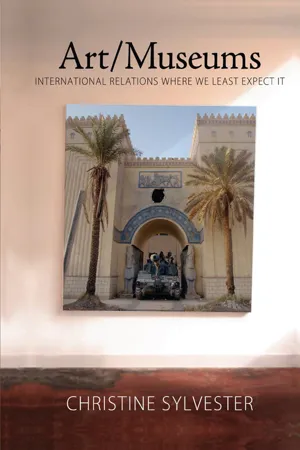
Art/Museums takes the study of international relations to the art museum. It seeks to persuade those who study international relations to take art/museums seriously and museum studies to take up the insights of international relations. And it does so at a time when both international relations and art are said to be at an end-that is, out of control and beyond sight of their usual constituencies. The book focuses on the British Museum, the National Gallery of London, the Museum of Iraq, the Museum of Modern Art in New York, the Getty museums, the Guggenheim museums, and "museum" spaces instantly created by the attacks on the World Trade Center in 2001. The art includes works over which museums might struggle, acquire through questionable means, hoard and possibly lose, such as the Parthenon sculptures, Raphael's Madonna of the Pinks, the ancient art of Babylon, modern art, and the art/museum itself in an era of rapid museum expansion. Bringing art, museums, and international relations together draws on the art technique of collage, which combines disparate objects, themes, and time periods in one work to juxtapose unexpected elements, leaving the viewer to relate objects that are not where they are expected to be.
Trusted by 375,005 students
Access to over 1.5 million titles for a fair monthly price.
Study more efficiently using our study tools.
Information
CHAPTER 1
Can International Relations and Art/Museums Come Together?
Can we talk about art/museums and international relations in the same breath or is the relationship too fugitive—or trivial? This book digs into that question guided by the strong hunch that there are layers of significance that huddle in the intersections of activities, institutions, and academic fields that do not usually have much to say to each other, at least not directly. Facing up to art/museums as institutions of power and reach takes the field of International Relations (IR) into new areas of analysis and strengthens work in art history and museum studies that ranges internationally, but somewhat naively, because it does not look at the world through any IR lens.
International relations, where the field of IR says it is and therefore expects it to be, conducts diplomacy over a fine state dinner, moves weapons and development advice between states or tries individuals in an international criminal court. It spies, secures, and sends personnel to the United Nations and its expanding agencies. Most noticeably, international relations conducts wars—everywhere and frequently. War is its traditional forte. But international relations where IR least expects it is furtive too, seemingly invisible, and thus can be missed by the field. It walks calmly through domestic airport security screenings on September 11, 2001, undetected. It darts nervously, hungrily across borders on a regular basis. It mingles international terrorism with tourism in a Bali nightclub or mixes into an artistic performance by entering a Moscow theater with bombs, shifting attention from the drama on the stage to a terrifying performance of interloper international relations in the stalls. Gory dioramas of massed toy soldiers can turn up in a London art gallery; or art can be taken from a Baghdad museum while combat-ready troops across the street look elsewhere for the real international relations of war.
This book focuses on institutional locations of international relations where IR would least expect it: in major art/museums and galleries. IR claims neither art nor museums as traditional bona fides of international relations. The field might glimpse art looters in the context of a war in Iraq, but it will be slow to incorporate that kind of activity into its studies of war. It will most likely not notice that the groups rushing in to save looted and damaged artifacts are international art teams and institutions. The saga of New York’s twin towers will not usually be talked about in terms of architectures suddenly fallen and replaced, after intricate politics, in ways that concretize and museumify an event of international relations. The worldly Guggenheim, at once art foundation, set of international museums and governance practices, and organizational network, operates peacefully, although not uncontroversially, in places thick with international relations. The Getty Museum and Center in Los Angeles is so wealthy it can conduct private art diplomacy, while the British Museum is diplomatically adept at warding off restitution claims on the Parthenon sculptures it exhibits and other objects acquired through imperial skulduggery. Interesting, all this, but not particularly so for IR—traditionally, and even now, when IR queries where an international that seems omnipresent resides (Millennium, 2007).
Analysts from the world of art and museums are more regularly attuned to the international in their midst. “It” appears unmistakably around the museums and archives of Iraq and Afghanistan. Art restitution claims often arise out of the international relations of wars and imperialist acts of the past and present. Globalization increasingly influences where museums locate, the architectures they build, and the visitor amenities they offer. International political economy enables large art museums to become international bazaars that sell ersatz art as neckties, scarves, jewelry, mugs, dinnerware, and vases: in 2003, the Metropolitan Museum of Art turned a profit of around $39 million from its house-managed retail operations (Schneider 2006, 31); its rug department alone seems a cross between a smart Fifth Avenue shop and a market in Dubai.1 Such money-spinning activities, promoted by museum managers, can be viewed askance by culture critics and artists, who can think the art/museum has lost its way. The Guggenheim has been blasted for its alleged profit-seeking ambitions. Major art institutions like the Getty and the Metropolitan Museum of Art can land in foreign courts for violating local cultural-heritage laws in their acquisitions. Big museum architectures and blockbuster exhibitions attract crowds but can leave critics apoplectic about tacky shows and crass commercialism.2 Even the field of museum studies can be critical of art museums as cultural superpowers ruthlessly ensuring that their art holdings are not “lost” to overseas competitor museums.
The bigger and more internationally esteemed the art institution, the more critical the views of it can be, from the outside and the inside. James Cuno (cited in McClellan 2003b, 36; also, Cuno 2004a, 2004b), who has been director of the Courtauld Institute in London and the Chicago Art Institute, insists that “an art museum’s fundamental purpose is to collect, preserve, and exhibit works of art as a vital part of our nation’s cultural patrimony.” He laments aspects of the new museum and would like to see art museums spend more time debating the direction of collecting and displaying art, research capacity, and future special exhibitions. Recent obsessions with attracting visitors, providing state-of-the-art security, and filling tills emerge from the international management models that major art museums are adopting. Somewhere in between traditional and reformist concerns lie the many discussions taking place about architectural spaces and how to use them, achieving the correct balance between art and nonart offerings, and establishing the kind of ambience to encourage—hushed, dignified, and reverential or noisy, busy, and more like an international air terminal than a traditional art museum. In the midst of these debates, it is not easy to work out what an art museum definitively is about today.
I want to say that a major art museum today is an institution that is heavily political, often involved with or implicated in international relations, and savvy about power. It is an intricate, multivalent, internationally implicated / socially situated social institution that seems to be growing in popularity and influence. Attendance at American art museums catapulted from 22 million in 1962 to more than 100 million in 2000 (Cuno 2004b, 17–18). Similar attendance jumps occurred across Europe, although this might not be historically unique.3 According to an American survey, visitors rank museums of all sorts higher than government institutions when it comes to providing trustworthy sources of objective information (Cuno 2004b). Most surveys also indicate time and again that the well-educated, affluent and/or upwardly mobile classes choose museum-going as their leisure pursuit (Wallach 2000; Falk 1998); when other groups come to an art museum, they report being very glad they did (Rice 2003, 84). Class concerns can even mean that the important high-end collectors, and the young audiences art museums like to court and who tend to prefer contemporary art, are not entirely catered to (Taylor, Spero, and Higgins 2007). Middle classes and middlebrow tastes can be seen in the endless repackaging of popular Impressionist works and artifacts from Pharaonic Egypt. Other forms of non-Western art bring out Western audiences largely when lashed to current international events; Islamic and Chinese art shows draw considerable media hype in this moment of international relations.
The museum sector is also expanding—dramatically. Large and small, urban and rural, private and public, art museums and galleries have sprouted from Las Vegas to Liverpool, from Marfa, Texas, to Naoshima, Japan, and from Kinmen Island to the Orkney Islands. Many are new: “more than half of our art museums were founded after 1970” (Cuno 2004b, 17). Established art museums try to keep up via ambitious architectural projects, such as the glass pyramid at the Louvre; the Sainsbury Wing of the National Gallery, London; and the new additions to the Denver Art Museum, the Los Angeles Country Museum of Art, the Phoenix Art Museum, and the Royal Ontario Museum, Toronto. Sometimes nothing will do except an entirely new building, such as those that house the Weisman Art Museum in Minneapolis, the New Museum in New York, and the Institute of Contemporary Art, which cantilevers over Boston Harbor. New complexes of museum buildings define the Getty Center in Los Angeles and the High Museum of Art in Atlanta, and major renovations have reworked the Yale Art Gallery in New Haven. Museum expansion and reshaping can also be geospatial. The Tate has branches in Cornwall and Liverpool, and the Guggenheim is now in New York, Venice, Berlin, and Bilbao; it has tried to be in Las Vegas and will soon showcase another Frank Gehry creation in Abu Dhabi. The historically conservative Louvre is also going to Abu Dhabi, clad in a Jean Nouvel creation. Paris’s Pompidou Center was planning to manage a new contemporary art museum bearing its name in Shanghai until talks suddenly failed. Startstop international collaborations are common, but it is also common for museums to fire up media attention before the negotiating process is very far along. The migrating art museum is a phenomenon these days.
International relations and art/museum practices blend into each other. The art world sees this, but its writings can be naive about international power and politics, largely because it has not taken on board relevant theories or ideas of IR. For its part, IR asks itself where the international is at a time when “it” seems to be driving politics and economics; and yet IR can hesitate to enter the art museum to find more of it. One field increasingly becomes an instance of the other, but academic work on art/museums does not reference works in IR, and the field that studies international relations does not load art/museums into its can(n)ons. There is a certain irony in residing in a shared black hole. Each field endeavors to be au courant even as changes around it push its boundaries and challenge its expectations. “More than ever,” says one specialist, “museums may be many things to many people and no one theory or discipline can do them justice” (McClellan 2003a, xviii).The same type of comment can be made about international relations. When significant activity recurs where it is not expected by academic overseers, it is possible that the field in question is at a certain end. It carries on as though nothing is amiss, but it misses much, reacts more than it anticipates, and risks becoming merely academic.
IR AT THE END?
Take IR as an example. As an academic field, IR has developed through three discipline-defining debates and a less-disciplined tumbling-in of new topics and field entrants in recent years.4 Controversy has been seen as keeping IR on its toes and attuned to trends in other social sciences and to changing relations of the international in the world. The field began as a peace-oriented discipline in the years immediately following World War I. It then shifted in the main toward a conflict-and-threat emphasis in the interwar years as aggression inched forward in Europe and Asia. The postwar cold war ensured that IR would stay on a conflict course rather than angle back to peace. Large swaths of IR also came under the influence of America’s postwar technocratic superpowerdom: North American scholars found science the promised road to description, explanation, and prediction of international relations. The British and Australians did not surrender to science, preferring to retain their more historical, philosophical, theoretical, and normative orientations to methodology. All sites of IR, however, became absorbed, each in its own way, in the struggles against the Soviet Union. It was only in the waning years of the cold war that spaces and people outside the frame of the East-West conflict climbed the fences of IR and claimed ground for their concerns. By then the soil had been prepared a bit by the oil shocks of the 1970s and by confrontations in the United Nations over postcolonial demands for redistributions of international resources.
In the end, IR’s debates and methodological plurality could not save it from the spectacular disciplinary failure to anticipate the peaceful demise of the Soviet Union. No branch of IR believed that a powerful state—a superpower—would declare itself out of business one day. And, given that superpower relations had been IR’s favorite topic, this fundamental failing weakened the field and enabled a plethora of new topics, people, and interests to stretch its small constellation of knowledge and awareness. Women, racial minorities, migrants from the poorer Southern Hemisphere and Eastern Europe, trafficked people, workers in shifting globalizing factories—all came into IR, in the flesh or as subjects of research. Through the 1990s they not only rearranged IR’s boundaries but also introduced new methodologies associated with critical theory, feminism, postcolonial analysis, constructivism, and poststructuralism. And then even more locations, people, actors, processes, and ways of knowing became possible, multiplying the possibilities of realizing the many places international relations was operating.
The narrow field of IR needed this broadening. Indeed, a continued bringing-in process is still required in IR before the subject area can begin to settle again into a distinctive field, if ever it does. As is often the case when change occurs, however, the upsurge of relevance also ushered in new problems. The too-tight field loosened to the point where it configured anew into a fragmented camp structure. IR is now a field of discernible and lively camps, each organized around a fairly narrow set of research interests, identities, geographical locations, and/or methodologies. Feminists have a camp and, in Britain, so do poststructuralists. There are European networks of critical IR scholars and American networks, each impelled by a different understanding of security. Some camps correspond to schools of thinking linked to locations: the English, Welsh, Copenhagen, and Paris schools. Some camps focus on the international politics of economic relations, and others grab hold of terrorism studies, peace studies, feminism, or international law5. It can be the case that the camps are relatively self-satisfied and disinclined to interact more than minimally or superficially with other camps, particularly camps that seem to have a very different take on the issues they also study. Debate, once thought of as disciplinary sport, is now more or less confined to within-camp issues. This means that each camp carves out specific areas of interest, uses a particular vocabulary to express that interest, upholds a different set of revered personages, and holds to canonical texts that camp followers read, reread, and cite incessantly and other camps might never even know of, let alone read or cite. The structure of IR confines art/museums to a small camp located in the British International Studies Association (BISA) that calls itself “art and politics.” Other camps ignore it.
The camp structure boosts diversity and widens purviews, but it does not disperse all the new knowledge evenly around the field. If you specialize in critical approaches to the study of international relations, you might be reasonably comfortable sharing some fire with scholars from feminist IR, European critical security studies, postcolonial analysis, or poststructuralist studies.6 But given that many IR camps have their own journals today, it is easy to concentrate on preferred topics and orientations and nearly ignore the rest. IR has become a field of differences rather than similarities, the differences often sneering at each other through camp fences.
There have always been groupings and schools of thinking in academia. The major change in today’s IR is that no camp is strong enough to set the parameters of the field or to knock out any other camp through brilliance, fiat, or control over academic positions and publishing. Publishing outlets proliferate and academic posts have globalized. One camp might accuse another of not studying the real international relations, but words cannot hurt today like they used to—not fatally. There is space for everyone within some camp zone where identity and knowledge fragments reign in a mise-en-scène that is nothing if not camp (Sylvester 2007a).
We might say that with IR specialists agreeing on very little today, including what the field is about, where it draws the line between itself and other fields, and what methods of analysis it should employ, IR is at a certain end. Obviously, the field carries on: classes are taught about “it,” articles are published about aspects of “it,” and students go on being trained in “it.” It is a field hard-pressed, though, to bring its considerable accumulated resources to bear on a troubled world where bombs sit in theaters, art empties into the streets of war, and the National Gallery of London fusses over saving a painting from the clutches of a distinguished art institution located in a foreign country. Art/museums are part of IR and yet are not seen to be part of camp IR. They are part of a field that for good or for ill—and the jury is out on this—is at the end of its capacity for common narratives of any sort. Some say art is in the same boat.
ART AT THE END?
Columbia University emeritus professor of philosophy Arthur Danto (1997) has argued since the 1980s that art is at an end. It ended, or rather the field of art history ended, in the 1960s, when Andy Warhol gave us Brillo boxes. By the time the likes of Damien Hirst arrived with sharks in formaldehyde, art had been at an end for nearly thirty years. It is not that the activities of art making ended or the writing about it wrapped up. Rather, at the end of art, “art” refuses to be the art that professional art historical narratives and norms say it is. Hans Belting (2003, 3), whose work on the same topic from a more European angle is coterminous with Danto’s, talks about the current period in art history as the age of the epilogue. In his view, it is not that art history is entirely flat-footed in its demise. Rather, in place of one canonical art history there are now, as in IR, “many art histories that exist side by side” (Belting 2003, 7). The frame has been shattered.
The art history frame had been largely Eurocentric pretending to be universal; so was IR in the “debates” phase of its existence. Art history traces its subject area to a period around 1400 when found images and forms from Greek or Roman times started to be designated as art and admired aesthetically by spectators who obviously were not themselves the artists (Belting 1987). By the nineteenth century, academic art history was flourishing around activities that included identifying art forms and materials, cataloging artworks, and periodizing history around distinctive styles or schools of art. The relationship of art making to art history has since been one of the chicken and egg, with the egg winning. As one art theorist puts it, “what artists make as art depends upon the context of intentions possible for a given era and culture—whatever the culture theorizes as art” (Freeland 2001, 57). That is to say, artists have innovated, customized, or become avant-garde with respect to art historical culture narratives rather than according to other standards, such as genius, talent, and quirkiness (Hickey 1997). And until recently, art historians, philosophers, and museum curators have written the scripts of art; the rest of us have been “Sunday spectators” meant to follow the lead of the experts (Hooper-Greenhill 1994).
These experts agreed early that fine visual art objects could come in only a few forms—painting, sculpture, architecture—using materials associated specifically with those forms. Objects put to use in life, such as pottery and fabrics, or even lawn ornaments, might look like art but could not be art; they were crafts or mass-produced kitsch items passed off as art (Greenberg 1985). As for styles and periods of art, art history periodized on the basis of composition, materials, and techniques, as well as subjects depicted. Danto believes that the end started when Warhol made simulacra of Brillo boxes and called that art. Was an enlarged and dreamlike but nonetheless exact reproduction of an everyday object found on grocery shelves and used in household cleaning really art? By blurring the lines between the fine and the prosaic object, between the distanced aesthetician and the viewer as consumer or housewife, between art and advertising, Warhol violated sacred codes of aesthetics and then drove the revolt further by doing “portraits” of Marilyn Monroe and other celebrities as silkscreen replicas of common media photographs. Roy Lichtenstein continued the trend by basing his work on popular cartoon characters and exaggerated comic-strip adventures. On it went from there. And then came counterparts to IR’s opening-up period: feminist, postcolonial, black, globalist, and non-Western artists and academi...
Table of contents
- Cover
- Title Page
- Copyright Page
- Dedication
- Table of Contents
- Acknowledgments
- List of Photographs
- 1 Can International Relations and Art/Museums Come Together?
- 2 Cultures, Nations, and the British Museum
- 3 The International Relations of Saving Art
- 4 MOMA Saves the West?
- 5 The Globalizing Guggenheim Saves the Basques?
- 6 Twin Towers of International Relations: The Museum
- 7 Art/Museums/International Relations: Collaging Afterlife
- Notes
- References
- Index
Frequently asked questions
Yes, you can cancel anytime from the Subscription tab in your account settings on the Perlego website. Your subscription will stay active until the end of your current billing period. Learn how to cancel your subscription
No, books cannot be downloaded as external files, such as PDFs, for use outside of Perlego. However, you can download books within the Perlego app for offline reading on mobile or tablet. Learn how to download books offline
Perlego offers two plans: Essential and Complete
- Essential is ideal for learners and professionals who enjoy exploring a wide range of subjects. Access the Essential Library with 800,000+ trusted titles and best-sellers across business, personal growth, and the humanities. Includes unlimited reading time and Standard Read Aloud voice.
- Complete: Perfect for advanced learners and researchers needing full, unrestricted access. Unlock 1.5M+ books across hundreds of subjects, including academic and specialized titles. The Complete Plan also includes advanced features like Premium Read Aloud and Research Assistant.
We are an online textbook subscription service, where you can get access to an entire online library for less than the price of a single book per month. With over 1.5 million books across 990+ topics, we’ve got you covered! Learn about our mission
Look out for the read-aloud symbol on your next book to see if you can listen to it. The read-aloud tool reads text aloud for you, highlighting the text as it is being read. You can pause it, speed it up and slow it down. Learn more about Read Aloud
Yes! You can use the Perlego app on both iOS and Android devices to read anytime, anywhere — even offline. Perfect for commutes or when you’re on the go.
Please note we cannot support devices running on iOS 13 and Android 7 or earlier. Learn more about using the app
Please note we cannot support devices running on iOS 13 and Android 7 or earlier. Learn more about using the app
Yes, you can access Art/Museums by Christine Sylvester in PDF and/or ePUB format, as well as other popular books in Art & Art & Politics. We have over 1.5 million books available in our catalogue for you to explore.