Sustainability, Infrastructure, and Cities the Zofnass Program for Sustainable Infrastructure
Chapter 1
1.1 THE PROGRAM
Paul Zofnass
Zofnass Program Founder
President, Environmental Financial Consulting Group, Inc. (EFCG)
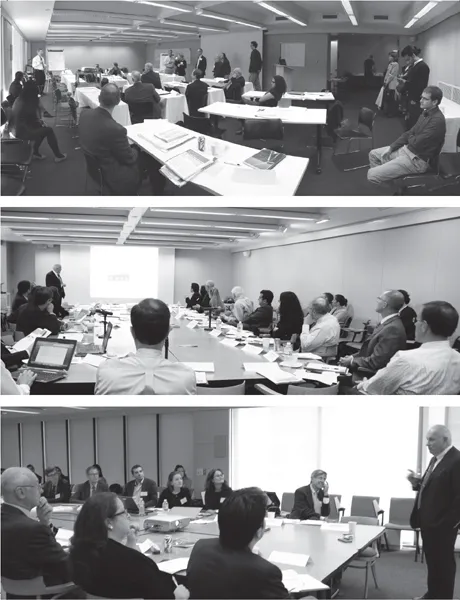
Zofnass Program Workshop, October 2014.
Having grown up in a beautiful suburb of Boston, surrounded by forests and farms, I developed at a very young age a passion for preserving our natural world. I have also gained an appreciation for how effectively measuring performance or quality can influence and incentivize human behavior. Give performance a rating, and we compete to do better. Consider, for example, how school grades push students to study harder; or how athletic teams or individuals strive to improve their performance to the extent that it can be measured. Corporate goals and metrics incentivize revenue or earnings growth. In hybrid cars, by making the miles per gallon achieved by the driver (in five-minute increments!) clearly visible, manufacturers have leveraged our innate human desire to improve to encourage better fuel economy. Consider how the US Green Building Council’s LEED® rating system for sustainability in building design has sensitized people to the meaning, importance, and benefits of “green building” and encouraged them to build more sustainably.
For the past 25 years I have been working with the engineering/consulting industry as a financial and strategy advisor. Observing the effectiveness of LEED, I began to wonder why a similar type of rating system had not been developed for the design and planning of public infrastructure. One reason may be that the scope and range of issues that need to be taken into consideration for public infrastructure are generally far more complex than for a single building. (Consider for example the impact of a new airport, railroad, highway, urban development project, sewer system, bridge or tunnel complex, waterway, power grid, or even new community or city, any of which can affect hundreds of thousands, in some cases millions, of people. These all have major effects not only on the environment but on many other aspects of society.) If we are going to make the world more “sustainable,” don’t we need to develop and apply a set of standards by which to analyze, define, and measure “sustainability” as it applies to these large infrastructure programs? And don’t we need to continue improving our understanding of the underlying sciences and meaning of sustainability? But where do we begin?
I noted that many of my engineering clients were developing their own tools and methods to measure “sustainability” as it might apply to the kinds of projects they were designing. But there was no commonality in their approaches to these metrics. And in fact, as each firm leveraged its proprietary tools and systems to demonstrate expertise and drive for sustainability in the marketplace, project owners found it difficult to compare the benefits between one tool and another. It was also hard, if not impossible, for a wider consensus to be developed or agreed upon. Yet it was clear to me that such a consensus approach could offer a very beneficial, productive path forward.
It also occurred to me that an approach driven primarily from an engineering perspective would likely fail to take into consideration many other factors in which engineers are not well versed, but which are still critical in understanding the broader scope of “sustainability.” Consider, for example, impacts on human health, social communities, and natural ecology, as well as the role of politics, economic development and human well-being, social justice, and obligations and goals of government. These issues go far beyond the resources or knowledge borders of any single engineering firm, or even group of engineering firms. They also cut across all aspects of the social and physical sciences, as well as our overall body of scientific knowledge.
These thoughts suggested to me that to create an effective measurement system for infrastructure sustainability, it needed to be developed by a wide range of sources. These included:
a) A broad and diversified base of participating design and engineering firms,
b) A globally recognized and respected, and multidisciplined, educational institution that could bring to bear all the academic disciplines required to define the concept of “sustainability,”
c) An array of senior government infrastructure directors who could help us understand their needs and issues, so that they could support funding for and use of sustainable design,
d) The support of the major professional associations affiliated with the engineering and design industries, to encourage the use of sustainable design in their work.
In 2007, I approached Harvard University (my alma mater) with an offer to fund 18 months of research to see if they could develop a conceptual framework by which to define sustainability as it might apply to major infrastructure projects, and create an initial set of metrics by which to measure this concept. The Zofnass Program for Sustainable Infrastructure was housed in the Harvard Graduate School of Design, under the direction of Professor Spiro Pollalis and leadership of Professor Andreas Georgoulias, and brought together roughly 30 professors from six different schools within Harvard (Design, Business, Public Health, Government, Sciences, and Law) and over 100 graduate researchers. Over the next two years they met quarterly with sustainability leaders of 30 major engineering/consulting (e/c) firms, and roughly 50 senior government infrastructure staff from different government sectors (federal, regional, state, and city) throughout the country, to attempt to develop a consensus-based set of sustainability parameters.
By 2009, the Program had developed a set of guidelines and metrics to define and measure sustainability as it relates to infrastructure that was sufficiently defensible to warrant further research and development. Twelve organizations (including 10 leading e/c firms) committed to provide significant funding for the ongoing development of this system, as members of the Sustainable Infrastructure Advisory Board at Harvard or SIAB. The SIAB members actively participated in the refinement and application of the system; they included: CH2M HILL, MWH Global, HNTB, Stantec, Golder, Power Engineers, Arcadis, exp., NV5, Granite, Autodesk, and the Inter-American Development Bank (IDB).
In 2011, the Program was approached by the Institute for Sustainable Infrastructure (ISI), a joint venture between three leading professional engineering associations, ASCE, ACEC, and APWA, which was on a similar path to develop a set of infrastructure sustainability standards. Given the need for a single consensus standard, the two programs made the decision to combine their individual systems into one, selecting the best characteristics from each. The combined system is called Envision®, and the two groups work in tandem to continue to improve this combined system. The Zofnass Program at Harvard focuses on further research and development for sustainable infrastructure and for the Envision® system, working to keep it current with the advances in the underlying sciences and knowledge. The Program also holds quarterly workshops that bring together the practical expertise and experience of the SIAB firm members with members of Harvard’s faculty and graduate schools and with representatives from governments and NGOs committed to making the world’s built infrastructure more sustainable over the long term. The Zofnass Program continues to work with the ISI, helping them to integrate this research and knowledge into a constantly improving Envision® rating system. While the Zofnass Program focuses on R&D and working with governments and NGOs, the ISI focuses on the training, credentialing, and marketing of Envision®.
With Envision®’s integration into the infrastructure marketplace accelerating and roughly 3,000 Envision® Sustainability Professionals, or ENV SPs, in the US and abroad, the Zofnass Program’s research is now moving toward the next logical step in creating a more sustainable world, integrating each component of sustainable infrastructure into a system applicable to whole-city design. This work, already seeing initial pilot implementation efforts, is very complex and highly interconnected, but offers a promising vision for how infrastructure of the future might be designed and built.
This textbook, the second since the initiation of this Program, presents our city-scale research results to date. It incorporates sustainable project analyses and case studies, covering many different fields and sectors of infrastructure, with contributions by professionals from the SIAB members and members of the Harvard University faculty.
I strongly believe that if we don’t start creating a more sustainable world today, we will not have one in the future. Our sincere appreciation goes to all those who have helped develop this system, who will help us continue to improve it, and who will be using the system to create a better world through sustainable infrastructure.
1.2 PRODUCED RESEARCH
William J. Bertera
President and CEO, Institute for Sustainable Infrastructure (ISI)
Planning for sustainable infrastructure has been practiced for decades, though often in a context in which the word “sustainability” has rarely appeared … until recently. Planners, engineers, architects, contractors, and public administrators have, nevertheless, been planning, designing, constructing, operating, and maintaining civil infrastructure using best practices that promote efficiency, safety, longevity, cost-effectiveness, and community values and priorities.
Many of these best practices also promote sustainability as we have come to define it, but none assure that sustainability as a strategy, objective, or goal is considered routinely in the development of civil infrastructure. When it has happened historically, it has occurred as a fortunate by-product of good planning or engineering. But the world is changing, and sustainable infrastructure is no longer, if it ever was, only a choice or a happenstance.
Population growth, its uneven distribution, increasingly taxed natural resources, the sensitivity of the natural world to external alterations, unpredictable weather patterns, and the challenges posed by the threat of global warming and attendant climate change all make doing business as we have in the past untenable. Planning civil infrastructure has become more complicated still. Our infrastructure’s claim on resources, its effects on the environment, its contribution to the creation of societies where humans can live in comfort and dignity have magnified and made more obvious its importance.
Infrastructure generally, civil infrastructure in particular, provides for personal security, the public health, economic stability, and quality-of-life benefits. It makes possible concentrations of people in dense environments and the transport of materials and people in pursuit of commercial and social goals: in short, it makes modern societies possible. That this infrastructure be sustainable, that the decisions associated with its planning, design, construction, and operation also be sustainable, i.e., justifiable in the context of an increasingly taxed natural world, has become an essential and critical element of the planning function.
The Brundtland Commission articulated a definition for sustainable development in 1987 that embodies the spirit of the challenge; phrased loosely, “do as little harm as possible and remember that our children walk in our footsteps.” In truth, sustainability, especially as it is applied to our civil infrastr...