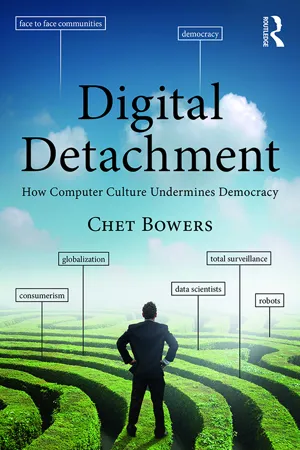
The digital revolution is changing the world in ecologically unsustainable ways: (1) it increases the economic and political power of the elites controlling and interpreting the data; (2) it is based on the deep assumptions of market liberalism that do not recognize environmental limits; (3) it undermines face-to-face and context-specific forms of knowledge; (4) it undermines awareness of the metaphorical nature of language; (5) its promoters are driven by the myth of progress and thus ignore important cultural traditions of the cultural commons that are being lost; and (6) it both by-passes the democratic process and colonizes other cultures. This book provides an in-depth examination of these phenomena and connects them to questions of educational reform in the US and beyond.
- 122 pages
- English
- ePUB (mobile friendly)
- Available on iOS & Android
eBook - ePub
About this book
Information
1
Computer globalization
The digital revolution represents the West’s latest effort to colonize the world’s cultures. Unfortunately, its success is gaining momentum at the same time that a variety of forces, such as the expanding world population, the degradation of life supporting ecosystems, and climate change, are increasingly making life more stressful for the majority of people now moving toward the nine billion mark. A variety of motives have justified past efforts to colonize other cultures: the desire to control their resources, to create new markets, to rescue them from backwardness and superstitions, to strengthen the military of the colonized nation, and so forth. The current efforts on the part of computer scientists to impose their exceedingly powerful yet limited form of knowledge on the world’s cultures is not unique in human history.
The titles of recent books by computer scientists are evidence of their hubris. Gregory Stock’s Metaman: The Merging of Humans and Machines into a Global Superorganism (1993), Ray Kurzweil’s The Singularity is Near: When Humans Transcend Biology (2005), and Eric Schmidt and Jared Cohen’s The New Digital Age: Reshaping the Future of People, Nations and Business (2013) are just a few of the books by computer scientists who assume they have a special, even missionary, responsibility to save the rest of the world from the condition of data deficiency that impedes their ability to progress economically and technologically. As the title of the book by Peter Diamandis and Steven Kotler suggests, computers will bring Abundance: The Future is Better than You Think (2012) to the entire world. It is important to note that Diamandis and Kotler devote only a few paragraphs to the loss of jobs to computer-driven automation, which appears as an afterthought in the Appendix.
These computer futurist writers, as well as other Social Darwinian scientists such as Richard Dawkins and E. O. Wilson, envision a radically different future for humankind. Yet they do not discuss the many forms of resistance to Western colonization now dominating the daily headlines. In order for other cultures to accept the digital transformation they must undergo, as dictated by the computer scientists’ interpretation of the Darwinian master narrative leading to the post-biological world of super-intelligent computers (also known as the coming era of Singularity), data must replace the authority of all other cultural forms of knowledge––as well as the wisdom traditions that are the basis of their moral values.
The above titles fit the definition of hubris, which is characterized by excessive self-confidence, an over-estimation of one’s own competence, and the need to elevate oneself (or group) above others. Hubris can also be understood as part of the pathology that drives imperialistic and colonizing social movements. As will be shown in the following chapters, while computer scientists exercise a high degree of certainty about how the digital revolution will improve the lives of the world’s diverse cultures, their mutually reinforced hubris has led to them ignoring the importance of learning about the belief systems and ecologically sustainable practices of different cultures. To make this point more directly: their fields of study, whether in the theoretical or applied computer sciences, require both a depth of knowledge and an ability to keep at the cutting edge of new insights and technological advances. This results in the double bind situation where their depth of knowledge in a very narrow field leads to new digital technologies being introduced without an understanding of the unintended consequences for the cultures into which they are being introduced. It is important to note that while the majority of computer scientists, venture capitalists, programmers, educators, and tech-minded people working to find more ways in which digital technologies can be used in everyday life are not likely to have read the futurist-predications of Gregory Stock and Ray Kurzweil, or the less extremist computer scientists such as Eric Schmidt and Peter Diamandis, they nevertheless represent a powerful social and economic force that threatens the intergenerational foundations of the world’s various approaches to democracy and the equally diverse cultural commons.
Misconceptions that Limit Criticism of the Digital Revolution
Unfortunately, the narrow and highly specialized education of computer scientists that leaves them indifferent to the cultural traditions overturned by their technologies goes largely unnoticed by the general public. This is due to the cultural lag perpetuated in universities, and thus in public schools, that has left most graduates with the same silences shared by the programmers, educators, venture capitalists, and the wide range of others engaged in spreading the digital revolution into every facet of daily life––all in the name of progress. The reasons for the cultural lag, which can be understood as perpetuating the high status thinking in vogue during the last decades of the twentieth century, is easily understood. As most of a person’s cultural knowledge, including that of professors, is taken for granted it is passed along to students at the same taken for granted level. Even the silences that accompany the interpretative frameworks that undergo minor elaborations as the professors’ field of inquiry undergoes changes are passed on to students.
Unfortunately, the loss of the varied forms of knowledge, including wisdom, resulting from the increased reliance upon digital storage and communication in such areas as civil liberties, personal security from hackers, and the loss of intergenerational knowledge of how to live less consumer and environmentally destructive lives, goes largely unnoticed. The many conveniences, increased efficiencies, and forms of control that come from living in a connected world are taken to be more important than the traditions that are being lost. But then, traditions have always been represented in the corporate controlled media, in public schools and universities, as what must be overturned if a higher level of material progress is to be achieved. The high-status metaphors that supported viewing traditions as sources of backwardness include “change,” “innovation,” “new ideas and values,” “experimentation,” “progress,” “critical thinking,” “transformative learning,” and “emancipation.” That millions of Americans have not experienced progress in achieving a higher standard of living seems not to have diminished the power of the myth that change, especially technological innovation, will bring about a better future.
The important issue, however, is how the cultural lag perpetuated by the media, universities, and now digital technologies leaves students with the high-status knowledge of the twentieth century, which has been largely responsible for the problems we face in the twenty-first century. As the narrow and highly specialized education of computer scientists leaves them with little more than highly abstracted accounts of key ideas of Western philosophers, such as John Locke’s explanation of the nature and origin of private property, Adam Smith’s notions about the invisible hand and the progressive nature of competition and free markets (which Ayn Rand has turned into the equivalent of Moses’ Mount Sinai moral tablets for governing all relationships), their simplified and reductionist ways of thinking lead them to assume that data, information, and other forms of abstract representations should be the basis of decision making for everyone in the world.
Before discussing why the cultural alternatives to the emergent digital culture must now become part of a critically informed public debate, it is necessary to take a conceptual detour that addresses what has been missing in the education of the majority of Americans who so willingly embrace each new digital technology, and who are unable to ask what is being lost that might contribute to an ecologically sustainable future. The following represents what students should have learned about the patterns that connect within their own cultural and natural ecologies––as well as those of other cultures. This missing background knowledge accounts for the widespread lack of resistance to the loss of traditions in the areas of work, civil liberties, creative arts, and patterns of mutual support.
Gregory Bateson put the problem somewhat differently. “The computer is only an arc of a larger circuit which also includes a man and an environment from which information is received and upon which efferent messages from the computer have effect. This total system,” he continues, “or ensemble, may be said to show mental characteristics” (1972, 317). If the formal and informal educational processes in the last decades of the twentieth century had addressed the cultural patterns taken for granted by the innovators and supporters of the digital revolution, as well as by a public that is unable to question the digital narrowing of cultural knowledge and possibilities, perhaps the public would then have a more balanced understanding of the appropriate and inappropriate uses of digital technologies.
What is Common to all Cultural and Natural Ecologies
As the ecological crises are the dominant issues of this century, given global warming, the acidification of the world’s oceans, the loss of species and habitats, and the multiple industrial chemicals that act like poisons surging through all plant and animal systems, it’s time we adopt the world “ecology” as a way of understanding all life-forming, -sustaining (and -destroying) systems as emergent, relational, and interdependent. Understanding that there are no autonomous things, individuals, facts, data, events, ideas, and so forth, but that everything exists in a larger web of emerging relationships that have a history and possibly a future provided we acquire a more accurate way of thinking than what has been taught in public schools and universities. In the past, the word “context” was often used to refer to what was thought missing in references to an idea, a fact, an event, a behavior, and so forth. But this word, which signaled something more that needed to be considered, is also an abstraction, just as the world “culture” is an abstraction.
Referring to a conversation, the displacement of workers by robots, playing a game of chess, the violinist’s participation in a group, a marriage undergoing stresses, and the purchase of the latest and biggest carbon-producing SUV, are all examples of ecologies. That is, the ecology of past ways of thinking (including the ecology of language that influences current thinking), ongoing and emergent expectations––including awareness of what is being communicated through the multiple information-rich cultural and natural pathways—characterizes every aspect of daily life. To make the point directly: there is nothing in the emergent nature of life that is static or independent of internal and external influences. The English language, especially the privileged status given to the use of nouns, as well as the reliance upon print and the abstract rational process of thinking that has been the legacy of mainstream Western philosophers, have marginalized awareness of the emergent nature of reality (or ecologies) that has been more easily understood in oral cultures.
Why emphasize the importance of thinking in terms of cultural and natural ecologies of emergent, relational, and interdependent? Why is this relevant as the digital revolution transforms every aspect of life into the wireless and increasingly connected world of data, facts, and information? There are a number of reasons that include the police state implications of governments acquiring data on people’s behaviors, relationships, and communications without considering the cultural ecologies (contexts) of emergent relationships from which the data is collected. There are social justice reasons that go beyond the data on the number of workers displaced (the new “disappeared” from the middle class) by computer-systems, and there are ecological sustainability issues connected with the loss of intergenerational knowledge and skills as the Internet generation turns its back on the elders of their communities. But the most important reason for keeping in the foreground of thinking that all life processes need to be understood as cultural and natural ecologies is that the digital revolution is promoting on a global scale that the only forms of knowledge that should become the basis of decisions are abstract data, information, and models of the current and future behaviors of natural and cultural systems.
Plato and other Western philosophers helped to put the West on a Titanic collision course with the world’s natural ecologies by privileging abstract theory over the forms of ecological intelligence developed to a high degree within many oral cultures. Driven by the myth of unending progress, computer scientists, and the army of their supporters and true believers (including uncritical consumers), are contributing to the globalization of data-based thinking and values. While data and information, on the surface, appear to be value free, both are interpreted by their collectors and promoters within value-laden conceptual frameworks that emphasize efficiencies, predictive control, continued innovation, and profits. In short, the moral framework supported by the emphasis on data is the market liberal ideology: that is, corporate capitalism that now aligns so closely with the abstract ideology of libertarianism.
Equally serious is how both print and data represent a world of fixed entities, of a moment of time in the emergent and relational world of a worker and of a consumer, and of other emergent and relational ecologies such as sending an email or making a phone contact with someone in a foreign country. What gets encoded in print or as data is only the surface phenomenon that the surveillance system is designed to represent as data. The immediate context, or emergent, relational, and co-dependent nature of the cultural ecology of a work situation or the behavior of a consumer, is not considered. The data and text that represents the information used to make judgments about a worker’s efficiency, likely future consumer choices, and so forth, is at best only surface information. Yet it is used to predict future behaviors. But it is often enough for people, given the way the general public has been indoctrinated to accept what appears in print and represented as data and information, to adapt their behavior to fit the personal profile that is put together by the data brokers who are in the business of selling these data and thus abstract profiles to governments and businesses.
Print has had many important, indeed, indispensable, uses. Less noticed is that its dominant role in public and university education has led many people to take for granted the same process of abstract thinking that characterizes the limitations of print. The limitations of print can be easily recognized by standing in front of a crashing ocean wave, and then reading how the printed account of the event is unable to represent the full range of the emergent, relational process of a giant wave crashing against the rocks that also involves a wide range of senses, emotions, and memories of the observer as she/he backs away from the surging water. Print has enabled people to learn about the distant past and to reflect on what the future might be like, and it has enabled people to encounter the insights and ability of others to use the printed word in ways that bring clarity and the beauty of the insights of others––which often lead to insights into the fog of one’s own taken for granted world.
But it has other characteristics that misrepresent the emergent and relational nature of cultural and natural ecologies that are the basis of life-sustaining processes––and of social life. That is, what appears in print represents a fixed reality open to being interpreted by the reader whose own process of thinking is often influenced by taken for granted cultural assumptions. It is also an immediately dated representation. Most importantly, the emergent and relational nature of experiences within the cultural and natural ecologies that cannot be fully represented in print and by data lead to abstract thinking where both are taken to represent reality. For example, the ways in which print leads to making the abstract more real than the emergent and relational nature of daily experience can be seen in how Western philosophers created abstract theories about the nature of knowledge, the source of values, the forces governing economic behavior, and so forth, without taking into account the cultural patterns enacted within their own communities––or the communities of other cultural groups.
Only the spoken word comes closer to representing the complex information (messages or what is communicated semiotically) circulating through the behaviors and patterns that connect within the interacting cultural ecologies. Speaking, listening, remembering, awareness of the full range of sensory experience, reflecting, and bodily movements are all part of interacting with the Others (both human and other-than-human) in the interdependent cultural and natural ecologies. What is often overlooked is that the spoken words of people socialized to think that the higher knowledge is acquired from printed texts too often take for granted that the following abstractions are real: “progress,” “individualism,” “freedom,” “democracy,” “literacy,” “modernization,” “free-markets,” and so forth. Giving attention to how these abstractions influence behaviors in the emergent and relational world of everyday experience becomes irrelevant for literate and progressive thinkers socialized to view themselves as autonomous rational thinkers. That is, an over-reliance upon print-based cultural storage leads to patterns of thinking and communication that marginalize awareness of what is being communicated through the information pathways that are part of all relationships. The use of the above nouns, like other English nouns, does not lead to an awareness of relationships and the cultural patterns that connect. While the above abstract ideas supposedly have a universal meaning, when relationships change meanings, in turn, undergo corresponding changes. For example, the individual’s experience in a consumer relationship or working at a repetitive task changes when engaged in a conversation of personal interest or in voluntarily helping others.
Ecological intelligence, as will be explained more fully when discussing how the digital revolution undermines the world’s diversity of cultural commons, is exercised by everyone when they adjust their behaviors and thinking in ways that take account of the emerging and relational nature of passing another car, engaging in a conversation that rises above that of a monolog, in knowing when to enter into an ongoing musical performance, in adapting one’s behavior to the timing required by an automated work process, and so forth. The exercise of ecological intelligence, in short, involves awareness of the emergent and relational patterns that are part of the ecology of information (semiotic) exchanges within which we live. Ecological intelligence is limited when relying upon abstract ideas, such as when the abstract idea of free markets prevents recognizing the connections between releasing billions of tons of carbon dioxide into the atmosphere and the rising rate at which the oceans are becoming acidic and thus are dying.
Ecological intelligence is also exercised by the person who is aware of relationships that involve prejudices and patterns of exploitation. This level of ecological intelligence is centered less on personal concerns about getting ahead, exercising control over others, and solving personal problems. In effect, it represents a social justice level of ecological intelligence where moral issues become a major concern. There is also a third level of ecological intelligence where the focus is on the relationships between personal practices, values, and consumer choices and their impacts on the sustainability of natural systems. Making consumer choices on what has a smaller carbon and toxic footprint, on pursuing a cultural commons lifestyle that reduces the need for consumerism and participating in the industrial/growth oriented economy, on reducing one’s need for accumulating material goods, and so forth, are common examples of exercising an ecologically sustainable form of ecological intelligence. As will be pointed out later, many indigenous cultures, that is, oral cultures that did not encode their knowledge in books, developed complex forms of ecological intelligence by encoding the ecological wisdom about relationships in their vocabularies, ceremonies, and daily practices passed forward through mentoring relationships and face-to-face interactions.
The important question is whether the data and print-based information accessed on Google and other servers accurately represent the culturally diverse emergent, relational, and interactive systems within the cultural and natural ecologies. Or do the data and print (even video) representations reproduce the Western pattern of elevating what is fixed (that is, a world of things, events, and autonomous entities supposedly free of cultural and natural contexts) and seemingly objective reality over the emergent and interdependent world of ecological systems? That is, does the Internet transform what is emergent and exists as multi-dimensional semiotic exchange systems, ranging from the molecular to the global and ...
Table of contents
- Cover
- Half Title
- Title Page
- Copyright Page
- Dedication
- Table of Contents
- List of contributors
- Preface
- Recent books by Chet Bowers
- 1. Computer globalization
- 2. The cult of data
- 3. Misconceptions about language
- 4. Digital colonization
- 5. The digital revolution in Muslim cultures
- 6. A different kind of connectivity
- 7. Localism, the revitalization of the cultural commons, and face-to-face democracy
- Bibliography
- Index
Trusted by 375,005 students
Access to over 1.5 million titles for a fair monthly price.
Study more efficiently using our study tools.
Frequently asked questions
Yes, you can cancel anytime from the Subscription tab in your account settings on the Perlego website. Your subscription will stay active until the end of your current billing period. Learn how to cancel your subscription
No, books cannot be downloaded as external files, such as PDFs, for use outside of Perlego. However, you can download books within the Perlego app for offline reading on mobile or tablet. Learn how to download books offline
Perlego offers two plans: Essential and Complete
- Essential is ideal for learners and professionals who enjoy exploring a wide range of subjects. Access the Essential Library with 800,000+ trusted titles and best-sellers across business, personal growth, and the humanities. Includes unlimited reading time and Standard Read Aloud voice.
- Complete: Perfect for advanced learners and researchers needing full, unrestricted access. Unlock 1.5M+ books across hundreds of subjects, including academic and specialized titles. The Complete Plan also includes advanced features like Premium Read Aloud and Research Assistant.
We are an online textbook subscription service, where you can get access to an entire online library for less than the price of a single book per month. With over 1.5 million books across 990+ topics, we’ve got you covered! Learn about our mission
Look out for the read-aloud symbol on your next book to see if you can listen to it. The read-aloud tool reads text aloud for you, highlighting the text as it is being read. You can pause it, speed it up and slow it down. Learn more about Read Aloud
Yes! You can use the Perlego app on both iOS and Android devices to read anytime, anywhere — even offline. Perfect for commutes or when you’re on the go.
Please note we cannot support devices running on iOS 13 and Android 7 or earlier. Learn more about using the app
Please note we cannot support devices running on iOS 13 and Android 7 or earlier. Learn more about using the app
Yes, you can access Digital Detachment by Chet A Bowers in PDF and/or ePUB format, as well as other popular books in Politics & International Relations & Colonialism & Post-Colonialism. We have over 1.5 million books available in our catalogue for you to explore.