- 256 pages
- English
- ePUB (mobile friendly)
- Available on iOS & Android
eBook - ePub
About this book
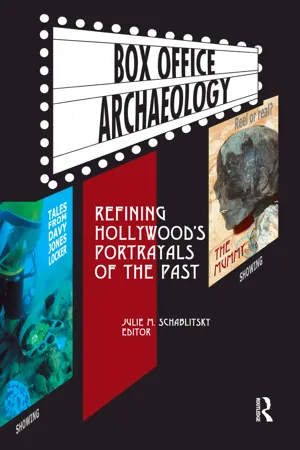
"How true is it?" is a common refrain of patrons coming out of movie theatres after the latest film on pirates, Vikings, or mummies. While Hollywood usurps the past for its own entertainment purposes, archaeologists and historians know a lot about many of these subjects, digging up stories often more fascinating than the ones projected on screen. This distinguished group of archaeologists select key subjects and genres used by Hollywood and provide the historical and archaeological depth that a movie cannot—what really happened in history. Topics include Egypt, the Wild West, Civil War submarines, Vikings, the Titanic, and others. The book should be of interest to introductory archaeology and American history classes, courses on film and popular culture, and to a general audience. Alternate Selection, History Book Club.
Information
Chapter 1
The Way of the Archaeologist
Julie M. Schablitsky
No one should have illusions about television. It is never going to be primarily an educational and cultural medium.
—Eric Sevareid (CBS correspondent, 1960)
Scholarship that focuses on the accuracy of Hollywood's portrayals of past events, places, and people is short sighted and ineffective at encouraging film producers to adhere to historical truths. For the past thirty years, historians have berated producers of movies and television shows for "getting it all wrong." Unlike modern movie budgets, television and movie production companies had limited funding, sets were simple, and intensive research on a historical-based story was the exception rather than the rule.
Today's Hollywood productions are savvy, the sets are impressive, and the wardrobes are impeccable. Movie producers take the time and allocate funding to hire historical consultants and employ prop masters to fine tune their sets. Before the film begins to roll, the actual setting is visited by production personnel; photos are taken, historical documents are copied, and historians and/or archaeologists are consulted. Within weeks, a mirror image of a historic town or building interior can be replicated from this research.
When Hollywood seeks out experts for use on the creation of their productions, they commonly solicit the knowledge of the amateur historian. Often, their published material is geared toward the public and their approach to the subject is filled with specific details rather than broad themes like those provided by professionals (Carnes 1996:21). When professional archaeologists are called on, they are used for specific aspects of the movie such as the reconstruction of lost languages. In other instances, their laboratories may be visited so that the film sets can be dressed with historically accurate tea sets, lighting, and decorative pieces.
A large part of this new attention to historic detail by producers is the direct result of a newly educated public. Active participation in historical reenactor groups, access to museums, and an increase in the number and variety of documentaries have created audiences who can discern between 19th- and 20th-century fashions and regional differences between American Indian homes. Although the cinematography and accuracy has dramatically improved over the years, filmmakers have not been inspired to capture an absolute past. Instead, Hollywood takes risks, pushes the envelope, and exercises creative liberties with our history. Unlike the archaeological community, their success is not measured by a scholarly panel but by the number of viewers who buy tickets and tune in to their stories.
As scholars of history, it is acceptable to acknowledge that our past played out on stage is limited, simplistic, and often witnessed from the majority's perspective. Many popular culture experts, along with members of the public, wonder why intriguing details, historical figures, and events are left out of movies when the truth is much more fascinating and effective at capturing our imaginations (Toplin 2002:1). Screen writers defend their approach, saying that when too many details and dimensions are placed within a film the audience is alienated; therefore, characters remain one dimensional, plots are kept simple, and details are ignored (Carnes 1996:13).
Another critique is the director's concentration on the lives of the social majority. One could argue that audiences want to see characters they can most closely identify with, thus Hollywood's main characters are primarily privileged White men and women. Hollywood, however, should not be blamed for providing moviegoers with what they want—an opiate that removes them from their own worlds and transports them to other places and times.
In Hollywood's defense, movie producers are hired to entertain and not teach history; the function of the big screen is different from the goal of scholars who tell the past as fully, completely, and unbiased as humanly possible. Inadvertently, the public is influenced by a gilded past flickering across the screen. Although some may find an ethical debate within an embellished true historical event or person's life, education can and does stimulate people to learn more about subjects highlighted by Hollywood. Often, positive audience responses to historical movies and television shows can be measured in increased tourism to a recently viewed historical location, purchases of biographies, and historical research. Hollywood productions do create a desire and interest in the public to learn more about what they watch on television and in movies (Carnes 1996:9). Producer, director, and writer Oliver Stone claims that "movies are just the first draft. They raise questions and inspire students to find out more" (Carnes 1996:306).
As a group of archaeologists who study the physical evidence left behind by people who lived hundreds of years ago, we propose to step beyond the current debates by popular culture historians on berating Hollywood or congratulating moviemakers (Toplin 2002). Instead, we will explore the past and discuss its complexity by using Hollywood productions as our stage and archaeology as our narrator. Through these chapters, archaeologists will lead the reader through the tombs of Egyptian mummies, sail them into tales of pirates and Vikings, and escort the uninitiated through the Wild West.
We hope that this book inspires the public, students, and scholars to recognize the differences between the mission of the archaeologist and the movie director, yet appreciate the way we learn more about our past from the study of crumbling ruins, dusty archives, and yesterday's garbage. Our duty, as archaeologists, is to bring the past alive and create a tangible link between us and those who lived before, resurrecting the past and reconnecting us on a personal and human level. The way of the archaeologist can confirm documented history, add new information and complexity to well-known stories, and contradict previously held popular myths. Do pirates bury their treasure? What was Pocahontas's life really like? Are there really secret Shanghai tunnels hidden beneath our cities?
This composition on archaeology and Hollywood begins with Stuart Tyson Smith "unwrapping the mummy," where he introduces us to the different types of Egyptian movie genres and uses archaeological methods to give the ancient Egyptians a voice. By far the most popular of the film genre, mummy movies have been with us for over a hundred years and continue to be blockbuster hits. Tyson's expertise as a movie consultant lends incredible insight into Hollywood mummy movies. In addition to movie references, he uses years of scholarly research to illuminate the lesser-known aspects of mummification and humanizes these final rites for the dead.
From Egypt, we travel to Iceland where Mark Axel Tveskov and Jon M. Erlandson expose us to popular misconceptions of Vikings found in movies, commercials, and cartoons. Referring to several films, the authors identify the homogeneous behavior of Hollywood Vikings. Using archaeological findings, Tveskov and Erlandson effectively deconstruct the stereotypical child-like warrior icon to rebuild the Norse as industrious people whose travels outside of the village were congruous with global trader rather than world conqueror.
Peg legs, parrots, and buried treasure are descriptors that can only be used to identify one thing ... pirates. But, how do underwater archaeologists differentiate a sunken pirate ship from thousands of other wrecks? Charles R. Ewen and Russell K. Skowronek discuss pirate imagery and their popularity in American culture over the last three generations. The history of piracy on the high seas is revealed, along with a confession on the challenge of identifying a pirate ship from a merchant vessel. Ewen and Skowronek dock their discussion on pirate archaeology by recognizing the need to not only identify artifact patterning to differentiate shipwrecks but to study the global impact of piracy.
Continuing our focus on underwater archaeology, James P. Delgado sails the reader through an amazing fleet of wrecks discovered and studied on the ocean floor. He acknowledges the fascination that Hollywood holds for these lost ships, particularly Titanic. Delgado describes a galley of films produced on this ship and reflects on our fascination with its sinking. Perhaps the most exciting part of his chapter is the description of the archaeologist's discovery of the Titanic and how findings such as these help reconnect us with the past. Delgado's contribution also warns us about the personal and ethical challenges we face with the awakening and revisiting of such tragedies.
Marching us back in time to the U.S. Civil War, Robert S. Neyland launches his story on the H.L. Hunley submarine with historical background on the construction, sinkings, and eventual loss of the vessel in Charleston Harbor, South Carolina. Although only two films and a handful of documentaries were produced about the Hunley, the author incorporates numerous examples of how archaeology has contributed new information on the history of the submarine. Discoveries within the Hunley are discussed, including the romantic tale woven around a bullet-bent gold coin and forensic details that reveal the arduous lives of the Confederate sailors.
Arriving at the first landing site in Virginia, Randy Amici introduces us to the timeless Pocahontas. We learn that history has painted a Western view of the Powhatan culture and fabricated Pocahontas's romantic interactions with John Smith. Much of what is told in popular cu lture is a result of the misinterpretation of Native American customs by the British, who carried these experiences back to England. Hie author unveils a vignette of the Powhatan culture through archaeological and historical discoveries. The most fascinating revelation of the chapter is when Amici exposes the true impact of Pocahontas on America.
Continuing the conversation on tribal representations in Hollywood and what archaeologists have learned from these sites, Charles M. Haecker focuses on battles between Native Americans and the federal government. Most importantly, he illuminates the misinformation and propaganda that surrounded violent encounters with Indians and effectively demonstrates how archaeological work has unveiled the true nature and outcomes of these battles. Throughout the chapter, Haecker revisits Hollywood accounts and representations of the Native American to demonstrate the perpetuation of stereotypes by the film industry and how archaeology is relieving us of this racist, silver-screen past.
Paul Mullins's Imagining Blackness chapter probes deeply into t he complex world of racism and the representation of African Americans in popular culture. Besides visiting Hollywood portrayals of African Americans, he also discusses the way archaeologists try to understand their world and culture. The author encourages us to question the origins of Hollywood's simplification and stereotypes of ancestral groups and cultures. Furthermore, Mullins underscores the challenge of archaeologists who may become so entrenched in the details of human culture that they become ineffective at moving toward historical truth.
The ubiquitous nature of archaeology is explored with Rebecca Yamin and Lauren J. Cook's excavation of New York City. The colorful representation of the Five Points Neighborhood in Martin Scorsese's Gangs of New York stepped into the slums and used a string of violent scenes to communicate the social and economic frustrations of newly arrived immigrants. The authors express disappointment with this homogenized and stereotypical portrayal of the poor, who are shown without employment or aspirations. Yamin and Cook illustrate how the archaeological record speaks for these impoverished families through discarded dinner bones, chipped plates, and personal belongings.
Emigrating from east to west, Julie M. Schablitsky introduces us to the people who lived and worked in 19th-century boomtowns. She uses the classic television series Bonanza, Tombstone the movie, and the current HBO series Deadwood to demonstrate the evolution of Westerns. In addition, this essay recognizes Hollywood's complacency with exposing viewers to the wide diversity of people who accumulated to form boomtown communities. Schablitsky ultimately demonstrates how archaeological findings illuminated an international culture of hard-working people who believed in superstitions, sunk their money in fashion, and took their drinking seriously.
The public's perception of 19th-century American Chinatowns is limited to a vice district formed through years of racism and perpetuated through Hollywood movies. Bryn Williams and Stacey Camp are breaking down this wall by identifying how and why these misconceptions were formed in America. Furthermore, they are using material culture to better understand the use of space in these neighborhoods through the analysis of stereotypical Chinese sojourner behavior, including opium smoking and gaming. With their intense study of San Jose, California's Chinatown, Williams and Camp are rebuilding a better understanding of these exotic communities.
Vergil E. Noble closes the book with a personal and scholarly reflection on historical movies and the chapters contained herein, His grasp on popular culture literature is obvious as he navigates us through a collection of movie classics. Common themes between the archaeologists' chapters are also discussed, such as our concern with Hollywood's complacency with the common man. Noble advises archaeologists to not be distracted by the unachievable goal of influencing Hollywood movies but to focus on the advancement of our own discipline.
References
CARNES, MARK C., EDITOR 1996 Past Imperfect, History According to the Movies. Henry Holt and Company, New York.
SEVAREID, ERIC 1960 TV Guide Roundup. "Big Rock Candy Mountain," pp. 15-18. Holt, Rinehart, and Winston, New York.
Toplin, Robert Brent 2002 Reel History, In Defense of Hollywood. University Press of Kansas, Lawrence.
Chapter 2
Unwrapping the Mummy
Hollywood Fantasies, Egyptian Realities
Stuart Tyson Smith
Ancient Egypt is one of the most popular archaeological film genres. From epic blockbusters to Grade B thrillers to soft porn, Egypt provides an exotic setting for a wide range of stories. This Hollywood Egyptomania draws heavily on the popularity of ancient Egypt in the fine and decorative arts, a phenomenon that goes back to the fascination of a future emperor, Napoleon Bonaparte, for past glories. The first multidisciplinary team of scholars accompanied his 1798 military expedition to Egypt. The magnificent publications of 1802-1828 sparked a timeless interest in all things ancient Egyptian. Newly opened national museums and wealthy collectors had to have something from Egypt. Architects built in pharaonic style, and Wedgwood made tea sets with Egyptian themes (Humbert et al. 1994).
No trip to a museum or Egypt was complete without a close encounter with a mummy. Mummies were so popular by 1833 that Egyptian ruler Mohamed Ali's advisor, Father Géramb, could say: "It would be hardly respectable, on one's return from Egypt, to present oneself in Europe without a mummy in one hand and a crocodile in the other" (Ikram and Dodson 1998:67). Tickets were issued to mummy unwrapping parties, which became all the rage in affluent society. When a new popular media, motion pictures, entered the scene around the turn of the last century, films with Egyptian themes were among the first produced, including 1899's Cléopâtre, which involved the revival of Cleopatra's mummy by a villain with diabolical plans.
The ancient Egyptian mummy in film, by far the most popular Egypt-themed genre, recently burst into theaters again with Universal Studios special effects-driven remake and sequel, The Mummy (1999) and The Mummy Returns (2001). A comparison of the portrayal of ancient Egypt in these and selected other films with the insights gained through archaeology and Egyptology will illuminate the differences between Hollywood's mummies, popular imaginings about Egyptian beliefs and practices, and the reality of death and bu...
Table of contents
- Cover
- Half Title
- Title
- Copyright
- Contents
- Preface
- CHAPTER 1 THE WAY OF THE ARCHAEOLOGIST
- CHAPTER 2 UNWRAPPING THE MUMMY: HOLLYWOOD FANTASIES, EGYPTIAN REALITIES
- CHAPTER 3 VIKINGS, VIXENS, AND VALHALLA: HOLLYWOOD DEPICTIONS OF THE NORSE
- CHAPTER 4 A PIRATES LIFE FOR ME! BUT WHAT DID THAT REALLY MEAN?
- CHAPTER 5 TITANIC
- CHAPTER 6 VOYAGE FROM MYTH: RETURN OF THE CONFEDERATE SUBMARINE H.L. HUNLEY
- CHAPTER 7 POCAHONTAS UNANIMATED: THE LIFE OF A POWHATAN PRINCESS
- CHAPTER 8 THE LIFE AND TIMES OF THE EVER-CHANGING HOLLYWOOD INDIAN
- CHAPTER 9 IMAGINING BLACKNESS: ARCHAEOLOGICAL AND CINEMATIC VISIONS OF AFRICAN AMERICAN LIFE
- CHAPTER 10 FIVE POINTS ON FILM: MYTH, URBAN ARCHAEOLOGY, AND GANGS OF NEW YORK
- CHAPTER 11 WESTERN BOOMTOWNS: THE LOST EPISODES
- CHAPTER 12 CONTESTING HOLLYWOOD'S CHINATOWNS
- CHAPTER 13 WHEN THE LEGEND BECOMES FACT: RECONCILING HOLLYWOOD REALISM AND ARCHAEOLOGICAL REALITIES
- INDEX
- ABOUT THE AUTHORS
Trusted by 375,005 students
Access to over 1.5 million titles for a fair monthly price.
Study more efficiently using our study tools.
Frequently asked questions
Yes, you can cancel anytime from the Subscription tab in your account settings on the Perlego website. Your subscription will stay active until the end of your current billing period. Learn how to cancel your subscription
No, books cannot be downloaded as external files, such as PDFs, for use outside of Perlego. However, you can download books within the Perlego app for offline reading on mobile or tablet. Learn how to download books offline
Perlego offers two plans: Essential and Complete
- Essential is ideal for learners and professionals who enjoy exploring a wide range of subjects. Access the Essential Library with 800,000+ trusted titles and best-sellers across business, personal growth, and the humanities. Includes unlimited reading time and Standard Read Aloud voice.
- Complete: Perfect for advanced learners and researchers needing full, unrestricted access. Unlock 1.5M+ books across hundreds of subjects, including academic and specialized titles. The Complete Plan also includes advanced features like Premium Read Aloud and Research Assistant.
We are an online textbook subscription service, where you can get access to an entire online library for less than the price of a single book per month. With over 1.5 million books across 990+ topics, we’ve got you covered! Learn about our mission
Look out for the read-aloud symbol on your next book to see if you can listen to it. The read-aloud tool reads text aloud for you, highlighting the text as it is being read. You can pause it, speed it up and slow it down. Learn more about Read Aloud
Yes! You can use the Perlego app on both iOS and Android devices to read anytime, anywhere — even offline. Perfect for commutes or when you’re on the go.
Please note we cannot support devices running on iOS 13 and Android 7 or earlier. Learn more about using the app
Please note we cannot support devices running on iOS 13 and Android 7 or earlier. Learn more about using the app
Yes, you can access Box Office Archaeology by Julie M Schablitsky in PDF and/or ePUB format, as well as other popular books in Social Sciences & Film History & Criticism. We have over 1.5 million books available in our catalogue for you to explore.