eBook - ePub
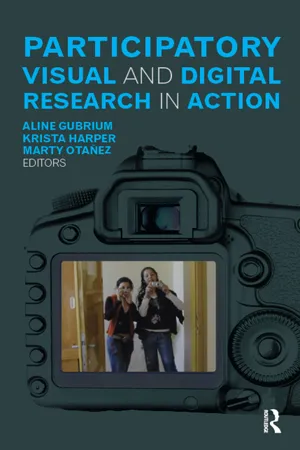
Participatory Visual and Digital Research in Action
- 296 pages
- English
- ePUB (mobile friendly)
- Available on iOS & Android
eBook - ePub
Participatory Visual and Digital Research in Action
About this book
This collection of original articles, a companion to the authors' Participatory Visual and Digital Methods, illustrates how innovative visual and digital research techniques are being used in various field projects in health care, environmental policy, urban planning, education and youth development, and heritage management settings. These methodologies produce rich visual and narrative data guided by participant interests and priorities, key tools for collaborative work. The 16 chapters-include digital storytelling, PhotoVoice, community-based filmmaking, participatory mapping and GIS, and participatory digital archival research;-provide a portfolio of model research projects for researchers who wish to collaborate on community-based studies;-will appeal to an audience across social science, heritage, health, education, and social service fields.An open-access companion website will allow readers to view the research products presented in each contributor's chapter.
Information
 | CHAPTER 1 | |

Introduction
Taking the “Participatory Turn”
As social researchers, many of us were trained to focus on researcher-generated questions contributing to generalizable knowledge that might or might not be applied in community settings at some later time. Postmodern critics of the late twentieth century drew focus to issues of power in scholarly representation, leading many ethnographers to take what is now known as the “literary turn” or the “reflexive turn” (Behar and Gordon 1995; Clifford and Marcus 1986; de Groof 2013; Foley 2002). Since that time, postcolonial, feminist, and other activist scholars pushed the critique beyond scholarly texts to new forms of participatory action research (Castleden et al. 2008; Hale 2008; Harper 2012; Hemment 2007). We have moved beyond the “literary turn” and reflexivity for reflexivity’s sake to a new “participatory turn” of collaborative and community-based research. At the same time, visual and digital media technologies present us with new ways to work alongside communities to produce and communicate our research collaboratively. But what does this “participatory turn” look like in action?
Participatory visual and digital research methods are changing the landscape of our work across disciplines and on the ground in collaboration with communities. Scholars in public health, anthropology, communication, environmental studies, science and technology studies, heritage studies, education and youth development, and museum studies are all taking the “participatory turn.” This collection consists of six parts, each featuring contributions by experts in each of the most well-known research methods.
As in our first book (A. Gubrium and Harper 2013), where we presented key figures in the field through their “core stories,” contributors recount how they came to be practitioners of emerging participatory visual and digital research and how their use of these methods changed them. Chapter authors present their own version of participation and collaboration as it plays out in action, their use of digital or visual technology, and discuss issues of power and ethics that relate to their project process or outcomes. A companion website to the book (www.pvdraction.org/) allows readers to view the research products presented in each contributor’s chapter.
Part I includes two very different projects that use digital storytelling. Digital storytelling is a workshop-based process in which participants create first-person narratives about an important moment in their lives and then use digital editing software to synthesize their narrative with digital images, video, text, and sound track to create a compelling short video (Lambert 2012). Darcy Alexandra’s chapter presents her longitudinal work with asylum seekers in Ireland and reflects upon digital storytelling as a way to foster “political listening,” empathy, and action. Marty Otañez and Andrés Guerrero use this method to learn about the lives and challenges of people living with Hepatitis C in Denver. The chapters in Part II highlight different issues in Photovoice. Photovoice is a participatory method in which participants take photos in relation to participant-derived themes, participate in generative conversations around selected photos, and then display and dialogue around the photos in a community forum setting to address key themes for action (Wang 1999). Ciann Wilson and Sarah Flicker use the method to elicit young women’s understandings of sexuality and sexual health in an African, Caribbean, and black neighborhood in Toronto, a context marked by racial, gender, and class inequalities. Cynthia Selin and Gretchen Gano harness Photovoice techniques to participatory technology assessment in the Futurescape City Tours project, in which citizens and experts explore neighborhoods as they discuss how new technologies might transform urban life in North American cities.
Part III presents the work of veteran participatory action researchers working in film and video. Charles Menzies offers a retrospective lens of his film projects with the Gitxaala Nation in Canada and his learning process as an indigenous filmmaker moving into an ever more collaborative approach. Jean Schensul and Campbell Dalglish describe their “improvisational film” technique for engaging youth in participatory action research (PAR) and communication campaigns on issues related to health and drug use.
Part IV moves into the intriguing terrain of participatory geographic information systems (PGIS). Researchers are increasingly using the cartographic techniques and sophisticated spatial analysis tools of GIS to study how maps and space matter. In PGIS projects, maps are participant-created and/or created using GIS software. Maps in either form are used as visual elicitations devices for answering four questions: 1) Where is something located? 2) Where is something concentrated? 3) What kinds of things coincide in a specific place? and 4) How is a place changing over time? (A. Gubrium and Harper 2013, 153–154). In Nick Rattray’s chapter, we see people with and without physical disabilities mapping and evaluating accessibility on a university campus and revealing “invisible barriers” in the process. Simona Perry takes a participatory, qualitative GIS approach in her work with rural Pennsylvania residents, representing layers of stories associated with specific landscapes affected by shale gas exploration. Historical archaeologist Edward González-Tennant uses GIS as a starting point for grappling with multimedia research, collaborating with survivors and descendants of a massacre that took place in an African-American town in the early 1920s. His Virtual Rosewood museum uses interactive online features to engage descendant communities and the broader public in coming to terms with “difficult heritage.”
Part V brings together several examples of participatory digital archives and museums. In our first book, we noted an opening up of “opportunities for the public to participate in collections and archives, not only as information consumers, but also as contributors and lay curators” (A. Gubrium and Harper 2013, 169). Heritage and digital humanities scholars increasingly see the digital archiving process as an entry point for participatory action research. Catherine Besteman gives an autoethnographic account of the development of an online archive of photographs and research materials from her fieldwork. She developed “The Somali Bantu Experience” in consultation with local Bantu refugees who were resettled in Maine after fleeing Somalia’s civil war. Madeleine Tudor and Alaka Wali present their use of PAR to develop interactive, community-based exhibitions at Chicago’s Field Museum, where “mixed media are the core for representing research to broader publics.” Finally, Natalie Underberg-Goode examines the iterative process of developing PeruDigital, a virtual ethnographic museum created by a team of scholars, students, programmers, and artists from the United States and Peru.
Part VI marks the robust emergence of participatory design ethnography as a mode that crisscrosses social science, art, and user-focused technology. Nancy Fried Foster offers case studies of participatory design in higher-education libraries that bring together students, staff, and faculty to produce better spaces and services. She argues for the urgency of participatory design and critical design studies as harnessing research to produce “shared value.” This concern runs through the chapter by Elizabeth Chin and colleagues, which follows the path of design students and homeless youth in Los Angeles as they work together to develop a multimedia installation inviting the public to “take a walk in someone else’s shoes.” In the final chapter, Matthew Durington and Samuel Collins take inspiration from Chin’s provocative question: “Why can’t design itself be a form of ethnography?” They present their team’s iterative process of designing fieldwork apps as a way to analyze and reflect on the community-based multimedia materials collected over the past several years by the Anthropology by the Wire project.
Taken together, these cases present an exciting array of possibilities for engaged research, but also new tensions for scholars to navigate. Crosscutting themes emerge across the chapters in relation to theoretical and ethical issues, the research process and methods, and the products, outcomes, and “broader impacts” of participatory visual and digital research.
Theoretical and Ethical Issues
A dialectics of collaboration undergirds our contributors’ research practice. Participatory work is not merely a way to gain entrée into difficult-to-access communities. Rather, the projects described here are rooted in an egalitarian ethic where the research participants and communities are first and foremost prioritized. Lying at the heart of much of this work are process questions: What good is it? Who is it good for? And who determines what good it is for?
In each contributor’s core story, there comes a moment where ethical and theoretical dilemmas drive them to take the participatory turn. One turning point in many of our scholarly trajectories came when we first read the works of Brazilian educator and philosopher Paulo Freire, cited by several contributors as an inspiration behind their collaborative and social justice commitments. The methods discussed in this book all draw upon Freire’s (2000) process of conscientization: a “cycle of dialogue, reflection and action [with participants in which they are] empowered via collective questioning of dominant narratives and explanations to develop critical consciousness,” as Schensul and Dalglish write in their chapter. In Freire’s model, inquiry is wedded to civic engagement and a vision of transforming unjust structures.
Scholars often take the participatory turn out of a commitment to “upending the political structure” of research as usual (Chalfen and Rich 2007, 63). Yet, our contributors do not romanticize the collaborative research process: they explore issues of power, particularly when working with multiple stakeholders in a project. Feminist scholar Donna Haraway’s (1988) notion of “situated knowledge” is instructive as it applies to structures of power and serves as a theoretical cue for many of us going participatory. Situated knowledge, rooted in local cultural, historical, and embodied specificity, may be especially trustworthy from the vantage point of the subjugated. “Situated knowledges require that the object of knowledge be pictured as an actor and agent, not as a screen or a resource, never finally as a slave to the master that closes off the dialectic in his unique agency and his authorship of ‘objective’ knowledge” (Haraway 1988, 592). Rattray uses a participatory mapping process with students, some disabled and some able-bodied, to gain their “embodied expertise” on geographical barriers to ease of movement on campus. Here, participatory research serves as a “countermapping” of the usual campus map depictions, which figure as authoritative/technocratic evidence of accommodation. Participant-produced maps evoke situated knowledges and more dynamic bodies of evidence. Or, as Haraway writes: “Only partial perspectives promise objective vision” (1988, 582–583).
A number of our contributors cite the work of French filmmaker and anthropologist Jean Rouch as an intellectual inspiration. Rouch proposes a “shared anthropology,” in which knowledge produced with or on a community or culture is accessible to its members (Ginsburg 1995). Similar to a Freirian emphasis on the dialogical process as critical to emancipatory research, Rouch places the collaborative process of filmmaking on equal footing with the outcome: the finished film. Collaboration serves as a “site for reflexivity and social engagement among those involved in the process” (A. Gubrium and Harper 2013, 97). A shared anthropology upgrades research participants to the position of co-researchers who are quite capable of interpreting their own experiences (Pink 2011; Rouch 1975; Rouch and Taylor 2003; Stoller 1992).
Broadening Our Spectrum of Engagement
Along with a shared research and media production process comes the idea that engagement and collaboration encompass a wide variety of roles, strategies, purposes, and outcomes. Many of our contributors position their work within the realms of PAR: some call it collaborative research, and yet others situate their work as community-based participatory research (CBPR). Some of this has to do with our theoretical influences and disciplinary conventions, as well as funding possibilities (see Peterson and A. Gubrium 2011). We do not make strong distinctions between these approaches here, but point to the common thread of scholars broadening their spectrum of engagement.
Tudor and Wali present building a museum collection as an act of community-based organizing and networking with multiple local organizations. They engage community members in the task of gathering archival material, curating assemblages of artifacts, and communicating submerged histories to the public. Besteman also frames her ethnographic work as one of “collaboration” rather than “participation,” entailing the design of a digital photo archive to house her past work in Somalia and present work in Maine with resettled Somalis. The work, she notes, has promulgated a variety of encounters of engagement among multiple parties, including research (in this case photography) “subjects,” students and faculty at her university, local community members in Maine where the photo archive is housed, and outside audiences viewing the photos from afar through the digital archive.
Other contributors move around within the spectrum of engagement. The specific form of participant engagement depends on the context and purpose of the particular project at hand. Flexibility in participatory strategy is exemplified by Menzies’s filmmaking work. In his full-length feature film, Bax Laansk—Pulling Together (2011), community members provided feedback on the rough cut of the film only after Menzies has edited the film to this stage. In another film, Gathering Strength (2014), the entire process evolved through ongoing consultation with a community organizing team. With In My Grandmother’s Garden (2009), he cuts a longer film into shorter pieces that he calls “video vignettes.” Video vignettes are produced to serve a variety of constituencies, including outside viewing audiences and local community members, for purposes of documentation and knowledge transfer. Menzies leaves open the possibility that others may splice and repurpose his films into smaller cuts to fit their needs, which is yet another way of engaging participation.
Power Asymmetries Do Not Go Away
One may enter research collaborations intent on disrupting uneven dynamics on the research playing field. Yet, it is important to enter the game with eyes wide open to the ways that positionality continues to affect power and agency. Funders, researchers, facilitators, and participants are all involved in this negotiation. Tudor and Wali raise important questions about power dynamics:
“Research can illuminate tensions and divides between social sectors and organizations, but can it help to address these conflicts? …Does awareness of exclusionary tendencies lead to action for inclusiveness? Do visual media provide more convincing evidence of areas of common ground between divided sectors than other ways of representing research findings?” (see page 209)
Like Tudor and Wali, we want to see how we can push participatory research furth...
Table of contents
- Cover
- Half Title
- Title Page
- Copyright Page
- Table of Contents
- List of Illustrations
- Foreword
- Acknowledgments
- 1 Introduction
- PART 2 Photovoice
- PART 3 Participatory Video
- PART 4 Participatory Mapping and GIS
- PART 5 Participatory Digital Archives and Museums
- PART 6 Participatory Design Ethnography
- Index
- About the Editors
- About the Contributors
Trusted by 375,005 students
Access to over 1.5 million titles for a fair monthly price.
Study more efficiently using our study tools.
Frequently asked questions
Yes, you can cancel anytime from the Subscription tab in your account settings on the Perlego website. Your subscription will stay active until the end of your current billing period. Learn how to cancel your subscription
No, books cannot be downloaded as external files, such as PDFs, for use outside of Perlego. However, you can download books within the Perlego app for offline reading on mobile or tablet. Learn how to download books offline
Perlego offers two plans: Essential and Complete
- Essential is ideal for learners and professionals who enjoy exploring a wide range of subjects. Access the Essential Library with 800,000+ trusted titles and best-sellers across business, personal growth, and the humanities. Includes unlimited reading time and Standard Read Aloud voice.
- Complete: Perfect for advanced learners and researchers needing full, unrestricted access. Unlock 1.5M+ books across hundreds of subjects, including academic and specialized titles. The Complete Plan also includes advanced features like Premium Read Aloud and Research Assistant.
We are an online textbook subscription service, where you can get access to an entire online library for less than the price of a single book per month. With over 1.5 million books across 990+ topics, we’ve got you covered! Learn about our mission
Look out for the read-aloud symbol on your next book to see if you can listen to it. The read-aloud tool reads text aloud for you, highlighting the text as it is being read. You can pause it, speed it up and slow it down. Learn more about Read Aloud
Yes! You can use the Perlego app on both iOS and Android devices to read anytime, anywhere — even offline. Perfect for commutes or when you’re on the go.
Please note we cannot support devices running on iOS 13 and Android 7 or earlier. Learn more about using the app
Please note we cannot support devices running on iOS 13 and Android 7 or earlier. Learn more about using the app
Yes, you can access Participatory Visual and Digital Research in Action by Aline Gubrium, Krista Harper, Marty Otañez, Aline Gubrium,Krista Harper,Marty Otañez in PDF and/or ePUB format, as well as other popular books in Social Sciences & Anthropology. We have over 1.5 million books available in our catalogue for you to explore.