- 176 pages
- English
- ePUB (mobile friendly)
- Available on iOS & Android
eBook - ePub
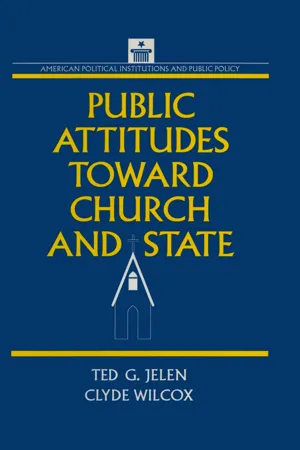
Public Attitudes Toward Church and State
About this book
Using data from the Williamsburg Charter surveys, this book provides a portrait of public attitudes on church-state issues. It examines the social, religious and political sources of differences on issues, making comparisons among Protestants, Catholics, Jews and non-denominational others.
1
Religion, Politics, and the Constitution
In the summer of 1994, the U.S. Supreme Court ruled that a New York state school district created for the benefit of the disabled children of Hasidic Jews was unconstitutional. In a 6-3 vote, the Court ruled in Board of Education of Kiryas Joel Village School District v. Grumet that such a school district violated the establishment clause of the Constitution (Biskupic 1994; Greenhouse 1994). Writing for the Court's majority, David Souter wrote that the legislature had created "a fusion of governmental and religious functions" and that government is required to demonstrate "'neutrality' among religions" (Biskupic 1994, Al). Souter argued that the establishment clause requires that "government should not prefer one religion to another, or religion to irreligion" (Greenhouse 1994, Al).
In a bitmg dissent, Antonin Scalia mocked Souter's reasoning, arguing: "The Court today finds that the Powers that be, up in Albany, have conspired to affect an establishment of the Satmar Hasidim... The Founding Fathers would be astonished to find that ... the Court has abandoned text and history as guides ... [and] nothing prevents it from calling religious toleration the establishment of religion" (Greenhouse 1994, D22).
In response to Scalia's dissent, Souter replied: "The license he [Scalia] takes in suggesting that the Court holds the Satmar sect to be New York's established church is only one symptom of his inability to accept the fact that this Court has long held that the First Amendment reaches more than classic, 18th-century establishments" (Greenhouse 1994, D21).
This unusually personal exchange between Supreme Court justices illustrates clearly that protagonists in the debate over the proper relationship between religion and government disagree fundamentally on a variety of issues. What is ultimately at stake are the meaning of the First Amendment to the Constitution and the proper role of religion in American public life. Such issues clearly have the capacity to provoke intensive, hyperbolic reactions and rhetoric. For more than half a century, the manner in which Americans "render unto Caesar the things which are Caesar's, and to God the things which are God's" (Matt. 22:21) has been a rich source of political and legal conflict in the United States.
The constitutional source of this conflict is sixteen words that begin the First Amendment to the U.S. Constitution:
"Congress shall make no law respecting an establishment of religion, or prohibiting the free exercise thereof...." The precise meaning of these two clauses of the First Amendment (generally called the establishment clause and the free-exercise clause, respectively) has vexed scholars, lawyers, and citizens alike for a number of years. The sparse language of the U.S. Constitution has occasioned a massive volume of legal and scholarly writing and much disagreement and controversy in academic and legal circles.
Although the meaning of the First Amendment language on religious establishment and free exercise is ultimately decided by the U.S. Supreme Court, it is also debated in the electoral arena. Many Republican (and some Democratic) candidates for state and national office have staked positions in support of more public displays of Christian imagery and language, in part to attract conservative evangelical Christians that have increasingly become an important part of their constituencies. State legislatures have frequently passed laws designed to circumvent Supreme Court rulings on school prayer and Bible reading, and members of those legislatures have run for reelection claiming credit for such measures. It is likely that there will be a highly publicized debate on church-state issues in 1995 as the new Congress considers a constitutional amendment to allow prayer in public schools.
Moreover, there is evidence that the public cares about many of these issues. Debates about religious symbols in public schools or at Christmas arouse strong emotions among many American citizens, as do issues involving the rights of religious minorities. There is reason to believe, therefore, that many citizens will have relatively coherent and often intense positions on issues relating to church-state relations. This is not to say, of course, that the average American has spent much time considering many of the concrete issues of religious establishment or free exercise that the Supreme Court has decided. Yet we will show in later chapters that the public orders their beliefs on these issues in a meaningful fashion and that their attitudes are explained by their political, religious, and demographic characteristics.
This book is about the attitudes of the American public concerning issues of church-state relations. As such, it is not a legal or polemical work, nor is it a work of advocacy. We do not seek to take sides in the frequent debates over issues of church and state but only to examine and illuminate public opinion on these issues. Our purpose in this chapter is to offer a brief description and explanation of the political and legal context in which such matters are debated.
Most of this debate has centered on the proper interpretation of the establishment clause, which has been the center of more litigation and legislation than the free-exercise clause. In general, the resulting legal and academic controversies have generated two opposing camps, usually termed "accommodationists" and "separationists." Proponents of each position differ profoundly about the "correct" constitutional meaning of the establishment and free-exercise clauses and the role of religion in American public life.
Accommodationism and the Establishment Clause
Some analysts have suggested that the proper relationship between government and religion is one of "benevolent neutrality" (Wald 1992). They have suggested that government should pursue a policy that is generally favorable toward organized religion but that does not involve any preference for any particular religion. This orientation, usually termed "accommodationism" (Wald 1992) or "nonpreferentialism" (Levy 1986), is based upon two important assumptions about the political nature of religious belief.
First, accommodationists tend to assume that religion has beneficial consequences for human behavior; that is, religion provides a transcendent basis for morality and provides limits for the scope of political conflict. For example, A. James Reichley (1985), after reviewing a number of different ethical systems, concluded that only "theist-humanism" combines an objective, nonarbitrary basis for public morality with respect for the dignity and autonomy of each individual. Such a theological system (of which the Judeo-Christian tradition is a prime example) balances the need for public order with a respect for individual liberty.
Second, accommodationists tend to assume that, at bottom, most Christian religious traditions have similar political effects. Many analysts (see, for example, Kirk 1986) have cited Alexis de Tocqueville approvingly on the political consequences of Christianity in the United States: "The sects that exist in the United States are innumerable. They all differ in respect to the worship which is due to the Creator; but they all agree in respect to the duties which are due from man to man.... Moreover, all the sects of the United States are comprised within the great unity of Christianity, and Christian morality is everywhere the same.... Christianity, therefore, reigns without obstacle, by universal consent; the consequence is ... that every principle of the moral world is fixed and determinate, although the political world is abandoned to the debates and experiments of men. . . ." (Tocqueville 1945, 314-15; emphasis added).
Thus, Tocqueville argued that the apparent diversity of American religion conceals a broad consensus on the behavioral consequences of religion. Whatever diversity exists among American Christians is confined to matters of doctrine and ritual (what some have called the "First Table" of the Ten Commandments) and does not extend to the duties that people owe one another. Religion is thought to fulfill a "priestly" function of legitimation of political authority (Jelen 1991b; Leege and Kellstedt 1993). Thus, a "Judeo-Christian tradition" is thought to provide the ethical basis of public life or what Peter Berger (1967) and Richard Neuhaus (1984) have termed a "sacred canopy" within which political affairs can be conducted.1
As Neuhaus elaborated: "Politics derives its directions from the ethos, from the cultural sensibilities that are the context of political action. The cultural context is shaped by our moral judgments and intuitions about how the world is and how it ought to be. Again, for the great majority of Americans such moral judgments and intuitions are inseparable from religious belief. Perhaps this is true not just of the majority but of all of us, whether or not we call our ultimate values religious. In any event, whether it is called the Judeo-Christian ethic, or Christianity,... it is the dynamic of religion that holds the promise of binding together [religare] a nation in a way that may more nearly approximate civitas" (1984, 60).
Given the assumption of a consensus on the ethical dimensions of religious faith, and the accommodationist belief in the positive effects of religion on political life, a certain view of the religion clauses of the Constitution follows. Accommodationists tend to take a very narrow view of the establishment clause, arguing that this clause only requires nonpreferentialism (Cord 1982; Wald 1992; Bradley 1987; Levy 1986). According to this view, government may not enact policies that favor one particular denomination over another, but there is no constitutional violation if government were to aid all religions impartially. Such policies as aid to parochial schools, tuition tax credits for private education, and nonsectarian school prayer are all considered constitutional by accommodationists, provided such policies are applied equally to all religions. Indeed, this view of the establishment clause may be considered the defining characteristic of the accommodationist position.
Separationism and the Establishment Clause
In contrast to the accommodationist emphasis on religious or cultural consensus, constitutional scholars within the tradition of "separationism" have tended to emphasize the diverse and divisive characteristics of American religion. Religious belief, it is argued, makes absolutist claims on the believer, which are not amenable to compromise (see Wald 1992). Far from being a source of social cohesion, religion is regarded as a source of much bitter political conflict. In his classic Federalist #10, James Madison listed differences in religion as a fertile source of "faction," which the Constitution is designed to control (Hamilton, Madison, and Jay 1937).2 In a somewhat more humorous vein, Finley Peter Dunne's fictional Mr. Dooley made essentially the same point:
"Rellijon is a quare thing. Be itself it's all right. But sprinkle a little pollyticks into it an' dinnymit is bran flour compared with it. Alone it prepares a man f'r a better life. Combined with polyticks it hurries him to it" (quoted in Levy 1986, ix).
Given the potential volatility of religion as applied to political subjects, separationists view the purpose of the religion clauses of the First Amendment as depoliticizing religious belief. Religion is regarded as a dangerous element in democratic politics, one which is best confined to the private sphere of activity (Levy 1986; Pfeffer 1967).
Constitutionally, separationists take a broad view of the establishment clause, arguing that this portion of the First Amendment proscribes government involvement with religion in any form (Pfeffer 1967; Levy 1988). This expansive understanding of the establishment clause was given the force of law in Hugo Black's opinion in Everson v. Board of Education (1947): "The 'establishment of religion' clause of the First Amendment means at least this: Neither a state nor the Federal government can set up a church. Neither can pass laws which aid one religion, aid all religions, or prefer one religion over another.... No tax in any amount, large or small, can be levied to support any religious activities or institutions, whatever they may be called, or what ever form they may adopt to teach or practice religion In the words of Jefferson, the clause against establishment of religion by law was intended to erect 'a wall of separation between church and state.'" (Cord 1982, 18; emphasis added).3
Accommodationists regard this stark language as fundamentally mistaken (Cord 1982; Reichley 1985) and, indeed, as pernicious. Black's interpretation of the establishment clause would seem to proscribe any form of government assistance to religion, including symbolic aid. Government encouragement of religious belief is considered to be forbidden, even if such assistance were favored by a large majority of the population.
Not surprisingly, some accommodationist analysts regard separationism as hostile to religion itself (Wald 1992). Indeed, one collection of accommodationist essays bears the title The Assault on Religion (Kirk 1986). Although it is clearly true that a separationist position would be appropriate for one who sought to minimize the impact of religious belief on political life, many separationists are deeply religious men and women who regard a very strict distance between religion and politics as beneficial to both. The religious case for separationism involves the claim that religion and politics each operate most effectively when their mutual independence is maximized.
According to Garry Wills (1990), Thomas Jefferson's brand of separationism was designed precisely to enhance the moral authority of religion. Jefferson (whose private correspondence is the source of the phrase "wall of separation") believed that "true" religion—the sort that satisfied the spiritual needs of the parishioners—required no governmental support. Only religions that were "false" or ineffective needed assistance from outside the congregation. If denominations or congregations were required to rely on their own resources, only those who actively attended to the needs and desires of their members would survive.
This argument is based on the metaphor of the economic market-place. A "free market" in religion, like its economic counterpart, will produce pastors with strong incentives to satisfy their religious "customers." In recent years, a number of contemporary social scientists have made this economic analogy more explicit. Several studies (lannaccone 1990; Finke 1990; Stark and McCann 1993; Finke and Stark 1992) have shown that competition between denominations (which is enhanced by a lack of governmental support of religion) increases the "supply" of religious "commodities" (number of churches, availability of clergy), as well as the extent of religious observance (for a critique of this more recent literature, see Bruce 1993). Thus, there exists a proreligion separationist argument to the effect that nonsupport of religion (perhaps paradoxically) creates the very environment in which a variety of religions can flourish.
Moreover, some separationists have argued that religion has an important political role to play, which is enhanced by independence between church and state. In a religiously pluralistic society, religion is often thought to have a prophetic function of moral and social critic (Jelen 1991b; Leege and Kellstedt 1993; Tinder 1989). Governments are run by men and women, who from the standpoint of most religious traditions are imperfect and prone to error. Religion's prophetic stance involves holding political actors accountable to standards imposed from outside the secular realm of politics. This critical position is arguably easier to maintain if religious bodies do not depend either directly or indirectly on government support. A natural reluctance to "bite the hand that feeds" might inhibit the ability of religious leaders to act as independent watchdogs on the political process.
The Free-Exercise Clause
Although most of the scholarly and political debate in the United States has focused on the establishment clause, there has been a good deal of litigation and controversy about free exercise as well. Although the...
Table of contents
- Cover
- Half Title
- Title
- Copyright
- Dedication
- Contents
- List of Tables
- Foreword
- Preface and Acknowledgments
- 1. Religion, Politics, and the Constitution
- 2. Religion and Politics: A Contested Public Space
- 3. Abstract Views of Church-State Relations
- 4. Concrete Views of Church-State Establishment
- 5. Attitudes toward the Free Exercise of Religion
- 6. Conclusion
- Appendix
- References
- Index
- About the Authors
Trusted by 375,005 students
Access to over 1.5 million titles for a fair monthly price.
Study more efficiently using our study tools.
Frequently asked questions
Yes, you can cancel anytime from the Subscription tab in your account settings on the Perlego website. Your subscription will stay active until the end of your current billing period. Learn how to cancel your subscription
No, books cannot be downloaded as external files, such as PDFs, for use outside of Perlego. However, you can download books within the Perlego app for offline reading on mobile or tablet. Learn how to download books offline
Perlego offers two plans: Essential and Complete
- Essential is ideal for learners and professionals who enjoy exploring a wide range of subjects. Access the Essential Library with 800,000+ trusted titles and best-sellers across business, personal growth, and the humanities. Includes unlimited reading time and Standard Read Aloud voice.
- Complete: Perfect for advanced learners and researchers needing full, unrestricted access. Unlock 1.5M+ books across hundreds of subjects, including academic and specialized titles. The Complete Plan also includes advanced features like Premium Read Aloud and Research Assistant.
We are an online textbook subscription service, where you can get access to an entire online library for less than the price of a single book per month. With over 1.5 million books across 990+ topics, we’ve got you covered! Learn about our mission
Look out for the read-aloud symbol on your next book to see if you can listen to it. The read-aloud tool reads text aloud for you, highlighting the text as it is being read. You can pause it, speed it up and slow it down. Learn more about Read Aloud
Yes! You can use the Perlego app on both iOS and Android devices to read anytime, anywhere — even offline. Perfect for commutes or when you’re on the go.
Please note we cannot support devices running on iOS 13 and Android 7 or earlier. Learn more about using the app
Please note we cannot support devices running on iOS 13 and Android 7 or earlier. Learn more about using the app
Yes, you can access Public Attitudes Toward Church and State by Clyde Wilcox,Ted G. Jelen in PDF and/or ePUB format. We have over 1.5 million books available in our catalogue for you to explore.