- 560 pages
- English
- ePUB (mobile friendly)
- Available on iOS & Android
eBook - ePub
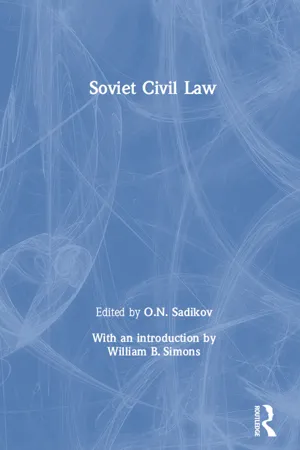
Soviet Civil Law
About this book
This volume is an unabridged translation of the textbook 'Soviet Civil Law', originally published in 1983 under the auspices of the USSR Ministry of Justice. Edited by Professor O.N. Sadikov, the work includes contributions from nine Soviet legal scholars
Part I
CIVIL LAW
General Provisions
Chapter 1. Concepts, Principles, and System of Soviet Civil Law
1. Civil law as a branch of Soviet law. Soviet civil law is one of the basic branches of Soviet law. Among the various social relationships, the determinant ones are the economic relationships. It is the task of civil law to regulate those which are conditioned by commodity-money forms. Therefore, civil law holds an important place in Soviet society, and its object is a wide range of social relationships.
In the first place, civil law regulates relationships connected with the solving of the tasks of economic development. The economic relationships between socialist organizations are arranged mainly on the basis of plan contracts and obligations; moreover, the improving of the industrial mechanism, the more intensive utilization of economic levers and stimuli, such as economic accountability [khozraschet], credit and profit, involve a wider application of civil law and a strengthening of its role.
Secondly, civil law regulates relationships meant to satisfy the material and spiritual needs of citizens, relationships which are linked to the development of creative activity. Thus, it actively helps in the solving of the basic economic task of socialism — the raising of the material and cultural level of the life of the people.
In the third place, the norms of Soviet civil law are of great significance in the regulation of relationships between citizens which concern their exercising of the right to personal property, inheritance, and other rights. In this way, the norms of civil law are employed in different areas to regulate diverse relationships.
A more exact definition of civil law necessitates the clarification of two basic questions: precisely what relationships does civil law regulate, that is, what is the object of civil law regulation, and how does the law regulate it, that is, what are the most general legal devices it utilizes or in what lies the method of civil law?
2. The object of Soviet civil law. In characterizing the object of Soviet civil law, the law defines three groups of relationships regulated by it. Among these relationships, Article 1 of the Principles of Civil Legislation of the USSR and the Union Republics (hereinafter to be cited by the abbreviation Principles) lists property relationships, personal non-property relationships which are connected with property relationships, and, in instances stipulated by law, other personal property relationships. Analogous positions are stipulated in Article 1 of the Civil Code of the RSFSR. Let us look at each of these groups of relationships.
The first group comprises those property relationships which are the fundamental object of civil law. The concept of property relationships does not coincide with the concept of economic relationships; they are a part of the latter, a narrower category. Property relationships are relationships based on property, that is, on material objects and other things of economic value. Thus, these are relationships based on concrete material objects and among concrete subjects.
Relationships among concrete subjects always have inherent in them a voluntary character, and this trait constitutes an important characteristic of property relationships. It is precisely because of the strength of this voluntary character that property relationships can be the subject of legal regulation, for the law exercises its regulatory function by influencing the will of the participants in the relationships.
Thus, property relationships are those economic relationships which are formed among concrete subjects, have a voluntary character and whose object is material objects and other things of economic value, for instance, services or other results of activity, even if they do not acquire material forms, e.g. inventions, trademarks, objects of literary creativity.
However, not all property relationships make up the object of civil law. According to the Principles, Soviet civil law regulates property relationships which are determined by the use of commodity-money form in communist construction. In other words, we are talking of property relationships which are linked with economic activity, its prerequisites and results.
In the main, it is the law of property which appears as the prerequisites and result of economic activity, and economic activity itself is conducted through the utilization of various contracts: purchase-sale, property-hire, carriage, etc. Property relationships regulated by civil law usually are reciprocal, although sometimes they are not (inheritance, gifts).
Those property relationships which are not connected with economic activity or with the commodity-money form are regulated not by civil but by other branches of law. For example, tax relationships, although they exist in monetary form, are not connected with economic activity and are regulated by financial law. Property relationships within the sphere of state administration are the object of administrative law.
The second group of relationships which makes up the object of civil law is that of personal non-property relationships connected with property relationships. Most frequently, these types of non-property relationships arise in connection with objects of creative activity. To this group belong, for instance, the creator’s right to the work of research, literature, and art or to an invention or rationalization proposal. Here also are included some rights which belong only to socialist organizations, for instance, the right to the firm name. Under this name, the organization enters into economic activity with its products and services, and it is in the final analysis connected with property rights.
The third group of relationships which the law places within the sphere of civil law consists of some “other personal nonproperty” relationships, that is, non-property relationships not directly connected with property relationships. These relationships, which express interests of a moral nature, are the individualization of the subject in society, his individuality, the worth of his personality, and data concerning his personal life. These personal, non-property rights, not connected with property rights, form part of civil law when this is expressly specified by law. With these belong the protection of honor and dignity (Art.7 Civil Code), the right to one’s own image (Art.514 Civil Code), and several others.
When the issue is about relationships which form the object of civil law, its norms act independently from the composition of the parties in these relationships. The subjects of civil law may be citizens, as well as organizations (only citizens, or only organizations; as well as both citizens and organizations). However, the regulation of civil-law relationships among citizens and among organizations have several, sometimes quite significant characteristics.
3. The method of Soviet civil law. If the object of regulation answers the question, what relationships are subject to the influence of civil law, then the method defines how this influence is exercised. It conveys the means by which the law influences regulated relationships, that is, manifests itself through basic devices which make up the content of that regulation.
The civil law method of regulation has significant characteristics in comparison with other branches of law, and this is plainly evident if civil law is compared with administrative law. In civil law the relationships between parties arise for the most part on the basis of their agreement (contract), while in administrative law they arise on the basis of the obligatory order of one of the parties (administrative act); in civil law, a right is defended, as a rule, through the method of bringing a suit in court or arbitrazh, while in administrative law through the method of filing a complaint to the competent organ.
The first characteristic of the method of civil law is connected with the status of its subjects. Economic activity assumes the equality of its participants, the impossibility that one of them force his will onto the other. This equality is a necessary condition of the basic relationship of economic activity and exchange. Therefore, a characteristic feature of the method of civil law is the equality of the parties involved in the relationships regulated by civil law. This does not mean that the parties involved in a specific relationship are allotted the same rights. On the contrary, rights may belong to only one side, while the other may bear only obligations. But the origin of the legal relationship and its substance depend in equal measure on both sides.
The second characteristic of the method of civil law is determined by the fact that economic activity demands the allocation to its participants of a certain degree of independence, of freedom of choice and maneuverability. This trait of the method, which is termed “dispositivity”, consists in the presence of certain possibilities in the disposition of the law, in the taking of decisions. Civil law sets up limits, within which the parties themselves may define their own actions. However, it is possible that there are circumstances when the realization of a right in a civil law relationship may give rise to an obligation in an administrative law relationship, and the discretion of the subject [sub”ekt] of civil law is limited to the defined boundaries which are expressed, in part, in the imperative norms of law.
The principle of “dispositivity” takes many forms. Civil law contains a large number of dispositive norms from which the parties may deviate. There exists a large number of civil rights, of which the law does not contain an exhaustive enumeration, just as in the law there is not an exhaustive listing of the grounds for the development of civil legal relationships (Art.4 Civil Code).
It is important to note that the principle of dispositivity applies not only to citizens but also to socialist organizations. Precisely because of this, the role of contractual relationships between them is very important. Their significance was emphasized during the XXV and XXVI Congresses of the CPSU. The party has repeatedly noted the importance of economic activity and initiative.
The third characteristic of the method of civil law is determined by the character of sanctions, e.g. the means of enforcement. When the rights of a participant in a civil law relationship are violated, it is, above all, his property interests which suffer. Hence the problem of restoring the property situation to the position which would have existed had there been no violation. The restoration of the property situation must be carried out at the expense of the violator. Therefore, the basic form of the restoration of property damage is the claiming of damages (Art.219 Civil Code), and, as a rule, their compensation must be complete.
Finally, the fourth characteristic of the method of civil law is linked with the carrying out of the enforcement. As a general rule, civil rights are protected by independent institutions which are not linked to any of the parties, whose special function consists in the settling of disputes — courts, arbitrazh, or arbitration tribunals (Art.6 Civil Code). The defense of civil rights by other organs in administrative procedure occurs only as an exception, in cases specified by law.
4. The delimitation of civil law from contiguous branches of law. The delimitation of civil law from contiguous branches of law is made possible by the characteristics of object and method. First of all, there is delimitation according to the object of the corresponding relationships, e.g. property relationships are separate from non-property relationships. Thus, family law regulates basically non-property relationships, and it follows that family relationships fall outside the borders of civil law. In addition, delimitation is also made by method, as there exist a number of branches which regulate property relationships. It is precisely through the criterion of method that it is possible to delimit, for instance, financial law, which is characterized by relationships of authority and subordination, from civil law. Method is a supplementary criterion for the division of the branches of law. Those branches of law which are contiguous to the civil branch of law, whose delimitation is particularly important, are specifically listed in paragraphs 3 and 4, Article 2 of the Civil Code. They are administrative, financial, family, labor, land and collective farm law, and others. Among these branches one must separate, first of all, those which regulate property relationships not through the method of equality but through the method of authority and subordination — administrative, financial, and land law. In these branches, property relationships do not have a commodity-money character, and they employ methods of authority in regulation.
Property relationships which are part of family, labor, or collective farm law also are not commodity-money relationships, and they do not serve economic activity, as is characteristic of civil law. The property relationships of family members (the payment of alimony) are not primary and reflect their personal ties; compensation for damages as a measure of liability does not play a role here.
As far as labor law is concerned, it regulates relationships in the work process which, under the conditions of socialism, do not have a commodity character. The same holds true of collective farm law characterized by intra-cooperative relationships (an important role among these being held by labor relationships) which do not have a commodity character. However, in the realization of the results of cooperative farm production, relationships having a commodity character do arise and are regulated by civil law.
Sometimes norms of law are promulgated to regulate a specific area of activity which go beyond the limits of one branch of law, for instance, capital construction or consumer services. These acts may form branches of legislation which combine the norms of various branches of law and therefore are called complex acts. This happens, for instance, in economic legislation which regulates relationships between socialist organizations in the sphere of economic activity and contains norms of civil, administrative, financial, and other branches of law. Treatises and texts may be devoted to these complex branches of legislation, and they may become the subject of special educational courses. However, in such cases new branches of law are not formed.
Thus, Soviet civil law may be defined as the totality of norms regulating through its own particular methods, under the conditions of a planned economy, property relationships which are dependent on the utilization of the commodity-money form, personal non-property relationships which are connected to these, and, in circumstances which are stipulated by law, other personal non-property relationships of socialist organizations and citizens, as well as among citizens and socialist organizations.
5. The leading role of the CPSU in the development of Soviet civil law. An examination of the object of civil law shows how substantial its significance is in the resolution of problems facing the country. Civil law aids in the raising of the material and cultural level of the life of the people, the growth of social productivity, and the heightening of its effectiveness. This explains the importance which the party has attributed to civil law as a means of solving economic and social problems ever since the first years of the existence of the Soviet state.
The elaboration of the first civil code, the 1922 Civil Code of the RSFSR, was carried out under the direct guidance of V.I. Lenin, who gave instructions on the fundamental, most basic, of its positions. His instructions on denying the protection of civil rights which are exercised in conflict with their social-economic purpose (we do not acknowledge anything private in the economic sphere), and on the importance of the principle of khozraschet, which he called commercial accounting, are well known.1
Later on, the Party also devoted significant attention to the development of Soviet civil law. The decisions of the Party Congresses and plenums, and the decrees of the Central Committee of the CPSU are the basis for the preparation and adoption of the most important civil law acts. In this connection, it is important to note the significance which is accorded to the strengthening of socialist legality and the legal order [pravoporiadok]. The importance of this trend is specifically noted in the Program of the CPSU.
In 1981, additions and changes, relating to the principles which were expressed in conformity with decisions of the party organs in the Constitution of the USSR, were made in the Principles of Civil Legislation of the USSR and the Union Republics.
As regards the regulation of economic activity, civil law legislation is being developed and improved. The XXVI Congress of the CPSU proposed “the perfection of the structure of khozraschet relationships and of the mutual economic interests and responsibility for the fulfillment of the tasks set by the plan and contractual obligations between the supplier and user, as well as between the client and contractor”. It is envisaged to elevate the role of finance-credit levers in the intensification of production, the consolidation of khozraschet, and the strengthening of the economic regime; to strengthen the effectiveness of economic sanctions for the non-fulfillment of plan quotas and contractual obligatio...
Table of contents
- Cover
- Half Title
- Title Page
- Copyright Page
- Table of Contents
- Table of Citations
- Introduction
- PART I. CIVIL LAW
- PART II. FAMILY LAW
- Russian-English Glossary
- English-Russian Glossary
- Index
- About the Editor
Trusted by 375,005 students
Access to over 1.5 million titles for a fair monthly price.
Study more efficiently using our study tools.
Frequently asked questions
Yes, you can cancel anytime from the Subscription tab in your account settings on the Perlego website. Your subscription will stay active until the end of your current billing period. Learn how to cancel your subscription
No, books cannot be downloaded as external files, such as PDFs, for use outside of Perlego. However, you can download books within the Perlego app for offline reading on mobile or tablet. Learn how to download books offline
Perlego offers two plans: Essential and Complete
- Essential is ideal for learners and professionals who enjoy exploring a wide range of subjects. Access the Essential Library with 800,000+ trusted titles and best-sellers across business, personal growth, and the humanities. Includes unlimited reading time and Standard Read Aloud voice.
- Complete: Perfect for advanced learners and researchers needing full, unrestricted access. Unlock 1.5M+ books across hundreds of subjects, including academic and specialized titles. The Complete Plan also includes advanced features like Premium Read Aloud and Research Assistant.
We are an online textbook subscription service, where you can get access to an entire online library for less than the price of a single book per month. With over 1.5 million books across 990+ topics, we’ve got you covered! Learn about our mission
Look out for the read-aloud symbol on your next book to see if you can listen to it. The read-aloud tool reads text aloud for you, highlighting the text as it is being read. You can pause it, speed it up and slow it down. Learn more about Read Aloud
Yes! You can use the Perlego app on both iOS and Android devices to read anytime, anywhere — even offline. Perfect for commutes or when you’re on the go.
Please note we cannot support devices running on iOS 13 and Android 7 or earlier. Learn more about using the app
Please note we cannot support devices running on iOS 13 and Android 7 or earlier. Learn more about using the app
Yes, you can access Soviet Civil Law by O.N. Sadikov in PDF and/or ePUB format, as well as other popular books in Law & Civil Law. We have over 1.5 million books available in our catalogue for you to explore.