eBook - ePub
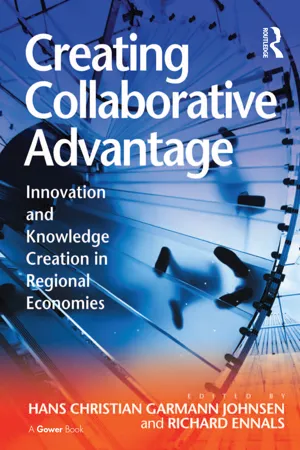
Creating Collaborative Advantage
Innovation and Knowledge Creation in Regional Economies
- 304 pages
- English
- ePUB (mobile friendly)
- Available on iOS & Android
eBook - ePub
Creating Collaborative Advantage
Innovation and Knowledge Creation in Regional Economies
About this book
In the emerging new collaborative economic order, innovation is achieved by an integrated process of collaboration between policymakers, business and society. Often, the focus for this collaboration is at a regional level. Creating Collaborative Advantage examines the trends in innovation policy that reflect this new thinking and regional focus. This book develops the view that collaboration is one of many ways of organising a competitive economy. It asks how, when and where collaboration is a meaningful way of organisation. It explores collaboration at business level, business networks between companies, and a wider collaborative coalition between business and public authorities. It is not a manual, a 'how to do it', because there is no single straightforward universal model to replace current orthodoxy on economic development, but it will enable people to learn. The contributors to this unique book have been involved with the implementation of some of the most outstanding examples of collaborative approaches, it therefore gives an outstanding picture of diversity, inbuilt comparisons and contrast, and debate between the cases. The co-authors give their understanding of these issues, but the book tries to establish some common understandings and bring the concept of collaboration to a larger audience, and to increase interest in a field which requires further exploration. Policy makers, advisers and administrators at all levels of government, those involved in research and development, and business leaders and educators, will find this book invaluable, together with readers having an academic interest in the subject of innovation.
Programmes for Collaboration
CHAPTER 1
Collaboration, Autonomy and Constructivist Society
BJØRN GUSTAVSEN
Introduction
Collaborative advantage presupposes the ability to collaborate. The idea of collaboration can be given different interpretations. One can, for instance, imagine collaboration to be a form of ‘mechanical’ process between people who are under the control of an external force of some kind or other, for instance ‘the market’, an authoritarian state, or the management of an organisation. In cases like this, ‘collaboration’ does not offer advantages other than those associated with words like ‘synchronisation’, ‘parallelisation’ or ‘co-ordination’. For collaboration to offer something not offered by the other notions, it must attain some special characteristics. It is reasonable to associate these characteristics with the basis for the interactive process, and to associate collaboration with a kind of relationship that presupposes free, or autonomous, partners.
Collaboration is something that people enter into because they want to, and see their interests served. Obviously, such notions as freedom and autonomy should not be taken in a fundamentalist sense. The kind of collaboration underpinning such processes as innovation exists between practical actors, for the purpose of achieving practical goals. Anyone who wants to participate in an innovation process needs to collaborate with someone; the point is that the actor can choose between different innovation systems, different discourses within each system, different ways of relating to other actors in face-to-face encounters. Each actor is not a cog in a machine but an active subject, able to choose, to move, to act, on the basis of their own interests and perspectives.
In the thinking on work and organisation, the focal concept in this context has been autonomy. The concept was first launched around 1950, with the background of a series of studies by the Tavistock Institute in Britain in the coal-mining industry. A post-Second World War wave of nationalisation, in combination with heavy investments in new technology, had implied an increase in division of work in the coal mines. In association with this increase, an increase in absenteeism and mental illnesses was noted. Studies to identify the reasons for this increase discovered that in some cases new technology had been implemented, while the traditional, group-based form of work organisation had been maintained. The interesting aspect about these cases was that they showed a higher degree of productivity per worker than was found in the recent, more specialised forms of work organisation. In the traditional teams, the workers shared a set of tasks between them, and decided themselves who was to do what at each stage. This kind of team came to be called an autonomous, or semi-autonomous, group (Trist and Bamforth 1951; Herbst 1962).
With this, the notion of autonomy became linked to the tasks facing the people in the workplace. While a highly specialised work role generally implied one operator, one task, the notion of autonomous group implied not only that a number of tasks were shared between a number of operators, but also that the operators themselves decided on what the task relationship structure should be each time.
Efforts to turn the notion of autonomous group into practical workplace reality, in the British coal-mining industry or elsewhere, ran into difficulties. It was not until the Tavistock researchers came into contact with researchers in Norway, who in turn had relationships to the labour market parties, that efforts to test the idea of autonomous work groups in new contexts became possible. In the period 1965 to 1970 a series of four field experiments were performed in industrial plants in Norway (Emery and Thorsrud 1976). In a process plant, a pattern of work organisation based on hierarchically structured, separate units to handle the tasks of, respectively, the plant, the control room, and maintenance, was replaced by a number of shift groups where each group was responsible for all the functions. The plant could be run with 30–40 per cent fewer operators, and with a higher level of output quality.
In the wake of results of this kind, there emerged what can be called a ‘movement for autonomy in work’, not only in Norway, but in a number of other countries as well, for example Sweden (Sandberg 1982), Denmark (Agersnap 1973); Germany (Fricke 1975), Holland (Beinum and Vliest 1979) and more. The peak of this period was reached in 1974, when Volvo opened its new factory for the final assembly of automobiles in Kalmar in Sweden. The assembly line was abandoned in favour of a system with movable carriers that allowed for group work with far longer cycles (Agurèn et al. 1976; Lindholm 1979). While few examples as radical as this appeared anywhere, cases demonstrating the relevance of autonomy in work appeared in many contexts. Notwithstanding this, the movement for autonomy seemed to lose momentum, and by the middle 1980s there were only a few publicly recognised examples of efforts to improve on worker autonomy to be found even on the global scene. Did the autonomy movement come to an end?
If we move to recent comparative studies of the evolution of work organisation in Europe (for example The European Foundation for the Improvement of Living and Working Conditions 2007; Lorenz and Lundvall 2011), we see that the criteria originally developed as characteristics of autonomy, such as the right to decide on work rhythm and work methods and the possibility of learning in work, are not only applied, but that the level of autonomy also seems to go up over time rather than down. This may be due to many circumstances, for instance the growing relative importance of professional services. Despite this, it cannot be argued that the autonomy movement is dead. Furthermore, the nations that come out with the highest scores on autonomy are Scandinavian, that is the countries where the idea was first converted into significant and visible practical experiments – Sweden, Denmark, Norway and later, Finland – (Gallie 2003). The question is what actually happened in the period between the 1960s and today, and what significance it has for our understanding of autonomy, and its role in contemporary working life.
Autonomy
The concept of autonomy is of Greek origin, and originally meant the right to issue one’s own rules (‘self-norming’ in a literal translation). The concept referred to the characteristics of sovereign (city) states, and belonged to an area which would, today, probably be characterised as political science. Bringing this concept into the individual organisation, and applying it at group level, implied some major jumps. As a characteristic of the (city) state, autonomy would be dependent upon a broad range of circumstances, ranging from material conditions to the skills of the generals and politicians who fronted the state. However, the ability to negotiate with other states, and in general to manoeuvre within a political space, played a major role, then as now.
When transferred to the workplace, the notion of autonomy came to acquire a very strong material orientation. The workplace was seen as made up of people, machines and material, and the roles assigned to the people were located within this framework (Emery 1959). Contrary to many other theorists of organisation, the proponents of the sociotechnical school did not argue a one-to-one relationship between material conditions and work roles. Under most material conditions there is space for ‘organisational choice’ (Trist et al. 1963). Autonomy was defined with reference to the tasks generated by the machines and materials, and autonomy became identical to the framework these conditions constituted for alternating between tasks, for supporting each other and for making decisions concerning who should do what.
The Communicative Turn
In Johnsen (2002) a project in a metal processing plant is described. The purpose of the project was to improve on worker–management co-operation; a purpose that was necessary if the plant was to improve on its performance in terms of output, quality and costs. The challenge was a traditional pattern of labour management relations, characterised by social distance, few meeting places and a strong element of conflict. The main thrust of the project was the establishment of a substantial number of new arenas for dialogue between the different groups of actors. The outcomes were significant improvements in quantity, quality and cost. Compared to the cases of the 1960s and early 1970s, there are some striking differences. The early cases were built on a general theory that was thought able to point out what material conditions exerted an influence over what work roles were possible, and point out the steps needed to achieve autonomy in work. Each project tended to take on a mix of characteristics from ‘applied research’ and ‘experimenting’. Contrary to this, in the case reported by Johnsen, the core thrust of the project was to establish new and improved dialogues between the local partners, for the purpose of making the local partners themselves able to redesign jobs, identify new training needs and whatever else was needed. Insofar as the case reported by Johnsen was steered by general perspectives, these perspectives were about dialogue rather than sociotechnical design.
This case belongs to the 1990s. What had happened between this period and the period of experimental cases? Having supported the use of research-driven field experiments to explore the potential of autonomous forms of work organisation, the labour market parties chose fairly cautious approaches. They were committed to the diffusion, or dissemination, of the results, but did not launch any high-profile campaigns in this context. They preferred diffusion to take place via the education of managers and shop stewards, direct contacts from enterprise to enterprise and similar approaches, rather than through major moves from the central organisations themselves. They were uncertain about projects with high-profile research roles, and preferred their members to be in charge of as much of the development as possible. After several years of effort within a number of areas, the labour market parties in Sweden, as well as in Norway, finally made agreements on workplace development (Gustavsen 1993). Going into force in both countries in 1983, these agreements did not express preferences for any specific form of work organisation. They emphasised the need for the local parties in the membership organisations to increase their focus on issues like work organisation, participation and leadership. For those members who wanted to use the agreement a support system was introduced, consisting of professional advice, as well as economic support for specific measures.
Throughout the 1980s, by far the most important measure within the framework of the Norwegian agreement was a kind of conference, initially called a mapping conference, later a dialogue conference (Gustavsen and Engelstad 1986). With participation from all levels of the formal organisation, the purpose of the conference was to create local discussions around issues like work organisation in the light of the challenges facing each enterprise. The point was the conversation as such.
In Sweden, the agreement was implemented in a different way. Sweden had established a Work Environment Fund in the 1970s, as a tripartite programme for development in working life (Oscarsson 1997). This fund, whose budget had, by the middle 1980s, reached a level of more than half a billion Swedish kroner (SEK) annually (about 50 million Euros), launched several initiatives to promote the agreement; a main one was a series of development programmes. Linked to themes such as work organisation, work environment, new technology, equal possibilities for men and women, small enterprises and occupational health services, these programmes created conversations and a multitude of practical solutions rather than one single best set of design criteria.
The ground was laid for an approach to work organisation based on local conversations between the parties concerned, rather than on the diffusion of ‘model patterns’. How could it be ensured that the local parties actually chose to pursue autonomy in work? Lacking a clear commitment to autonomous forms from the parties centrally, what guarantee existed that other purposes would not be pursued? Before turning to these questions, we should indicate, however briefly, those developments that occurred later.
In the period 1990–1995, Sweden saw perhaps the most sizeable effort to create development in working life ever to emerge anywhere. With a total budget of about 10 billion SEK (approximately 1 billion Euros) the Work Life Fund was established. During its five-year running time this fund created about 25,000 projects, reaching 1.5 million male workplaces and 1.7 million female, altogether about half of the total Swedish labour market. The fund had several goals, ranging from improving the rehabilitation of long-term absentees to increasing productivity. According to an evaluation, about 85 per cent of the organisations that had used the fund reported improvements with respect to one or more of the aims of the fund. It emerged, furthermore, that changes in work organisation towards more autonomy were the main key to these improvements (Gustavsen et al. 1996: 103–105).
Denmark has generally had less in terms of formal programmes or other initiatives within the field of work organisation than Sweden and Norway, but saw, in the 1990s, two major initiatives; one to combat one-sided, monotonous work, and one to promote work as a source of human development (Hvid 2001). These initiatives were less firmly structured than the Swedish Work Life Fund, and had much less money directly available. They functioned as campaigns, rather than specific programmes, and the results are less easily accessible. However, it seems the major interest groups, in particular The Confederation of Danish Trade Unions, were satisfied with the outcome of both initiatives. They seem to have functioned more or less as the Norwegian and Swedish ones; creating focus and conversations while promoting a multitude of practical solutions.
During the 1990s, after the breakdown of the Soviet trading relationship, Finland launched several initiatives for economic renewal, including a programme for the promotion of new forms of work organisation. Much the same mechanisms as had been seen in the other Scandinavian countries came into force. While the programme initially focused to a large extent on design criteria, focus successively shifted more towards learning conditions and associated processes between the local parties (Alasoini 2006; Arnkil 2004).
What can be seen is that autonomy is still very much on the agenda, but that its development autonomy is mediated by local conversations, or dialogues. Autonomy does not emerge out of a research-based implementation of design criteria, but out of the focus and interests of the local parties themselves.
New Research-based Programmes
The communicative turn, and the growing emphasis on local solutions as mediated through local dialogues, posed new challenges for research. How could research participate in processes where local dialogues were the chief vehicle, and where practical change came to be expressed in a multitude of different local patterns?
The first research-based programme for workplace development to reflect the perspectives from the agreement on development was the Leadership, organisation and Co-Determination LOM programme in Sweden (Gustavsen 1992; Naschold 1993). While this programme made it possible to explore new ways of building relationships between research and enterprises, it did not give rise to continuous development.
It was with ‘Enterprise Development 2000’, launched in Norway in 1994, that an initiative with the potential of becoming continuous emerged (the above case is from this programme; an overview can be found in Gustavsen et al. 2001). Although the programme was based on the idea of giving support to individual enterprises in their development, it came to spearhead the development towards inter-organisational collaboration, and the eventual maturation of this kind of development into notions like regional development, learning regions and innovation systems (Gustavsen et al. 2007). ‘The communicative turn’, turned out, literally speaking, to be a process where one major aspect was, and is, the continuous expansion of the circle of actors participating in each specific conversation. When ‘Enterprise Development 2000’ was later replaced by a programme called ‘Value Creation 2010’, this process of expansion continued, making this programme develop a main focus on regional development.
The Swedish Work Life Fund was designed to support individual organisations rather than networks and similar constructions. The Fund was, however, organised into 24 regional offices. As the programme rolled on, these offices came more and more to act as linking pins on a regional level, bringing programme users together, organising diffusion events and similar activities. The notion of boundary-crossing impulses emerged as the main perspective from this programme. The campaign nature of the Danish initiatives was based on the notion of creating ‘ripples in the water’ effects. The Finnish workplace development programme initially addressed individual organisations but has, to an increasing degree, been oriented towards networks and other combinations of organisations.
The more specific nature of each of the initiatives will not be more closely described and discussed here. Instead, the focus is on what these changes imply for the notion of autonomy and its sources and, through this, for the notion of collaboration between free actors.
Autonomy Within a Communicative Context
In the kind of design strategy applied in the early projects, autonomy has to come from outside; from sources of reason, above, or beyond, the workplace actors themselves. A main aspect of the contemporary approach is not only that the workplace actors have to discover the significance of autonomy for themselves, but that this discovery lies inherent in the use of language. Before design criteria or any other issue can be discussed, there must be a language that makes discussion possible. By linking the notion of autonomy to the emergence and nature of this language, autonomy is located as early in the chain of constructivist activities as possible. Since the ability to freely express one’s ideas and experiences is a basic condition f...
Table of contents
- Cover Page
- Half Title page
- Title Page
- Copyright Page
- Contents
- List of Figures
- List of Tables
- List of Contributors
- Preface
- Introduction: Collaborative Advantage in Regional Economies
- Part I Programmes for Collaboration
- Part 2 Governing Regional Development through Collaborative Networks
- Part 3 Collaboration in Regional Innovation Systems
- Part 4 Collaboration as Strategy in and Between Organisations
- References
- Index
Trusted by 375,005 students
Access to over 1.5 million titles for a fair monthly price.
Study more efficiently using our study tools.
Frequently asked questions
Yes, you can cancel anytime from the Subscription tab in your account settings on the Perlego website. Your subscription will stay active until the end of your current billing period. Learn how to cancel your subscription
No, books cannot be downloaded as external files, such as PDFs, for use outside of Perlego. However, you can download books within the Perlego app for offline reading on mobile or tablet. Learn how to download books offline
Perlego offers two plans: Essential and Complete
- Essential is ideal for learners and professionals who enjoy exploring a wide range of subjects. Access the Essential Library with 800,000+ trusted titles and best-sellers across business, personal growth, and the humanities. Includes unlimited reading time and Standard Read Aloud voice.
- Complete: Perfect for advanced learners and researchers needing full, unrestricted access. Unlock 1.5M+ books across hundreds of subjects, including academic and specialized titles. The Complete Plan also includes advanced features like Premium Read Aloud and Research Assistant.
We are an online textbook subscription service, where you can get access to an entire online library for less than the price of a single book per month. With over 1.5 million books across 990+ topics, we’ve got you covered! Learn about our mission
Look out for the read-aloud symbol on your next book to see if you can listen to it. The read-aloud tool reads text aloud for you, highlighting the text as it is being read. You can pause it, speed it up and slow it down. Learn more about Read Aloud
Yes! You can use the Perlego app on both iOS and Android devices to read anytime, anywhere — even offline. Perfect for commutes or when you’re on the go.
Please note we cannot support devices running on iOS 13 and Android 7 or earlier. Learn more about using the app
Please note we cannot support devices running on iOS 13 and Android 7 or earlier. Learn more about using the app
Yes, you can access Creating Collaborative Advantage by Hans Christian Garmann Johnsen,Richard Ennals in PDF and/or ePUB format, as well as other popular books in Business & Business General. We have over 1.5 million books available in our catalogue for you to explore.