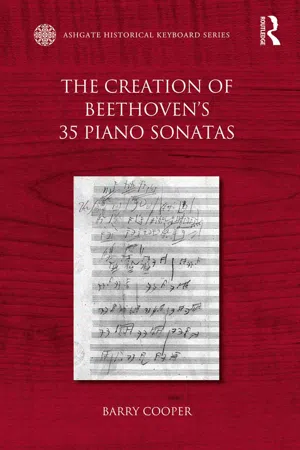
Beethoven's piano sonatas are a cornerstone of the piano repertoire and favourites of both the concert hall and recording studio. The sonatas have been the subject of much scholarship, but no single study gives an adequate account of the processes by which these sonatas were composed and published. With source materials such as sketches and correspondence increasingly available, the time is ripe for a close study of the history of these works. Barry Cooper, who in 2007 produced a new edition of all 35 sonatas, including three that are often overlooked, examines each sonata in turn, addressing questions such as: Why were they written? Why did they turn out as they did? How did they come into being and how did they reach their final form? Drawing on the composer's sketches, autograph scores and early printed editions, as well as contextual material such as correspondence, Cooper explores the links between the notes and symbols found in the musical texts of the sonatas, and the environment that brought them about. The result is a biography not of the composer, but of the works themselves.
- 228 pages
- English
- ePUB (mobile friendly)
- Available on iOS & Android
eBook - ePub
The Creation of Beethoven's 35 Piano Sonatas
About this book
Information
1 Approaching Beethoven’s piano sonatas
Sonata biography
Beethoven’s piano sonatas are such a major cornerstone of the pianist’s repertoire that it is hardly surprising that numerous books have already been written devoted specifically to them. They are also discussed in a large number of shorter articles and in sections of books that cover a wider range of material. William S. Newman’s The Sonata in the Classic Era, which devotes a substantial section to Beethoven’s piano sonatas, notes that ‘more than fifty authors have devoted whole books exclusively to Beethoven’s piano sonatas or certain aspects of them’.1 Some of these were described as ‘comprehensive surveys’, others as ‘structural analyses’ or ‘random subjective comments’. Since Newman’s book was first published, many more studies of Beethoven’s piano sonatas have appeared. Noteworthy examples include those by Rudolph Reti, Denis Matthews, Jürgen Uhde, Kenneth Drake, Siegfried Mauser, Charles Rosen, Robert Taub, Dmitri Smirnov and Moo Kyoung Song.2 There are also whole books devoted to the study of individual sonatas, including Op. 31 No. 2, Op. 57, Op. 106, Op. 109 and Op. 111.3
None of these many books, however, gives an adequate account of the processes by which Beethoven’s piano sonatas were composed and published, except in a few cases for individual sonatas. Thus the present book aims to answer questions such as: Why did Beethoven write his sonatas when he did, and why did they turn out as they did? How did they start out and how did they reach their final form? These questions were addressed briefly in the present writer’s edition of the 35 sonatas,4 where each sonata was provided with a short historical introduction. But these introductions, which were on average about a single page each, merely served to highlight the absence of more detailed investigation that covered the entire corpus. A much more extensive survey would be needed than could be accommodated within the commentaries of a performing edition.
Seeking links between the notes or symbols found in the musical texts of the sonatas, and the environment that brought them about, is hazardous. It is well-nigh impossible to forge convincing connections between life in Beethoven’s day and individual passages within these sonatas, or even between his personal life and such passages, apart from in one or two very exceptional situations (notably his ‘Lebewohl’ movement addressed as a farewell to Archduke Rudolph in the Sonata Op. 81a). Yet biographical and musical connections can be found very clearly at the interface between the work and its historical context, when one examines the manuscripts on which the sonatas were first written down, the publishing history of their original editions, and other documents surrounding their creation, such as correspondence with patrons and publishers. It is this material that forms the substance on which the present account is based. The result is not a biography of the composer (though biographical elements are often integrated into the narrative) but more a biography of the sonatas themselves, from the moment when the written record of a sonata begins, with brief ideas in the form of preliminary sketches, or even just a note of a commission, through its growth as revealed in the advanced sketch record and the writing out of the final score, right up to its final printed form. The written record is often tantalizingly incomplete, with important documents missing, as with any biography; but enough survives for many new insights to be obtainable. Such a biography should provide a clearer understanding of the subject, with each sonata or group of sonatas observed through a historical lens that is so often absent in other accounts of these works. As with most biographies, the order in which events unfolded provides the main guideline for the discussion, both of individual sonatas and the output as a whole.
Beethoven and the eighteenth-century keyboard sonata
The sonata as a genre emerged in Italy in the late sixteenth century, and initially the word simply denoted music to be played, as distinct from a cantata – music to be sung. Throughout the seventeenth and early eighteenth centuries, sonatas were almost invariably composed for more than one instrument, but sonatas for solo keyboard instrument became established towards the middle of the eighteenth century by composers such as Domenico Alberti, Domenico Scarlatti and Baldassare Galuppi. These might have one, two or three movements and the titles of the works sometimes varied. In Germany the leading figure was Carl Philipp Emanuel Bach, who from 1742 onwards published an important series of sets of keyboard sonatas. Beethoven may have become acquainted with some of these during his early years in Bonn, but there is no direct indication. In 1809 he wrote that he had only a few of C.P.E. Bach’s keyboard works and expressed admiration for them; three times between then and 1812 he asked Breitkopf & Härtel to send him scores by the composer,5 though they seem not to have done so. Beethoven also apparently possessed a copy of a set of sonatas by C.P.E. Bach’s brother Johann Christian,6 though it is uncertain when he acquired it, and he is not known to have expressed any admiration for this composer.
The main models for Beethoven’s sonata composition appear to have been the sonatas of Haydn, Mozart and Clementi, and it is noteworthy that Beethoven seems to have singled out three composers who are still today regarded as the leading figures in this genre in the late eighteenth century. All of Mozart’s keyboard sonatas are in three movements, as are most of Haydn’s and Clementi’s, with the pattern fast–slow–fast being the most common structure and therefore the most likely to be followed by Beethoven, at least in the initial stages. Beethoven encountered the music of all three composers at an early age, for the music dealer Nikolaus Simrock in Bonn, a friend of Beethoven’s father, possessed a large store of recent publications. From this collection he lent Beethoven’s father, for Beethoven’s use, ‘all Haydn’s keyboard works, much by Clementi and later by Mozart, of which the boy at the age of 8 could play much very well’.7 It is not difficult to find similarities between their sonatas and Beethoven’s, although the extent of direct influence must remain a matter of conjecture.
The theoretical context for Beethoven’s sonatas was provided by a number of writers. For performance issues such as fingering and ornamentation, he seems to have relied most on C.P.E. Bach’s Versuch über die wahre Art das Clavier zu spielen, which gives much useful advice on these subjects, as well as on figured bass.8 For aspects of harmony and counterpoint he consulted writings by Johann Philipp Kirnberger and Johann Mattheson,9 and later Johann Georg Albrechtsberger. More pertinent, however, is a discussion of ‘Sonata’ in Johann Georg Sulzer’s Allgemeine Theorie der schönen Kunste [General Theory of the Fine Arts], 1771–74. The article was apparently written by Johann Adolph Peter Schulz,10 and was probably read by Beethoven, perhaps at quite an early age. It asserts that there is no instrumental genre more capable than the sonata of depicting sentiments, and that the sonata can portray any and every character or emotion. The sonatas of C.P.E. Bach are singled out as outstanding models, and such compositions are deemed to require a combination of genius, knowledge and sensibility.
Heinrich Koch, developing some ideas from Sulzer’s book, gives a detailed explanation of how someone might set about creating a composition, in Volume 2 of his Versuch einer Anleitung zur Composition, mentioning three different stages: plan, realization and elaboration.11 The explanations here, however, would surely have seemed rather elementary to Beethoven by the time they were published in 1787. The concept of the sonata was also discussed briefly by Daniel Gottlob Türk in 1789. Echoing Schulz, he asserts that in no other genre is the composer so free to express sentiments and passions. ‘The more a sonata has expression, the more one hears the composer speak in tones, the more the composer knows to avoid the commonplace, the more excellent is the sonata.’12 Thus the sonata was widely perceived in the 1780s as the most elevated instrumental genre, with the possible exception of the symphony and concerto, and was therefore inevitably going to attract Beethoven’s attention from an early stage. Theories of form, however, and particularly sonata form, were seriously under-developed in his earlier years, and he had to absorb the possibilities inherent in sonata form direct from the models of Haydn, Mozart and others.13 He even developed his own terminology for sonata form: in his sketches he used ‘1ter Theil’ [first part] to denote the exposition, with the letters ‘m.g.’ (mitte Gedanke or middle idea) for the second subject; ‘2ter Theil’ [second part] marked the beginning of the development section; ‘d.c.’ the start of the recapitulation, or any other type of reprise of the main subject; and ‘Schluss’, ‘Ende’ or ‘Coda’ to indicate the final section.
His aim seems always to have been to compose music at the highest artistic level. He expressed this explicitly later in life: ‘I have always wished just to master the art of music’, and ‘My supreme aim is that my art should be welcomed by the noblest and most cultured people.’14 In 1807 he wrote in like manner: ‘I hope even in my early years to achieve the worth of a true artist.’15 Thus he would inevitably attempt to excel in the most advanced genres, where the ‘commonplace’ was to be avoided. During the 1790s he seems to have shared the prevailing view that the sonata was one of the most elevated genres, and he wrote quite a large number in fulfilment of his aims. By the end of 1802, however, he had already composed 23 piano sonatas and was looking for fresh and greater challenges. From that time onwards he wrote far fewer sonatas, and on several occasions expressed reservations about the genre. As early as 23 November 1802, apparently in response to a request from the publisher Johann André of Offenbach for a set of three sonatas, his brother Carl wrote on Beethoven’s behalf: ‘Should you want three piano sonatas … you cannot receive these all at once, but one every five or six weeks, because my brother no longer bothers much with such trifles and writes only oratorios, operas etc.’16 Piano sonatas were now no longer an elevated genre but mere ‘trifles’, at least compared with operas and oratorios, and none were currently in progress, which is why it would take five or six weeks before one could be sent. It may well be that Beethoven’s emotional crisis as reflected in the Heiligenstadt Testament of 6–10 October that year induced him to reassess his artistic direction, which included a turn away from sonatas. Certainly, having recently sold a set of three sonatas (Op. 31) to the Swiss publisher Nägeli, he was less than eager to compose another set so soon afterwards.
A similar attitude is evident in a letter to Breitkopf & Härtel in 1809: ‘I am not keen on writing solo piano sonatas, but I promise you a few.’17 Around June 1818 he complained of having to scrawl for bread and money, to enable him to write a great work; and the following year he stated: ‘It is hard to compose almost entirely for bread.’18 On both occasions the work in question was none other than the ‘Hammerklavier’ Sonata, which he evidently regarded as being on a lower plane than a great symphony or opera. Similarly, he complained in November 1821 that he could not attend to his Missa solemnis as he had to finish some ‘Brot-Arbeiten’ [potboilers].19 The ‘potboilers’ he was composing on this occasion were his last two piano sonatas, Opp. 110 and 111, regarded today as incomparable masterpieces. Whatever he thought of the genre in general, however, he always aimed for the highest standards in all his sonatas, and many are now considered among his finest works, including those he dismissed so readily in 1818 and 1821. All his piano sonatas received opus numbers (except the three written in Bonn), which he generally reserved for his more important works.
The 35 sonatas span almost his entire creative life, from 1783 to 1822,20 and reflect his changing style perhaps more than any other genre. His output is often divided into three periods, and although his sonatas do not fit as well into such a clear pattern a...
Table of contents
- Cover
- Half Title
- Title Page
- Copyright Page
- Table of Contents
- List of music examples
- List of tables
- Abbreviations
- Preface and acknowledgements
- 1 Approaching Beethoven’s piano sonatas
- 2 The Bonn sonatas
- 3 The Opus 2 sonatas and Haydn
- 4 The sonatas of 1796–97
- 5 The sonatas of 1798–1800
- 6 New century, new approaches
- 7 A ‘new path’?
- 8 The middle period opens up
- 9 A Clementi commission
- 10 Moving into the late period
- 11 The last three sonatas
- Bibliography
- Index of original sources
- Index of Beethoven’s works
- General index
Trusted by 375,005 students
Access to over 1.5 million titles for a fair monthly price.
Study more efficiently using our study tools.
Frequently asked questions
Yes, you can cancel anytime from the Subscription tab in your account settings on the Perlego website. Your subscription will stay active until the end of your current billing period. Learn how to cancel your subscription
No, books cannot be downloaded as external files, such as PDFs, for use outside of Perlego. However, you can download books within the Perlego app for offline reading on mobile or tablet. Learn how to download books offline
Perlego offers two plans: Essential and Complete
- Essential is ideal for learners and professionals who enjoy exploring a wide range of subjects. Access the Essential Library with 800,000+ trusted titles and best-sellers across business, personal growth, and the humanities. Includes unlimited reading time and Standard Read Aloud voice.
- Complete: Perfect for advanced learners and researchers needing full, unrestricted access. Unlock 1.5M+ books across hundreds of subjects, including academic and specialized titles. The Complete Plan also includes advanced features like Premium Read Aloud and Research Assistant.
We are an online textbook subscription service, where you can get access to an entire online library for less than the price of a single book per month. With over 1.5 million books across 990+ topics, we’ve got you covered! Learn about our mission
Look out for the read-aloud symbol on your next book to see if you can listen to it. The read-aloud tool reads text aloud for you, highlighting the text as it is being read. You can pause it, speed it up and slow it down. Learn more about Read Aloud
Yes! You can use the Perlego app on both iOS and Android devices to read anytime, anywhere — even offline. Perfect for commutes or when you’re on the go.
Please note we cannot support devices running on iOS 13 and Android 7 or earlier. Learn more about using the app
Please note we cannot support devices running on iOS 13 and Android 7 or earlier. Learn more about using the app
Yes, you can access The Creation of Beethoven's 35 Piano Sonatas by Barry Cooper in PDF and/or ePUB format, as well as other popular books in Media & Performing Arts & Music. We have over 1.5 million books available in our catalogue for you to explore.