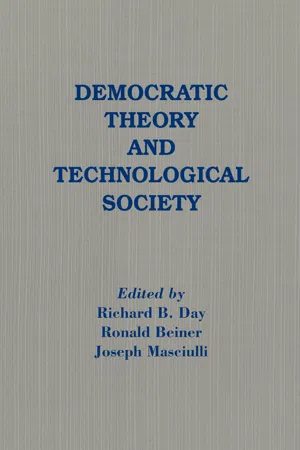
What are the chief challenges posed to contemporary democracy by modern technology, and how can democratic theory best respond to, or at least reflect on, those challenges? Inhabiting the kind of technologically advanced era in which we live, what sources are available within political theory for theoretical insight concerning the problem of democratic engagement with technology? The purpose of this volume is to canvas a broad range of theorists and theoretical traditions in order to address these questions, including Hegel and Marx, Rousseau and John Dewey, Heidegger and Simone Weil, Habermas and Walter Benjamin, Hannah Arendt and Hans Jonas. Commentaries on all these important thinkers -- focused on the issue of contemporary technology as posing unique social and political challenges for democratic political life -- yields rich and ambitious resources for theoretical reflection.
eBook - ePub
Democratic Theory and Technological Society
- 370 pages
- English
- ePUB (mobile friendly)
- Available on iOS & Android
eBook - ePub
Democratic Theory and Technological Society
About this book
Information
Part I
THE REGIN OF TECHINE
Political Imagination in a Technical Age*
Willem H. Vanderburg
If the roles modem science and technology play in shaping our modem world are both fundamental and decisive, I would expect them to be the focus of a great deal of political imagination. Yet this does not appear to be the case. Despite the fact that science and technology are human creations, their development is typically treated as something close to an independent variable in present-day human and social evolution. Whether this situation results from a profound belief that this strategy will usher in a better world for us all, create a true socialism, lead to a revitalization of democracy, or whether it is considered the only “realistic” option (because if we do not take advantage of this or that new technical possibility the Russians or Japanese will, and ...) makes no real difference. The result in each case is that political creativity and imagination is withdrawn from modem science and technology.1
I am not denying that problems and issues related to the influence science and technology have on society receive considerable attention. Individuals and groups constantly demand that governments take action, but at the same time there is a profound skepticism that much will come of it. The fact that so many human activities today are directly or indirectly regulated and controlled by the state and other large institutions, the influence of power elites, and the ideological implications of modem science and technology, unquestionably make genuine democratic political action difficult. This is all the more reason, however, to treat the widespread skepticism about the possibility of genuinely effective political activity as a phenomenon of great significance. Governments come and go, and with them hopes wax and wane, public opinion oscillates, but there is a sense that underneath it all flows a fundamental current that keeps moving in the same direction.
Political life today may perhaps be regarded as an ocean on whose surface things change constantly. From time to time storms may whip up large waves and create a great deal of turbulence while at other times there may be a great calm. One hundred feet below the surface everything remains much calmer and stable, while at the very bottom things proceed largely undisturbed by events at the surface. Similarly, few of the political events reported by the media appear to have a decisive and long-lasting effect. Much in the political life of the community changes while its deep structures appear to change much less rapidly. If this analogy has any merit, it would suggest that modem political life must be regarded in its complete sociocultural setting. This is particularly true if the political state of affairs in a society is to be understood “as if people mattered“2 and as if democracy is a goal worth striving for. The macro-level analyses of a society’s political framework, institutions and processes must include the broad cultural forces which shape the political will, imagination, determination, and action present in the daily lives of its people.
Although democracy is an “essentially contested concept,”3 I shall assume that a genuine democracy permits the members of a community to exercise political imagination and creativity in both thought and action when making choices between viable options they recognize as having a significant and lasting effect on their community, so as to pursue their aspirations and traditions according to values freely arrived at. They thus exercise power to create, maintain and expand a sphere of public freedom in the face of determinisms and constraints. While this state of affairs may never be achieved by any one society, democracy may be seen as an ongoing process whereby a community accepts the constraints under which its members live as a challenge to be overcome by creating a sphere of freedom through political thought and action.4
The social sciences and humanities have revealed the extent to which the individual and collective life of a community is determined by internal and external factors. When a society accepts these constraints as a destiny, its ability to develop freely its way of life in the face of these constraints will decline, causing its mechanistic aspects to grow as its vitality diminishes.5 True democratic politics therefore excludes any decision which merely recognizes a constraint or necessity such as administrative expediency or economic efficiency. In the face of such constraints, democracy gives the members of a society at least some control over their lives and an opportunity to renew, redirect or modify the social order in some way. It is an expression of what it is to be alive in a world of determinisms. It struggles against the constraints imposed by scientific and technical development and refuses to accept that human life and social change are little more than dependent variables in a world where other forces and phenomena constitute the independent variables.
What concerns me in this article is what I perceive as a lack of effective political imagination and action throughout the world to match the power and effectiveness of the development of science and technology. I shall attempt to analyze the cultural deep structures which are blocking this political imagination and action in order to come to some understanding of what might be done to weaken these constraints. By shedding some light on the constraints and determinisms related to modem political life, I hope to make a contribution to stimulating democratic political imagination and action, which are vital if humanity is to transcend the many problems it now faces.
Technology and Politics
The division of intellectual labor currently found in the university makes it difficult to obtain a comprehensive understanding of the roles science and technology play in human life and society in general and the political sphere in particular. The social sciences and humanities on the one hand, and the professional applied sciences and engineering on the other, evolve with minimal reference to and dependence on each other. When surveying the textbooks introducing students to the former, one has the impression that an understanding of a particular sphere of human life can be obtained without giving the phenomena of science and technology a central place. Textbooks related to the professional applied sciences likewise make minimal reference to the human and social context. If the pictures drawn of these different spheres of human activities are accurate, then either our daily life experience of the transforming roles of science and technology must be an illusion or the pictures are fundamentally inadequate.
The recognition that the traditional conceptual frameworks such as liberal capitalism and state socialism were created for a radically different context from the present one, does more than simply invite the research hypothesis that their relevance for the present situation has progressively been eroded, particularly during the past fifty years. The extent of the discussions about the nature of modem societies and human life within them might be taken as support for such a research hypothesis. This is equally true for a particular sphere of human activities such as politics. Researchers have noted complex and fundamental changes in the political sphere resulting from the widespread application of modem science and technology, but these are not easily integrated into the traditional frameworks of interpretation.
It might be objected that I am implying too great a role for modem technology. This indeed would be the case if we continued to think about technology in ways that were quite adequate for the nineteenth and first half of the twentieth century. Max Weber, however, already alerted us to a fundamental transformation when he wrote:
The term “technology” applied to an action refers to the totality of means employed as opposed to the meaning or end to which the action is, in the last analysis, oriented. Rational technique is a choice of means which is consciously and systematically oriented to the experience and reflection of the actor, which consists, at the highest level of rationality, in scientific knowledge. What is concretely to be treated as a “technology” is thus variable. The ultimate significance of a concrete act may, seen in the context of the total system of action, be of a “technical” order; that is, it may be significant only as a means in this broader context. Then concretely the meaning of the particular act lies in its technical result; and conversely, the means which are applied in order to accomplish this are its “techniques“. In this sense there are techniques of every conceivable type of action, techniques of prayer, of asceticism, of thought and research, of memorizing, of education, of exercising political or religious control, of administration, of making love, of making war, of musical performances, of sculpture and painting, of arriving at legal decisions.6
Weber goes on to state that:
The presence of a “technical question” always means that there is some doubt over the choice of the most efficient means to an end. Among others, the standard of efficiency for a technique may be the famous principle of “least action“, the achievement of the optimum result with the least expenditure of resources, not the achievement of a result regardless of its quality, with the absolute minimum of expenditure.7
In other words, techniques have increasingly displaced the customs and traditions of a society’s culture to the point (as we shall see later) of fundamentally affecting the role of a society’s culture as its socio-ecology. Several decades later, the French sociologist Jacques Ellul concluded that the phenomenon of technique had become the most decisive one in western civilization at this point in its history. He defined technique as “the totality of methods rationally arrived at and having absolute efficiency (for a given stage of development) in every field of human activity.“8 In other words, Ellul’s concept of technique includes but is not limited to machines or a specific procedure for obtaining an end. Because of the widespread misinterpretation of Ellul’s work, I shall begin by outlining the significance of the phenomenon of technique for human life and society in general and politics in particular, by making use of my theory of culture cited earlier.
It would appear that in the debate over the nature of modem society (whether it is postcapitalist, postindustrial, technological or other) the declining role of culture has been overlooked. Surely one of the things that sets these societies apart from all others is that a wide range of activities is no longer based on custom or tradition grounded in a culture. These societies systematically investigate virtually every sphere of human activity in order to render it more effective, rational and efficient or to eliminate certain problems. They do this on the assumption (and this is one of the implicit cultural hypotheses that underlies modem societies) that the quality of life can be improved by rendering the means of our existence more efficient. These investigations take the form of what I shall call the technical operation, constituted by four stages.
The first stage comprises the study of some area of human life for a particular purpose. The results of the study are used in the next stage to build some kind of model that can range from a precise mathematical theory to one that is largely qualitative. In the third stage the model is examined to determine what happens when its parameters are altered in order to discover when it functions optimally. The technical operation concludes with the reorganization of the area of human life studied originally, to achieve the highest efficiency and rationality demonstrated possible by the model. It is by means of this pattern of events that modem societies seek to improve the productivity of a plant, the running of a large office or hospital, the effectiveness of classroom instruction, the performance of a professional athlete or hockey team, the functioning of a group and even the satisfaction derived from a sexual relationship. As a result, the technical operation deeply permeates the fabric of individual and collective life. Its application has produced a wide range of technologies or techniques.
Modem societies are not so much characterized by their industrial and machine-related technologies as by the fact that almost every aspect of these societies is organized and reorganized on the basis of a variety of techniques that together have helped to constitute a knowledge base that is drawn on to ensure that everything is done as effectively as possible. Technology is only one part of the larger phenomenon of technique.
The reason why the so-called industrially advanced nations began to generate a mass of information at a certain point is now evident. When techniques increasingly replaced tradition as the basis for a sphere of activities, a great deal of information about that sphere was generated as a result of the pattern of events that we have called the technical operation. As these developments gained momentum, bottlenecks occurred which necessitated new technologies or techniques to deal with the mass of information. The computer and associated techniques were developed to meet this challenge, and as a result immediately found a wide range of applications. This in turn greatly accelerated the patterns of development described above.
The development of a so-called information economy, the proliferation of theoretical services, the rise of new intellectual techniques, the emergence of a new class of technical experts, the growth of the service sector in the economy and other phenomena taken to be signs of a new “postindustrial age” are therefor...
Table of contents
- Cover Page
- Democratic Theory and Technological Society
- copy
- dedication
- Contents
- Introduction
- PART 1 THE REGIN OF TECHINE
- PART II PROSPECTS FOR DEMOCRACY
- PART III PONDERING OUR DESTINY
- Notes on Contributors
Trusted by 375,005 students
Access to over 1.5 million titles for a fair monthly price.
Study more efficiently using our study tools.
Frequently asked questions
Yes, you can cancel anytime from the Subscription tab in your account settings on the Perlego website. Your subscription will stay active until the end of your current billing period. Learn how to cancel your subscription
No, books cannot be downloaded as external files, such as PDFs, for use outside of Perlego. However, you can download books within the Perlego app for offline reading on mobile or tablet. Learn how to download books offline
Perlego offers two plans: Essential and Complete
- Essential is ideal for learners and professionals who enjoy exploring a wide range of subjects. Access the Essential Library with 800,000+ trusted titles and best-sellers across business, personal growth, and the humanities. Includes unlimited reading time and Standard Read Aloud voice.
- Complete: Perfect for advanced learners and researchers needing full, unrestricted access. Unlock 1.5M+ books across hundreds of subjects, including academic and specialized titles. The Complete Plan also includes advanced features like Premium Read Aloud and Research Assistant.
We are an online textbook subscription service, where you can get access to an entire online library for less than the price of a single book per month. With over 1.5 million books across 990+ topics, we’ve got you covered! Learn about our mission
Look out for the read-aloud symbol on your next book to see if you can listen to it. The read-aloud tool reads text aloud for you, highlighting the text as it is being read. You can pause it, speed it up and slow it down. Learn more about Read Aloud
Yes! You can use the Perlego app on both iOS and Android devices to read anytime, anywhere — even offline. Perfect for commutes or when you’re on the go.
Please note we cannot support devices running on iOS 13 and Android 7 or earlier. Learn more about using the app
Please note we cannot support devices running on iOS 13 and Android 7 or earlier. Learn more about using the app
Yes, you can access Democratic Theory and Technological Society by Richard B. Day,Ronald Beiner,Joseph Masciulli in PDF and/or ePUB format, as well as other popular books in Politics & International Relations & Political Philosophy. We have over 1.5 million books available in our catalogue for you to explore.