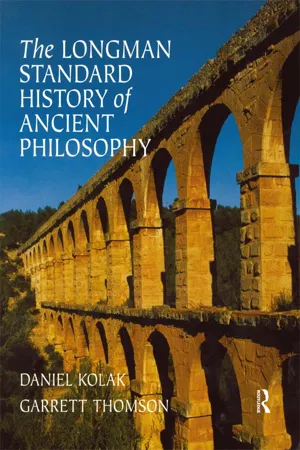
The Longman Standard History of Ancient Philosophy
eBook - ePub

The Longman Standard History of Ancient Philosophy

  1. 576 pages
  2. English
  3. ePUB (mobile friendly)
  4. Available on iOS & Android
eBook - ePub

The Longman Standard History of Ancient Philosophy

About this book

With selections of philosophers from Thales to Sextus Empiricus, this new anthology provides significant learning support and historical context for the readings along with a wide variety of pedagogical assists.

Biographical headnotes, reading introductions, study questions, and special "Prologues" and "Philosophical Overviews" help students understand and appreciate the philosophical concepts under discussion. "Philosophical Bridges" discuss how the work of earlier thinkers would influence philosophers to come, and place major movements in a contemporary context showing students how the schools of philosophy interrelate and how various philosophies apply to the world today.

In addition to this volume of Ancient Philosophy, a comprehensive survey of the whole of Western philosophical history and other individual volumes for each of the major historical eras are also available for specialized courses.

Trusted by 375,005 students

Access to over 1.5 million titles for a fair monthly price.

Study more efficiently using our study tools.

Information

Publisher
Routledge
Year
2016
eBook ISBN
9781315508870

SECTION
II


PLATO


PROLOGUE

This prologue will concentrate on Socrates (469–399 B.C.), Plato’s mentor, who is perhaps the most famous of all philosophers. Why is Socrates so well known? He was not the first philosopher; he did not write a philosophical treatise. Our knowledge of Socrates comes from four principle sources: Plato’s dialogues, in 20 of which Socrates is the main character; Xenophon, who wrote the Memorabilia, which claims to record several Socratic conversations; Aristophanes, who wrote a comedy, the Clouds, featuring Socrates; and, finally, Socrates is mentioned many times by Aristotle. Socrates is portrayed best in the early dialogues of Plato, which reveal something of his extraordinary character.
Socrates’ fame is due to the remarkable force of his personality, which is in many ways the embodiment of the philosophical approach. Socrates does not profess to have special knowledge. On the contrary, he claims to be ignorant. He is fascinated by philosophical questions, and, rather than forming fixed views, he asks brilliantly penetrating questions. He engages those around him in thinking, and, in these dialogues, he goads his interlocutor into offering a definition of a key idea, such as justice, courage, or knowledge. He persists with his questioning until either he arrives at a satisfactory answer or he has shown that the proposed theory cannot be true because it contains a hidden contradiction. Socrates’ method, often called elenchos, or refutation, challenges us to face our ignorance and stimulates us to think more deeply. In summary, Socrates’ way of being makes him the best-known of all philosophers.
This does not mean that Socrates did not advance any philosophical claims. His views are reflected in Plato’s early dialogues, a point that is confirmed by the works of Xenophon and Aristotle. Among the early dialogues are the following: the Laches, Charmides, Hippias Major, Euthyphro, Apology, Crito, and Protagoras, as well as the Gorgias, which was probably the last work of this early period. Plato has no part himself in any of his works; Socrates usually takes the leading role, and in the early dialogues, Plato restricts himself to portraying Socrates’ way of thinking and conveying the master’s views. It is only in the dialogues of the middle and later periods that Plato argues for his own theories. As portrayed in the early dialogues, Socrates was almost exclusively concerned with the question ‘How should a person live his or her life?’ In the Laches, Charmides, Hippias Major, and Euthyphro, he searches for an answer to these questions, but the dialogues end inconclusively.
Socrates was concerned with virtue or excellence (àreté), regarding which he advances three main claims. First, he argues that knowledge of goodness is necessary and sufficient for virtue. This implies that no one does wrong intentionally: we always will what we perceive as good. As a consequence, there is no such thing as weakness of the will (akrasia). Second, Socrates argues for the unity of the virtues. A person who is virtuous cannot lack any of the virtues; for example, a just person must be also courageous and temperate. Third, Socrates argues that there can be no higher good than virtue: a virtuous person is bound to be happier than one who is not. Given these three claims, we can see why Socrates and Plato thought that study of the good was supremely important for our lives.
Socrates’ questioning was perceived as threatening and rebellious. In 399 B.C., he was charged with corrupting the youth of Athens and not recognizing the gods of the city. Once convicted, he was condemned to drink the poisonous hemlock that killed him. These dramatic scenes are immortalized in some of Plato’s dialogues. The Euthyphro portrays Socrates on his way to court; the Apology, the trial itself; the Crito shows Socrates’ refusal to escape from prison; and the later Phaedo, the last conversation and death of the old master.
PLATO (427–347 B.C.)

Biographical History

Plato was only 28 when his beloved teacher, Socrates, was condemned to death. These events affected profoundly the young philosopher, who left Athens shortly afterward. For nearly ten years, he traveled in southern Italy and Sicily, where he began writing his famous dialogues.
Plato came from a prominent aristocratic Athenian family. His mother was a descendent of Solon, the great seventh-century B.C. poet and statesman, who initiated constitutional reforms, wrote many of Athens’ laws, and celebrated Athenian democracy in popular poems. Plato received the best education available to prepare him for a great political career. He excelled in poetry, music, and wrestling. However, he grew up during the 27-year Peloponnesian War between Athens and Sparta, and when Athens surrendered in 404 B.C., the young Plato grew disillusioned. He spurned the idea of a life dedicated to politics. Instead, he turned to philosophy, having been influenced by the Sophist Cratylus, and having studied the Eleatics, Protagoras, and Heraclitus. Finally, he became a pupil of Socrates.
After his stay in Sicily following the death of Socrates, Plato returned to Athens and established his famous school, the Academy, a center for the advancement of wisdom and learning. At around the age of 60, Plato received an invitation to train the newly appointed king of Syracuse, Dionysius, to become a philosopher-king, following the model of Plato’s work, the Republic. When the political climate of Syracuse became unfavorable, Plato was sent away. Four years later, he returned to Syracuse, but had to flee again because of political intrigues.

Philosophical Overview

Plato is the first philosopher to have an integrated view of philosophy as a separate discipline. He combines all of the elements of philosophy discussed by the pre-Socratics and Socrates, and more besides, into one global vision, which encompasses the theory of knowledge, metaphysics, the philosophy of language, mind, mathematics, science, art, education, morality, and politics. Philosophy reveals the existence of and the need for objects that are inaccessible to the senses, and these Forms show us how we should transform our own individual lives and the politics of the state. From this vision, philosophy emerges as the most important of all disciplines. This grand vision is based foremost on the existence of the Forms. These are abstract, eternal, and changeless entities that exist independently of us but can be known through thought, and that define the essence of things in the world. A question such as ‘What is Justice?’ seeks to understand the Form of Justice. The basis of morality and wisdom is to know the Form of the Good. The existence of the Forms in a way synthesizes Heraclitus and Parmenides. The world of appearances or of the senses is in flux, but the world of the eternal Forms is changeless.
There are 26 surviving dialogues by Plato. They are usually divided into three periods: the early, middle, and late. The early dialogues reflect the thinking and style of Socrates. Plato develops his own philosophical system in the middle period.

The Early Period

The early dialogues are remarkable for their portrayal of the extraordinary personality of Socrates. They show Socrates philosophizing, examining, and challenging views, and they demonstrate how we can deepen our philosophical understanding without necessarily settling on a definitive answer. From this early period we have selected the Euthyphro, the Apology, the Crito, and important excerpts from the Protagoras and Gorgias.

The Middle Period

Around 386 B.C., when Plato was in his early forties, he developed his own system of thought. The center of this philosophy is the theory of Forms. According to Plato, there exist abstract, nonmaterial objects or entities, called Ideas or Forms. These Forms make worldly objects what they are. Whenever a predicate term, which classifies reality into different types, is applied to many things, there is a Form corresponding to that term. For example, all square things are squared because they participate in the Form of Squareness. Wisdom consists in understanding this realm of Forms, especially the Form of the Good. Knowledge of this Form will make a person happy and virtuous, and, thereby, such knowledge is valuable for the political life of the community. In the Republic, Plato tries to show the benefits of leading a virtuous life, quite independent of any of the implications for the afterlife. Plato’s mature philosophy is above all a theory of the Forms.
There are a few dialogues that some scholars classify as transitional, in which Plato’s own thought begins to emerge but does not yet attain the full maturity of the middle period. Among this transitional group, the most important are the Meno and the Phaedo, which we have included in the selections. In the Meno, Plato argues that learning is really the recollection of knowledge that the soul acquired prior to birth. In the Phaedo, Plato also argues for the immortality of the soul, thinking that the true benefits of living virtuously can only be received after the death of the body.
The middle period dialogues include the Symposium, Republic, Phaedrus, Parmenides, and Theaetetus. The Symposium is famous for its discussion of the nature of love. The Republic is Plato’s most famous and complete work. The Parmenides and Theaetetus mark Plato’s transition to the later period. The Theaetetus contains his theory of knowledge, and the Parmenides apparently contains his own criticisms of his theory of Forms.

The Late Period

Around 367 B.C., Plato became aware of deficiencies with his own theory of Forms, and he tried to modify the theory. For example, in the Statesman, he clarifies that there are not Forms corresponding to every predicate. Forms exist only for natural classifications, and not for arbitrary human divisions, such as the distinction between Greek and non-Greek.
Late-period dialogues include the Timeaus, Critias, Sophist, Statesman, Philebus, and Laws. With the exception of the Philebus, Socrates plays only a minor role in these later six dialogues. This is perhaps because the later Plato wanted to signal that his later views were different from those of the middle period. In the Sophist, Plato tries to refute Parmenides’ claim that we cannot think about what is not. The Philebus is famous for its discussion of pleasure. The Timeaus, which has been included in this volume, gives a beautiful, semimythical account of the creation of the universe.

EUTHYPHRO

This dialogue takes place shortly before Socrates’ trial and subsequent execution in 399 B.C. Euthyphro is a young religious man who believes that piety requires him to prosecute his own father. The father, a rich landowner, accidentally caused the death of a slave who had murdered another slave. Euthyphro’s father left the murderer tied up in a ditch while he went to call the authorities, and the slave died. As a consequence, Euthyphro thinks that he is required to accuse his father of manslaughter. This is how the dialogue begins.
If we take his words at face value, Socrates is impressed by Euthyphro’s commitment to moral justice and piety. Socrates asks Euthyphro to teach him the true meaning of piety, so that he can better defend himself against the impending charge of impiety. However, none of Euthyphro’s answers satisfy the persistent Socrates.
First, Euthyphro gives an example of piety, that is, his own actions: prosecuting someone for some wrongdoing. Socrates points out that an example is not a definition. A definition is a general statement that can then be used to determine whether some particular action is pious or not. To understand a general concept, such as piety, requires more than citing examples because the meaning of the concept is itself necessary for classifying the examples.
Euthyphro tries to rectify his mistake by giving a definition. Pious actions, he says, are those that please the gods, whereas impious actions are those that displease the gods. Instea...

Table of contents

  1. Cover
  2. Half Title
  3. Title Page
  4. Copyright Page
  5. Table of Contents
  6. Preface
  7. General Introduction
  8. I: Early Ancient Greek Philosophy
  9. II: Plato
  10. III: Aristotle
  11. IV: Hellenistic and Roman Philosophy
  12. Sources

Frequently asked questions

Yes, you can cancel anytime from the Subscription tab in your account settings on the Perlego website. Your subscription will stay active until the end of your current billing period. Learn how to cancel your subscription
No, books cannot be downloaded as external files, such as PDFs, for use outside of Perlego. However, you can download books within the Perlego app for offline reading on mobile or tablet. Learn how to download books offline
Perlego offers two plans: Essential and Complete
  • Essential is ideal for learners and professionals who enjoy exploring a wide range of subjects. Access the Essential Library with 800,000+ trusted titles and best-sellers across business, personal growth, and the humanities. Includes unlimited reading time and Standard Read Aloud voice.
  • Complete: Perfect for advanced learners and researchers needing full, unrestricted access. Unlock 1.5M+ books across hundreds of subjects, including academic and specialized titles. The Complete Plan also includes advanced features like Premium Read Aloud and Research Assistant.
Both plans are available with monthly, semester, or annual billing cycles.
We are an online textbook subscription service, where you can get access to an entire online library for less than the price of a single book per month. With over 1.5 million books across 990+ topics, we’ve got you covered! Learn about our mission
Look out for the read-aloud symbol on your next book to see if you can listen to it. The read-aloud tool reads text aloud for you, highlighting the text as it is being read. You can pause it, speed it up and slow it down. Learn more about Read Aloud
Yes! You can use the Perlego app on both iOS and Android devices to read anytime, anywhere — even offline. Perfect for commutes or when you’re on the go.
Please note we cannot support devices running on iOS 13 and Android 7 or earlier. Learn more about using the app
Yes, you can access The Longman Standard History of Ancient Philosophy by Daniel Kolak,Garrett Thomson in PDF and/or ePUB format, as well as other popular books in Philosophy & Philosophers. We have over 1.5 million books available in our catalogue for you to explore.