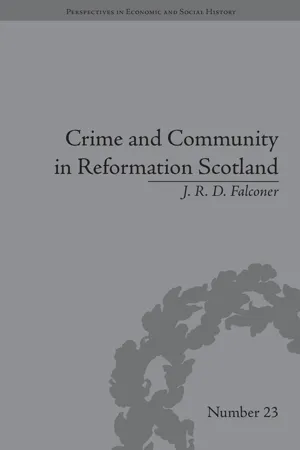
Based on church and state records from the burgh of Aberdeen, this study explores the deeper social meaning behind petty crime during the Reformation. Falconer argues that an analysis of both criminal behaviour and law enforcement provides a unique view into the workings of an early modern urban Scottish community.
eBook - ePub
Crime and Community in Reformation Scotland
Negotiating Power in a Burgh Society
- 240 pages
- English
- ePUB (mobile friendly)
- Available on iOS & Android
eBook - ePub
About this book
1 CRIME, COMMUNITY AND BELONGING
At the heart of the regulatory processes at work in Aberdeen was the idea, common in both England and Scotland at the time, of protecting the ‘commoun weal’. Paul Slack has argued that for early modern English towns, the common weal ‘was not a programme, still less a manifesto for a party, not even a strategy. Well before the 1540s it was a rhetorical slogan conferring legitimacy on almost any public activity; and it was in origin simply a translation of a commonplace aspiration.’1 While dates associated with historical events and trends tend to also have a specific geographical relationship, Slack’s identification of concerns for the common weal existing prior to 1540 in England can be extended to include Scotland as well. Roger Mason has shown that during the early modern period the ‘commonweal’ roughly equated to the ‘community’; this in turn can be taken to mean the ‘community of the realm’ and the ‘community of the burgh’.2 Accounts found in the Aberdeen Council Register indicate that plague, poverty, idle persons, breakers of local statutes and committers of various other offences occupied the daily business of the baillies and the rest of the town council. In performing their civic duties, these officials equated regulating society and maintaining the established social order with protecting the common weal. Even in instances where the court clerk did not expressly use the words ‘commoun weill’ or ‘guid of the toun’ in his accounts, he made it clear that the court perceived such actions as threatening the community. For example, two inhabitants of the burgh convicted for drawing swords and attacking each other found themselves amerced for ‘trubling of the town’.3 While the clerk did not explicitly use the words ‘commoun weill’, his concern that misbehaviour undermined the community’s well-being is apparent. This stands in contrast to attitudes held elsewhere.4
The goal of protecting the common weal of the burgh raises a number of questions on the nature of the burgh community. What exactly did the idea of the ‘commoun weill’ mean to contemporary Aberdonians? Who constituted the community of the burgh and what determined membership within this group? How did criminality affect membership or alter boundaries that included and excluded individuals from participation in the community? Were there competing visions of the community and if so what can the records tell us about alternative ideas about belonging? Was it only the elites, and those elites in positions of formal power in particular, that were interested in maintaining the common weal of the burgh? In providing answers to these questions, and the numerous corollary questions they engender, it should be possible to come to some conclusions on whether or not crimes committed within the burgh constituted an informal means by which individuals, regardless of their status in society, affected a change in both their social space and the amount of social power they wielded.
In large part, urban historians of Scotland have focused on the elite sectors of burgh society - magistrates, burgesses and merchants, and to a somewhat lesser extent free craftsmen and professionals.5 A particular area of interest to the relatively few historians exploring Scotland’s urban past has been the supposed tensions between the merchants and craftsmen.6 Yet, while debate continues over whether such tensions dominated life in Scottish burghs, very little scholarship has been undertaken to explore closely the complex nature of specific early modern Scottish burgh societies. In particular, historians need to look more closely at the multiple locations of belonging within a single community.7 For example, a sixteenth-century Aberdonian baxter may naturally have seen himself as a member of the burgh community. However, his ‘sense of place’ within the community would undoubtedly be as different from that of a wealthy guild merchant as it would be from an unfree day labourer. Of course, wealth and status were not the only factors determining one’s place in the community. One’s gender, health, occupation, place of abode and adherence to the prescriptions of normative society and, after 1562, religious conformity helped situate individuals within the community. That is not to say that any one member held a singular place in society. The complex nature of early-modern burgh social structures, not unlike most modern societies, stemmed from the basic fact that members of the community could feel a sense of belonging to a number of different communities that made up burgh society.
Criminality and challenging the boundaries of acceptable behaviour was not unique to Aberdeen.8 Indeed, early modern historians have demonstrated that the changes occurring in the sixteenth century in terms of kin relationships, population growth, plague, famine and dearth, further socio-economic polarization, growth of commercial activities, the growth of state apparatus, developing legal practices and shifts in religious practices all influenced contemporary attitudes on social order, disorder and community.9 Increasingly, historians have been undertaking examinations of the localities to shed light on the national experience. In this respect, studies of early modern Scotland lag behind.10 The relatively limited number of studies examining crime and power structures and authority in Scotland during the middle ages and early modern period underscores the real need to begin exploring such topics.11 The same can be said for Scottish urban history.
Over the past two decades remarkably few historians have attempted to fill this relatively large void in Scottish historiography.12 In the 1980s and 1990s, E. P. Dennison (formerly Torrie), Michael Lynch, Ian Whyte and Elizabeth Ewan paved the way for further studies on Scottish burghs.13 Characteristic of the work that has been done is a continuous reliance on the notion that social relations and power structures were dichotomous in nature. Lynch, for example, stressed that the key power dynamic within early modern Scottish burghs was between ‘masters and men, employers and employees, rulers and ruled’.14 Indeed, such binary constructions of burgh society are commonplace in most Scottish urban histories. Dennison has suggested that in Dundee, as crafts became incorporated in the sixteenth century, an increasingly stratified society emerged engendering tensions between craftsmen and merchants. However, by the seventeenth century Dundee had emerged not only as second burgh of the realm but also a burgh whose ‘urban aristocracy embraced both merchants and craftsmen’.15 However, Jane Thomas and Elizabeth Ewan have demonstrated that while such urban aristocracies existed in Scottish burghs, often the power dynamics within these groups demonstrate a slightly different reality of burgh life.16 Ewan underscored the complexities of urban life by arguing that burgh inhabitants experienced multiple places of belonging given the attachments they formed to smaller communities within the wider burgh society.17 Bearing this idea in mind, this chapter outlines the community of the burgh in sixteenth-century Aberdeen and highlights the characteristic features of the burgh, its inhabitants and the mechanisms in place for governing the community.
The Community of the Burgh
The two towns of Old and New Aberdeen lie on the banks of the rivers Don and Dee respectively and on the coast of what contemporary sixteenth-century Aberdonians referred to as the German Sea. In the twelfth century David I bestowed upon the inhabitants of New Aberdeen a charter creating the royal burgh of Aberdeen with all of the attendant privileges and liberties.18 Throughout the late middle ages, and well into the modern period, the royal burgh of Aberdeen19 functioned as an important port with access to European markets, a market town, a seat of a sheriffdom and one of the four principal burghs of the realm. In 1661 the Scottish surveyor and cartographer James Gordon of Rothiemay described the ‘new burgh’ as exceeding ‘not onlie the rest of the touns of the north of Scotland, bot lykewayes any citie quhatsumever of that same latitude, for greatnes, bewtie, and frequencie of trading’.20 The capital of north-eastern Scotland, Aberdeen, according to Rothiemay stood in stark contrast to the surrounding countryside:
the fields nixt to the gaits of the citie are fruitfull of corns … and abounds with pastures; bot any where after yow pas a myll without the toune, the countrey is barran lyke, the hills craigy, the plains full of marreshes and mosses….the corne fields mixt with thes bot few.21
The burgh design resembled that of most other Scottish burghs. Burgage plots lined the town’s principal streets running back in a herringbone pattern. These plots, held of the community, provided both the land that housed the town’s burgesses as well as areas to grow foodstuffs and keep animals. It was through possession of a burgage that individuals were able to enjoy the rights and liberties associated with burgess-ship – trade, protection, use of merchandise, self-government and freedom to be tried exclusively in the burgh court.22 Burgesses frequently let out the so-called backlands of their burgages to house workshops for local craftsmen and homes for the poorer sorts.23 Although a principal port, and an obvious point of disembarkation for invading armies, Aberdeen does not appear to have possessed town walls or other ‘protective barriers’ during the sixteenth century.24 Old Aberdeen, as well as the immediate surrounding fishing villages of Nigg and Futty, played a role in the burgh and it is clear from the free movement of the inhabitants of these locales within the town that neither custom and statute nor gated walls could keep them out. Despite frequent references to the fishermen of Futty causing disturbance within the burgh, there is no indication that the burgh was inclined to exclude them from the town. For administrative purposes, the burgh was divided into four quarters – Crooked, Even, Green and Futty – with a Baillie in place to administer to the needs of those living within those boundaries.
As in many urban centres in Northern Europe, Aberdeen possessed a bustling marketplace that in essence defined the burgh’s existence.25 It is likely that the basic design of Aberdeen was in place by the fourteenth century. The Castlegate, in the north-east part of the burgh, was the site of the market; within the market square stood the symbols of civic pride and authority: the market cross, the tolbooth and the tron [the town’s weighing device]. Not only did the presence of these symbols underline the town’s burgh status with its important mercantile liberties and privileges, they functioned as important sites for regulating behaviour within the community and feature prominently in conviction accounts for the burgh. Indeed, while the tron helped to identify those who tried to cheat the market, the tolbooth housed the burgh court, council meeting hall and occasionally served as a prison.26 As with the tron and the tolbooth, the market cross functioned in the regulation of behaviour within the community as an important site for public proclamations as well as public punishments.
Rothiemay’s depiction of life in the burgh complemented his description of the burgh itself. In his account of the burgh’s layout and the surrounding countryside, Rothiemay asserted that the region’s ‘temperat’ climate afforded the townspeople an ‘acuteness of wit’ and an inclination to be civil not to be found in most northerly parts.27 Historians since Rothiemay have been inclined to follow his lead in depicting the inhabitants of Aberdeen as a rather civil community. Kennedy, in the nineteenth century, argued that in terms of the unrest and uproar that accompanied the Reformation in other parts of Scotland, ‘the mischief done by the reformers at Aberdeen was inconsiderable’.28 Likewise, Alexander Keith argued that ‘the Reformation in Aberdeen involved no victimization by the Reformers … the picture that presents itself, indeed, is one that might confound those whose conception of the Reformation is based upon highly coloured legends of the religious revolution.’29 While a rather conservative approach to religion continued in Aberdeen until the early seventeenth century, there were other significant areas that marked a lack of civility within the burgh.30
In particular, the political landscape, dominated by the Menzies family for most of the sixteenth century, was frequently bothered by intrigue and unrest. As early as the late 1530s, a Menzies provost of Aberdeen faced internal attacks on his ability to manage the town’s funds. While most likely those challenging Menzies rooted their accusation of mismanaging the so-called ‘Common Good’ funds in typical political opposition, the Privy Council Records describe the individuals involved in putting the matter before the Lords of Council as ‘conspirators against the town’.31 It is interesting that similar accusations appeared in the final days of the Menzies dominance of the provostship of the burgh in the late 1580s. During the 1537 election of Thomas Menzies of Pitfodells (1537–44) the King had to intervene to quell the ‘disturbance’ that the election engendered. In a letter to the burgh council, James V (r. 1513–42) underlined the prescribed regulations behind the election of town officials, and in particular the need for common consent. However, the King also stressed that the inhabitants of the burgh should ‘live in liberty and freedom like burgesmen, but [without] outthrowing of outmen [outsiders] or great persons.’32 Throughout the sixteenth century the involvement of outsiders, and in particular the Earls of Huntly, caused considerable discontent within the burgh.33
By 1535, George, fourth earl of Huntly, had become a member of the Privy Council, Lord Lieutenant of the North and Lord Lieutenant of the Kingdom.34 His considerable influence in the north almost immediately earned him enmity throughout the kingdom. By 1562 Huntly was in open rebellion. Instigated first by his son’s escape from incarceration in Edinburgh for violent behaviour, Huntly’s displeasure at the Queen’s dispossession of him in the earldom of Moray in favour of James Stewart, her Protestant half-brother, was more likely the cause of his revolt. His marshalling of forces in the north brought t...
Table of contents
- Cover
- Half Title
- Title Page
- Copyright Page
- Table of Contents
- Acknowledgments
- List of Figures and Tables
- Introduction: Community, Conflict and Control
- 1 Crime, Community and Belonging
- 2 Godly Discipline
- 3 Property
- 4 Violence
- 5 Disobedience and Exclusion
- Conclusion: (RE)Defining the Community of the Burgh
- Notes
- Works Cited
- Index
Trusted by 375,005 students
Access to over 1.5 million titles for a fair monthly price.
Study more efficiently using our study tools.
Frequently asked questions
Yes, you can cancel anytime from the Subscription tab in your account settings on the Perlego website. Your subscription will stay active until the end of your current billing period. Learn how to cancel your subscription
No, books cannot be downloaded as external files, such as PDFs, for use outside of Perlego. However, you can download books within the Perlego app for offline reading on mobile or tablet. Learn how to download books offline
Perlego offers two plans: Essential and Complete
- Essential is ideal for learners and professionals who enjoy exploring a wide range of subjects. Access the Essential Library with 800,000+ trusted titles and best-sellers across business, personal growth, and the humanities. Includes unlimited reading time and Standard Read Aloud voice.
- Complete: Perfect for advanced learners and researchers needing full, unrestricted access. Unlock 1.5M+ books across hundreds of subjects, including academic and specialized titles. The Complete Plan also includes advanced features like Premium Read Aloud and Research Assistant.
We are an online textbook subscription service, where you can get access to an entire online library for less than the price of a single book per month. With over 1.5 million books across 990+ topics, we’ve got you covered! Learn about our mission
Look out for the read-aloud symbol on your next book to see if you can listen to it. The read-aloud tool reads text aloud for you, highlighting the text as it is being read. You can pause it, speed it up and slow it down. Learn more about Read Aloud
Yes! You can use the Perlego app on both iOS and Android devices to read anytime, anywhere — even offline. Perfect for commutes or when you’re on the go.
Please note we cannot support devices running on iOS 13 and Android 7 or earlier. Learn more about using the app
Please note we cannot support devices running on iOS 13 and Android 7 or earlier. Learn more about using the app
Yes, you can access Crime and Community in Reformation Scotland by J R D Falconer in PDF and/or ePUB format, as well as other popular books in Economics & Economic Theory. We have over 1.5 million books available in our catalogue for you to explore.