- 196 pages
- English
- ePUB (mobile friendly)
- Available on iOS & Android
eBook - ePub
About this book
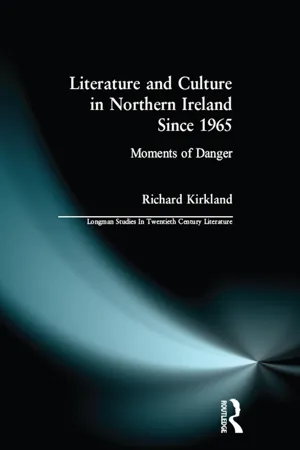
This study considers writing within the cultural context of Northern Ireland and discusses how writing creates a sense of community, and the different forms this takes when written from loyalist or republican perspectives. The book takes its major theoretical energy from readings of Antonio Gramsci's concept of hegemony and Walter Benjamin's work on historiography. hese are applied to major writers such as Seamus Heaney, Tom Paulin, Paul Muldoon and Edna Longley and to institutions such as the Ulster Folk and Transport Museum.
Information
CHAPTER ONE
Introduction: The Interregnum, the Institution and the Critic
To articulate the past historically does not mean to recognise it ‘the way it really was’ (Ranke). It means to seize hold of a memory as it flashes up at a moment of danger.
(Benjamin 1973: 247)
The Ulster Museum in the heart of South Belfast fulfills its role as the ‘national museum for Northern Ireland’ (Ulster Museum 1993:2) with some grace. An elegant mix of architectural styles, its hybrid form reflects the pluralist historiography to which it now aspires and which is testified to by its commitment to the Education for Mutual Understanding programme and its support for the cross-curricular theme of Cultural Heritage. Anxious to ‘present impartially the complicated story of Ulster’s past’ (Ulster Museum 1993: 6), the museum’s major exhibits demonstrate a sense of the shared dignity of labour and Northern Ireland’s great contribution to the world’s industrial development. Met by a series of large static machine plants used in the production of Irish linen, the visitor wishing to follow the recommended tour begins on the ground floor and progresses up the building in a spiral movement. Following the arrows, he or she moves from linen to aeronautics and ship-building, past the reconstruction of a shop window from an indiscriminate age, before encountering what seems like a narrative proper. Starting in 1590 with Sir Arthur Chichester and Hugh O’Neill, plantation is considered with indecent haste and within twenty yards the visitor encounters Henry Joy McCracken’s uniform close to that of a First World War soldier of the 36th (Ulster) Division. Soon after, history ends. Moving past the formation of the Ulster Special Constabulary (1920) the narrative of Ulster’s past is foreclosed just as Ulster is rendered a politically meaningless framework due to partition. However, as it is the national museum for Northern Ireland, the visitor to the institution could reasonably expect some indication of post-partition development in the North. Following the arrows, which after all now suggest a narrative of sorts, one is led directly from 1920 to an exhibition of dinosaurs followed by the micro-colonial instant represented by the mummy of Takabuti. As a metaphor, or even a joke, the resonances are telling.
It would though be unfair to see the Ulster Museum’s reticent refusal to stray beyond the post-partition development of Ulster as anomalous. Rather such an absence acknowledges unfinished business just as it bespeaks a form of timidity and no great imaginative leap is required to apply the words of ‘Wystan’ in Paul Muldoon’s ‘7, Middagh Street’ to Northern Ireland itself: ‘The roots by which we were once bound/are severed here, in any case,/and we are all now dispossessed’ (Muldoon 1987: 39). With this sense of fissure, Northern Ireland as an imagined entity continues to ask radical questions of historiographic procedure and it is through the cultural forms of folk-memory, marginalia and anecdote that such questions are most insistently posed. In 1968 the Dublin magazine Hibernia published an article by Patrick Boyle on Northern Ireland – then strictly exotic territory – titled ‘Ulster Revisited’. The article was envisaged as humour and the author could not have foreseen the imminent explosion of prolonged violence in the North. As such his depiction of pre-Troubles quietude and silent sectarianism in Dungannon now appears irredeemably ironic:
Fenian gets, one learned, were heavily built, slow moving people, falling mostly into paunch at an early age. They had high complexions, bulging blue eyes and a rotundity of visage that earned them the epithet ‘Bap-face’. Pushed well back on their foreheads, they wore soft hats. They were quarrelsome in drink, foul-mouthed, over-fond of the weemen, but still it could be said in their favour they paid regular and ceremonious visits to their places of worship.
Orange hoors, on the other hand were lean and light-footed. They were pale faced with fanatical, deep-set eyes and thin lips. Pulled well down over their foreheads, they wore dunchers. They were quarrelsome in drink, foul-mouthed, over-fond of the weemen, but still it could be said in their favour they paid regular and ceremonious visits to their places of worship.
(Boyle 1968: 11)
A version of Seamus Heaney’s satiric ‘“One side’s as bad as the other,” never worse’ (Heaney 1975: 59), the impossibility of writing an article such as ‘Ulster Revisited’ after 1968 testifies to the fact that, whatever else the political and social crisis in Northern Ireland has done, it has shattered any idea of a solely nativist solution to constitutional settlement. As such the piece presents a society of fixed forms and binarisms, a battered relic from an idea of history as endlessly circular and dependent on an oppositional, rather than dialectic, relationship: ‘Another swig of creamy malt. Ah, well! The old ways are undoubtedly the best. Society was never meant to be other than polarised between the two distinct races – the Fenian gets and the Orange hoors.’ Such satire exposes the pernicious forms of exoticisation1 prevalent in many forms of writing about Northern Ireland, and it is through the series of tropes that this concept consists of that history is presented as foreclosed and betraying. The Dungannon Boyle finds in the summer of 1968 relives versions of itself in a manner designed to deny any sense of a developmental history, and locates in that passivity a communal past which renders antagonism as a kitsch folk-memory present in every gesture and at every unfulfilled moment.
Significantly, on 24 August of that year, just one month after the article was published, a march by the Northern Ireland Civil Rights Association from Coalisland to the town highlighted the ongoing process of housing discrimination against Catholics in the area. This was met by a loyalist counter-demonstration which succeeded in preventing the intended culminative rally by NICRA going ahead. The binary social structures of Boyle’s article had begun to be remade in terms of a narrative of dispossession, singular and indivisible. Possibly taking cognisance of this, in 1983, Tom Paulin found in the town something quite different again:
Can you describe history I’d like to know?
Isn’t it a fiction that pretends to be fact
like A Journal of the Plague Year?
And the answer that snaps back at me
is a winter’s afternoon in Dungannon,
the gothic barracks where the policemen
were signing out their weapons in a stained register,
a thick turbid light and that brisk smell of fear
as I described the accident and felt guilty –
guilty for no reason, or cause, I could think of.
(Paulin 1983: 55–6)
Perhaps a distinctly Northern Irish reading of (or political response to) T.S. Eliot’s epiphanic moment in ‘Little Gidding, V’: ‘History is now and England’ (Eliot 1984: 222), Paulin’s historical memory conceives of the past as a series of moments, ‘accidents’, which are inherently resistant to the embryonic meta-narrative he is required to construct. The fine ambiguity playing around the particular ‘cause’ the narrator might espouse reminds the reader of the oppositional political positions such a reading of the past can engender while all around the textual detritus of an oppressed history (‘a stained register’) inevitably accrues. This forms a useful illustration of the difficulties surrounding any attempt ‘to articulate the past historically’, while ‘Martello’ in its entirety enacts the process of seizing ‘hold of a memory as it flashes up at a moment of danger’ and reads it as a constitutive paradigm.
It is out of the silences and ellipses signalled by the Ulster Museum’s fragmented narrative, and the discontinuity between ‘Ulster Revisited’ and ‘Martello’ that a structural principle appropriate to the cultural narratives of Northern Ireland can be constructed. For if, as we have seen, the act of transforming the process of time into a narration is necessarily open to the accusation of deceit, the concomitant belief engendered in the ultimate telos of a narrative involves at all points a consciousness of finite time; a structure which insists upon points of departure, digressions from the main strand of the instilled history and the arrogance of the writer’s struggle with what Walter Benjamin perceived as that which is ‘infinite in every direction and unfulfilled in every instant’ (Benjamin 1977: 134). As history imposes itself on the scene of the past, so it grants significance to the primal act through the anterior reconstruction of events. In this way historical time is marked only by the referential absences of its signification, by its blankness. As Benjamin reminds us (Benjamin 1979), the subject lost in the labyrinth of the state is a familiar trope but within the process of history it is equally difficult, although not impossible, to trace an imaginative exit.
Benjamin’s denial of an integrated totality to history can offer the possibility of a historical process which harmonises with Roland Barthes’s famous definition of the scriptible nature of certain textual strategies (Barthes 1990: 3–4), and it is through an acknowledgement of this confluence that the critic can gain an empowered position over the very arbitrariness of heterogeneous data. This, however, can only remain so if the lisible (or passive) act of reading is countenanced as an ever-present threat both to a notionally insecure selfhood and a critical position without institutional ratification. For the dispossessed or the non-believer, as Friedrich Nietzsche insisted, ‘the entire history of a “thing”, an organ, a custom, can be a continuous sign chain of ever new interpretations and adaptations whose causes succeed and alternate with one another in a purely chance fashion’ (1967: 77). In these terms the history of Northern Ireland becomes imposition rather than reconstruction: a process struggling with the eternal collision of arbitrary events and even if, following Benjamin, this may hint at the possibility of a historical method, it becomes a method bound to a near implausible level of agonised self-consciousness. To brush history ‘against the grain’ (Benjamin 1973: 256) is to remain in opposition to the present state of the dominant, only waiting for, or believing in, the messianic happening which marks elimination, not of the subjective consciousness which changes the dialogue from act to act, but of history itself.
For these reasons entering the cultural narratives of Northern Ireland is a task which should be undertaken with understandable care. Edward Said, who has written sympathetically of these kind of departures, has noted that, ‘beginning is a consciously intentional, productive activity … moreover, it is activity whose circumstances include a sense of loss’ (Said 1975: 372). Foregrounding the sense of beginning as conscious allows us to perceive that, just as the act of conclusion is at all times present in any one narrative, so is the point of origin. A text or a community, once having delineated its sphere of existence (and thus provoked the sense of loss to which Said refers), can continually rebegin itself, continually reassess its ending, without gaining freedom from the narrative stricture referred to above. Universal history may remain as a construct without ‘theoretical armature’ (Benjamin 1973: 254), but at least can be encountered with the real hope on the part of the materialist of ‘blasting a specific life out of the era or a specific work out of the lifework’ (Benjamin 1973: 254). In such a way, the process of making a beginning, of filling the empty time, requires a definite circumspection towards the significances of previous narratives.
To this end the contesting narratives of Northern Ireland can be considered as strictly mythologised entities with the necessary condition that, as Fredric Jameson states in relation to Benjamin’s work on Elective Affinities (Jameson 1974: 65), ‘we understand myth as that element from which the work seeks to free itself.’ Here care needs to be exercised. The litany of dates (for instance 1690, 1798, 1916) and the communal affinities which surround them in Northern Ireland are often taken as evidence of a mythologised community in the classic sense.2 In these can be found the formation of narratives from primal beginnings and a concomitant belief in the malign nature of atavistic forces. In this reading, history can reassert itself as a corrective force. The narrative which contains the sickness can be cured through a rigorous application of wholesome historical methodology.
This essentially revisionist model of narrative development, which seeks to subtend the narrative singular under the narrative plural, challenges Benjamin’s messianic nihilism through its belief in reforming telos as cure, by a sense in which the sub-narrative can be framed as temporary neurosis. Such approaches are currently not uncommon within Northern Irish historiography; indeed the myth of awakening has an obvious and understandable appeal yet this should not disguise the potential limits of such an interpretation. For Benjamin the true failure of non-materialist historiography lies in its arbitrary fixing of signification, the necessary result of which is the transformation of empty time into an allegorical landscape sundered from the activity of human existence. As such, allegory becomes the method by which meaning is extended across the diversity of heterogeneous time by the manoeuvres of the dominant authority, the subjective is rendered objective and valorised by the ultimate allegorical concept, history itself. An allegorised landscape therefore has no boundaries, no possibility of escape back to a world of pure matter, and can provoke little more than a longing for a violent dissolution of the totality.
In this way Northern Ireland as a community mythologised through allegory is by no means unique yet such a perception does enable a wider contextualisation of the province3 along simultaneous time and thereby entail a necessary reading of the area as essentially heterogeneous. Again, with this awareness, it is salutary to return to Barthes who wrote consciously from within such a delineated historical space (albeit with his own irony) and further developed this perception through his own well-known theory of myth:
Myth is not defined by the object of its message, but by the way in which it utters this message: there are formal limits to myth, there are no ‘substantial’ ones. Everything, then, can be a myth? Yes, I believe this, for the universe is infinitely fertile in suggestions. Every object in the world can pass from a closed, silent existence to an oral state, open to appropriation by society, for there is no law, whether natural or not, which forbids talking about things.
(Barthes 1987: 109)
It is of interest that Barthes’s strategy for survival in a mythologised society is to enter it fully, to be part of the ‘oral state’. Under the condition of a historical totality Benjamin seeks elimination, Barthes subversive integration. Throughout his decipherment of societal codes which forms the text Mythologies, Barthes exudes a sense of bemused wonder that he too can read the language of myth, that he too is of the historical moment. This may be the last of a series of desperate ironies yet it can also be paradigmatic in its veiled insistence that to escape from the system, the only way is to go in deeper.
Such an approach can inform an individual reading of Northern Irish culture. To reveal the constitutive forces of a myth it is necessary to insist upon its status as understandable, to perceive it as ‘universe’ and to witness its passing from silence to allegory. In turn, the concept of simultaneity, which is crucial to this critical position, becomes, as Benedict Anderson states, ‘transverse, cross-time, marked not by prefiguring and fulfilment, but by temporal coincidence’ (Anderson 1991: 24). Although Anderson is concerned with the development of nationalist communities, the sense of an individual imagining her/himself as part of a wider, or more specialised, human activity moving through history (activity which of course – and the distinction is important when considering Northern Ireland – need not be aspiring to the state of nationhood) is a significant one. It fulfills the function of myth precisely because it is imagined; it is not necessary or even desirable for each individual to ‘know’ personally all or any of the other subscribing members of the group but only to be displaced within a narrative. Barthes’s own mythical reputation as heroic semiotician developed from the sense that he was consciously placing himself at the point of ‘temporal coincidence’, that he was prepared for the sake of identifying myth to imagine his own community as subject.
So how can the narrative of Northern Ireland be read at this point of ‘transverse, cross-time’? In what sense, if any, is there a recognisable macro-narrative which is distinctive? Here interesting aberrations from universal models of the historical totality arise. Northern Ireland has often been considered as a geographically and culturally discontinuous community. On the margins of Western Europe and subject both to the effects of exterior influences from beyond its physical borders and interior disturbances of its own internal disputing narratives, it becomes definable only by its heterogeneity: the archetypal ‘border country’ (Hughes 1991: 3). As I will discuss, the often arbitrar...
Table of contents
- Cover
- Half Title
- Title Page
- Copyright Page
- Table of Contents
- Acknowledgements
- Dedication
- 1. Introduction: The Interregnum, the Institution and the Critic
- 2. ‘In the Midst of All this Dross’: Establishing the Grounds of Dissent
- 3. ‘This Thing Could Rule the World’: Northern Writing and the Idea of Coterie
- 4. ‘Unconscious Partitionism’: Northern Criticism in the Eighties
- 5. ‘Nothing Left but the Sense of Exhaustion’: Field Day and Counter-hegemony
- 6. ‘Just Another Twist in the Plot’: Seamus Heaney, Paul Muldoon and the Final Institution
- Works Cited
- Index
Trusted by 375,005 students
Access to over 1.5 million titles for a fair monthly price.
Study more efficiently using our study tools.
Frequently asked questions
Yes, you can cancel anytime from the Subscription tab in your account settings on the Perlego website. Your subscription will stay active until the end of your current billing period. Learn how to cancel your subscription
No, books cannot be downloaded as external files, such as PDFs, for use outside of Perlego. However, you can download books within the Perlego app for offline reading on mobile or tablet. Learn how to download books offline
Perlego offers two plans: Essential and Complete
- Essential is ideal for learners and professionals who enjoy exploring a wide range of subjects. Access the Essential Library with 800,000+ trusted titles and best-sellers across business, personal growth, and the humanities. Includes unlimited reading time and Standard Read Aloud voice.
- Complete: Perfect for advanced learners and researchers needing full, unrestricted access. Unlock 1.5M+ books across hundreds of subjects, including academic and specialized titles. The Complete Plan also includes advanced features like Premium Read Aloud and Research Assistant.
We are an online textbook subscription service, where you can get access to an entire online library for less than the price of a single book per month. With over 1.5 million books across 990+ topics, we’ve got you covered! Learn about our mission
Look out for the read-aloud symbol on your next book to see if you can listen to it. The read-aloud tool reads text aloud for you, highlighting the text as it is being read. You can pause it, speed it up and slow it down. Learn more about Read Aloud
Yes! You can use the Perlego app on both iOS and Android devices to read anytime, anywhere — even offline. Perfect for commutes or when you’re on the go.
Please note we cannot support devices running on iOS 13 and Android 7 or earlier. Learn more about using the app
Please note we cannot support devices running on iOS 13 and Android 7 or earlier. Learn more about using the app
Yes, you can access Literature and Culture in Northern Ireland Since 1965 by Richard Kirkland in PDF and/or ePUB format, as well as other popular books in Literature & English Literary Criticism. We have over 1.5 million books available in our catalogue for you to explore.