- 256 pages
- English
- ePUB (mobile friendly)
- Available on iOS & Android
eBook - ePub
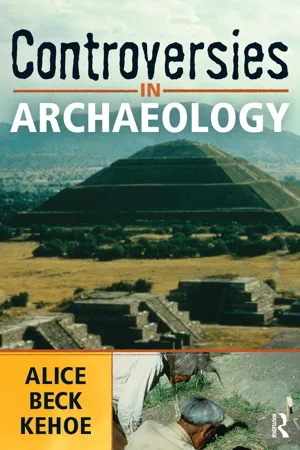
Controversies in Archaeology
About this book
Atlantis, ancient astronauts, and pyramid power. Archaeologists are perennially bombarded with questions about the "mysteries" of the past. They are also constantly addressing more realistic controversies: origins of the First Americans, the ownership of antiquities, and national claims to historical territories. Alice Beck Kehoe offers to introductory students a method of evaluating and assessing these claims about the past in this reader-friendly, concise text. She shows how to use the methods of science to challenge the legitimacy of pseudoscientific proclamations and develop reasonable interpretations on controversial issues. Not one to shy away from controversy herself, Kehoe takes some stands—on transpacific migration, shamanism, the Kensington Runestone—which will challenge instructor and students alike, and foster class discussion.
Information
1 The Past is Today
What does it mean to be human? One part of being human is to know we have a past. Other animals have memories without, so far as we can understand them, the mental concept of "the past," a whole world that once existed but no longer exists as it was. Literate societies have, for centuries, recorded the world in writing and visual images, other societies in orally presented history and tales and in images. Relics from the past have been collected, wondered at, or put to use. Europeans thought stone ax heads found in fields might be thunderbolts. The Aztecs in Mexico brought offerings of ancient figurines and ornaments to the Great Temple in their capital city, Tenochtitlán. Other vestiges of the past have been so familiar they were overlooked: prehistoric earth mounds unnoticed because they seemed just part of the landscape, scatters of potsherds ignored like recent broken pottery. Systematic searching for remains from the past is part of modern science.
British archaeologist Glyn Daniel remarked that "the past" can be construed in different ways, and he warned against naively accepting a "wished-for past," a picture of a past age that is more daydream than history Robin Collingwood, a professor of philosophy at Oxford who was also a practicing field archaeologist, taught that the real past cannot be known: the real past had uncountable gazillions of animals, plants, bacteria, viruses, grains of sand, molecules, raindrops, snowflakes, zaps of lightning—you get the picture. "Known pasts" are put together out of material relics, transmitted knowledge, and assumptions; the interplay between data (always, of course, far less than once existed) and stereotypes produces a series of projected "known pasts." We have privileged written documents from the past over other artifacts as evidence for the past, creating (in the nineteenth century) the profession of historian to glean a known past out of these texts. That left most of human existence and huge areas of the world as "peoples without history," a disrespect archaeologists challenge. From stains in soil, undecayed remnants of artifacts, food, and shelter, landscape modifications, and biological effects of habitat and behavior seen in skeletons, archaeologists construct pictures of settlements, and by looking at style distributions in time and space, estimate political organizations. With written texts, as in Mesopotamia from 3000 B.C.E. or by the Maya in Mesoamerica, we can put names to gods and rulers; without texts, the people in the past are nameless but no less vividly known to archaeologists.
Our predecessors recognized "pasts" and the fact that changes occurred in the past. Classical Greeks described a Golden Age when living was easy and luxurious, from which societies had degenerated into corruption. Mesoamericans and Hindus preached a series of earthly ages, each demolished by cataclysms, followed by resurrections created by deities. Christians took the Old Testament literally: patriarchs living nine hundred years, the Tower of Babel, Noah's flood, and all (see Chapter 6). They did not make these claims without some evidence. Greeks occasionally found gold ornaments from Mycenaean times a thousand years previously; Mexicans picked up strange figurines and ancient temple remnants they matched to local memories of destructive eruptions and floods; and Christians claimed various ruined walls and eroded valleys resulted from biblical events. A favorite theme in Western culture is a contrast between our alienated materialistic society and a wished-for past of contentment with simple pleasures, a Garden of Eden. This could be melded with a wished-for geography where Noble Savages live happily, with simple pleasures and deep true spirituality—Classical Greeks proposed they were Scythian nomadic pastoralists on the steppes of Asia and eastern Europe, and some Europeans viewed American Indians as mythical Noble Savages. The myth supposes that Noble Savages never change—that is, they are "the living Past," evidence of a more general way of life in past time, a way of life led by the ancestors of our own alienated, materialistic city-dwellers. American Indians have to put up with well-meaning tourists visiting contemporary reservations wanting to see living-fossil Stone Age Man and maybe discover True Spirituality, only to come away disappointed that Indian people live in tract houses, watch TV, and eat potato chips. The past is gone.
"Known pasts" live in the present. This chapter looks at the issue of "who owns the past." Is it the descendants of the people whose remains are excavated, or the modern government administering the territory? Or perhaps all humanity? This latter view led the United Nations to designate a number of places as "World Heritage Sites." Known pasts are used to draw tourists, often making up a substantial part of a local economy. Tourists may want to see "the real thing," provoking disputes over whether antiquities ought to be subject to pollution or feet pounding on a landscape ought to be permitted. Some communities feel tourists may pay more money to see re-creations in a theme park. Other uses of the known past involve private collections of antiquities; commercial dealers sell attractive objects, often for many thousands of dollars, and wealthy persons may buy antiquities as investments, figuring they are as good as gold in being readily convertible to cash if needed. But this high-end market for ancient art encourages looters to vandalize archaeological sites in search of marketable objects, never mind the destruction of irreplaceable scientific data.
Nationalism
"Our past" has been essential to modern nationalism, which narrows the term "nation" to a physical territory with a distinct language. Modern nations assert their inalienable right to their homeland by exhibiting archaeological finds from the territory, proving that people did live there for millennia. Right—but that doesn't really legitimate the nation: Were the ancient people the forebears of the present population? Sampling DNA from populations has revealed much more interbreeding than fervent nationalists want to admit. Does it matter?
National museums function as shrines. They select the most beautiful objects from the past in their territory, some of which may actually be imports (but if so, demonstrate the good taste and buying power of imputed ancestors). They may have maps with arrows showing migrations or timelines marked with new dynasties, implying how desirable it always was to come live in their nation. Architectural displays and preservation districts complement museum messages, generally downplaying international architectural styles in favor of the local.1 Museums may display artifacts from other cultures to contrast them as crude against their own society's art heritage, as anthropologist Stephanie Moser discovered the British Museum had done in the eighteenth century with Egyptian antiquities. English eyes looked at this art as primitive next to Classical Greek and Roman sculpture though it often predated classical objects by thousands of years.
Scientific archaeology has its own nationalistic roots. A method for systematically and carefully discovering and recording vestiges of the past was launched early in the nineteenth century in Denmark, after that country had been disastrously defeated by Napoleon's navy. King and people rallied around the idea that, although they had just lost a good part of their former territory in Sweden, they had a substantial past no one could take from them. Royal patronage supported a new National Museum that was assiduously filled with antiquities dug from Danish soil, arranged by the curator to show progression from a primitive Stone Age through an Age of Bronze (the first use of metal) to an Iron Age and the present. This three-age framework demonstrating Progress attracted interest throughout Europe, making Denmark admired just as the king had hoped. Excavators could see the sequence in the ground: iron and steel tools just below the surface, bronze tools lower down, and stone tools lowest of all. The sequence also fit Enlightenment (the eighteenth-century intellectual movement) logic, having most ancient humans using the simplest tools of natural materials, followed by people manipulating easily worked copper and alloying it to make bronze, and eventually metallurgists figuring how to smelt and work iron for cheaper, better tools. In the 1840s, about the time Danish-style archaeology was being taken up throughout the rest of Europe, a French avocational scientist, Jacques Boucher de Perthes, presented papers describing stone tools embedded deep in gravel banks along the Somme River Valley, along with fossil bones of mammoth and other extinct beasts. Boucher de Perthes assumed the animals and their hunters had all perished in Noah's Flood. After Charles Darwin published his On the Origin of Species in 1859, a biblical explanation lost favor. A delegation of British scientists visited Boucher de Perthes, examined the Somme gravel banks with him, and declared their opinion that his stone tools were artifacts from the Stone Age and thousands, maybe millions, of years old. Human culture evolved as did animals and plants, from ancestors through descent with modification. Natural selection applied to us as well as the rest of the natural world.
While scientific archaeology and its sister sciences geology and paleontology were developing field methods and classifications, antiquities from Mediterranean and Western Asian cities were retrieved from palace and temple ruins and brought to Europe for display Much of the region was within the Ottoman Turk empire, successor to Byzantium, with its capital at Istanbul (Byzantine Constantinople) where the Black Sea outlet runs into the Mediterranean. Invading from central Asian steppes in the fourteenth century, Turks overran ancient Mesopotamia (south western Asia), Egypt and adjacent North Africa, Greece, and southeastern Europe. Their method of government was to permit local religions, languages, and legal customs to continue, so long as people respected the Ottoman governors' decrees and paid taxes. Such relatively tolerant rule let nationalistic sentiments persist. As Europe shifted out of medieval feudal states into larger, centralized modern nations, Turks controlling the eastern Mediterranean were a major threat. Along with their political, military, and commercial power, they controlled the cities and art treasures of Classical Greece, Egypt, and Mesopotamia—the foundations of Western civilization, revered since Europe's fifteenth-century Renaissance. European intellectuals wanted to rescue these antiquities from the infidel Turks.
In 1799, Thomas Bruce, seventh Earl of Elgin, was named British Ambassador to the Ottoman court. He used his post to save—he claimed—the beautiful marble sculptures adorning the Parthenon Temple in Athens. The building itself, more than two thousand years old, was damaged in 1687 when a bombardment by attacking Venetians hit gunpowder stored in the temple by Ottoman defenders. More than a century afterward, Lord Elgin felt justified in stripping off the carved panels and statues and shipping them to England "for safekeeping." He offered them to the British Museum to improve public taste, a noble gesture except that he asked over a hundred thousand dollars for the treasures. After several years of haggling, the Museum bought "the Elgin Marbles," and they have adorned the London museum ever since (Figure 1.1).
Meanwhile, Greeks fought the Ottomans, achieving independence in 1829. Their rebellion engaged romantic European intellectuals, including English poet George Gordon, Lord Byron, killed by fever in a rebel Greek camp in 1824. Wars of independence by southeastern European territories against the Ottoman Empire fueled nineteenth-century Europeans' picture of Asian states as "backward," despotic, ignorant of science, and mired in mystifying spiritualism. Now labeled "orientalism," myths about Asians colored interpretations of Asian (and Egyptian) antiquities and histories at the same time that they bolstered Europeans' adoration of Classical Greek and Roman relics. They conveniently disregarded the fact that medieval Arab scholars in Baghdad, Cairo, and Damascus preserved the Classical texts of the Greeks and Romans and conducted substantial scientific research while Europe was mired in the Dark Ages. Nor did Europeans recognize the contributions that Chinese science and technology contributed to Europe—gunpowder, watermills, magnetic compass, and paper, to name a few.
As tourism grew into one of the globe's largest industries after World War II, Classical Athens's acropolis drew millions of visitors, becoming a significant part of Greece's contemporary economy. Tourists expected to see the famous sculptures of the Parthenon. Greece asked Britain to return the Elgin Marbles. The British Museum replied "No," claiming its charter forbids giving away its collections. Greece appealed on grounds that Lord Elgin never had Greece's permission to remove the art; furthermore, the Ottoman permit Elgin did obtain is rather ambiguously worded, perhaps meant to allow only removal of loose fallen stone. Greece's most glamorous actress, Melina Mercouri, passionately spoke for the return of the Marbles. Nothing availed; although Germany did return a small piece of the frieze in its possession, more than half of the frieze of horsemen, fifteen statues, and over a dozen other Parthenon sculptures remain as the centerpiece of the British Museum.

FIGURE 1.1 Parthenon temple sculpture, Athens, Greece, ca. 440 B.C.E. From George Redford, A Manual of Ancient Sculpture, London 1886.
Where do the Elgin Marbles belong? In the hands of the British, who claim to have legally obtained them and have preserved them for the past two hundred years? Or do they belong to the Greeks, who claim them as their heritage and want them back in their original context? Clearly, this is a controversy between competing national interests.2
Who Should Excavate Sites? Who Has the Right to Keep Antiquities?
Archaeology worldwide was first practiced by a few western European and North American nations. It has been customary for excavation projects in less-developed countries to be financed by wealthy patrons and institutions from major world powers, with recovered artifacts divided between the host country and the excavators. Supposedly, each gets half of the "best" as well as of ordinary material. Ever since these arrangements began, in the nineteenth century, host countries have complained that they get the commonplace stuff and foreigners the "goodies." France, Germany, Britain, the United States, and other Western nations formally arranged "concessions" whereby they had exclusive privilege to excavate important sites, or a region, or even all archaeology in a country. For example, in 1900 France was granted a monopoly on archaeological work in Persia (present-day Iran), with the right to export expedition finds without customs inspection. This lasted until 1927, when pressure from the U.S. government on France resulted in a new agreement in which a Frenchman remained as Persia's Director of Antiquities, but American museums were allowed to carry out excavations. An American government representative wrote in 1935 that the Persian antiquities transported in great quantities to U.S. museums are America's "national treasure ... contributing to the cultural advancement of the American people" (quoted in Gholi Majd 2003:187). Ironically, the University of Chicago Oriental Institute insisted, after the 2003 outbreak of war in Iraq and of Near Eastern hostilities implicating Iran, that Chicago is really the proper custodian for its collections from the region, because it can preserve them from destruction in their embattled homelands.
Controversial as are "custodial" arrangements that never end, loans for exhibits that don't come back, and divisions of finds that don't seem fair, the picture darkens more when we consider illegal digs and black-market dealings,3 There are many families in antiquities-rich areas whose income derives from looting graves and ruins and selling the attractive objects illicitly to dealers (see below, "Who Benefits from Archaeology?"). Some of the objects may be bought by museums from dealers claiming they had been exported before passage of laws protecting antiquities (see box, "Antiquities Laws and Trade"). Most of the objects go to private collectors, in some cases solely as investments likely to
Antiquities Laws and Trade
Most United Nations member states signed the 1970 UNESCO Convention on the Means of Prohibiti...
Table of contents
- Cover
- Half Title
- Title
- Copyright
- Contents
- ILLUSTRATIONS
- PREFACE
- INTRODUCTION
- CHAPTER 1 The Past is Today
- CHAPTER 2 Scientific Method
- CHAPTER 3 Popular Archaeology
- CHAPTER 4 America's First Nations and Archaeology
- CHAPTER 5 Finding Diversity
- CHAPTER 6 Religion and Archaeology
- CHAPTER 7 "Diffusion" versus Independent Invention
- CHAPTER 8 What People Before Us Could Do: Earlier Technologies
- CHAPTER 9 Neandertals, Farmers, Warriors, and Cannibals: Bringing in Biological Data
- CHAPTER 10 Competing Theories of Cultural Development
- NOTES
- BIBLIOGRAPHY
- INDEX
- ABOUT THE AUTHOR
Trusted by 375,005 students
Access to over 1.5 million titles for a fair monthly price.
Study more efficiently using our study tools.
Frequently asked questions
Yes, you can cancel anytime from the Subscription tab in your account settings on the Perlego website. Your subscription will stay active until the end of your current billing period. Learn how to cancel your subscription
No, books cannot be downloaded as external files, such as PDFs, for use outside of Perlego. However, you can download books within the Perlego app for offline reading on mobile or tablet. Learn how to download books offline
Perlego offers two plans: Essential and Complete
- Essential is ideal for learners and professionals who enjoy exploring a wide range of subjects. Access the Essential Library with 800,000+ trusted titles and best-sellers across business, personal growth, and the humanities. Includes unlimited reading time and Standard Read Aloud voice.
- Complete: Perfect for advanced learners and researchers needing full, unrestricted access. Unlock 1.5M+ books across hundreds of subjects, including academic and specialized titles. The Complete Plan also includes advanced features like Premium Read Aloud and Research Assistant.
We are an online textbook subscription service, where you can get access to an entire online library for less than the price of a single book per month. With over 1.5 million books across 990+ topics, we’ve got you covered! Learn about our mission
Look out for the read-aloud symbol on your next book to see if you can listen to it. The read-aloud tool reads text aloud for you, highlighting the text as it is being read. You can pause it, speed it up and slow it down. Learn more about Read Aloud
Yes! You can use the Perlego app on both iOS and Android devices to read anytime, anywhere — even offline. Perfect for commutes or when you’re on the go.
Please note we cannot support devices running on iOS 13 and Android 7 or earlier. Learn more about using the app
Please note we cannot support devices running on iOS 13 and Android 7 or earlier. Learn more about using the app
Yes, you can access Controversies in Archaeology by Alice Beck Kehoe in PDF and/or ePUB format, as well as other popular books in Social Sciences & Archaeology. We have over 1.5 million books available in our catalogue for you to explore.