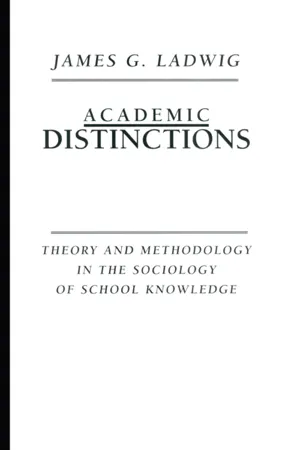
Academic Distinctions is the most sustained and rigorous critique of radical sociology of school knowledge and its major figures to date. Using a variety of theoretical lenses to analyze and reconstitute the field--structuralist, poststructuralist and feminist--James Ladwig documents how the so-called "new sociologists of education" lost their theoretical way and failed to realize their educational goals.
eBook - ePub
Academic Distinctions
Theory and Methodology in the Sociology of School Knowledge
- 208 pages
- English
- ePUB (mobile friendly)
- Available on iOS & Android
eBook - ePub
About this book
Information
twoConstructing the Field
DOI: 10.4324/9781315538884-2
It must be acknowledged that in few of the civilized nations of our time have the higher sciences made less progress than in the United States; and in few have great artists, distinguished poets, or celebrated writers, been more rare.—de Tocqueville, Democracy in America
One can note, in the case of the United States, the absence to a considerable degree of traditional intellectuals.—Gramsci, Prison Notebooks
IN MANY WAYS, THE FIELD I ANALYZE IN THIS PROJECT, the radical sociology of school knowledge in the United States, is peculiarly American. There are many characteristics of the work done in this field which mark the lines of intellectual endeavors of the larger social arena known as the American Academy. Where the American Academy has been seen to present itself as anti-intellectual, apolitical, empiricist, overly practical, and isolationist, radical sociologists of school knowledge as oppositional intellectuals have consciously aspired toward a high degree of intellectualism, anti-empiricism, and overtly strategic political commitment (Hofstader, 1962; Popkewitz, 1991). From this standpoint, there seems to be a spiritual congruence between the dispositions of radical educational scholars and the thoughts of Alexis de Toqueville and Antonio Gramsci. Where American education and sociology have been largely and decidedly ignorant of European intellectual movements, the radical sociologists of school knowledge openly (though not exclusively) built their intellectual positions on European works. And so it goes that I, like many before me, turn toward Europe to describe the intellectual origins of RSSK.
Before turning to my excavation of this field, though, I would like to introduce what I intend this chapter to do. Roughly speaking, I frame this chapter as an analysis of the conceptual origins of what has become something of a signature position in United States's RSSK—namely, Michael Apple's “Parallelist Position.” In this position, three social dynamics are presented as essential for radical sociological analyses of curriculum: race, gender, and class. While each of these three dynamics and the interconnections between them are taken as potentially crucial, no single dynamic is to be given analytical primacy prior to any analysis. Pace orthodox Marxist positions, the Parallelist Position does not analytically place a priori primacy on economic class relations. In addition to these three social dynamics, three social spheres are nominated as important sites of investigation: the economic, cultural, and political spheres. Arguing here against what is seen as an overly economic Marxist tradition, Apple suggests analyses of culture and the State are also crucial. As with the social dynamics included in this model, the logic governing the social spheres is similarly additive—a priori primacy is given to none, and the interconnections among the three spheres are highlighted as potentially important.1
This conceptual matrix is, in a sense, considerably more complex than were the first works which proposed to analyze the relationship between power and curriculum through sociological lenses. Indeed, it is perhaps difficult to see easily how such a position is the consequence of its apparent Marxist ancestry. For instance, one could also note the surface similarity between this conceptual matrix and traditional Weberian analyses of class, status and power. But when viewed within the context of a developing analytical history, this position can be understood as growing out of a series of progressive conceptual moves.
Hence, in this chapter, I intend to narrate the intellectual lineage of the United States's RSSK beginning with Michael F. D. Young's opening essay from Knowledge and Control To tell this story, I shall be using a language of development and progress in terms that mark how this field can be seen to have more or less linearly developed. In this view, the sociology of curriculum can be seen to have dialectically oscillated between “subjective,” interpretivist understandings of the socially constructed nature of curriculum and how individuals construct meaning through texts (broadly speaking), and “objective,” structural accounts of how curricular practices reproduce social stratification. In this Hegelian rendering of the ever recreated synthesis of past oppositional approaches, progression is seen and progress assumed.
In constructing this story, I shall be demonstrating that since Apple's formulation of the Parallelist Position, the Structural Neo-Marxist research agenda of the radical sociology of curriculum has analytically stagnated. Here, the focus of this chapter is specifically on the analytical logic of this Structural Neo-Marxist agenda. I am not suggesting that this analytical logic impedes the production of research. I am suggesting however, that this line of research is caught within a logic whose consequent claims and conclusions are as predictable as they are limited. Generally, as I shall argue in much more detail below, in its research endeavor the analytical logic of U.S. Structural Neo-Marxist sociologies of school knowledge faces recurrent conceptual dilemmas which it seemingly cannot escape. First articulated in 1983, twelve years have passed since the public announcement of the Parallelist Position, and no signs have been given that this tradition has moved beyond its initial concerns and intellectual frame (Apple and Weis, 1983a). This point, in itself, should be demonstrated and explained, for it implies that what may have appeared a progression will no longer progress.
It is very important to note that the very possibility of seeing this stagnation lies endogenously within the Neo-Marxist analytical lenses and language of that tradition. In telling a story of a stagnated tradition, I will simultaneously be using the very language which makes claims of stagnation seem plausible. To substantively explain this view, I will consider how central Neo-Marxist concepts limit what is possible for a sociology of school knowledge. As I delineate two major strands within the Structural Neo-Marxist sociology of school knowledge (the structural and the phenomenological), I shall highlight, inter alia, two conceptual legacies of this discourse—what I call a lack of interpretive justification and a tendency to confound potential empirical verification.
Problems of interpretation and verifiability are commonly raised in educational research, and that I raise them with respect to the radical sociology of school knowledge is probably not that surprising. In this chapter I will not directly address the debates about these methodological issues per se. Rather, my interest in this chapter is to establish that the research in RSSK is open to these methodological criticisms and to argue that the conceptual framework represented in the Parallelist Position carries serious limitations for attempts to persuasively respond to such methodological problems.
One final caveat should be noted before I turn to surveying the origins of RSSK. In the analysis below I have not attempted to provide an exhaustive account of the research done in this field. Rather my interest is one of trying to frame the conceptual categories which regulated or governed the way in which American scholars imported early European studies in the field. The texts I reference and discuss below have been selected for their illustrative utility in this effort.2
THE ORIGINS OF A FIELD
Past attempts to survey the development of this field of inquiry cite, among others, the work of Michael F. D. Young and Basil Bernstein in England and Anyon, Apple, and Giroux in the United States, as prime authors in the field (Whitty, 1985; Wexler, 1987). Within these reviews, Young's (1971c) edited volume Knowledge and Control has been seen as the germinal volume in the field of the sociology of curriculum. I too begin my historical survey of RSSK with this declaration.
As his book title suggested, Young saw central concerns for the sociology of education turning around two pivotal positions. On the one hand, building from the work of Dawe, Young maintained that the “defining problem” of the sociology of education was one of social control. Here Young argued that the sociology of education's focus on control lay in the recognition that 1) the “problem of order” or “doctrine of control” has been the cornerstone of sociological inquiry since the eighteenth century; and that 2) twentieth century commonsense conceptions of “science” and “rationality” have embroiled sociology in the representation of “dominant legitimizing categories” (Young, 1971a, pp. 2–5). On the other hand, the second (and perhaps more central) pivotal position among the constellation of the New Sociology's analytical repertoire was the questioning of how sociological analysis related its own practices and proclamations to knowledge. Central here was the notion that knowledge itself is a social construct, a position that has been linked to the works of philosopher Alfred Schutz and sociologists Berger and Luckman (see Esland, 1971; Karabel and Halsey, 1977a). In seeking to understand the ways in which sociological studies of education were implicated in relations of power and control, Young argued that traditional educational sociology had not sufficiently questioned “what counts as educational knowledge.”
Subtitled “New Directions for the Sociology of Education,” Young presented the collected works in this book as a response to what he and his colleagues saw as the fundamental inadequacies of the sociology of education. In opposition to seemingly taken for granted assumptions implicit in public policy proposals for educational reform, the New Sociology chastised sociology of education for not adequately making explicit these public assumptions and for not questioning their sociological implications for educational practice. Young, for example, criticized what he saw as “government pressure for more and better technologists and scientists,” questioning the social construction of what was taken as “science” in public policy. In opposition to a tendency in the sociology of education to take for granted educational problems, the New Sociology sought to reveal an implicitly accepted “order doctrine.” Here the New Sociology has been interpreted as rejecting a structural-functionalist sociological view in favor of phenomenological studies that have been seen as an “interpretivist” view (see Karabel and Halsey, 1977a). And in opposition to the sociology of education's lack of attention to the content of education, the New Sociology placed questions of the curriculum and knowledge center stage.
More specifically, among the surveyors of this field, Young's (1971b) opening chapter to Knowledge and Control, “An Approach to the Study of Curriculum as Socially Organized Knowledge,” has been presented as the benchmark declaration of what the sociology of school knowledge is. In this chapter, a foundation for the sociological study of curriculum was stated positively, rather than in a series of negative oppositional stances. Paraphrasing Raymond Williams, in part, Young framed the New Sociology's agenda in these terms:
Sociologists seem to have forgotten … that education is not a product like cars and bread, but a selection and organization from the available knowledge at a particular time which involves conscious and unconscious choices. It would seem that it is or should be the central task of the sociology of education to relate these principles of selection and organization that underlie curricula to their institutional and interactional setting in schools and classrooms and to the wider social structure, (p. 24)
Here it was clear that Young sought to connect the patterns of micro-level daily practices of schooling (“principles of selection and organization that underlie curricula”) to their mezzo-level institutional setting and to the macro-level societal structure. By questioning the organization of school knowledge (manifest in the curriculum) and attempting to relate it to wider social structures, Young's perspective retraced a central problematic of the sociology of knowledge (a connection he made explicit in a subsection of his essay entitled “The Sociology of Knowledge and the Curriculum”) (pp. 26–27).
After favorably citing Alfred Schutz's phenomenological insights into the social construction of knowledge, and stating that this work was not then well known in sociology, Young (1971b) stated that from the perspective of the sociology of knowledge, “(t)he school curriculum becomes just one of the mechanisms through which knowledge is ‘socially distributed’” (p. 27). Young then went on to criticize the sociology of knowledge for its lack of impact on the sociology of education, stating that “(t)hree strands, which characterize the more familiar traditions in the sociology of knowledge (i.e. not Schutz), indicate not its lack of potential but why the direction it has taken has made its contribution to the sociology of education so insignificant” (p. 27).
Young's offered three criticisms of the sociology of knowledge: 1) that its research had been mostly concerned with epistemology and the existential nature of knowledge, a program in which “substantive empirical research (had) been eschewed,” 2) that since Marx there had been a “neglect of the cognitive dimensions of the categories of thought,” and 3) that the process of transmitting knowledge, itself seen as a social construct, had not been studied (p. 27).
With these criticisms and the view that the sociology of knowledge offered strong potential for the sociological study of school knowledge, Young then entered into an interesting evaluation of sociology's founding traditions—those associated with sociology's founding fathers, Marx, Weber, and Durkheim. According to Young, although Marx's theories offered a general account “for the changes in men's (sic) consciousness or categories of thought in terms of the changing means of production and the social relations they generate” (pp. 27–28), Marxist theories had not addressed education sufficiently and had neglected the process of knowledge acquisition. Correspondingly, Young pointed out that although Marx's claim that education in a capitalist society is a tool of ruling class interest gave some direction to an examination of the relationship between education, elite curricula, and the economy, Marx's general theoretical level did not “point to explanations of the dynamics of particular configurations or different curricula” (p. 28). Among the Marxist theorists Young considered were Gramsci, Perry Anderson, and Raymond Williams.3 Weber's work on education was taken by Young to be helpful for its comparative framework, but limited by its lack of “an overall framework for linking the principles of selection of content to the social structure” (p. 30). Durkheim's work on education was seen to be “not very helpful” (p. 31), in part due to the standing criticisms of Durkheim's harmonious view of society and focus on social integration. But Durkheim's sociology of religion and its connection to the sociology of knowledge, according to Young, had been employed by Bourdieu and Bernstein in a potentially productive way.
Young's recognition of the value a Durkheimian analysis offered the soci...
Table of contents
- Cover Page
- Half Title Page
- Title Page
- Copyright Page
- Dedication
- Table of Contents
- Acknowledgments
- One Introduction
- Two Constructing the Field
- Three Deconstructing the Field
- Four Reconstructing the Field, Partially
- Five Was the Critique of Positivism a Mistake?
- Six Wherein Lies the Scientific Rhetoric?
- Seven Constructing a Science with an Attitude
- Notes
- Bibliography
Trusted by 375,005 students
Access to over 1.5 million titles for a fair monthly price.
Study more efficiently using our study tools.
Frequently asked questions
Yes, you can cancel anytime from the Subscription tab in your account settings on the Perlego website. Your subscription will stay active until the end of your current billing period. Learn how to cancel your subscription
No, books cannot be downloaded as external files, such as PDFs, for use outside of Perlego. However, you can download books within the Perlego app for offline reading on mobile or tablet. Learn how to download books offline
Perlego offers two plans: Essential and Complete
- Essential is ideal for learners and professionals who enjoy exploring a wide range of subjects. Access the Essential Library with 800,000+ trusted titles and best-sellers across business, personal growth, and the humanities. Includes unlimited reading time and Standard Read Aloud voice.
- Complete: Perfect for advanced learners and researchers needing full, unrestricted access. Unlock 1.5M+ books across hundreds of subjects, including academic and specialized titles. The Complete Plan also includes advanced features like Premium Read Aloud and Research Assistant.
We are an online textbook subscription service, where you can get access to an entire online library for less than the price of a single book per month. With over 1.5 million books across 990+ topics, we’ve got you covered! Learn about our mission
Look out for the read-aloud symbol on your next book to see if you can listen to it. The read-aloud tool reads text aloud for you, highlighting the text as it is being read. You can pause it, speed it up and slow it down. Learn more about Read Aloud
Yes! You can use the Perlego app on both iOS and Android devices to read anytime, anywhere — even offline. Perfect for commutes or when you’re on the go.
Please note we cannot support devices running on iOS 13 and Android 7 or earlier. Learn more about using the app
Please note we cannot support devices running on iOS 13 and Android 7 or earlier. Learn more about using the app
Yes, you can access Academic Distinctions by James G. Ladwig in PDF and/or ePUB format, as well as other popular books in Education & Education General. We have over 1.5 million books available in our catalogue for you to explore.