eBook - ePub
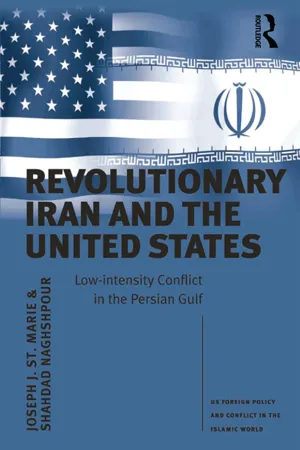
Revolutionary Iran and the United States
Low-intensity Conflict in the Persian Gulf
- 214 pages
- English
- ePUB (mobile friendly)
- Available on iOS & Android
eBook - ePub
Revolutionary Iran and the United States
Low-intensity Conflict in the Persian Gulf
About this book
A unique and major contribution to the scholarly and policy debate on American foreign and economic policy toward the Islamic Republic of Iran. A volume that will be of interest to scholars and policy makers who struggle to understand the complex rivalry between these two nations and wish to analyze the Iranian/American relationship since 1979. Authors frame the conflicted relationship between Iran and the United States as a low intensity conflict, embodying elements of superpower gamesmanship, insurgent tactics and economic warfare. Revolutionary Iran and the United States is unique in its approach by exploring how diplomatic, military, and economic weapons are employed to bolster each nation's strategic and tactical advantage. This analysis encompasses the political, military, and economic facets of the rivalry.
Information
Chapter 1 Low-Intensity Conflict and Fourth Generation Warfare
DOI: 10.4324/9781315606323-1
The relationship between the Islamic Republic of Iran and the United States is for all practical purposes a non-relationship with each nation pursuing adversarial and hostile policies and actions towards the other. The reality of the situation is that Iran and the United States are nations engaged in a low-intensity conflict. This work examines the low-intensity conflict between the United States and Iran, with respect to the military, economic, and political aspects in which the conflict has taken in the past thirty years.
This chapter investigates the relationship between The Islamic Republic of Iran and the United States of America before and after the 1979 Iranian Islamic Revolution with particular emphasis on the post-revolutionary war stages. The analysis examines the adversarial relationship, fourth generation warfare (political, economic and diplomatic war in the 21st. Century), and the theoretical constructs that surround this form of warfare between states. Furthermore, this chapter sets the stage for subsequent chapters by demonstrating how domestic politics and low-intensity warfare are linked. This linkage, we argue, determines the ebb and flow of the conflict.
The Adversarial Relationship
The effective date of this conflict can be pinpointed as 4 November 1979, when Iranian radical students seized the US embassy in Tehran, taking US diplomats and civilian workers hostage for 444 days. This action, which was tacitly sanctioned by Ayatollah Ruhollah Khomeini, produced a long lasting and significant change in US foreign policy toward Iran (Jordet nd, Pollack 2004, Quosh 2007). The diplomatic crisis was highlighted by the failed American rescue attempt of the hostages, which put each nation firmly in a confrontational state. Subsequent confrontations were manifested through moral or ideological struggles between two opposing ideologies pursued by means other than direct military confrontation.
Similar to Western political practice, the Islamic Republic has democratic institutions and constitutional checks and balances. However, these governmental characteristics are derived from Islamic law which is inherently undemocratic. For example, candidates for political office are required to submit their credentials to religious scholars before they are certified to stand for election (Abrahamian 2008, Thaler et al. 2010). The Constitution of the Islamic Republic is derived from Shia Islamic law, which in turn is derived from the Koran, the “infallible word of God.” The Islamic Republic has created a political system diametrically opposed to the American and Jeffersonian ideals of “life, liberty, and the pursuit of happiness” through the implementation of various social, economic, and political controls. The Iranian government sees the American constitution and political system as corrupt and devoid of the perquisite religious component, which they deem necessary for a just society. With such diverse ideological views there has been little common ground for compromise or co-existence. Those episodes of cooperation such as “Arms for Hostages” have tended to end badly. Even Iranian assistance in the defeat of the Taliban was short lived after Iran was made part of the “Axis of Evil” short of direct military conflict both have sought various means to demonstrate their ideological superiority within political and economic arenas.
Levels of Analysis
To begin, a meaningful comparison of Iranian and American interaction must examine the levels of analysis to determine how they relate to low-intensity conflict and fourth generation warfare. To be sure, it is generally accepted that individual, state, and systemic or global levels of analysis are proper domains of inquiry for the study of international relations and, more specifically, conflicts. The present analysis crosses various domains as an essential function of the nature of modern conflict. Since modern conflict is multi-dimensional our analysis will be multi-dimensional.
The individual level of analysis is primarily concerned with the motivations, constraints, and incentives a decision maker works under. While there are incentives and constraints imposed upon all decision makers, the personal traits of a policy maker are appropriate for the study of low-intensity conflict and fourth generation warfare (Lind 2004). Given the overarching ideological or moral component of this new type of warfare, personal attributes become important when examining individual and collective motivations or preferences for certain policy actions.
Looking at the state and its internal attributes to determine policy direction is another part of fourth generation warfare analysis. Clearly the alignment, relative power, and ideology of constituent groups within a state have a profound impact on the policies a state may pursue. The fragility of the ruling coalition, strength of the opposition as well as economic and military threats all impact decisions made by elites within the state. Including the state level of analysis in our conflict model is appropriate as specific tactics and strategies are constrained by domestic factors as well as personal and systemic factors (Putnam 1988).
The global or systemic level of analysis emphasizes the impact decision makers have on the global political economy. Given that fourth generation warfare includes economic elements, the inclusion of economics within the global level of analysis is reasonable. In addition, such analysis allows for the interaction of global markets with domestic factors and the impact on the decision making process. While we do not examine conflict that is global in respect to the number and location of the participants we do examine conflict that has global implications. For example, a blockade of the Straits of Hormuz would have a profound economic impact on industrialized countries. Conversely, lack of revenue would cause serious social and economic disruptions in the Persian Gulf States (Barnett 2005, Cordesman 2006, 2009, Hugill 1998, Krepinevitch et al. 2003, Larson et al. 2004, North & Choucri 1983, Truver 2008). While it is generally considered a taboo to mix the levels of analysis, in this work it is essential to understand the complicated nature of fourth generation warfare (see Waltz 1979 for a discussion of levels of analysis). The nature of low-level conflict is necessarily one that requires an analysis of those decision makers who wield power, the domestic sources of policy, and how such policies will affect the larger international system. One aim of this study is to validate the concept of fourth generation warfare as a form of total warfare that encompasses all aspects of decision making.
Low-Intensity Conflict and the Fourth Generation of Warfare
Low Intensity Conflict
Low intensity conflict has been characterized as a war that never reaches a critical mass of men, material, and the will to definitively win. It is also a tool employed by weaker states, groups, and movements that seek some sort of concessions. Low intensity conflict differs to a great extent in so far as it may be prolonged, it may ebb and flow, and it may have various levels of intensity, yet resolution is elusive (Liang & Xiansui 1999).
Fourth Generation Warfare: What it is and What it is Not
The term fourth generation warfare has only been in the security lexicon since 1989 with the publishing of an article in the Marine Corps Gazette (Lind et al. 1989). In this article, fourth generation warfare is seen as an evolution of warfare whereby the first generation is characterized by muskets and static lines firing upon each other at short ranges. The second generation of warfare is characterized by rifled guns, machine guns, indirect artillery fire, and movement as opposed to static tactics. The third generation of warfare begins in 1918 and focuses on maneuver warfare where flexibility and bringing dispersed units together quickly to overwhelm an adversary brings victory. Each of these evolutions has produced increased casualties, material damage, and economic costs to the adversarial countries. The fourth generation can be described as ‘networked’ or ‘technology’ driven warfare. Technology has driven many of the advances since the culmination of the air-land battle of the third generation (the Gulf War of 1991). Thomas X. Hammes sees fourth generation warfare as both a strategic and tactical endeavor (Hammes 2005, 2007).
The strategic side of modern fourth generation warfare is reversed from previous forms of warfare. For example, a fourth generation war need not have territorial ambitions, nor will the linear battlefield be the primary ground where battles will be fought. Conversely, opponents attempt to change the minds of enemy decision makers through various means of persuasion utilizing the tools of fourth generation warfare. These means are what make fourth generation warfare distinct from previous forms of warfare. The ways and means of this new type of warfare can be summed up simply as “total war” meaning that any type of weapon be it cyber-attacks, conventional military attacks, public relations smears, or economic undermining can be considered a weapon in the arsenal of fourth generation warfare. Thus, for purposes of this work, we define fourth generation warfare as: conflict between two or more nation-states aimed at persuading/coercing the other to bend to its demands, whether they be military, economic, or political; whereas the means of conflict are not restricted to military or uniformed combatants; whereas political, military and economic means are used as weapons to gain persuasive advantage. Fourth generation warfare is thus “total” warfare where the only rule is that there are no rules (Liang & Xiansui 1999).
Characteristics of Fourth Generation Warfare
Fourth generation warfare may be characterized as more of a moral struggle rather than a set-piece or maneuver battle. Moreover, this type of warfare is predicated on the examination of various political, economic, and military networks of an adversary and attacking at specific nodes that will cause widespread damage within and between networks. For example, a fourth generation warfare attack on Pakistan by India to “persuade or compel” Pakistan to refrain from supporting terrorist organizations intent on attacking India (Bombay hotel attack type of operation) might include a cyber attack on military and economic targets, such as the air defense network and the power grid. A hypothetical example of a political attack might involve jamming of Pakistani television and radio stations and inserting propaganda or disinformation. Accompanied by small and limited conventional military incursions, insurgent infiltrations, and small scale attacks, India could “persuade” Pakistan to change its policy, if sufficient “damage” was inflicted. Fourth generation warfare takes advantage of the complexities in military infrastructure, economic systems, and political approval to achieve its goals. The importance of examining conflict through the lens of fourth generation warfare is that the boundary lines between civilian and combatant; between permissible targets and off-limits targets; between economic and military targets; and differences between political systems are all blurred. Modern warfare is not the black and white of the old days but a continuum from black to white with fourth generation warfare comprising a large gray area between each pole (Liang & Xiansui 1999).
Fourth generation warfare is a type of warfare that seeks to undermine the unique and specialized strengths an enemy might have. For example, in Operation Iraqi Freedom and its aftermath insurgents faced a much stronger opponent yet were able to destroy or disable the American M-1 Abrams main battle tank, an armored vehicle that has few peers on the battlefield. In a similar way, roadside bombs, kidnappings, intimidation, and demonstrations all undermined the feeling that the American military would be able to protect the population. To undermine the enemy's strength highlights vulnerabilities which lead to a loss of confidence by the population of the defender. Four-generation warfare is not insurgency since it is played out in the diplomatic and realm of states as opposed to intrastate violence. Loss of confidence is one key aspect of how fourth generation warfare attempts to persuade a government to change its policies. In this case, a democratically elected government may find itself faced with significant domestic unrest as a result of being attacked, and the perception of citizens that it is defenseless in the face of renewed attacks. Undermining the confidence in the population is one strategy an aggressor can use to create advantages even when it is militarily weaker. Authoritarian governments are even vulnerable to unrest as the result of lost battles with weaker adversaries such as with Russia in 1905. Strongmen rely upon a system of redistribution of rents to hold on to power. If this system is interrupted their hold on power is reduced and less absolute and they become susceptible to coups or invasion. Modern warfare is predicated upon exploiting the enemy's weaknesses on the battlefield. However, fourth generation warfare widens the battlefield to include politics and economics; thus, the numbers of avenues of attack are increased exponentially. Militarily, weaknesses may be found in persons who lack training, in weapons systems that are non-operational or too complex for conscripts to operate. The military leadership is another aspect that may be attacked either directly (in the case of a diversionary battle) or individually (through assassination). Any aspect of the military is a target such as personnel, leadership, or equipment.
Recent history has shown that complex weapons systems can be rendered useless when faced with targets for which they were not designed. Examples include the M-1 main battle tank and American fighter aircraft in Iraq and Afghanistan. The lightly armored humvee was found to be highly susceptible to small roadside bombs, something the designers never contemplated. In some cases highly complex weapons do not function well when confronted with simple weapons. Fourth generation warfare sees persuasion to change policies as a multi-faceted problem bringing to bear any and all weapons at an adversary's disposal to render so-called strengths weak and to exploit these weaknesses.
Another characteristic of fourth generation warfare is the presence of differential weaponry and operations. Related to the notion of exploiting an enemy's weaknesses, a weaker opponent uses non-standard and improvised means to attack a stronger opponent, through economic, political or military means. For example, in Iraq, demonstrations are lead by disaffected groups centered on religious festivals and holy shrines. Any attempt by American troops to break up the demonstration would be met with hostility based upon religious and cultural beliefs. Such use of culture and religion by adversarial groups is an excellent example of the sort of differential tactics used against a stronger force. Differential power levels and abilities are characteristic of fourth generation warfare that leads each side to change its tactics in response to moves by the other side. It is not important which side moves first. The other is obligated to follow suit. In conventiona...
Table of contents
- Cover Page
- Half-Title Page
- Series Page
- Title Page
- Copyright Page
- Dedication
- Table Of Contents
- Acknowledgements
- 1 Low-Intensity Conflict and Fourth Generation Warfare
- 2 Early Contacts
- 3 End of Qajar and the beginning of Pahlavi Dynasty (1914-1925)
- 4 The Beginning of American Influence
- 5 Economic Relations between the United States and Iran
- 6 The 1979 Revolution and the Beginning of the Conflict with the United States
- 7 Low-Level Military Confrontation in the Persian Gulf
- 8 The Future of the Relationship
- Index
Trusted by 375,005 students
Access to over 1.5 million titles for a fair monthly price.
Study more efficiently using our study tools.
Frequently asked questions
Yes, you can cancel anytime from the Subscription tab in your account settings on the Perlego website. Your subscription will stay active until the end of your current billing period. Learn how to cancel your subscription
No, books cannot be downloaded as external files, such as PDFs, for use outside of Perlego. However, you can download books within the Perlego app for offline reading on mobile or tablet. Learn how to download books offline
Perlego offers two plans: Essential and Complete
- Essential is ideal for learners and professionals who enjoy exploring a wide range of subjects. Access the Essential Library with 800,000+ trusted titles and best-sellers across business, personal growth, and the humanities. Includes unlimited reading time and Standard Read Aloud voice.
- Complete: Perfect for advanced learners and researchers needing full, unrestricted access. Unlock 1.5M+ books across hundreds of subjects, including academic and specialized titles. The Complete Plan also includes advanced features like Premium Read Aloud and Research Assistant.
We are an online textbook subscription service, where you can get access to an entire online library for less than the price of a single book per month. With over 1.5 million books across 990+ topics, we’ve got you covered! Learn about our mission
Look out for the read-aloud symbol on your next book to see if you can listen to it. The read-aloud tool reads text aloud for you, highlighting the text as it is being read. You can pause it, speed it up and slow it down. Learn more about Read Aloud
Yes! You can use the Perlego app on both iOS and Android devices to read anytime, anywhere — even offline. Perfect for commutes or when you’re on the go.
Please note we cannot support devices running on iOS 13 and Android 7 or earlier. Learn more about using the app
Please note we cannot support devices running on iOS 13 and Android 7 or earlier. Learn more about using the app
Yes, you can access Revolutionary Iran and the United States by Joseph J. St. Marie,Shahdad Naghshpour in PDF and/or ePUB format, as well as other popular books in Theology & Religion & Politics. We have over 1.5 million books available in our catalogue for you to explore.