eBook - ePub
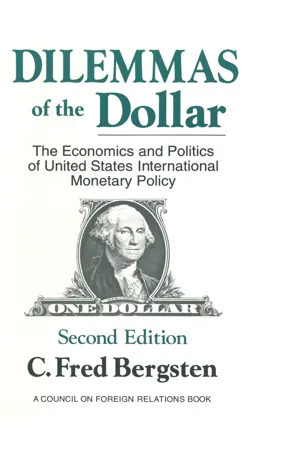
Dilemmas of the Dollar
Economics and Politics of United States International Monetary Policy
- 614 pages
- English
- ePUB (mobile friendly)
- Available on iOS & Android
eBook - ePub
Dilemmas of the Dollar
Economics and Politics of United States International Monetary Policy
About this book
An examination of the role of the dollar in the global financial system which presents a long-term historical perspective on the international monetary system in this century. The main focus is on the evaluation of the global financial system in the post-war period.
Information
Subtopic
Business GeneralIndex
EconomicsPart I
The International Monetary System-Myth and Reality
1
The United States and International Monetary Reform
The Purpose of This Book
This book is about the effects of alternative international monetary arrangements on the national interests of the United States. Its method is to analyze the costs and benefits of the alternatives to the United States, by applying a number of economic and political criteria to each. Its objective is twofold: to deepen understanding of the impact of different monetary arrangements on the United States and to propose an approach to international monetary policy for the United States that will maximize the benefits for it.
The book thus differs markedly from almost all of the previous voluminous literature on international monetary issues. Most analysts have sought to explain the operation of the monetary system from a global standpoint, and virtually all proposals for reform have been based on global criteria, assuming implicitly that each individual country would benefit from a system that provided the best worldwide framework. To be sure, the United States has a major national interest in the effective functioning of the overall monetary system, and this book devotes much attention to that issue. But the economic and political interests of the United States go well beyond the smooth functioning of the system itself, to the specific nature of the very different kinds of conceivable international monetary arrangements. They are the focus of this book.
A second fundamental difference between this book and most other efforts in the field is its explicit effort to integrate economic and political considerations in order to maximize the usefulness of its analysis for policy-making in the real world. Numerous economists have developed elegant models of optimum adjustment devices and international reserve arrangements. A few political scientists have addressed the international monetary issue from the standpoint of its effect on overall relations among nations. But integration of the two approaches has been exceedingly rare, and is absolutely essential to understand the effects of the dollar's role in the past and the implications of its different potential roles in the future. This book attempts to develop such an approach.
The international roles of the dollar1 are the vehicle for pursuing this analysis. The dollar's roles enabled the United States to run balance-of-payments deficits for two decades, and thus to acquire real resources from the rest of the world and avoid serious external financial constraint on either its domestic economic policy or its foreign policy. But the roles of the dollar also precluded effective adjustment of those deficits, generating unemployment in the United States and promoting tendencies toward protectionism and isolationism which raised major questions about the overall world role of the United States in the 1970s and beyond. The pervasive roles of the dollar both derived from and in turn promoted the globalist foreign policy of the United States, but they may have impeded necessary and desirable modification of that policy. As we shall see, these and other dilemmas deriving from the dollar's international roles have had pervasive effects on U.S. economic and foreign policies throughout the postwar period, and choices made concerning the dollar's future roles will continue to have an important impact on both for the foreseeable future.
Indeed, the viewpoint of this book is that U.S. international monetary policy can only be effectively understood through an analysis of the dollar's international roles, and of the perceptions of those roles and the outlook for them held by U.S. officials. Views about the dollar go far to explain why the United States has always opposed an increase in the official price of gold, even when it held by far the largest share of the world's stock; why, seemingly paradoxically, it promoted rivals to itself through the international use of other national currencies in the early 1960s and the creation of Special Drawing Rights in the mid-1960s; why it frequently opposed exchange-rate changes, even revaluations by surplus countries which would have helped the U.S. balance of payments, throughout most of the postwar period; and why, in what appears to be a total reversal, it has become an ardent advocate of exchange-rate flexibility in the 1970s. This book will assess U.S. international monetary policy through the focus of the international roles of the dollar—past, present, and potential. It covers much of the life cycle of the dollar as a key currency: its birth, its moderate expansion in the early postwar period and rapid expansion during the late 1960s and early 1970s, and its widespread repudiation by other countries in 1975.
This analysis of the dollar also has important implications for the functioning and future of the international monetary system. It is obvious that the dollar played a dominant role in the Bretton Woods system, which provided the financial basis of the postwar world economy from 1946 until 1971. In fact the evolution of the postwar monetary system can be conveniently viewed in the four phases marked by the different positions of the dollar. The first phase lasted through 1958, when the dollar was the only major convertible currency and the term "dollar shortage" best typified the international currency situation. The second phase lasted from 1959 until 1967-68, when all major currencies were truly convertible. The third phase ran until August 1971, with the dollar's convertibility into U.S. reserves (primarily gold) becoming increasingly nominal and the world splitting into de facto currency areas as a result. The fourth has been with us since August 1971, when the dollar has been the only major currency not convertible into the reserve assets of its national monetary authority and the international monetary system has quickly evolved in significant new directions—including the rapid ascendance to international prominence of several additional national currencies, particularly the German mark.
Significantly, the four major postwar phases of the balance-of-payments adjustment process are virtually identical with these four phases of the roles of the dollar. Until 1958, controls over international transactions—both capital and trade flows—were pervasive, and changes in those controls were the major mode of adjustment used by most countries. From 1959 until 1967-68 adjustment was largely eschewed in favor of financing of the surpluses (in Continental Europe) and deficits (in the United States and United Kingdom) which dominated. From 1967 to 1971, exchange rates once more began to change and controls over international transactions again began to proliferate. And, since 1971, flexible exchange rates and frequent changes of the parities which continued to exist have wholly transformed the adjustment process. The changing roles of the dollar thus provide a useful basis for analyzing all key aspects of the postwar monetary system, past and present.
Of even greater importance is the fact that different views about the roles to be played by the dollar in the future are a central issue, perhaps the centra] issue, in the efforts undertaken by national authorities around the world since 1971 to develop a stable successor to the Bretton Woods system. Debates about "convertibility" and new modes of adjustment are rooted in sharply divergent views about the future of the dollar. Some experts, particularly in the United States, but also to a surprising extent in other countries, wish to return to the dollar standard of the past—often without openly saying so. Others wish to eliminate completely the international roles of the dollar; having done so, part of this group would seek simply "to return to the charter of Bretton Woods," while others would seek an entirely new system instead. And others strike a more intermediate position.
This is partly because much of the debate about the international monetary system really centers on the distribution of income and political power, both among and within countries. There are a number of technically feasible solutions to the problems of balance-of pavments adjustment and international reserves. But the different solutions may have quite different effects on different countries, and different groups within countries. Because the focus of this book is the national interests of the United States, in both economic and political terms, it recognizes this reality and pays significant attention to it.
Thus the roles of the dollar are the organizing principle of the volume rather than the usual focus on the adjustment, liquidity and confidence problems—although each of those three issues will be carefully considered in the analysis of the dollar's roles. Indeed, it is the thesis of this book that the roles of the dollar were so central to "the Bretton Woods system" that any fundamental changes in that system can be achieved only through sweeping changes in the roles of the dollar. It is also a conclusion of this book that fundamental change would be very much in the national interests of the United States. In any event, it is clear that the implications of alternative new monetary arrangements can be understood—particularly from the standpoint of the United States—only in the light of thorough analysis of the effects of the roles of the dollar throughout the postwar period.
In addition, the monetary system which has been evolving in recent years, and even more so the system of the future, could be decisively affected by the international roles of new key currencies, particularly th German mark and perhaps also the Japanese yen. This study of the postwar roles of the dollar should expand understanding of the implications of such developments, from the standpoint of both the new key currency countries themselves and the system as a whole. Indeed, this book will draw general conclusions about the international roles of national currencies—which have, despite textbook references to a "gold standard" and "the Bretton Woods System," dominated international monetary affairs for at least a century.
Throughout this analysis of the effects on the United States of the international roles of the dollar, references are made to the effects on the United Kingdom, past and present, of the international roles of sterling. From this comparison emerges empirical evidence concerning the criteria which originally propel national currencies into international roles and their effects on the respective key currency countries. These patterns can be applied to the outlook for the evolution of new currencies in the future, and they do in fact derive additional (if very preliminary) support from the rapid international emergence of the German mark in recent years. The analysis of the international roles of national currencies in this book thus carries implications for future monetary arrangements beyond those which apply directly to U.S. policy and the dollar.
The Plan of the Book
This book is divided into three parts. Part I outlines the economic and political requirements which must be fulfilled by any effective international monetary system, and traces the way in which the pre-1914, interwar, and postwar systems have gone about doing so in practice as well as in theory. Both the conceptual and historical presentations focus on the pervasive roles played in those systems by national currencies, originally (but not solely) sterling and especially the dollar since World War II. Part I should provide useful orientation and background for the nonspecialist. The specialist can skip most of it. However, most economists will find new material in the discussion of the political underpinings of international monetary arrangements in the second half of Chapter 2. And my short history of the postwar period in Chapter 3 puts forth the original thesis that the "Bretton Woods system" can best be understood as a tripartite world comprising three evolving de facto monetary zones: a dollar area and a gold bloc along with the widely recognized sterling area.
Part II provides the analytical core of the book. Chapters 4, 5, and 6 assess the political and economic criteria which a currency must meet to achieve and maintain key currency status. The analysis is both conceptual and empirical, drawing on the British and American experiences of the past century. It attempts to provide a general theory of key currencies, and its conclusions pave the way for costbenefit analysis of the effect on the United States of alternative international roles for the dollar by indicating what is required of the United States under such alternatives. It also paves the way for predictions about the evolution of new key currencies in the future.
Chapters 7 through 10 estimate the effects on the United States or the roles of the dollar, primarily under the monetary system which existed prior to August 1971. Chapter 7 assesses the net direct impact on the U.S. balance-of-payments of the dollar's roles: changes in foreign lending by U.S. banks, the interest payments and earnings which result. It will reach conclusions on the conditions under which the dollar's roles provide net financing for U.S. deficits, a...
Table of contents
- Cover
- Half Title
- Title
- Copyright
- Comment Robert Guttmann
- Dedication
- Contents
- Preface
- Part I THE INTERNATIONAL MONETARY SYSTEM—MYTH AND REALITY
- Part II THE INTERNATIONAL ROLE OF THE DOLLAR
- Part III POLICY ALTERNATIVES AND REFORM PROPOSALS
- Index
- About the Author
Trusted by 375,005 students
Access to over 1.5 million titles for a fair monthly price.
Study more efficiently using our study tools.
Frequently asked questions
Yes, you can cancel anytime from the Subscription tab in your account settings on the Perlego website. Your subscription will stay active until the end of your current billing period. Learn how to cancel your subscription
No, books cannot be downloaded as external files, such as PDFs, for use outside of Perlego. However, you can download books within the Perlego app for offline reading on mobile or tablet. Learn how to download books offline
Perlego offers two plans: Essential and Complete
- Essential is ideal for learners and professionals who enjoy exploring a wide range of subjects. Access the Essential Library with 800,000+ trusted titles and best-sellers across business, personal growth, and the humanities. Includes unlimited reading time and Standard Read Aloud voice.
- Complete: Perfect for advanced learners and researchers needing full, unrestricted access. Unlock 1.5M+ books across hundreds of subjects, including academic and specialized titles. The Complete Plan also includes advanced features like Premium Read Aloud and Research Assistant.
We are an online textbook subscription service, where you can get access to an entire online library for less than the price of a single book per month. With over 1.5 million books across 990+ topics, we’ve got you covered! Learn about our mission
Look out for the read-aloud symbol on your next book to see if you can listen to it. The read-aloud tool reads text aloud for you, highlighting the text as it is being read. You can pause it, speed it up and slow it down. Learn more about Read Aloud
Yes! You can use the Perlego app on both iOS and Android devices to read anytime, anywhere — even offline. Perfect for commutes or when you’re on the go.
Please note we cannot support devices running on iOS 13 and Android 7 or earlier. Learn more about using the app
Please note we cannot support devices running on iOS 13 and Android 7 or earlier. Learn more about using the app
Yes, you can access Dilemmas of the Dollar by C. Fred Bergsten in PDF and/or ePUB format, as well as other popular books in Economics & Business General. We have over 1.5 million books available in our catalogue for you to explore.