Taking as a starting point the most enduring insights to emerge from acclaimed researcher Arthur Applebee's scholarship, this volume brings together leading experts to fully examine his work for its explanatory power and its potential to shape current and future research agendas. Focused on the ways in which students learn, schools teach, and assessors evaluate the forms and uses of language needed to flourish and grow, Applebee's work reconceptualized how educators view language development and use in relation to schooling. Organized around three themes—Considering Curriculum as Conversation; Writing as a Tool for Learning; Talking it Out: Class Discussion and Literary Understanding—the 14 fascinating chapters in this book extend and challenge Applebee's insights.
eBook - ePub
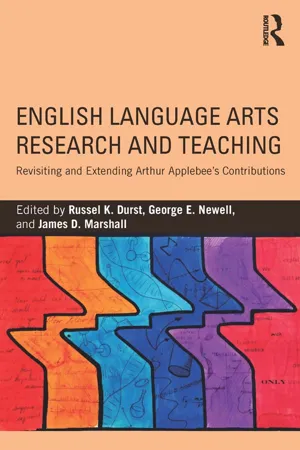
English Language Arts Research and Teaching
Revisiting and Extending Arthur Applebee’s Contributions
- 252 pages
- English
- ePUB (mobile friendly)
- Available on iOS & Android
eBook - ePub
English Language Arts Research and Teaching
Revisiting and Extending Arthur Applebee’s Contributions
About this book
Information
1
INTRODUCTION
Arthur N. Applebee: A Scholar’s Life in Retrospect
Arthur Noble Applebee was a major scholar in English language and literacy for more than 40 years. Throughout this time, his work has had a major influence on both policy and practice in the United States and across the world. In this chapter, I will discuss aspects of his life as well as his work; together they help us understand the complex intellectual base that underlay his inquiries and interpretations.
As Arthur knew so well, life’s experiences shape thinking, and his own life provides keen evidence of this assertion. The quick review that follows will help us understand the breadth of experience that served as roots of his intellectual development. Arthur Noble Applebee was born into a highly educated family. His parents both had master’s degrees, and the grandfather for whom he was named and with whom he had a very close relationship was a physician who graduated from Chicago Medical School, was Chief Surgeon for the British government in St. Kitts and Nevis, and then was director of a tuberculosis rehabilitation center in New York state. His great grandfather William, the physician’s father, was a Presbyterian minister who studied religion at the University of Edinburgh and, upon his request, was assigned a ministry in Halifax, Nova Scotia. When grown, William’s children eventually settled in England, Scotland, Canada, and in Arthur’s grandfather’s case, the United States. Arthur was born in Canada. Although he moved to the United States as an infant, for most of his adult life, his passport was always questioned upon re-entry to the United States. As a result, as a professional who travelled often, he remained fearful of border crossings until 2001 when the United States legalized dual citizenship.
Arthur attended a small rural school outside of Rochester, New York through his junior year in high school. There, he was such a good student that the guidance counselor suggested that he apply to the top agricultural school in the country for his college education, his vision of stellar job preparation for the best and brightest. As fate would have it, at just about that time, Arthur’s father Roger, who had been teaching English in Rochester and working on projects with Jim Squire, then Director of the National Council of Teachers of English (NCTE), was offered a position teaching English at the University of Illinois, Urbana/Champaign. And so, Arthur spent his last year of high school at the University of Illinois, Urbana’s Uni High, where he was such a math whiz that he took all of the advanced mathematics and economics courses offered. For spending money, he worked as a stock boy at NCTE. This marks the beginning of his sensitivities, sensibilities, and future.
When he began his freshman year at Yale, Arthur was a declared economics major; but a problem soon arose. Although he had already taken what he considered equivalents of the freshman economics courses, his advisor insisted it was policy for all students to take the Yale courses—to have exposure to Yale’s basics. Arthur did so but was so bored that after his first year, he transferred to an English major, where he studied happily through graduation. His advisor was John Hersey and he took courses with Robert Penn Warren while also working part-time for NCTE doing research and writing for the association. His citations for articles begin in 1966 when he was a sophomore (Applebee and Corbin, 1966).
After Yale, Arthur took his MAT at Harvard, also taking linguistics courses with Noam Chomsky, among others. He continued to research and write for NCTE, often doing historical research into the history of English education that would feed into his first book Tradition and Reform in the Teaching of English (Applebee, 1974), published by NCTE and presently available online and used in English education classes as well as for reference. During his years as a master’s student, he was influenced by his reading of Roger Brown (1958), Jerome Bruner (1968), Kenneth Burke (1945, 1950, 1957, 1966), and Thomas Kuhn (1962), among others.
Arthur’s master’s studies coincided with the Vietnam War, during which time his position as a conscientious objector led him to complete two years of alternative service in the Child Development Laboratory at Massachusetts General Hospital, where Keith Connors was director. Arthur’s role was to run lab tests on what were then called “learning disabled” children. This led to the publication of three articles (Applebee, 1971a, 1971b, 1973b), two of which (1971b and 1973b) are still cited today.
While at Harvard and the Child Development Laboratory, Arthur read broadly in the areas of linguistics, philosophy, and psychology as well as education, and he developed a special interest in teaching and learning from a framework anchored in language and thought in social settings. He was particularly taken by the work of James Britton (see Britton, 1970; Britton, Burgess, Martin, McLeod, and Rosen, 1975) at the University of London, whose focus was on reading, writing, and discussion as natural language activities that support learning, which is most effectively achieved in language and content-rich classroom environments. Following his inclination, Arthur’s doctoral years were spent at the University of London with James Britton as his advisor. There, he read widely: his intellectual framework was influenced by such scholars as Roger Brown (1958), Jerome Bruner (1968, 1974), Kenneth Burke (1945, 1950, 1957, 1966), Courtney Cazden (1979), Michael Halliday (1977), Arthur Koestler, 1964), Thomas Kuhn (1962), George Kelly (1955), and Lev Seminovich Vygotsky (1962). While in England, Arthur also taught English and drama and was an evaluator in the International Microteaching Research Unit at the University of Lancaster. Several papers on microteaching and repertory grids grew from this work (Applebee, 1975, 1976a, 1976b, 1976c; Perrott, Applebee, Hall, Heap, and Watson, 1975a; Perrott, Applebee, Heap, and Watson, 1975b, 1976). His dissertation, The Child’s Concept of Story (Applebee, 1978), was extremely well received and remains a classic.
Once Arthur completed his dissertation, he began applying for and receiving multiyear grants to support his work. He had learned from his mentors and from his previous success in winning large-scale grants (see Appendix 1). For instance, in 1980, he had a two-year grant from the National Institute of Education (the precursor of the Institute on Educational Science) to do a National Study of Writing in the Secondary School. By 1982 he had a four-year grant from the National Institute of Education to study Writing and Learning in the Secondary School Curriculum. This was followed by the establishment of the National Research Center on Literature Teaching and Learning (1987–1996; co-founded with Judith Langer and Alan Purves), which became the National Research Center on English Learning and Achievement (CELA; 1997–2005). After government funding in the area ran out, CELA continued with research supported by a series of foundation grants. Throughout his career, the topics Arthur chose to study were those he felt had been scantly conceptualized, little studied, problematic in the field, or any or all combinations of these.
It was from this rich and multifaceted background that Arthur Applebee’s professorial work began, first at Stanford University and then at the University at Albany where he was Distinguished Professor as well as Department Chair in Educational Theory and Practice and co-director of the Center on English Learning and Achievement (CELA). From his earliest professorial days, he was a mature scholar who took on weighty issues that he hoped would inform and change the field—and they did. We will look at his work in chronological order. This will permit us to identify particular themes and concerns that persist as well as those that have changed and those that have emerged over time.
Let us look at the work from seven vantage points: the history of English education, literature and children’s concepts, writing and schooling, what happened to the canon, what curriculum means, writing instruction revisited, and the development of writing abilities. The discussion here does not encompass all his works and, with the exception of the last body of work, focuses on his research studies and the books that followed rather than on his articles and chapters—and even those that are discussed can be re-sorted around other equally potent themes.
The History of English Education
Arthur’s first book, Tradition and Reform (Applebee, 1974), began as a high school English assignment that “got out of hand.” Arthur’s work at NCTE stoked his curiosity about the history of the teaching of literature, and his paper stoked NCTE’s desire to learn more aspects of that history. It is here we can we can read the historical evidence from colonial times through the 1960s that underlies the book; and we see, through his presentation, how this convinced Arthur that societies change over time and that with these, come changes in what people consider to be the goals of education—in this case literature education—and the best ways to teach it. The book was Arthur’s attempt to lay out the intellectual roots of the field. For example, among other traditions, he describes the beginnings of and thereafter the always present but intermittently popular Progressivism and the continuing attempts to teach increasingly more students to read through literacy and culture. Further, he makes it clear that there is always tension between past and present, tradition and reform. He shows us that over time, there were false starts but also much change—whether in the components deemed critical to the discipline, the structure of the curriculum, specifically who English students were deemed to be, and/or the effects of these on approaches to teaching. These issues are real and recurring.
Literature and Children’s Concepts
As mentioned above, Arthur was deeply impressed by the works he read as a master’s student and then a doctoral student, and these strongly contributed to his own developing theoretical framework. For his doctoral dissertation, with a focus on relationships between language and understanding, he wanted to identify and explain patterns in children’s literary sense-making from the ages of 2 to 17. As a model, he used James Britton’s research group’s multiyear study, published in The Development of Writing Abilities (11–18) (Britton et al., 1975). They were near completion of the work when Arthur joined the London group, and he was taken with the complexity of the study, the freshness of the ideas, and the importance it held for education. No matter that Arthur had no grant, no research team, and no completed work to build on; because of his work at Massachusetts General, his work on Tradition and Reform, and his taste of the research approach used by Britton’s team, he forged ahead on a project that was far beyond dissertation-size in scope and complexity. And as had been and continued to be his working style, he took it on full steam.
During the era in which the work was done, psychological studies focused on conceptual development out-of-context. Following this lead, Arthur’s research traced conceptual understanding of literature from a neo-Piagetian perspective. He looked at reading, writing, and oral language as natural literacy activities without distinction, but not in the context of schooling, which Arthur’s work soon did, with the addition of sociolinguistic, psycholinguistic, and constructivist conceptualizations to his own theoretical construct. Throughout his career, the data would be gathered in classrooms within the ordinary contexts of teaching and learning. In The Child’s Concept of Story (Applebee, 1978), Arthur’s reading of scholars such as George Kelly (1955), Thomas Kuhn (1962), Susanne Langer (1942, 1953, 1967), Michael Polanyi (1958), and Lev Seminovich Vygotsky (1962, 1978) helped him combine analyses of children’s discourse with experiments from stage analysis. Together, they made him very aware of the tensions between experimental and qualitative/interpretive paradigms, and his attempt to resolve this tension was visible in all of his future work marked by mixed method designs.
Since the reader of this chapter already knows a bit about Arthur’s early mathematical abilities as well as the research traditions in which he was trained, it may be interesting to note that throughout his career, Arthur continued to keep up with new and innovative experimental as well as qualitative methodologies, especially those he considered essential to his work. He also encouraged his students to follow in this tradition. The Child’s Concept of Story, the work of one person over two years...
Table of contents
- Cover
- Half Title
- Title Page
- Copyright Page
- Table of Contents
- Artist’s Statement about the Cover
- Preface
- 1 Introduction: Arthur N. Applebee: A Scholar’s Life in Retrospect
- Section 1 Considering Curriculum as Conversation
- Section 2 Writing as a Tool for Learning
- Section 3 Talking it Out: Class Discussion and Literary Understanding
- Section 4 Conclusion
- List of Contributors
- Index
Trusted by 375,005 students
Access to over 1.5 million titles for a fair monthly price.
Study more efficiently using our study tools.
Frequently asked questions
Yes, you can cancel anytime from the Subscription tab in your account settings on the Perlego website. Your subscription will stay active until the end of your current billing period. Learn how to cancel your subscription
No, books cannot be downloaded as external files, such as PDFs, for use outside of Perlego. However, you can download books within the Perlego app for offline reading on mobile or tablet. Learn how to download books offline
Perlego offers two plans: Essential and Complete
- Essential is ideal for learners and professionals who enjoy exploring a wide range of subjects. Access the Essential Library with 800,000+ trusted titles and best-sellers across business, personal growth, and the humanities. Includes unlimited reading time and Standard Read Aloud voice.
- Complete: Perfect for advanced learners and researchers needing full, unrestricted access. Unlock 1.5M+ books across hundreds of subjects, including academic and specialized titles. The Complete Plan also includes advanced features like Premium Read Aloud and Research Assistant.
We are an online textbook subscription service, where you can get access to an entire online library for less than the price of a single book per month. With over 1.5 million books across 990+ topics, we’ve got you covered! Learn about our mission
Look out for the read-aloud symbol on your next book to see if you can listen to it. The read-aloud tool reads text aloud for you, highlighting the text as it is being read. You can pause it, speed it up and slow it down. Learn more about Read Aloud
Yes! You can use the Perlego app on both iOS and Android devices to read anytime, anywhere — even offline. Perfect for commutes or when you’re on the go.
Please note we cannot support devices running on iOS 13 and Android 7 or earlier. Learn more about using the app
Please note we cannot support devices running on iOS 13 and Android 7 or earlier. Learn more about using the app
Yes, you can access English Language Arts Research and Teaching by Russel K. Durst,George E. Newell,James D. Marshall in PDF and/or ePUB format, as well as other popular books in Filología & Educación general. We have over 1.5 million books available in our catalogue for you to explore.