eBook - ePub
The Social Project Manager
Balancing Collaboration with Centralised Control in a Project Driven World
- 200 pages
- English
- ePUB (mobile friendly)
- Available on iOS & Android
eBook - ePub
The Social Project Manager
Balancing Collaboration with Centralised Control in a Project Driven World
About this book
The Social Project Manager describes a non-traditional way of organising projects, managing project performance and progress. The aim being to deliver, at the enterprise level, a common goal for the business; one that harnesses the performance advantages of a collaborative community. Social elements help mitigate the constraints associated with the control aspect of project management, which is essential for governance. Team collaboration, problem solving and engagement in projects will never come from technology alone but require careful management. Peter Taylor draws on research from projects and the worlds of social media and communication to paint a vivid and practical guide to the why and how of social project management. There is no simple template for you to follow; instead he provides an explanation of the benefits, the tools and the constraints so that readers can navigate through to an approach that is sensitive to the culture of their organization and the nature of the projects that they run. Alongside the author's ideas, the text features advice and case examples from many of the leading technology providers. The Social Project Manager is a very-readable and down-to-earth guide from one of the most highly-regarded practitioners and commentators on the world of project management.
1 The Past, the Present and the Possible Social Future
A project is a temporary endeavour where people come together to work towards a common goal and purpose; it is therefore a temporary endeavour that must rely on a social system of communication and collaboration in order to succeed. Projects that can be delivered by a single person alone do exist, but tend to be minimal in terms of their impact, scope and purpose. That said, even in such cases, more than likely, there will have been historical or current indirect reference to other people’s thoughts and views and so, in reality, there is no such thing as a non-social project.
As such, for common purpose in a social project to be achieved, there cannot be chaos, there cannot be a vacuum of communication, nor can there be an absence of control.
I have previously described project management as entering its fourth phase:1 the original was the organic growth of project capability from the early dawn of mankind through the construction of the iconic structures we still know of today; the second was back in the mid-twentieth century, which was a period focused on tools and process; and the third was at the end of the twentieth century, which was about attitude and behaviour. Now we are in the fourth phase, where the challenge of today is complexity and criticality. This challenge is being met by a new generation of project ‘social’ managers and a new generation of project ‘social’ tools – the generation of the ‘Social Project Manager’.
Social project management is a non-traditional way of organising projects and managing project performance and progress aimed at delivering, at the enterprise level, a common goal for the business, but harnessing the performance advantages of a collaborative community.
There is a paradigm shift taking place in many organisations that is about finding a practical balance between the challenges to traditional project management made by what is known as Project Management 2.0 – which encouraged a move away from centralised control of projects and instead promoted the value of team collaboration – and the practical recognition that large-scale projects do require a stronger form of centralised control and governance.
It is this balance, if correctly made, that will take the best of both worlds and move project management into the highest levels of performance and achievement, into the world of the social project and therefore the world of the Social Project Manager.
THE TRADITIONAL AND THE SOCIALLY CHALLENGED WORLD
There is an argument from some people that project management, as we have known for the last 50 or so years, is ‘broken’, but at the same time we are being offered an opportunity to take project management to a whole new level of collective and collaborative ways of working.
Whether you believe in the ‘broken’ theory or not, it is generally accepted that we, in project management, are in the midst of a period of transition as technology – in particular, the social tools – offers a platform for this new way of collective and collaborative way of working.
In this section we will take a closer look at the opportunity of what is commonly referred to as social project management, but with a reflection of the first two iterations of project management; traditional project management and Project Management 2.0, as well as further exploring the idea of project management being ‘broken’.
At this point we can begin to consider the challenges of moving to a real social project management world as opposed to acting only as ‘digital’ project managers trying to balance both the old (the traditional) with the new, and throwing effort into the ‘social’ as an overlaying addition.
TRADITIONAL PROJECT MANAGEMENT AND PROJECT MANAGEMENT 2.0
It is important to start with an understanding of where we are and how we got here. Therefore, let us take a short look at what is referred to as ‘traditional project management’ and then to what is known as ‘Project Management 2.0’, before we move on to explore true ‘social project management’.
TRADITIONAL PROJECT MANAGEMENT
Dr Harold Kerzner,2 the leading authority on project management, states succinctly that traditional project management (or what might be retrospectively referred to as Project Management 1.0)3 is where projects and project management are based upon the following activities:
Projects are identified, evaluated and approved without any involvement by project managers.
Project planning is done by a centralized planning group, which may or may not include the project manager.
Even though the planners may not fully understand the complexities of the project, the assumption is made that the planners can develop the correct baselines and plans which would remain unchanged for the duration of the project.
Team members are assigned to the project and expected to perform according to a plan in which they had virtually no input.
Baselines are established and often approved by senior management without any input from the project team. The assumption is made that these baselines will not change over the duration of the project.
Any deviations from the baselines are seen as variances that need to be corrected to maintain the original plan.
Project success is defined as meeting the planned baselines; resources and tasks may be continuously realigned to maintain the baselines.
If scope changes are necessary, there is a tendency to approve only those scope changes where the existing baselines will not change very much.
And he goes on to suggest that:
executives were fearful that project managers might begin making decisions that should be made only at the executive levels. Senior management wanted standardization and control in the way that projects were being managed. Project managers were given very little real authority to make decisions. Almost all important decisions were made by the project sponsors. Enterprise project management (EPM) methodologies were created with the mistaken belief that one size fits all. Every project had to follow the EPM methodology because it supported the executives’ comfort zones regardless of the ramifications. The EPM methodologies were constructed around rigid policies and procedures. Project status reporting resulted in massive reports and as much as 25% of a project’s budget could be consumed by reporting requirements.
And so it was a world of centralised control and delegation through which the project manager had to conduct top-down planning from an executive level, with an implied structure of authority down through the project levels: steering group to project sponsor to project manager to project team members. Communication, the true heartbeat of projects, was managed in a way that, if not exactly discouraging inter-team communication, did restrict it in a way that made the project manager a centralising and approving point.
This should not be considered purely in a negative way. Just take a look around you and consider the amazing success of many projects that have added to our quality of life – projects of such complexity and scale that the outcome and deliverables make us proud and often take our breath away as to what we humans can achieve when we get it right.
PROJECT MANAGEMENT 2.0
Dr Harold Kerzner states about the progression to what is known as Project Management 2.04 in the following way:
The idea for PM 2.0 came primarily from those project managers involved in software development projects where adding version numbers to project management seemed a necessity because of the different tools now being used and different project needs. Over the years, several studies have been conducted to determine the causes of IT project failures. Common failure threads among all of the studies included lack of user involvement early on, poor governance, and isolated decision making. These common threads have identified the need for distributed collaboration on IT projects. From an IT perspective, we can define PM 2.0 using the following formula:
PM 2.0 = PM 1.0 + distributed collaboration
Distributed collaboration is driven by open communication. Traditional project management favoured hierarchical decision making and formalized reporting whereas PM 2.0 stresses the need for access to information by the entire project team, including the stakeholders and those people that sit on the project governance committee. Collaboration through formalized reporting can be a very expensive proposition which is why PM 2.0 focuses heavily upon project management metrics, KPIs [key performance indicators] and dashboard reporting systems.
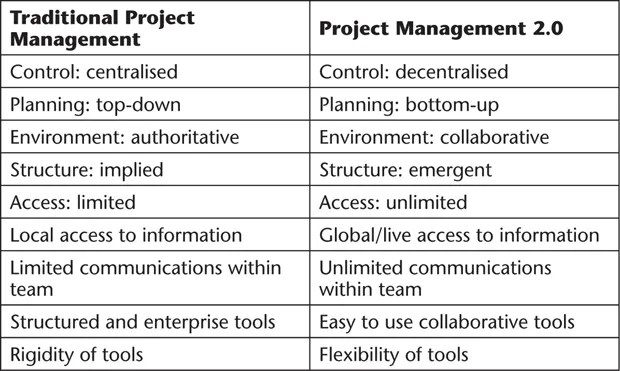
And so this is a project world of decentralised control, with planning from the bottom up and in a collaborative environment – a collaborative environment with a far more open approach and access to information and decisions, together with the active encouragement for communications at and through all levels of the project team structure for greater efficiency and team member empowerment.
Table 1.1 Traditional and 2.0 Project Management Comparisons
But to counter-balance this, there is the need of the large-scale projects to require a much stronger form of centralised control and governance in order to manage the risk and coordinate the full programme of activity, perhaps with a regulatory overhead.
To summarise these two worlds, Table 1.1 outlines the opposing focus of the traditional and the 2.0 project management approaches, looking at control, planning, the project environment, the project structure, access to information and the style of communication along with tool usage.
But we need to understand that this is Project Management 2.0 and not true social project management. Dr Kerzner himself goes on to comment that ‘This increase in collaboration leads some people to believe that PM 2.0 is “socialized project management”’, but adds a word of caution: ‘Although PM 2.0 has been reasonably successful on small projects, the question still remains as to whether PM 1.0 is better for large projects. The jury has not delivered a verdict yet; however, some of the publications that discuss how PM 1.0 and PM 2.0 can be combined offer promise. Perhaps in a few years we will be discussing PM 3.0. Only time will tell.’
In this book we will explore social project management and the way we will do this on the basis, and founding assumption, that social project management recognises that there are clearly two worlds:
• first, the world of the large, enterprise project requiring a more centralised form of control; and
• second, the world of the smaller, less complex projects that can thrive in a decentralised controlling manner,
but with the belief that both large/complex and small/simpler projects can benefit from higher levels of social collaboration and team empowerment.
If you search for ‘social project management’ or ‘social project manager’ online, what you will find, at least for the first three or four pages of results, is a long list of social tool providers, clearly a gr...
Table of contents
- Cover Page
- Title Page
- Copyright Page
- Contents
- List of Figures
- List of Tables
- Acknowledgements
- Foreword
- 1 The Past, the Present and the Possible Social Future
- 2 The Challenge of Being a Social Project Manager
- 3 The Practical Social Project Manager
- 4 The Social Project Manager as a Commercial Force
- 5 The Socially Mature Organisation
- 6 Social Project Management Tips
- Appendices
- Index
Trusted by 375,005 students
Access to over 1.5 million titles for a fair monthly price.
Study more efficiently using our study tools.
Frequently asked questions
Yes, you can cancel anytime from the Subscription tab in your account settings on the Perlego website. Your subscription will stay active until the end of your current billing period. Learn how to cancel your subscription
No, books cannot be downloaded as external files, such as PDFs, for use outside of Perlego. However, you can download books within the Perlego app for offline reading on mobile or tablet. Learn how to download books offline
Perlego offers two plans: Essential and Complete
- Essential is ideal for learners and professionals who enjoy exploring a wide range of subjects. Access the Essential Library with 800,000+ trusted titles and best-sellers across business, personal growth, and the humanities. Includes unlimited reading time and Standard Read Aloud voice.
- Complete: Perfect for advanced learners and researchers needing full, unrestricted access. Unlock 1.5M+ books across hundreds of subjects, including academic and specialized titles. The Complete Plan also includes advanced features like Premium Read Aloud and Research Assistant.
We are an online textbook subscription service, where you can get access to an entire online library for less than the price of a single book per month. With over 1.5 million books across 990+ topics, we’ve got you covered! Learn about our mission
Look out for the read-aloud symbol on your next book to see if you can listen to it. The read-aloud tool reads text aloud for you, highlighting the text as it is being read. You can pause it, speed it up and slow it down. Learn more about Read Aloud
Yes! You can use the Perlego app on both iOS and Android devices to read anytime, anywhere — even offline. Perfect for commutes or when you’re on the go.
Please note we cannot support devices running on iOS 13 and Android 7 or earlier. Learn more about using the app
Please note we cannot support devices running on iOS 13 and Android 7 or earlier. Learn more about using the app
Yes, you can access The Social Project Manager by Peter Taylor in PDF and/or ePUB format, as well as other popular books in Business & Business General. We have over 1.5 million books available in our catalogue for you to explore.