- 117 pages
- English
- ePUB (mobile friendly)
- Available on iOS & Android
eBook - ePub
About this book
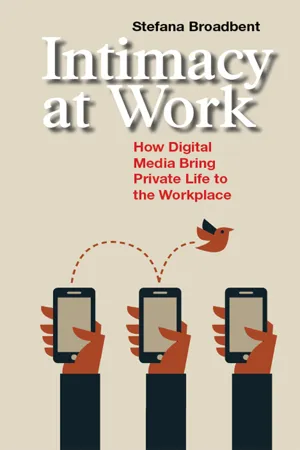
According to some social critics, the digital age involves a retreat into the isolation of intelligent machines. Acclaimed scholar Stefana Broadbent takes another view, that digital technologies allow people to bring their private lives into the often alienating world of work. Through ethnographic evidence and data gathered from large samples in Europe and the U.S., Intimacy at Work looks at a paradox in modern life: Although human beings today spend so much of their waking hours working, they remain increasingly connected to family and friends—because of digital and social media. This book -shows how portable communications sustain personal networks offering a sense of identity, comfort, support, and enjoyment in the workplace;-demonstrates through numerous case studies that digital technologies provide a kind of "safety net" in times of economic crisis, softening the precariousness of existence;-is a revised edition of a volume published in French (L'Intimité au Travail, 2011), which won the prestigious AFCI Prize for books on business communications.
Information

Chapter 1
Some Characteristics of Digital Communication
Communicating with an Intimate Network in 2009
By 2009, in developed countries, by and large, most people had access to multiple mediated channels of communication every day: voice calls through a fixed or mobile phone or through some VOIP channel; textual communication via e-mail; texting, messaging, and social networking platforms; and images and videos via social media in various forms. A good proportion of adults in Europe and the United States were using at least four different channels a day. Many regular Internet users had more than one e-mail account, and most social networking users had more than one personal page. In a number of European countries there were more mobile subscriptions than inhabitants.
All this is well known and extensively hyped. What is less known is that with all these channels, devices, and services, a user contacted on average the same five people 80 percent of the time.
The media rarely reported this concentration of exchanges on very few relationships, and very often users themselves were not aware of it. The concurrent emergence of social networking sites and the sudden generalisation of new forms of very ostensive public communication, obfuscated the more mundane transformation of private and intimate exchanges. And yet, even now, the vast majority of people have regular contact with only a tiny subset of the people they know, essentially with the inner core of significant relationships. What has significantly changed have been the social settings in which these exchanges are taking place. In the following chapters, I will argue that the profound transformation of intimate communication has been no less subversive than social media and has in fact deeply challenged some well established norms and institutions.
Communicating with Loved Ones
Between 2004 and 2008 I ran an Observatory of Digital Life at Swisscom, the national Telecom operator in Switzerland, where, with a group of social scientists, we carried out extensive research on people’s communication habits. Over a period of four years we asked more than six hundred people, from all age groups, life stages, professional, linguistic, and regional backgrounds, to keep a record of all their communications, excluding only professional exchanges and face-to-face conversations. Participants were asked to keep a diary for four days jotting down every mediated interaction—dialogues via SMS, e-mail, voice calls on landline and mobile phones, and IM sessions or calls from the PC.
It emerged that conversations and exchanges were concentrated among very few partners. In most cases the diversity of channels did not include a diversity of interlocutors on a daily or weekly basis. Multiple channels were being used with the same partners, depending on different situations and different content. Although on average the number of interlocutors mentioned in the diaries ranged between seven and fifteen, most of the exchanges were concentrated on five people. This was particularly true with voice calls from mobiles. Our qualitative data was then confirmed by a data analysis (Schnorf 2008) of the mobile-user database of 5 million subscribers, indicating that 80 percent of the calls from any one phone during a one-month period were made to four people. Written channels such as SMS and e-mail seemed to be slightly more diverse in terms of the number of communication partners.
We also found that channels are used redundantly: the more intense the relationship with someone, the more likely it was that a variety of channels to communicate with that person were being used, calling them on the mobile and landline and also sending SMS messages and e-mails. Parents, children, partners, close friends, and relatives were contacted frequently and with all the channels available.
By contrast, people who were at the periphery of the social environment—contacts seen less frequently or felt to be more distant—were contacted essentially on one channel only. The distant aunt would receive a Christmas card, the friend who lives far away an occasional text, an old colleague the occasional e-mail or message. Only exceptional occasions—such as a visit to the town where the contact lives, an important event, or a request for help—may lead to a change in the communication channel and an increase in the intensity of exchanges.
In 2009 a group of social science researchers from the Facebook Data Team published a report that analyzed the number of communication events between the total database of Facebook subscribers. It emerged that, on average, users had 120 friends but that they actively communicate with less than 10 percent of them.
Facebook researchers defined friendship networks in four different ways:
• All friends: the set of all people they have verified as friends.
• Reciprocal communication: the number of people with whom a person has reciprocal communications or an active exchange of information between two parties.
• One-way communication: the total set of people with whom a person has communicated.
• Maintained relationships: the set of people for whom a user had clicked on a newsfeed story or visited their profile more than twice.
For each user they calculated the size of their reciprocal network, one-way network, and network of maintained relationships, and they then plotted this as a function of the overall number of friends a user has.
People who had 120 friends (which at the time corresponded to the great majority of users) were actively engaging with fewer than 10 people. When the figures were divided by gender, it emerged that the average male user was leaving comments on seven friends’ photos, status updates or wall, and messages and chatted with only four friends. The average female user was commenting on ten friends’ photos, status updates or wall, and messages and chatted with six friends. In other words, Facebook users comment on posts from only about 5 to 10 percent of their Facebook friends.
Users were passively engaging (simply visiting their page or looking at their links) with between two and two and a half times more people in their network than they actively communicate with. The average user was regularly “checking out” the pages and posts of twenty friends. This passive engagement is what leads social networking site users to believe they are communicating more and keeping in touch with more people.
The PEW Institute for Internet and American Life Project, which publishes the most extensive and systematic data on the adoption and usage of digital media in the United States, presented a study in 2009, Social Isolation and New Technology, on the impact of ICT on people’s social ties. Challenging the assumption that online digital life isolates people from their social network and neighbourhood, they found that online activity correlated with a greater level of local engagement and greater variety of social ties. People who regularly spent time online had a slightly bigger number of core ties and a greater likelihood to have nonfamily members in the core group of contacts. However, we should note that the difference was not great: on average the core network of social relations comprises three people—for active Internet users the average was 3.8 people.
This limited number of regular contacts was also found in countries outside Europe or the United States. Japan’s most popular social networking site at the time was MIXI (Takahashi 2010), MIXI users had on average twenty people in their circle of MIXI connections, but of those users around 50 percent had four or fewer people in their “my-miku,” and only 4.8 percent had over forty-one people. Again we found a very small, intimate set of friends being connected via these services.
Data from studies on women’s use of mobile phones in China (Wallis 2008) and in India (Lee 2009; Pryanka 2010) also suggested that communication was focused on a few connections. The migrant women in China interviewed by Wallis had few contacts in their phonebooks. Overall Pryanka’s study on gender and mobile usage in India indicates women’s very restricted use of the phone in many rural households.
In 2010, wanting to study how communication patterns were changing thanks to services like Skype, my students in London and Paris interviewed people who have relatives and family abroad. The vagaries of recruiting people gave us a mix of households, some with very significant and recent ties with people in foreign countries and some who simply came from families who had migrated to Europe many years ago. We also interviewed some people living in hostels in London who were planning to spend just a few months away from home. We were completely blown away by how much communication is going on between adults and, specifically, their mothers.
The ages of the people we interviewed ranged from twenty-five to fifty-five, and we talked to both men and women, some living alone and others with partners and children. Their occupations were also very varied: students, job seekers, nurses, translators, bank clerks, and shop assistants. Some who were living in France or in the UK were originally from Spain, Algeria, Lebanon, Colombia, or Romania. Regardless of geographical distance—some mothers lived in the same city—we found that the most frequent, regular, and lengthy calls these adults were making were, systematically, with their mothers.
The conversations with their mothers were all oral, rarely if ever by text or email, and took place either on the landline or on Skype, occasionally on the cell phone. Everyone mentioned a regular pattern of call, either daily or weekly. Women seemed to be calling on a daily basis, and men weekly or biweekly. The mothers were sometimes retired but sometimes still active professionally. Fathers were mentioned much less frequently; conversations with them were often incidental to talking to the mothers: on Skype, for instance, they might say hello when passing in front of the webcam. Interestingly, many of the participants mentioned that they spoke with their mothers more since they had moved far away than when they lived together under the same roof. They even considered that in many ways their relationship had greatly improved now that it was distant and mediated by technology.
But parents and children were not the only relations who saw their communication increase since the adoption of new communication channels (Brugière and Rivière 2010). In the United States couples talked, texted, or e-mailed each other many times a day, regardless of their age. In a report by the Pew Institute for Internet and American Life (Wellman et al. 2008), it emerged that 47 percent of married couples in America communicated on the cell phone at least once a day.
Jonathan Donner, a researcher who has been studying the adoption of mobile phones in Western Africa, describes the use of deliberate beeping or missed calls in Rwanda. These missed calls, in Donner’s analysis, have different meanings: a request to call back, prearranged codes, or, very often, ways to say, “I’m thinking of you.”
Patrick and his wife beep each other various times a day: “When my wife sees a morning beep, she knows I am just saying ‘hi,’ but if my wife beeps me twice in the late evening, I know that she is done with her work and then I always go to pick her up. I always call back if she beeps more than once” (Donner 2007, 13).
In our own research in France and Switzerland we also found that couples stayed in contact throughout the day.
Mireille and François
Mireille and François have recently had a baby. Mireille is on maternity leave and stays at home most of the day except when she goes out with the baby for a walk. In the bedroom of their small flat they have a computer (with a big monitor), which is always switched on and is their primary means of keeping in touch during the day. François’s office is outside Paris. He has a long commute and also works long hours, often finishing late in the evening. The couple exchange a few e-mails during the day just to say hello and talk about what the baby is doing. When the evening comes and Francois is alone in the office, he switches on Skype and a webcam and so does Mireille at home. While he continues to work, they can have a chat, and François can see what is going on at home. Often in the evening, while the baby is sleeping, Mireille sits at the computer watching videos or e-mailing her friends and chatting away with François at the same time.
Chandy
Chandy is from Sri Lanka and had been living in Switzerland for thirteen years, for the last twelve working as a waiter in a luxury hotel. He has a wife and two children. Chandy at the time was a head waiter and highly appreciated in his job. He had recently been offered the chance of a second job in a nearby town, in an elegant café that belongs to the same chain of luxury hotels. He accepted in order to earn a bit more, even though it meant travelling thirty minutes each way by train during his “break” time from the hotel or working an extra shift at the end of the day and spending less time at home.
Chandy married his wife in Sri Lanka only a few years before, and she came back with him to Switzerland. She did not speak any German, spent most of her day at home with the children, and relied as far as possible on Tamil shops that she knew and a few Tamil friends. However, for most practical matters, such as arranging appointments with doctors or answering letters and paying bills, she had to rely on her husband. If anyone phones the house during the day, she would tell them that her husband would call them back later. Chandy phoned home regularly during his breaks to see if everything was fine and if there were any calls he should make or matters to attend to.
Because his wife really did rely on him for most things, Chandy’s mobile phone was absolutely essential for him. In general he preferred to call her, and she knew not to call him while he was working unless it was truly urgent.
Once routines of mediated communication are established—such as calling each other during the day for a quick hello, messaging, e-mailing, or sending a picture or video to keep abreast of daily events—people tend to rely on these moments of contact and proximity. When, for different reasons such as financial or professional, the routines are interrupted and cannot be substituted with other means of contact, people can become very distressed.
Louis
Louis is a second-generation immigrant from South America who grew up in France and, although he still didn’t have citizenship, felt very French. His parents worked very hard when he was a child and managed to put some money aside for their retirement and his future. They had genuinely suffered from being employed by people who did not consider them in the same way they considered French-born employees. That meant that having your own small business was the road to independence and safety, so some years ago they bought a small café and, after running it for a while, left it to Louis.
The café is cramped, and although in a very nice neighbourhood, it is on a small side street with little to no traffic. It is essentially a place for regulars—local residents who want to get out of the house. In South America going out for a drink or coffee with friends is a well-established respite from family life and home. In the small provincial town of G., where Louis and his parents live, if the habit ever it existed, it disappeared years ago. So business is very bad. Although Louis tried a variety of formulas to attract more customers—small hot snacks at lunch, happy hour drinks—nothing seems work, and he would have sold it ages ago if he didn’t feel an obligation towards his parents.
At the time of the interview the situation was a financial catastrophe. His wife, Isabelle, had to stop working in the café and take on cleaning jobs to bring money to the household. Louis and his wife were always very close, either working side by side or talking together on their mobiles whenever they had a moment. By 2008 they couldn’t afford two cell phones, so he gave up his and only had the café landline. His wife kept hers as a measure of security, but she could not call Louis during the day: one of her employers made a scene because she found Isabelle talking on her mobile phone during working hours, so now she calls her husband only when she is on her way home or between her jobs. To say that Louis and his wife were depressed is not an exaggeration; he felt terribly lonely and stuck in his failing café, and she felt alone in her jobs that she hated.
Louis and his wife had a very strong relationship that their financial situation strained. The unhappiness of both having jobs they disliked was made worse because they could not alleviate their loneliness with a short call or contact during the day.
Continuous Communication
Continuous contact with loved ones mediated by different digital channels rapidly emerged as fairly universal behaviour, embraced by people of different generations and cultures. It was also the first massive digital transformation we witnessed in mediated communication, largely preceding the social media phenomenon. Teenagers were the first to recognise the possibility offered by mediated channels for maintaining a sense of permanent awareness of their friends; they were rapidly copied by their elders.
Mimi Ito, whose research on teenagers in Japan was among the earliest studies of the phenomenon of mobile culture, described very vividly the feeling of being “within earshot.” Writing about SMS, she says,
These messages are predicated on the sense of ambient accessibility, a shared virtual space that is generally available between a few friends or with a loved one. They do not require a deliberate opening of a channel of communication but are based on the expectation that one is in “earshot” … people experience a sense of persistent social space constituted through the periodic exchange of text messages. These messages also define a space of peripheral background awareness that is midway between direct interaction and non-interaction. (Ito and Okabe 2005, 132)
Her description of texting can equally apply to all the other channels of mediated communication, and what we have witnessed was, in fact, the use of multiple channels to ensure that this sense of being in a “persistent social space” is maintained throughout the day, across multiple situations.
Most of the exchanges we captured through our diary studies can be characterised as short updates. All through the day people seemed to make short calls or, increasingly, short texts, messages, and pictures to coordinate arrangements or simply to say what they are doing or feeling. These status reports, endearments, or sharing of some little event provide the sense of permanent awareness described by Mimi Ito.
When we interviewed Ron in 2008 he was in his late thirties and had recently had a baby with his second wife. He also had a teenage son from his previous marriage. He was the sole employee of a car rental company and had quite a lot of empty moments in his day while waiting for customers. The owner was an elderly gentleman who trusted Ron completely: he knew that Ron loves technology and staying in contact but that he is also serious and reliable when it comes to clients and cars.
Ron talked to and sent texts to his wife many times a day:
I really like mobile phones—I have two and so does my wife. I have a mobile line with one company and one with another, and my wife has the same subscriptions as me so the calls to each other are free. Plus we have a fixed phone at home.
I call my wife to say h...
Table of contents
- Cover
- Half Title
- Title Page
- Copyright Page
- Table of Contents
- Acknowledgments
- Introduction
- Chapter 1: Some Characteristics of Digital Communication
- Chapter 2: How Digital Channels Are Supporting Intimacy
- Chapter 3: Intimacy at Work
- Chapter 4: Communication, Productivity, and Trust
- Chapter 5: Accidents, Distraction, and Private Communication
- Chapter 6: Conclusions: Communication and Attention
- Notes
- References
- Index
- About the Author
Trusted by 375,005 students
Access to over 1.5 million titles for a fair monthly price.
Study more efficiently using our study tools.
Frequently asked questions
Yes, you can cancel anytime from the Subscription tab in your account settings on the Perlego website. Your subscription will stay active until the end of your current billing period. Learn how to cancel your subscription
No, books cannot be downloaded as external files, such as PDFs, for use outside of Perlego. However, you can download books within the Perlego app for offline reading on mobile or tablet. Learn how to download books offline
Perlego offers two plans: Essential and Complete
- Essential is ideal for learners and professionals who enjoy exploring a wide range of subjects. Access the Essential Library with 800,000+ trusted titles and best-sellers across business, personal growth, and the humanities. Includes unlimited reading time and Standard Read Aloud voice.
- Complete: Perfect for advanced learners and researchers needing full, unrestricted access. Unlock 1.5M+ books across hundreds of subjects, including academic and specialized titles. The Complete Plan also includes advanced features like Premium Read Aloud and Research Assistant.
We are an online textbook subscription service, where you can get access to an entire online library for less than the price of a single book per month. With over 1.5 million books across 990+ topics, we’ve got you covered! Learn about our mission
Look out for the read-aloud symbol on your next book to see if you can listen to it. The read-aloud tool reads text aloud for you, highlighting the text as it is being read. You can pause it, speed it up and slow it down. Learn more about Read Aloud
Yes! You can use the Perlego app on both iOS and Android devices to read anytime, anywhere — even offline. Perfect for commutes or when you’re on the go.
Please note we cannot support devices running on iOS 13 and Android 7 or earlier. Learn more about using the app
Please note we cannot support devices running on iOS 13 and Android 7 or earlier. Learn more about using the app
Yes, you can access Intimacy at Work by Stefana Broadbent in PDF and/or ePUB format, as well as other popular books in Social Sciences & Anthropology. We have over 1.5 million books available in our catalogue for you to explore.