eBook - ePub
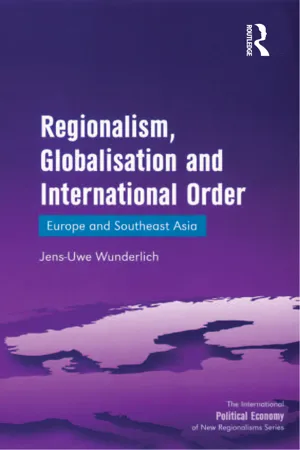
Regionalism, Globalisation and International Order
Europe and Southeast Asia
- 222 pages
- English
- ePUB (mobile friendly)
- Available on iOS & Android
eBook - ePub
About this book
New regionalism and globalization have been prominent themes in academic and political debates since the beginning of the 1990s. Despite the considerable amount of scholarly attention that the new regionalism has received in recent years, its full empirical and theoretical potential has yet to be fully investigated. This illuminating study provides an overview of new avenues in theorizing regionalism and proposes a consolidated framework for analysis and comparison. Offering a comparative historical perspective of European and Southeast Asian regionalism, it presents new and imaginative insights into the theory and practice of regionalism and the links between regional developments, globalization and international order.
Information
Chapter 1
Regionalism and Integration Theory
The First Wave: Traditional Approaches
Theory has to be located within its historical context. That is one of the central arguments of this chapter. Theories of regionalism have emerged in two big waves, each characterised by its own debates between different schools of thought. The first wave lasted from the end of World War Two until the end of the 1980s. Two forms of enquiry drove this wave: First, the need to find theoretical explanations for the development of regional integration in Western Europe; and, second, concerns with finding a solution to the security dilemma arising out of the condition of international anarchy, e.g. the absence of a central authority above state level. Concerted efforts focused on reining in sovereignty and power of the nation-state and on transcending nationalism. Thus, the theoretical debate between supranational and intergovernmental approaches dominated in this period. Generally, supranational approaches aim at restraining the sovereignty of nation-states with the establishment of institutions and decision-making bodies that supersede and override the sovereign authority of nation-states. This stands in contrast to intergovernmental approaches, which emphasise the centrality of sovereignty and the nation-state within the context of international and regional cooperation. The second wave, the new regionalism, will be the topic of the following chapter. This wave of theorising is characterised by a new debate, this time between two different academic disciplines: European studies and international relations. In each wave a distinctive intellectual debate is discernable between scholars coming from very broadly conceived and separate theoretical traditions. An understanding of these debates and their evolution is imperative for our understanding of not only theoretical but also empirical developments. These intellectual exchanges have not only formed and shaped the development of regionalism theory but have also influenced different regional projects.
This chapter offers an overview of the context in which traditional ‘first wave’ theories on regionalism and regional integration emerged, and the form these theories took. Although this literature covers a wide range of issues, what emerges is the overwhelming domination of studies looking at the European process. The greatest challenge for any student of regionalisation is therefore to transcend Euro-centrism and the dualism presented by supranational and intergovernmental approaches in order to facilitate more holistic understandings of regionalism. One of the underlying arguments of this chapter is that integration theory, with its theoretical exchange between suprantionalism and intergovernmentalism, is a sub-branch of regionalism theory and emerged in the wider context of international relations theory. Therefore, we will pay particular attention to the relationship between regionalism, the nation-state and international order.
Theoretical approaches to regionalism, regional integration and regional cooperation have a long history. Scholars have been fascinated with developments in Western Europe where organisations such as the European Coal and Steel Community (ECSC) and the European Economic Community (EEC), emerging in the 1950s, seemed to provide an entirely new paradigm for regional integration. Europe, therefore, became something of a testing ground for a variety of new approaches. This has to be seen in the context of particular historical circumstances. The interest in regional integration and cooperation were an outcome of the popularity of federalism and functionalist approaches in the late 1940s and early 1950s. Their popularity, in turn, can only be properly understood in the light of World War Two, which had generated a lasting suspicion of the nation-state and nationalism.
Restraining Sovereignty and the State: Supranational Approaches
Following the failure of the League of Nations in the 1930s and the perceived failure of inter-war Wilsonian liberalism, realism became the dominant paradigm in the post-World War Two world.1 For many it was the ‘only game in town’ within the still comparatively young academic subject of international relations. ‘The whole of Gaul was conquered…’ wrote Hirtius in Caesar’s Commentaries on the Gallic War (Goldsworthy 2006, p. 350). ‘The whole of Gaul – except one small village’, the famous comic series Asterix liked to emphasise. Just as in the Asterix comics Rome had conquered all of Gaul except one small village, so realism seemed to dominate international relations. However, liberalism continued to prosper against the odds in Europe, just like the small village. The emerging European Communities offered a significant challenge to the ruling realist paradigm in the 1950s and 1960s. Realism’s hallmarks – state centrism and the centrality of security concerns in international relations – were seen as problematic and became the subject of systematic questioning amongst academics and political decision-makers in Western Europe. In this climate supranational approaches, such as federalism, functionalism and neofunctionalism, began to emerge in an attempt to shape European integration and to explain it.
Federalism
Post-1945 Europe offered an ideal breeding ground for federalist ideas. Some thinkers such as, for instance, Alberto Spinelli, were arguing that the very embodiment of political organisation, the nation-state, is the root of all evil. The way forward seemed to lie in the reconstruction of Europe along federal lines.2
Federalism is part of the liberal tradition. It has a clear supranational dimension. At a general level, federalism proposes the creation of a political community founded on a strong constitutional and institutional framework. This, people such as Spinelli hoped, would contain nationalism, and once nationalism had been confined to history books, the age-old nightmare of intra-European warfare between individual states would surely cease. After all, nationalism in some form or another had driven most European conflicts. For early federalists, far removed from Thomas Hobbes’ ideas, the Westphalian nation-state had become more of a problem for human security than a solution.3 Early federalism, therefore, aimed to severely limit the power of the nation-state in Europe by introducing a strong supranational framework. A central (supranational) government would be endowed with sovereign authority over territory and population. The power of the nation-state would be reduced to limited authority in designated areas. The European federal system would be a supranational polity characterised by the distribution of power between the regional, the national and the sub-national level (Elazar 1987, p. 11). Citizen rights would be enshrined in a constitution with a Supreme Court guarding them. Thus, early federalism was moving towards integration and directing it towards a well-defined ideal.
However, the European federalist movement failed to get organised. By the time of the Congress in The Hague in 1948, proponents of the nation-state had mustered enough strength to provide resistance to the federalist project. The outcome of the Congress was the Council of Europe, an intergovernmental institution and a far cry from the federalist constitution envisioned by Spinelli and others. Sovereignty as a basic political value was more difficult to overcome than had been assumed.
However, federalism’s impact on the debate on the future direction and shape of the European project has been profound at all stages in the integration process. Federalism learned from its early failures and contemporary federalists are more pragmatic about their goals than their post-war predecessors (Jones 1996, p. 40). For some the EU is still heading towards a fully-fledged federal union. Indicators for the evolution of a federal structure are plentiful, they would argue, and include the development of the internal market and a common foreign and security policy, the increase in the decision-making powers of supranational institutions such as the European Parliament, the Commission or the European Court of Justice, and the principle of subsidiarity enshrined in Article 5 of the Maastricht Treaty (also know as Treaty on European Union) that guarantees the division of powers between supranational, national and regional levels of government.4 The Draft Constitution seems to further substantiate these ideas.
Indeed, constitutionalism is one of the forms in which federalism remains of contemporary relevance. It refers to a process whereby the relations among countries governed by treaties are transformed into relations governed by constitutional principles, more akin to municipal rather than international law (Caporaso 1996, p. 35). This is the principle of legal federalism. Dehousse and Weiler (1992) and Weiler (1999) argue that legal integration in Europe has made significant progress since the early 1960s. Through a series of important landmark decisions, the European Court of Justice has established direct effect, supremacy of EU law and pre-emption.5 These are significant developments which parallel in importance the establishment of judicial review, federal supremacy and federal regulation of interstate commerce by the Supreme Court in the United States (Caporaso 1996, p. 37). In the European context, this indicates a centralisation of legal powers at the supranational level at the expense of the national level, which is common in federal entities. Furthermore, the Treaties of Rome and Maastricht have been transformed from agreements between sovereign states into a set of binding rules, which at the same time confer on citizens rights that are enforceable in national courts (Stone 1994).
Federalism manages both to inspire the public imagination and to be perceived as a threat. In the public debate, two basic and largely opposing understandings of federalism are identifiable. One, championed by a group of Eurosceptics, equates federalism with centralisation at a higher level of administrative and political power. According to this view, the ability to influence decision-making processes will be virtually removed from the local, the regional and the national level, to be vested in unrepresentative, non-accountable bureaucrats in Brussels. This position can be easily traced, for instance, amongst sections of the British media.
A continental understanding of the notion of federalism, however, implies the dispersion of authority, decentralisation and devolution. In many ways, the different understandings of federalism symbolise different visions for the future of the European project. At the risk of oversimplifying an extremely complex debate, it might be argued that the two extremes are exemplified by the position taken by the UK on one side, and the original six members of the European Communities on the other. Britain owes its Euroscepticism to very different historical experiences with regard to the Westphalian state model compared to its continental counterparts.6 These different understandings are symptomatic of a much deeper divide.
Functionalism
Regionalism and questions of international order and security are intrinsically linked. While federalism was being contemplated as a solution to the problem of warfare at the European level, some thinkers attempted to address the issue at the wider international level. Progress in this direction came also from the liberal tradition in international relations theory. And here David Mitrany, a historian and political theorist, certainly stands out in providing a challenge to realism. Mitrany exposed the weaknesses and limits of an anarchical system based on sovereign nation-states. The development of modern technology in industry, communication and warfare, as well as growing social and economic pressures had exposed the weaknesses and limitations of the state-system. Influenced by a long line of liberal writers including Immanuel Kant, Mitrany saw the value of the liberal solution to the problem of international relations – taking a page from domestic politics into the international arena, or ‘peace through law’. Woodrow Wilson’s League of Nations had been a good first step in this direction. However, it did not go far enough, leaving too much room for nationalism to escalate yet again, precipitating another world war. Nevertheless, the failure of the League did not necessarily discredit liberal ideas. A different approach, however, was needed to bring about the vision of ‘perpetual peace’. While certainly aware of the federalist project in Western Europe, Mitrany dismissed it as a possible way forward. Any form of regionalism, he felt, would be counterproductive. While mitigating the problems of nationalism and anarchy at the regional level, conflict would only be transferred to another level of international relations. Mitrany’s vision was more globally oriented and centred on investing in functionally constituted international agencies, implying a functional reallocation of authority and jurisdiction away from the national level (O’Neill 1996, p. 33). The aim was to create a network of functional organisations performing specific tasks and transcending national boundaries. As the number of these agencies increased, governments would find their room for independent action restricted since they would come to depend on these agencies for their own functioning. In addition, the international institutions and agencies would provide a framework for a complex socialisation process for political, social and economic decision-makers, undermining their loyalties to particular nation-states.
The essential principle is that activities would be selected specifically and organized separately – each according to its nature, to the conditions under which it has to operate, and to the needs of the moment (Mitrany 1994, p. 89).
Under such a framework, the function determines the executive instrument suitable for its particular activity and the question of wider integration into other sectors arises (known as functional spillover) (Mitrany 1994, p. 91). In other words, the functionalist school of thought represented by Mitrany sees integration as a global process with its own intrinsic dynamics. States start to cooperate in specific limited areas creating new functional institutions. Once that is done, pressures arise demanding more cooperation and coordination in other sectors. In Mitrany’s functionalist vision there is a clear distinction between political cooperation on the one side and functional cooperation on the other. It combines elements of cosmopolitanism in a clear way to overcome communitarian divisions in world politics by ‘gradually undermining state sovereignty by encouraging technical co-operation in specific policy areas across state boundaries’ (Jones 2001, p. 44).
Not without a twist of irony, Mitrany’s global functionalism had its most fundamental impact on the regional level. Seeing that the federalist debate in Europe was leading nowhere, Robert Schuman, then Foreign Minister of France, actively promoted a proposal for sectoral integration devised by Jean Monnet, that incorporated key aspects of the functionalist idea. Like Mitrany, Schuman and Monnet believed that cooperation would come about more easily when confined to a limited area where the advantages would clearly outweigh the disadvantages of the possible loss of sovereign authority. Therefore, the Schuman Plan of 1951 envisioned a step-by-step approach to European integration. The economic sector provided the starting point. Once integration within a certain economic area had been achieved, the need for political cooperation would arise in order to consolidate the benefits of sectoral collaboration. This would create ‘a situation in which a given action, related to a specific goal, creates a situation in which the original goal can be assured only by taking further actions, which in turn create a further condition and a need for more action and so forth’ (Lindberg 1963, p. 10). In time, full economic, political and social integration would be achieved through subsequent functional integration measures.
Functionalism in Europe involved the transfer of a modest degree of sovereignty in exchange for economic benefits. The foundation and initial success of the European Coal and Steel Community (ECSC), the European Atomic Energy Community (EURATOM) and the European Economic Community (EEC) lent remarkable support to the validity of the functionalist idea. However, a major weakness of this paradigm was the assumption that functional cooperation and politics could be separated. From the very outset, the technical agencies at the European level were highly political and torn by political disputes.7
Neofunctionalism
It is here that neofunctionalism enters the stage. The neofunctionalist school of thought is critical to any serious reflection on integration theory. Indeed, so fundamental has been its impact that it has almost become synonymous with integration theory. It was certainly the dominant theoretical paradigm for integration and regionalism for a long time.
The emergence of neofunctionalism must be placed in the wider context of the development of international relations theory. In the 1950s and 1960s, international relations had reached a degree of maturity as an academic discipline. A new debate had emerged within the subject, overshadowing the old liberal idealist/realist divide. This was not a debate between different theoretical viewpoints; it went much deeper than that. At its core were issues of ontology and epistemology. It was a debate concerned with the appropriate methodologies for the study of the social sciences, and of particular interest here are behaviouralism and its positivist legacies.
Behaviouralism favours rigorous and precise empirical analysis over the study of history and philosophy. Behavioural methodologies operate on the conviction that there can be a cumulative social science of increasing precision, parsimony and predictive and explanatory power. Its main aims are to replace subjective beliefs with testable and verifiable hypotheses. Underlying behaviouralism is the assumption that there are certain regularities and behavioural patterns in the social world. The application of appropriate methodologies will help to uncover these patterns – the ‘laws’ of the social world, including international relations. Behaviouralism gave rise to scientific (positivist) lines of enquiry in the social sciences. At its core is an epistemology that allows scholars to make generalisations about the social world that are empirically verifiable. The behavioural revolution transformed the social sciences – including the study of regionalism and regional integration. Both neorealism and neofunctionalism incorporate positivist ontologies. Just as neorealism presents a ‘scientific’ re-orientation, neofunctionalism offers a friendly critique of its predecessor, functionalism, and replaces it with a more complex and positivist framework.
Neofunctionalism, therefore, adopts many elements of functional thought, including a revised form of spillover. Bainbridge (2002, p. 299) holds that neofunctionalism employs functional methods in order to achieve federal objectives. Thus, neofunctionalism in Europ...
Table of contents
- Cover Page
- Title Page
- Copyright Page
- Contents
- List of Tables
- Acknowledgements
- List of Abbreviations
- Introduction
- 1 Regionalism and Integration Theory The First Wave: Traditional Approaches
- 2 New Regionalism The Second Wave: Towards a Framework for Comparative Regionalism
- 3 Regionalism in the EU and ASEAN During the Cold War: The First Wave
- 4 Second-Wave Regionalism: The Post-Cold War Period
- 5 Identifying Regions: Emerging Regional Identities in Europe and East Asia
- Conclusion
- Appendix
- Bibliography
- Index
Trusted by 375,005 students
Access to over 1.5 million titles for a fair monthly price.
Study more efficiently using our study tools.
Frequently asked questions
Yes, you can cancel anytime from the Subscription tab in your account settings on the Perlego website. Your subscription will stay active until the end of your current billing period. Learn how to cancel your subscription
No, books cannot be downloaded as external files, such as PDFs, for use outside of Perlego. However, you can download books within the Perlego app for offline reading on mobile or tablet. Learn how to download books offline
Perlego offers two plans: Essential and Complete
- Essential is ideal for learners and professionals who enjoy exploring a wide range of subjects. Access the Essential Library with 800,000+ trusted titles and best-sellers across business, personal growth, and the humanities. Includes unlimited reading time and Standard Read Aloud voice.
- Complete: Perfect for advanced learners and researchers needing full, unrestricted access. Unlock 1.5M+ books across hundreds of subjects, including academic and specialized titles. The Complete Plan also includes advanced features like Premium Read Aloud and Research Assistant.
We are an online textbook subscription service, where you can get access to an entire online library for less than the price of a single book per month. With over 1.5 million books across 990+ topics, we’ve got you covered! Learn about our mission
Look out for the read-aloud symbol on your next book to see if you can listen to it. The read-aloud tool reads text aloud for you, highlighting the text as it is being read. You can pause it, speed it up and slow it down. Learn more about Read Aloud
Yes! You can use the Perlego app on both iOS and Android devices to read anytime, anywhere — even offline. Perfect for commutes or when you’re on the go.
Please note we cannot support devices running on iOS 13 and Android 7 or earlier. Learn more about using the app
Please note we cannot support devices running on iOS 13 and Android 7 or earlier. Learn more about using the app
Yes, you can access Regionalism, Globalisation and International Order by Jens-Uwe Wunderlich in PDF and/or ePUB format, as well as other popular books in Politics & International Relations & Globalisation. We have over 1.5 million books available in our catalogue for you to explore.