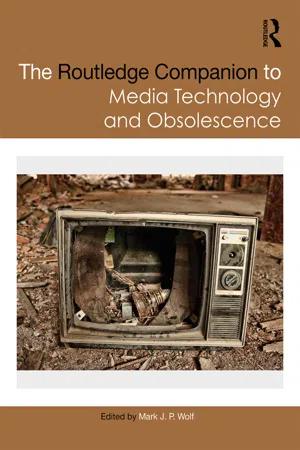
While so many books on technology look at new advances and digital technologies, The Routledge Companion to Media Technology and Obsolescence looks back at analog technologies that are disappearing, considering their demise and what it says about media history, pop culture, and the nature of nostalgia. From card catalogs and typewriters to stock tickers and cathode ray tubes, contributors examine the legacy of analog technologies, including those, like vinyl records, that may be experiencing a resurgency. Each essay includes a brief history of the technology leading up to its peak, an analysis of the reasons for its decline, and a discussion of its influence on newer technologies.
eBook - ePub
The Routledge Companion to Media Technology and Obsolescence
- 402 pages
- English
- ePUB (mobile friendly)
- Available on iOS & Android
eBook - ePub
The Routledge Companion to Media Technology and Obsolescence
About this book
Information
1
PAPER SLIPS
The Long Reign of the Index Card and Card Catalog
Peter Krapp
Before fading toward obsolescence, the index card and card catalog had developed into an influential technology of knowledge management and discovery: a mere clutch of paper scraps deployed to great effect not only in libraries but in academic research and in offices, for business and creative pursuits alike, permitting storage, processing, and transmission of data in discrete, mobile, uniform chunks that can be rearranged according to various principles.
Yet, is this range of applications for index cards completely obsolete? Certainly the index card as an informative object has faded in importance, and while you can still find purveyors of normed index cards among stationery or school and business supplies, it is a safe assumption that librarians, office managers, and writers no longer rely much on index cards, despite the fact that the card catalog long reigned supreme in those information environments. Few students today cram vocabulary, for instance, or formulae with index cards, yet a certain type of hipster will proudly own a piece of furniture originally designed for a library card catalog. However, while the object as such might have faded, arguably the affordances of a card index have not. Few among us maintain our own system of cross-references among browser bookmarks, recipe collections, metadata for CDs ripped to our gadgets, or any other sort of data collection, yet most of us have grown accustomed to associative indexing, from Amazon’s reading suggestions based on your past browsing to streaming music service recommendations.
Certainly under the conditions of hypertext, as manifested across networked computers, the storing, processing, and transmitting of data (business data, library data, audio recording metadata, etc.) allows for a kind of serendipitous discovery of correlations and cross-references that were one strength of index cards, as valued by generations of writers, artists, and academics. One might say the card index lives on in a number of related formats: from hypercard stacks as introduced by Apple—maintained from 1987 to 2004 as a multimedia programming environment, for CD-ROM interactive content and games like Myst (1993)—to the generalized footnote we now call hypertext, and even to the ubiquitous slide decks, be they collated in PowerPoint or Keynote or Prezi. Each of these media exhibits features of what made index cards a success for centuries.
From Library Catalogs to Accounting and Business
A scholar is only a librarian’s way of creating another scholar.
—Daniel Dennett1
Establishing origins is, so often, hazardous terrain. A British historian of science, Staffan Mueller-Wille at the Centre for Medical History at the University of Exeter, recently claimed that Swedish natural scientist Carl Linnaeus (1707–1778), the father of modern taxonomy, had “invented” the card index to manage his information storage and retrieval. Working with paper slips that could be shuffled, updated, and sorted according to different criteria, Linnaeus certainly helped change the understanding of the natural world, away from linear filiation models and toward networks of characteristics that could be mapped.2 Despite such claims, one can find index card systems that predate Linnaeus.
At the end of the 17th century, a comparison of techniques for excerpting led the German lawyer and librarian Vincent Placcius (1642–1699) to develop a “learned box” to enable the relational manipulation of notes.3 German polymath Gottfried Wilhelm Leibniz (1646–1716) was able to buy such a piece of furniture to accommodate his paper slips in 1676.4 And in the 16th century, Swiss doctor Conrad Gessner (1516–1565) reflected openly on how to generate and copy excerpts for a register, although then paper slips were usually threaded together.5 For rhetorical memory, it was preferable not to work with loose sheets, as this could imperil the entire project if their positions were variable.6 The ability to sort and shift entries in varying correlations was long perceived not as a valued feature of knowledge management, but as a dangerous weakness of excerpting, copying, and note-taking. Although secretaries in 17th-century France or Italy were forbidden to speak of their work in public, their confiscated speech never dampened their drive to express the master-medium dialectic of their employment. As Foucault demonstrates, doctors, like confessors, figured as stenographer of a client’s secrets, until the birth of the clinic forced them out of their secretarial role. Discussing the documentary system of surveillance, Foucault points to a “partly official, partly secret hierarchy” in Paris that had been using a card index to manage data on suspects and criminals at least since 1833. In a note, he dryly remarks: “Appearance of the card index and constitution of the human sciences: another invention the historians have celebrated little”.7 Soon, card catalogs were used not just in a learned scholar’s study but in libraries and in business.
Upon taking office, librarians often complained about the lack of order in the stacks and catalogs, and went about reorganizing shelves and finding aids. Document mobility requires addressing and recombination both of what is cataloged and of catalogs themselves. The Viennese Imperial Library established a card catalog (around 300,000 paper slips in 205 boxes) of its holdings in 1780, featuring instructions for the cataloger, along with a flowchart for dividing indexing labors. As Krajewski tells it, however, it was an accidental reinvention at the Harvard College Library in 1817 that brought the card catalog to the New World. Instead of tackling the overwhelming task of cataloging all stock, William Croswell cut up the partially bound catalogs compiled by his predecessors, allowing him to prepare a complete card index for over 20,000 volumes in less than six months.8 But before the card index could also reign in office management, technical questions had to be settled.
In many places, the search for a normed paper slip size was conveniently settled: playing cards were in use for indexing at least since the French Revolution. On May 15, 1791, the French government decreed that a list of nationalized holdings was needed to make them accessible to the public. Librarians working for aristocrats and clergy resisted, since they had reason to fear that after an index went to Paris, the items themselves would soon follow. Thus, new instructions were issued to aides who would take stock where intractable librarians procrastinated. Regardless of local cataloging, they were to copy each item’s identifying information on a numbered playing card. The operation netted the commission 1.2 million cards, soon used to add 300,000 volumes to the national library.9
By the time energetic reformer Melvil Dewey returned from Europe to his roots in the United States (having played a lot of cards on the transatlantic voyage), the country was ready for the standardization by Dewey’s business, Library Bureau. Patenting the card index and furnishing drawers that held 1,000 slips in two rows, he succeeded in getting the American Library Association to bless his index card format in 1877. Within a few years, the business found more demand from offices rather than libraries.10 By 1896, Library Bureau supported census data in several countries, in major contracts with the Hollerith Tabulating Machine Company (renamed IBM as of 1924). Before punched cards took over, the humble paper slip economy made inroads in government and business offices around the globe.
Elsewhere, this method for a flexible knowledge repository was soon adapted and adopted by historians, writers, lawyers, and philosophers. And while the memory crutch and administrative kludge long goes unacknowledged, soon one sees card index techniques openly credited: while John Locke had published a description of his card index in 1686 anonymously, by 1796 Jean Paul could publish a novel called The Life of Quintus Fixlein, pulled from 15 card indexes. Whatever occurred to Leibniz while reading or even on his walks, he scribbled onto slips for which he had a special cabinet constructed.11 As contemporaries of Hegel describe in detail, he systematically hoarded ideas and excerpts on note cards, and carried them with himself from his school days, when he started at age 15, to his death.12 A similar system was described by Charles Darwin:
I keep from thirty to forty large portfolios, in cabinets with labeled shelves, into which I can at once put a detached reference or memorandum. I have bought many books and at their ends I make an index of all the facts that concern my work. Before beginning on any subject I look to all the short indexes and make a general and classified index, and by taking the one or more proper portfolios I have all the information collected during my life ready for use.13
One can find index cards at play all the way into the 20th century, for instance in Walter Benjamin’s unfinished Arcades Project (1983/2002). Pioneering social scientist Beatrice Webb reported in her autobiography, My Apprenticeship (1980), of her attempts to persuade Oxbridge graduates that her index cards were “an indispensable instrument in the technique of sociological enquiry”, and C. Wright Mills notes that what he called cross-classification was crucial in keeping index cards.14 And indeed, all the way into the 20th century, the playing card remains one model for how to interact with paper slips to generate new knowled...
Table of contents
- Cover Page
- Half Title
- Title Page
- Copyright Page
- Table of Contents
- About the Contributors
- Preface
- Acknowledgments
- 1 Paper Slips: The Long Reign of the Index Card and Card Catalog
- 2 From Hero to Zero: The Rise and Fall of the Slide Rule as the Calculating Tool of Choice
- 3 The History of Punched Cards: Using Paper to Store Information
- 4 A History of the Electrical Signal: From the Atlantic Telegraph Cable to the Quest for Artificial Intelligence
- 5 The Life, Death, and Rebirth of the Typewriter
- 6 The Lure of the Ticker
- 7 The Overhead Projector: Visuality and Materiality
- 8 Flammable Workhorse: A History of Nitrate Film from the Screen to the Vault
- 9 Farewell to the Phosphorescent Glow: The Long Life of the Cathode-Ray Tube
- 10 The Moviola and Other Analog Film Editing Machines
- 11 Analog Audio Synthesis: Oscillations, Traces, and Trajectories
- 12 Armchair Harmonics: Radio Remote Controls and the Historical Persistence of Push-Buttons
- 13 Standardized Film Leaders
- 14 Vinyl, Vinyl Everywhere: The Analog Record in the Digital World
- 15 Don’t Take My Kodachrome Away: The Rise, Fall, and Return of Kodachrome Color Film
- 16 Shake It Like a Polaroid Picture: The Rise and Fall of an Analog Social Medium
- 17 Hollywood in a Box: Time-shifting, Rental, and Videocassettes
- 18 Projecting Play: The Give-a-Show Projector and Children’s Audiovisual Media Toys of the Mid-20th Century
- 19 Parakeets, Morse Code, The Roar of the Crowd: The Fading Signal of the Modem
- 20 Illuminating Obsolescence: Eastman Kodak’s Carousel Slide Projector and the Work of Ending
- 21 “Poor Black Squares”: Afterimages of the Floppy Disk
- 22 Video Game Cartridges: The History of Durable, Removable, and Portable Software
- 23 Digital Data Demise: Obsolete Digital Data Formats
- 24 Laserdiscs: On the Way to a Digital Video Future
- 25 Perfect Sound Forever? How the Compact Disc Sowed the Seeds of Its Own Demise
- 26 Hello Again: An Untimely Requiem for the Flip Phone
- 27 HD DVD Technologies
- 28 Appendix: Timeline of Obsolescence
- Index
Trusted by 375,005 students
Access to over 1.5 million titles for a fair monthly price.
Study more efficiently using our study tools.
Frequently asked questions
Yes, you can cancel anytime from the Subscription tab in your account settings on the Perlego website. Your subscription will stay active until the end of your current billing period. Learn how to cancel your subscription
No, books cannot be downloaded as external files, such as PDFs, for use outside of Perlego. However, you can download books within the Perlego app for offline reading on mobile or tablet. Learn how to download books offline
Perlego offers two plans: Essential and Complete
- Essential is ideal for learners and professionals who enjoy exploring a wide range of subjects. Access the Essential Library with 800,000+ trusted titles and best-sellers across business, personal growth, and the humanities. Includes unlimited reading time and Standard Read Aloud voice.
- Complete: Perfect for advanced learners and researchers needing full, unrestricted access. Unlock 1.5M+ books across hundreds of subjects, including academic and specialized titles. The Complete Plan also includes advanced features like Premium Read Aloud and Research Assistant.
We are an online textbook subscription service, where you can get access to an entire online library for less than the price of a single book per month. With over 1.5 million books across 990+ topics, we’ve got you covered! Learn about our mission
Look out for the read-aloud symbol on your next book to see if you can listen to it. The read-aloud tool reads text aloud for you, highlighting the text as it is being read. You can pause it, speed it up and slow it down. Learn more about Read Aloud
Yes! You can use the Perlego app on both iOS and Android devices to read anytime, anywhere — even offline. Perfect for commutes or when you’re on the go.
Please note we cannot support devices running on iOS 13 and Android 7 or earlier. Learn more about using the app
Please note we cannot support devices running on iOS 13 and Android 7 or earlier. Learn more about using the app
Yes, you can access The Routledge Companion to Media Technology and Obsolescence by Mark Wolf, Mark Wolf,Mark J.P. Wolf, Mark J.P. Wolf in PDF and/or ePUB format, as well as other popular books in Social Sciences & Media Studies. We have over 1.5 million books available in our catalogue for you to explore.