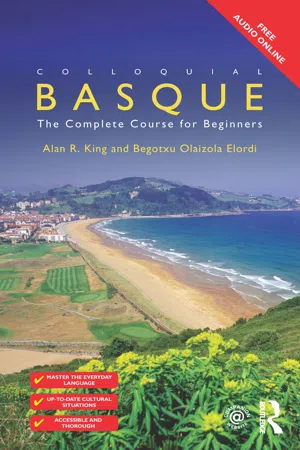
Colloquial Basque
eBook - ePub

Colloquial Basque

A Complete Language Course

  1. 246 pages
  2. English
  3. ePUB (mobile friendly)
  4. Available on iOS & Android
eBook - ePub

Colloquial Basque

A Complete Language Course

About this book

Colloquial Basque: The Complete Course for Beginners has been carefully developed by an experienced teacher to provide a step-by-step course to Basque as it is written and spoken today.

Combining a clear, practical and accessible style with a methodical and thorough treatment of the language, it equips learners with the essential skills needed to communicate confidently and effectively in Basque in a broad range of situations. No prior knowledge of the language is required. Colloquial Basque is exceptional; each unit presents a wealth of grammatical points that are reinforced with a wide range of exercises for regular practice. A full answer key, a grammar summary, bilingual glossaries and English translations of dialogues can be found at the back as well as useful vocabulary lists throughout.

Key features include:

  • A clear, user-friendly format designed to help learners progressively build up their speaking, listening, reading and writing skills
  • Jargon-free, succinct and clearly structured explanations of grammar
  • An extensive range of focused and dynamic supportive exercises
  • Realistic and entertaining dialogues covering a broad variety of narrative situations
  • Helpful cultural points explaining the customs and features of life in n the Basque countryAn overview of the sounds of Basque
  • Balanced, comprehensive and rewarding, Colloquial Basque is an indispensable resource both for independent learners and students taking courses in Basque.

Audio material to accompany the course is available to download free in MP3 format from www.routledge.com/cw/colloquials. Recorded by native speakers, the audio material features the dialogues and texts from the book and will help develop your listening and pronunciation skills.

Frequently asked questions

Yes, you can cancel anytime from the Subscription tab in your account settings on the Perlego website. Your subscription will stay active until the end of your current billing period. Learn how to cancel your subscription.
No, books cannot be downloaded as external files, such as PDFs, for use outside of Perlego. However, you can download books within the Perlego app for offline reading on mobile or tablet. Learn more here.
Perlego offers two plans: Essential and Complete
  • Essential is ideal for learners and professionals who enjoy exploring a wide range of subjects. Access the Essential Library with 800,000+ trusted titles and best-sellers across business, personal growth, and the humanities. Includes unlimited reading time and Standard Read Aloud voice.
  • Complete: Perfect for advanced learners and researchers needing full, unrestricted access. Unlock 1.4M+ books across hundreds of subjects, including academic and specialized titles. The Complete Plan also includes advanced features like Premium Read Aloud and Research Assistant.
Both plans are available with monthly, semester, or annual billing cycles.
We are an online textbook subscription service, where you can get access to an entire online library for less than the price of a single book per month. With over 1 million books across 1000+ topics, we’ve got you covered! Learn more here.
Look out for the read-aloud symbol on your next book to see if you can listen to it. The read-aloud tool reads text aloud for you, highlighting the text as it is being read. You can pause it, speed it up and slow it down. Learn more here.
Yes! You can use the Perlego app on both iOS or Android devices to read anytime, anywhere — even offline. Perfect for commutes or when you’re on the go.
Please note we cannot support devices running on iOS 13 and Android 7 or earlier. Learn more about using the app.
Yes, you can access Colloquial Basque by Begotxu Olaizola Elordi,Alan R. King in PDF and/or ePUB format, as well as other popular books in Languages & Linguistics & Languages. We have over one million books available in our catalogue for you to explore.

1 Bidean
En route

In this unit we will look at:
Grammatical nuts and bolts
  • word order
  • asking questions (1)
  • omission of the subject
Saying what you mean
  • saying which and where
  • singular personal pronouns
  • â€Činâ€Č, â€Čonâ€Č, â€Čatâ€Č, â€Čtoâ€Č and â€Čfromâ€Č
Doing things with words
  • being polite
Strategies for communication
  • saying where you are from
  • saying where you live
Language and life
  • Basque towns
  • speaking Basque

headset.webp
Dialogue 1 (Audio 1:3-5; 7-11)

At the Bilbao bus station

Elin addresses a bus driver
ELIN: Barkatu!
DRIVER: Zer?
ELIN: Hau da Donostiako autobusa?
DRIVER: EZ.
ELIN: Non dago, mesedez?
DRIVER(pointing): Hantxe.
ELIN: Eskerrik asko.
(Elin approaches a young woman waiting at a bus rank.)
ELIN: Aizu, badakizu euskaraz?
(The woman just smiles and shakes her head. Elin tries a young man.)
ELIN: Euskaraz badakizu?
XABIER: Bai!
ELIN: Aizu, Donostiako autobusa hau da?
XABIER: Bai, bai, hauxe da.
ELIN: A!

Vocabulary

a! oh! I see! right!
aizu! hey! I say! could you tell me 
 ?
autobusa a/the bus
badakizu (do) you know
Badakizu euskaraz? Can you speak Basque?
bai yes
barkatu! excuse me! I beg your pardon! I’ m sorry to bother you!
da is, it is (for saying what something is)
dago is, it is (for saying where something is)
Donostia San Sebastian, an important Basque town
Donostiako autobusa the San Sebastian bus
eskerrik asko thank you (very much)
euskara the Basque language
ez no
han or hantxe there, over there (a good distance away)
hau or hauxe this
mesedez please, if you don't mind
non where
Xabier man's name
zer what

Pronunciation and spelling

In the Gipuzkoan dialect, words have main stress peak most often on the second syllabel, thus autĂłbusa, badĂĄkizu, barkĂĄtu, eskĂ©rrik, askĂł, mesĂ©dez, euskĂĄldun(a), ‘Basque’, hondĂĄrtza ‘beach’but it may be on the first syllabel: ĂĄizu, kĂĄixo ‘hello’, hĂĄntxe, bĂ­zi ‘live’, pĂłzik ‘happy’, gĂ©ro ‘then’. Most words with first-syllabel stress are either two-syllabel words, as in the preceding examples, or words formed by adding suffixes to a monosyllabic root as in nĂłngoa ‘where from?’ (non ‘where?’), trĂ©nean ‘on the train’(tren ‘train’), dĂ©ituko ‘will call’(dei ‘a call’). With two-syllabel roots, the stress may be on the first or second syllabel, sometimes even as alternative pronunciations for the same word form, e.g. hĂ©rriko tabĂ©rna or herrĂ­ko taberna ‘the village bar’(herri ‘village, town’). Bisyllabic roots for which initial stress is obligatory include most roots ending in a such as dĂ©nda ‘shop’, gĂ©la ‘room’.
Basque has five vowel sounds, represented by a, e, i, o and u. These are pronounced roughly as in English pat, pet, pit, pot and put respectively. They can combine in d...

Table of contents

  1. Cover
  2. Half Title
  3. The Colloquial Series
  4. Full Title
  5. Copyright
  6. Contents
  7. Map of the Basque Country
  8. Introduction
  9. 1 Bidean: En route
  10. 2 Kafetxo bat?: Cup of coffee?
  11. 3 Iritsi zara!: You've arrived!
  12. 4 Herria ikusten: Seeing the town
  13. 5 Etxean: At home
  14. 6 Goazen buelta bat ematera!: Let's go out!
  15. 7 Erosketak (1): Shopping (1)
  16. 8 Erosketak (2): Shopping (2): Shopping (2)
  17. 9 Asteburua: The weekend
  18. 10 Bidaia prestatzen: Travel preparations
  19. 11 'Hortik zehar': On the road
  20. 12 Etxerantz: Going home
  21. Appendix
  22. Key to exercises
  23. Basque-English vocabulary
  24. English-Basque vocabulary
  25. Subject index