eBook - ePub
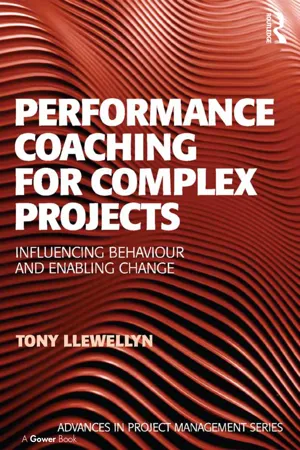
Performance Coaching for Complex Projects
Influencing Behaviour and Enabling Change
- 182 pages
- English
- ePUB (mobile friendly)
- Available on iOS & Android
eBook - ePub
About this book
Performance Coaching for Complex Projects recognises a world of complex undertakings for which the common transactional mindsets and methodologies will not produce the required results. The author advocates, instead, the novel concept that the project manager or team leader should coach the team as part of their role. Managing complexity requires greater use of influence and less reliance on coercion. Learning how to recognise the clues that reveal personal preferences, character traits and motivations will allow you to communicate in a way that recognises how different team members see the world. Team coaching helps the project team work together to think through their issues and then collectively implement the solution. Tony Llewellyn has structured his book in two parts. Part I looks at the challenges of complexity and makes the case for a shift from a transactional directive mindset to a transformational coaching philosophy. Part II introduces a model of project team coaching including the processes and methodologies that have been shown to be effective in improving team performance. Complex projects are invariably messy, not least because of the human factors associated with them. Performance Coaching for Complex Projects is essential reading for anyone responsible for managing in uncertain, challenging and changing environments.
A New Skill Set for the Twenty-first Century
Chapter 1
The Challenge of Managing Complexity
This book is about those components of teamwork that are not set out in a legal document or performance specification. It is about how, as project manager (PM) and project leader, you tap into the only resource that can make complex projects work – human ingenuity.
Graham is a PM who specialises in projects in the rail industry. In 2009 he led a team delivering part of a major project to upgrade the rail link between Edinburgh and Bathgate. Rail work is complex. It requires several major contracting organisations to work together, providing civil engineering, rail construction, signalling and other technical operations. The complexity comes from the need to work in a live environment. This means that at the end of every shift, the team need to leave the site in a state that is safe for trains to run through it. It needs to be 100 per cent safe, not just reasonably safe. The scope for miscommunication and error is particularly high as there are so many interfaces to tie up between the different contractors. This project stands out in Graham’s memory as a great example of collaborative working. The timetable was tight and the team were constantly fighting the elements to stay on programme. Given the unpredictable Scottish weather, the fact that the project was delivered only one month behind schedule was quite remarkable.
I asked Graham what made this contract work when so many other infrastructure projects run substantially over time and over budget. He was able to identify some key environmental factors such as a well-prepared brief and a knowledgeable client. The critical distinction however was the project environment, where each organisation worked together with a single focus, even though there was no formal contract between them. The project worked because everyone appeared to understand that if one of the contractors failed, so did everybody else.
Teamwork
What comes to mind when you first think of the phrase ‘teamwork’? To some, it means a group of people working efficiently and effectively to complete a task. To others it creates an image of too much talking and not enough action. Your mental picture will be influenced by your experiences and your personal motivations. For the reasons discussed later in the book, many of our team experiences are negative. It is therefore surprising that, as a rule, people still have a high degree of faith in the potential of teams. Psychologists and social historians believe that our attraction to teams is hardwired into our brains and goes back to our prehistoric origins, where the ability to hunt for food in groups was the key to survival. In the modern age, we continue to create teams on a regular basis. When there is a big problem to solve, the instinct is to assemble a set of individuals with complementary skills who can work together. The problem is that quite often they don’t.
People are complicated. Our psychological motivations are shaped by many different factors, some genetic, others learned. Childhood influences become overlaid by social norms so that by the time we reach adulthood, most of us have worked out how to establish and maintain social and professional relationships, at least at a superficial level. So whilst we can appear to make good social connections with the other members of a new group, there is a lot of ‘stuff’ going on underneath the surface. We know from experience that most people will, over time, reveal a series of behaviours that will impact the effectiveness of the group.
Studies of people working in groups consistently confirm that each individual’s behaviours can be strongly influenced, for better or for worse, by other members of the group. The individual with the most influence will typically be the group leader. On large projects, the leader will invariably be undertaking the role, in whole or in part, of the ‘project manager’. As the leader, you are the one who is responsible for creating and maintaining the dynamics of a successful team. Of course, the PM role is multifaceted. You may have the role of client representative, programme co-ordinator, or quite literally the manager of the project. Whatever the title, if you are the one person that the other team members turn to when there is a question for which they do not know the answer, then you are the primary influencer.
Is this what you signed up for when you decided to become a PM? Probably not. Most PMs come into the role from some other trade or professional discipline. You got the job because you were good at organising. No one said anything about being good at ‘influence’. I believe however, that as projects become increasingly complex, this is the one skill that will distinguish good PMs from the rest of the pack. The underlying theme of this book is how, as the leader of the team, you make a shift in your own behavioural strategy, and learn when to change from the tactics of coercion to those of influence.
The Project Management Role is Evolving
The shift from organiser to influencer is probably not a choice. The world is changing, presenting both threats and opportunities, and if you are to remain successful in this career, it is probably a good idea to consider what is happening outside of your immediate environment. The forces of change are more complicated than they used to be.
THE WORLD IS CHANGING
We increasingly work in a global economy. Wherever your project is based, it will be affected by whatever is happening elsewhere around the world. Forecasters predict shorter economic cycles and less stable political environments. Organisational hierarchies are changing, causing more frequent disruption to high-level decision making. Similarly, environmental challenges and energy scarcity will continue to create continuous shifts in economic and social behaviour. The result is likely to be increased pressure to deliver project outcomes more quickly.
PROJECTS ARE CHANGING
The population in many parts of the world are moving into urban centres. This shift is creating a need for more accommodation as well as all the infrastructure and services that are required to support increased population density. We are likely to see an increasing growth in ‘smart city’ technology, where utilities, transport infrastructure and public services are all linked to create an efficient and competitive environment. Many projects will have an increase in engineering and technology components, requiring greater interaction between technical specialists and multiple stakeholders. Big projects will also create a need for larger ‘distributed’ teams, working from different locations, often in different countries.
THE DEMAND FOR PM SKILLS IS CHANGING
Basic project management services are going to become increasingly commoditised. Professions that rely on discrete knowledge are already finding that someone, somewhere, is prepared to do that work for a lower fee. It is no longer a strategy to rely on technical knowledge to maintain competitive advantage. The basic information upon which knowledge workers have traditionally relied is now readily available for anyone who cares to search for it. Less obvious, but probably more significant, is the need to recognise that advances in data analysis software will mean that significant chunks of knowledge-based activity will eventually be automated. Professions that rely primarily on their awareness of how to navigate around the rules are going to struggle. It is therefore quite possible that the processing component of the traditional project management service of the future may either be outsourced or automated. The outlook for the PM might therefore appear a little bleak. On a more positive note, for the foreseeable future, at least, the one thing that digital technology will not be able to replace is the management of the successful interactions between human beings.
Collaborative Working
As projects grow in size and complexity, there will be an increased need for organisations to work collaboratively. The size of global markets make the prize for success much greater, but the scale of ambition will often exceed the capability and capacity of organisations to deliver a project if they work alone. We are therefore likely to see an increase in demand for projects based on partnering and collaborative ventures, both as a way of maximising resource and reducing risk.
Collaborative teamwork requires a shift in mindset that needs to move beyond transactional thinking. The word collaboration means different things to different people, but from a project perspective I like the following definition. ‘Collaboration is a reciprocal process in which two or more individuals or organisations work together. It assumes that participants have common objectives. In general, they seek more benefits, by forming a collaborative relationship in which they are required to share resources and knowledge, than by working alone’ (Son and Rojas, 2011).
Collaboration therefore also involves an element of risk and so requires the team to develop a high degree of interpersonal trust. It is about giving something up in anticipation of a future benefit that is not yet defined as a contractual obligation. It is almost impossible to work collaboratively where either, or both, of the parties is holding back to see who is the first one to expose themselves to the risk of non-reciprocation.
The problem with collaboration is that it is easy to talk about, but more difficult to implement. Joint ventures are often dreamt up over the boardroom table by senior executives who are can see the potential synergies of two organisations applying their complementary skills to achieve a common goal. Once the headline terms of the joint venture are agreed, then quite frequently the responsibility for implementation is dropped down to a number of managers who are tasked with getting on with the job. The problem in many joint ventures is that their middle managers are used to working in a transactional manner, so any sense of common goals tends to be lost ‘in translation’.
Some people have a natural predisposition to collaborate. They have a strong internal belief in the power of teams and have learned to quickly build trusting relationships. More often, however, those tasked with the implementation of a joint venture have a transactional mindset which places limited value on interpersonal skills and is more concerned with risk. More time is spent trying to tie down contractual obligations and less time is invested in building relationships. By the time that the project gets underway, the prospect of finding potential synergies has been lost.
The Advanced PM
This book is published under a series title of Advances in Project Management. The series is a response to the growing recognition that the PM skill set needs to evolve to accommodate their changing role. Michael Cavanagh (2012) makes the case that PMs need to move on from the traditional toolkit of systems such as Earned Value Management, PRINCE2 and other PM processes. He is keen to emphasise that these tools are still valuable but, in themselves, they are not going to be sufficient to solve the challenges that come with complex projects. Cavanagh identifies a number of additional skills that will help the PM move to the next level or Second Order. Those include processes such as systemic thinking, outcome management, experiential learning and appropriate contracting. I see tremendous value in each of these propositions, but would add another fundamental capability, which is to learn the interpersonal skills that are required to lead a team through a complex environment.
The curriculum for most project management training includes a notional element of team development, but my observation is that it is given a low priority. For example, the competency framework used by the Royal Institution of Chartered Surveyors (RICS) (2015) requires a PM seeking accreditation to demonstrate an awareness of ‘different styles of leadership, and of different motivation theories’. It also asks for an ‘understanding of the ingredients that are necessary to create high performing teams’. Yet when I talk to colleagues who have the RICS qualification, they look slightly puzzled when I ask them where they found their source information to develop this awareness. The reality is that such people-oriented skills are given a low priority in most forms of project management training.
This is not surprising since the people who design the training competency frameworks can only do so within the context of their own experience. For most young professionals, the learning process is structured around a progression from simple contracts to larger more complicated projects. There is, quite rightly, a strong emphasis on building the technical foundations upon which other skills can be built. The problem, as I perceive it, is that people-oriented skills are not yet regarded as a critically important component of the PM skill set. They are an optional extension to the development programme. My view is that, in the future, skills such as leadership, communication and relationship management are going to be more prominent in the development of a qualified PM. In reading this book, you are simply giving yourself a chance to get ahead of the curve.
Escaping the Transactional Mindset
Making the transition from organiser to influencer requires a fundamental adjustment in the way that you perceive your role when a project moves from complicated to complex. The big question is whether you are you able to recognise the extent to which your thinking is governed by a transactional mindset?
We live in a society where a lot of our day-to-day activity is conducted on a transactional basis. To give an example, I might pay you a sum of money to do the things that are necessary to achieve the specific outcome that I am looking for. The more that I understand what it is you do, the more comfortable I am in seeking an alternative price for the service you offer. We contract with each other, you deliver the service and I write you a cheque. This is lovely and simple. There is limited need to build any sort of relationship if I choose not to, and I have no further obligation to you once the project has been completed. This transactional process requires one key element to work efficiently. We both need a high level of certainty as to what is required. I need to know that you can do what I need to be done, and you need to understand clearly what I want doing.
If all business could be done on this basis, commercial life would be much less stressful. In practice, of course, it is not, and yet there is an underlying tendency in all businesses to try to reduce commercial interactions to the lowest common denominator of the simple transaction. In the rush to develop efficient processes and methodologies, we have often removed context from the equation. The inexperienced PM can follow the rulebook, and ‘join up the dots’, but will often struggle to recognise the clues and signals that offer solutions before they become problems. Many managers never learn how to develop the interpersonal skills that are required to handle arrangements that contain a level of ambiguity or uncertainty.
The Conspiracy of Optimism
As discussed later in this chapter, complexity arises when there are too many unknown variables affecting the project. How can you enter into a transactional relationship with a client/stakeholder when he does not yet know exactly what he wants, and you don’t know exactly how to provide it? Cavanagh (2012) makes reference to the ‘Conspiracy of Optimism’ where clients, delivery agents and suppliers press on with a project on a transactional basis. They know that this approach is unlikely to achieve the performance criteria needed to achieve the desired outcome. They just hope that it all turns out for the best. Each of them is aware that there are so many uncertainties in the...
Table of contents
- Cover Page
- Dedication
- Title Page
- Copyright Page
- Contents
- List of Figures
- List of Tables
- Preface
- The Storytellers
- PART I A NEW SKILL SET FOR THE TWENTY-FIRST CENTURY
- PART II A MODEL OF PROJECT TEAM COACHING
- References
- Index
Trusted by 375,005 students
Access to over 1.5 million titles for a fair monthly price.
Study more efficiently using our study tools.
Frequently asked questions
Yes, you can cancel anytime from the Subscription tab in your account settings on the Perlego website. Your subscription will stay active until the end of your current billing period. Learn how to cancel your subscription
No, books cannot be downloaded as external files, such as PDFs, for use outside of Perlego. However, you can download books within the Perlego app for offline reading on mobile or tablet. Learn how to download books offline
Perlego offers two plans: Essential and Complete
- Essential is ideal for learners and professionals who enjoy exploring a wide range of subjects. Access the Essential Library with 800,000+ trusted titles and best-sellers across business, personal growth, and the humanities. Includes unlimited reading time and Standard Read Aloud voice.
- Complete: Perfect for advanced learners and researchers needing full, unrestricted access. Unlock 1.5M+ books across hundreds of subjects, including academic and specialized titles. The Complete Plan also includes advanced features like Premium Read Aloud and Research Assistant.
We are an online textbook subscription service, where you can get access to an entire online library for less than the price of a single book per month. With over 1.5 million books across 990+ topics, we’ve got you covered! Learn about our mission
Look out for the read-aloud symbol on your next book to see if you can listen to it. The read-aloud tool reads text aloud for you, highlighting the text as it is being read. You can pause it, speed it up and slow it down. Learn more about Read Aloud
Yes! You can use the Perlego app on both iOS and Android devices to read anytime, anywhere — even offline. Perfect for commutes or when you’re on the go.
Please note we cannot support devices running on iOS 13 and Android 7 or earlier. Learn more about using the app
Please note we cannot support devices running on iOS 13 and Android 7 or earlier. Learn more about using the app
Yes, you can access Performance Coaching for Complex Projects by Tony Llewellyn in PDF and/or ePUB format, as well as other popular books in Business & Business General. We have over 1.5 million books available in our catalogue for you to explore.