eBook - ePub
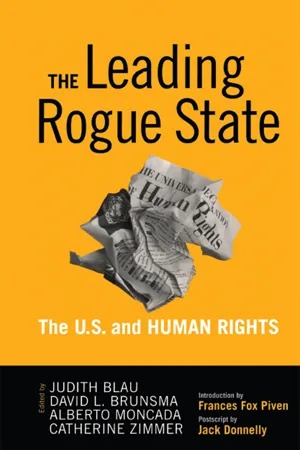
Leading Rogue State
The U.S. and Human Rights
- 264 pages
- English
- ePUB (mobile friendly)
- Available on iOS & Android
eBook - ePub
Leading Rogue State
The U.S. and Human Rights
About this book
Most Americans would be surprised to learn that their government has declined to join most other nations in UN treaties addressing inadequate housing, poverty, children's rights, health care, racial discrimination, and migrant workers. Yet this book documents how the U.S. has, for decades, declined to ratify widely accepted treaties on these and many other basic human rights. Providing the first comprehensive topical survey, the contributors build a case and specific agendas for the nation to change course and join the world community as a protector of human rights.
Information
CHAPTER ONE

Human Vulnerabilities
ON INDIVIDUAL AND SOCIAL RIGHTS
The debate about the status and purpose of individual rights as against social rights depends a great deal on how we define these terms. Although it is difficult to come to a definitive philosophical or jurisprudential conclusion about social versus individual rights, textbooks on human rights recognize the difference between the two traditions (Gearon 2003). Furthermore, the difference between these two traditions is consequential in the real world. For example, the so-called twin covenants embrace this distinction. There is the International Covenant on Civil and Political Rights (ICCPR), which was promulgated on December 16, 1966, and came into effect on March 23, 1976. There is the parallel International Covenant on Economic Social and Cultural Rights (ICESCR), which was promulgated on December 16, 1966, and came into effect on January 3, 1976.
The ICCPR is often seen to embrace the classic liberal “negative freedoms,” namely a set of rights that are “freedom-from rights,” essentially freedom from oppression. By contrast, the ICESCR is regarded as embracing those rights and entitlements that have underpinned welfare systems in both liberal democracies and socialist regimes. They are the “positive freedoms” that provide people in need with resources to achieve certain desirable outcomes. These two covenants became somewhat entangled in cold war ideological conflicts between liberal capitalist democracies and socialist states. The controversial nature of the two covenants is illustrated by the fact that, while they were presented to the UN General Assembly in 1966, it took a further decade before they could be ratified in order for them to come into operation.
It is often said that, while the West has recognized the ICCPR because it is compatible with liberal ideology, socialist states have felt more comfortable with the ICESCR. For example, China has found it easier to support social and economic rights that are seen to be more consistent with its own emphasis on development. The ICESCR came into force in China on June 27, 2001, but as of 2005, the ICCPR had not been ratified. If we take the view that economic development is a necessary precondition for the enjoyment of rights, then China has made great progress toward establishing a human rights regime.
Whereas somewhere around 22 million people had died of starvation during Mao’s Great Leap Forward (1958–1960), China has subsequently managed to feed its own people, which represent 22 percent of the world’s population on only 7 percent of the world’s arable land. This economic growth is compatible with the notion of a right to development that was accepted by the Vienna Declaration in 1996 (Goldman 2005). Other authors have tried to conceptualize the distinction between authoritarian Asian regimes that often prefer to support social rights and liberal individualistic capitalism by recognizing that in Asia the responsibility of the state to its citizens can be understood in terms of “enforceable benevolence” or “patriarchal benefice” (Woodiwiss 1998). Therefore, attempts to conceptualize the difference between social and individual rights often implicitly or explicitly articulate ideological differences between socialism and capitalism, and hence the conceptual distinction is overburdened by history and ideology.
By contrast with China, the United States has championed the idea of personal liberty and individual rights, and it has therefore been reluctant to support social rights, remaining deeply suspicious of the human rights revolution (Ignatieff 2001). As a result, the United States has found itself isolated internationally, being often hostile to the United Nations and to specific UN institutions. For example, in 1997 the United States refused to join the international community in banning the use of antipersonnel land mines, and in 1998 the United States voted against the creation of the International Criminal Court. The dubious status of Guantanamo Bay in international law in the context of a war on terror has only reinforced this gap (Butler 2004). The situation has been summarized by Geoffrey Robertson (1999, 72) in his Crimes Against Humanity when he noted that “the nation with the most to offer the human rights movement in the twenty-first century will, it appears, do so only on the strict condition that other countries are the targets” of human rights legislation.
The United States has been specifically hostile to any formulation of social and economics rights that might limit the functioning its own version of capitalism or question its ideology of individualism. It has consequently opposed the ICESCR. The ideology of individualism is deeply suspicious of state involvement in social benefits and therefore often antagonistic to the development of social welfare rights. While individual rights such as freedom of conscience and freedom of religious belief have been defended, social rights—especially economic rights relating to unionism and labor laws—are regarded as aspects of international socialism. For example, in 1948, the American Bar Association’s House of Delegates opposed the Declaration of Human Rights because it contained social and economic rights; the Eisenhower administration attempted to downplay the importance of the twin covenants on rights; and following action by Secretary of State Dulles, the United States did not ratify the Convention on Genocide (Galey 1998; Henkin 1998). The American political elite opposed the Declaration of Human Rights on the grounds that its social provisions smacked of communism, and with the fall of the Soviet Union in 1992, American conservatives were able to celebrate neoliberal economic policies as the only viable global strategy. They proclaimed the “end of history,” insisting that Western-style democracy was the only regime worth defending.
Although there has been much opposition to both covenants, it is necessary to provide a definition of social and individual rights, or at least to offer an analysis of the problems that are entailed by such a definition. Consequently, this chapter is concerned with understanding the differences between the social rights of citizens and individual human rights. Briefly, social rights are those entitlements that are enjoyed by citizens and are enforced by courts within the legal framework of a sovereign state. These social rights may be called “contributory rights,” because effective claims are associated with contributions that citizens have made to society through work, war (or a similar public duty), or parenting (Turner 2001). In this model, rights and duties are closely connected.
A system of universal taxation is an obvious indication of the obligations of citizenship. In return for taxes, citizens expect certain benefits, such as security and welfare. By contrast, human rights are rights enjoyed by individuals by virtue of being human, and as a consequence of their shared vulnerability. Human rights are not necessarily connected to duties and they are not contributory. There is, for example, no corresponding system of taxation relating to the possession of human rights. There is as yet no formal declaration of human duties—although there has been much discussion of such obligations. The UN Educational, Scientific, and Cultural Organization (UNESCO) encouraged an initiative for a charter of the duties and responsibilities of states, but these initiatives have yet to have any practical consequence. While states enforce social rights, there is no sovereign power uniformly to enforce human rights. Social rights of citizens are national; human rights are universal, but it is often claimed that these are not “justiciable” and have no “correlativity” with duties.
This apparently neat division becomes blurred in practice, especially in the United States. Because Americans tend to regard the Constitution as a universal declaration of democratic rights, having universal implications for everybody, Americans have often resisted the idea that human rights treaties apply to them. The retention of the death penalty in the United States is in contravention of UN declarations, and the practice of “extraordinary rendition” is contrary to UN norms surrounding arbitrary arrest and unfair trial, as outlined in Article 8 of the Declaration of Human Rights. The U.S. government tends to resist such constraints, either from political expediency or because the Constitution trumps all competing international laws. In popular discourse in the United States, there is therefore a tendency to confuse the civil liberties of Americans (such as the right of black Americans to have the franchise) with human rights, partly because the Constitution is implicitly regarded as a universal legal code.
It is, however, important to retain the distinction. The bottom line is that the social rights of citizens are given (and taken away) by states, but human rights are not given by state legislatures and they cannot be taken away by states. Human rights are frequently the last line of defense against rapacious, arbitrary, and corrupt states.
Hannah Arendt presented an especially challenging criticism of “the rights of Man” in The Origins of Totalitarianism (1951) when she observed that these alleged inalienable rights were supposed to exist independently of any government, but once the rights of citizenship with the support of a government had been removed, there was no authority left to protect them as human beings. Human rights without the support of a sovereign state, she argued, are merely abstract claims that cannot be enforced. Critics argue that it is impossible to define what they are or to show how they add much to the specific rights of citizens of national states. The right to rights makes sense only for people who are already members of a political community. Against Arendt, it is important to protect the idea that there is a right to resist arbitrary governments and that the role of legitimate opposition (in a system of political parties) has to be protected. Human rights abuse is characteristically a product of state tyranny, dictatorship, and state failure as illustrated by civil wars and anarchy; a viable state is important as a guarantee of rights. There is a valid argument therefore that the liberties of citizens and their social rights are better protected by their own national institutions than by external legal or political intervention. The often chaotic outcome of human rights interventions in East Timor and Kosovo might force us to the conclusion that any government that can provide its citizens with security, but with weak democracy, is to be preferred over bad and ineffective government (Chandler 2002).
The history of social rights is essentially the history of citizenship. Historians have recognized the growth of citizenship in ancient Greece but also noted its restriction by birth to men, the exclusion of women, the presence of class divisions, and dependence on slavery (Finley 1983). Max Weber (1958) emphasized the importance of Christian universalism in the growth of citizenship in which faith rather than blood was recognized as the basis of community. He contrasted the autonomous city in Europe with the city in the East as a military camp. Although we can detect the ancestry of citizenship in the urban institutions of classical Greece and Rome, there is little evidence of social citizenship until the modern period. Because women were excluded from participation in public life, we should hesitate in assuming that citizenship was fully developed in ancient Athens and Rome. It is more accurate to argue that classical citizenship was limited in its scope, and therefore we might suitably call this classical form political citizenship, asserting that the revolutionary struggles that produced modernity also produced modern or social citizenship. Modern citizenship has two important characteristics: (1) It developed a notion of membership that is not in formal terms dependent on gender and ethnicity; and (2) it is closely connected with the rise of the welfare state.
Citizenship in the context of liberalism is also closely associated with the growth of individualism. However, the modern notion of individualism as subjectivity, the self, and privacy is more or less the opposite of the classical world. In classical Greece, private affairs were often negatively defined in opposition to the public sphere and public duty. The private arena was associated with deprivation (privatus), and the public sphere was one of freedom and reason, where citizens congregated for political debate, economic exchange, and entertainment. The autonomous individual could exist and develop only in the public domain. In the “quarrel between the ancients and moderns,” Benjamin Constant compared respect for public institutions in the ancient city with the emphasis on conscience and individual subjectivity in modern society.
The liberty of the ancients, which arose from their active engagement in politics, required them to sacrifice their personal interests in their service to the polis. By contrast, the moderns are encouraged to pursue their personal pleasures, regarding politics as merely a means to protect and enhance their private lives. It was only when men left the privacy of the household that they emerged from these biological necessities to participate in politics as free individuals. This distinction was formulated in Aristotle in the contrast between zoe (biological life) and bios (the cultivated form of life). Men could rise to bios only through politics and the public sphere. In modern America, the great emphasis on the emotional integrity of the private individual is the exact opposite of the Aristotelian idea of politics and virtue (Brogan 2005). In modern society, human beings are bound together, but the common threads are paradoxically the private desires of consumption and a common mass culture.
NATIONAL CITIZENSHIP AND THE WELFARE STATE: T. H. MARSHALL
As we have seen, there is a common intellectual tradition that locates the origins of citizenship in the ancient polis. It is, however, sociologically more appropriate to treat citizenship as a product of three political revolutions—the English Civil War, the American War of Independence, and the French Revolution. These revolutions were the cradle of both modern nationalism and citizenship as the rights and duties of a person who is a member of a national community. The creation of European nation-states from the seventeenth century necessarily involved the creation of imaginary communities that assumed the existence of, and went a long way to create, homogenous populations. The Treaty of Westphalia in 1648 was the origin of the modern world system of nation-states, and state formation involved the creation of nationalist identities on the basis of a double colonization, both internal and external. This process was the cultural basis for the creation of national forms of citizenship.
National citizenship was politically important because it incorporated the working class into nascent capitalism through the creation of welfare institutions. In practice, welfare capitalism achieved the subordination of the working class with relatively little concession to the fundamental issue of inequalities in wealth and political power. Citizenship left the class structure of capitalism intact, and welfare states avoided the revolutionary conflicts of the class system that were fundamental to Karl Marx’s vision of capitalist crises. However, there was great variation within different capitalist regimes. While in Germany Bismarck developed social rights through welfare legislation, political rights were underdeveloped. Neither fascism nor authoritarian socialism supported civil and political rights, although they did develop welfare institutions and social rights.
In the twentieth century, the understanding of citizenship was dominated by the sociological theory of T. H. Marshall (1950). Citizenship expanded through three stages: the growth of legal rights in the seventeenth century produced habeas corpus, the jury system, and the rule of law; political rights in the nineteenth century resulted in the parliamentary system, free elections, and the secret ballot box; and social rights in the twentieth century were associated with social security and the welfare state. Marshall argued that citizenship was a status position that ameliorated the class inequalities that arise from a capitalist market. The British welfare state can be regarded as the practical expression of the sociological theories of Marshall, the economic analysis of J. M. Keynes (1936), and the social policy of Richard Titmuss (1958).
In substantive terms, the mass mobilization of the population for warfare was an important condition for the growth of postwar social rights, but Titmuss also traced the origins of the National Health Service to the medical inspections of the South African Boer War, when the British working class was deemed unfit for combat. The expansion of social rights in the twentieth century was closely connected with military discipline and combat requirements, and subsequently with postwar social reconstruction.
Marshall’s account of British social citizenship helps us to identify important differences between the development of citizenship institutions ...
Table of contents
- Cover
- Half Title
- Title Page
- Copyright Page
- Dedication
- Table of Contents
- List of Tables and Figures
- Introduction
- 1 Human Vulnerabilites: On Individual and Social Rights
- 2 Rights to Housing
- 3 Health as a Human Right
- 4 Labor Rights and Rights of Workers
- 5 Rights of the Child
- 6 Rights of Migrants and Minorities
- 7 Women’s Rights
- 8 Rights of People with Disabilities
- 9 Rights of Indigenous Peoples
- 10 The Human Right to Sexual and Gender Self-Expression
- 11 Language Rights as Human Rights
- 12 Cultural Rights
- 13 Rights to Water, Food, and Development
- 14 Environmental Rights
- 15 Rights of Prisoners
- 16 Human Rights and International Humanitarian Law
- 17 Rights to Participate in Democracy
- 18 The Social Forum Process and Human Rights
- 19 Freedom and Security
- Postscript
- Index
- About the Editors and Contributors
Trusted by 375,005 students
Access to over 1.5 million titles for a fair monthly price.
Study more efficiently using our study tools.
Frequently asked questions
Yes, you can cancel anytime from the Subscription tab in your account settings on the Perlego website. Your subscription will stay active until the end of your current billing period. Learn how to cancel your subscription
No, books cannot be downloaded as external files, such as PDFs, for use outside of Perlego. However, you can download books within the Perlego app for offline reading on mobile or tablet. Learn how to download books offline
Perlego offers two plans: Essential and Complete
- Essential is ideal for learners and professionals who enjoy exploring a wide range of subjects. Access the Essential Library with 800,000+ trusted titles and best-sellers across business, personal growth, and the humanities. Includes unlimited reading time and Standard Read Aloud voice.
- Complete: Perfect for advanced learners and researchers needing full, unrestricted access. Unlock 1.5M+ books across hundreds of subjects, including academic and specialized titles. The Complete Plan also includes advanced features like Premium Read Aloud and Research Assistant.
We are an online textbook subscription service, where you can get access to an entire online library for less than the price of a single book per month. With over 1.5 million books across 990+ topics, we’ve got you covered! Learn about our mission
Look out for the read-aloud symbol on your next book to see if you can listen to it. The read-aloud tool reads text aloud for you, highlighting the text as it is being read. You can pause it, speed it up and slow it down. Learn more about Read Aloud
Yes! You can use the Perlego app on both iOS and Android devices to read anytime, anywhere — even offline. Perfect for commutes or when you’re on the go.
Please note we cannot support devices running on iOS 13 and Android 7 or earlier. Learn more about using the app
Please note we cannot support devices running on iOS 13 and Android 7 or earlier. Learn more about using the app
Yes, you can access Leading Rogue State by Judith R. Blau,David L. Brunsma,Alberto Moncada,Catherine Zimmer in PDF and/or ePUB format, as well as other popular books in Politics & International Relations & American Government. We have over 1.5 million books available in our catalogue for you to explore.