- 400 pages
- English
- ePUB (mobile friendly)
- Available on iOS & Android
eBook - ePub
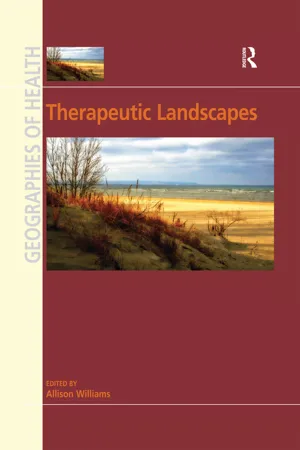
Therapeutic Landscapes
About this book
The therapeutic landscape concept, first introduced early in the 1990s, has been widely employed in health/medical geography and gaining momentum in various health-related disciplines. This is the first book published in several years, and provides an introduction to the concept and its applications. Written by health/medical geographers and anthropologists, it addresses contemporary applications in the natural and built environments; for special populations, such as substance abusers; and in health care sites, a new and evolving area - and provides an array of critiques or contestations of the concept and its various applications. The conclusion of the work provides a critical evaluation of the development and progress of the concept to date, signposting the likely avenues for future investigation.
Chapter 1
Introduction: The Continuing Maturation of the Therapeutic Landscape Concept
Wil Gesler first developed the concept of therapeutic landscapes in the early 1990s, approximately 15 years ago. Since then, the concept has developed into a central component of health geographical thinking, being recognized at the 9th International Medical Geography Symposium (Montreal, 2001) as one of a few recent, internationally recognized contributions that health geographers have made to the larger discipline. Several books have been devoted to the subject and the number of peer-reviewed research papers appears to grow exponentially as each year passes. The centrality of the therapeutic landscape concept within the sub-discipline of health geography is confirmed with its inclusion in general health geography texts, the most recent being Health and Inequality (Curtis, 2004). While employed in a growing range of subject areas within health and social geography more broadly, the concept has been increasingly used in disciplines outside health geography, illustrating its flexibility and wide-ranging potential. This collection provides evidence of both the expanded use of the concept within the discipline of health geography – with 16 chapters illustrating a wide range of subject areas, as well as the innovative use of the concept in the anthropology of health, with four chapters illustrating various applications. This introductory chapter is broken up into three sections; the first section briefly traces the evolution of the concept, noting the central critiques. Second, a topical overview of the collection provides the foundation for the third and final section, which outlines ongoing trajectories and future directions.
The Evolution of the Therapeutic Landscape Concept
This section begins by first reviewing the concept’s early application to traditional healing sites and carries through to contemporary applications in geography. Following, a discussion of the critiques of the concept, the current wide-ranging and ever-expanding use of the concept both within and outside geography is then reviewed. Due to the brevity of this review, not all pertinent work is discussed; only a few pieces of work have been noted to highlight the trajectory of the concept thus far.
The therapeutic landscape concept has its theoretical origins in cultural ecology, structuralism, and humanism, and provides a framework for analysis of natural and built, social, and symbolic environments as they contribute to healing and well-being in places – broadly termed landscapes (Gesler, 2003). Gesler’s pioneering work on the Asclepian Sanctuary at Epidauros, Greece (1993), Marian Shrine at Lourdes, France (1996) and Roman Baths at Bath, England (1998) provided the template from which further applications emerged. Certainly, the ongoing examination of traditional sites continues to inform our understanding of the variant attributes or characteristics that should be given attention when creating a healing or healthful environment.
In addition to my own work in holistic health applications, which first suggested the idea of ‘landscapes of the mind’ (Williams, 1998), the first edited collection, entitled Therapeutic Landscapes: The Dynamic between Place and Wellness (Williams, 1999), illustrated the growing acceptance of the therapeutic landscapes concept within a socio-ecological model of health, with attention to a population health approach. In addition to covering traditional landscapes, the collection examined applications for marginalized populations, and applications in health care sites. These original three sub-sections, as used in the first collection – traditional landscapes, applications for marginalized and special populations, and health care applications – operate as categories for the work that followed, and still apply to the organization of the work contained within this current volume.
The use of the concept in examining the spaces and places for marginal and special populations have been many. Among them are numerous health promoting sites, including children’s health camps (Kearns and Collins, 2000), gardens for the elderly (Milligan et al., 2004), community-based alcohol recovery programs (Wilton and DeVerteuil, 2006), respite centres (Conradson, 2005), and home for home-based caregivers (Williams, 2002). Related to this is the literary analysis of fiction that has used the therapeutic landscape as an interpretative framework (Baer and Gesler, 2004; Tonnellier and Curtis, 2005). Further, the application of the concept to specific cultural groups outside of the developed West illustrated the wide potential use of the concept (Wilson, 2003; Williams and Guilmette, 2001; Madge, 1998). As expected, a number of applications have been made to better-known health care settings. Included among these are those highlighted in Gesler’s Healing Places (2003); hospital environments (Gesler et al., 2004; Curtis et al., 2007) and long-term care facilities (Andrews and Peter, 2006).
The evolution of the therapeutic landscapes concept has taken place, in part, due to numerous critiques (Gastaldo et al., 2004; Wakefield and McMullan, 2005; Conradson, 2005). One critique has been that healing places are not limited to places celebrated for their reputed healing qualities. Rather healing can take place in everyday, ordinary places, whether a residential backyard, a hospital room, or an imagined landscape. This critique has immeasurably extended the application of the concept beyond its earliest understanding, where reputed sites such as Lourdes, and Epidauros, made up the sites from which the concept was first developed. Another critique contests the nature of sites considered to be healing or therapeutic, arguing that such places can be simultaneously healthful and hurtful. A related critique has been made specific to the varied potential of any particular site for healing and/or health; what may be healing for one individual or group may not be for another. Finally, perception of whether a health-related landscape is therapeutic or not is context-dependent; that is, it is affected by local social and economic conditions and their associated changes. These latter critiques have certainly forced us to look at landscapes and places deemed to have therapeutic qualities more carefully, being sure to explore as many viewpoints as possible.
The concept has, not surprisingly, expanded in its reach beyond the discipline of geography. Certainly the idea of landscapes as therapeutic has been used extensively in landscape architecture, with the study of landscape design with respect to health and healing being well established before the concept of therapeutic landscapes was introduced in geography. Similarly, building design specific to health care facilities has been ongoing for approximately 30 years. The term therapeutic landscape is now being used formally in these literatures (Cooper Marcus, 2001). Environmental psychologists have a long history of research specific to therapeutic environments, specifically as they relate to natural environments; this is reviewed in the introduction to Part 5 in the present volume: Transcending Geography: Applications in the Anthropology of Health. Like geographers, anthropologists have borrowed from the psychology literature but, surprisingly, have only recently applied the therapeutic landscape concept to their work, as discussed in the introduction to Part 5. The four chapters making up this section thereby provides the initial employment of the term in anthropological research.
Further to anthropology, a number of other disciplines have been formally employing the therapeutic landscape concept, as we have come to understand it in geography; kinesiology, sport sociology, midwifery and nursing are among these disciplines. The meaning of summer camp, as therapeutic landscapes for youths with disabilities specific to identity development, has been researched by kinesiologists in Canada (Goodwin and Staples, 2005). The health experiences of members of a running club for sexual minorities highlight the social aspect of the therapeutic landscapes concept in research on the sociology of sport (van Ingen, 2004). The health professions of nursing and midwifery have recognized the importance of place in healing, noting how the therapeutic landscape concept incorporates social relations as well as the characteristics of the physical environment (Kennedy et al., 2004; Andrews, 2002). The growing use of the therapeutic landscapes concept outside of geography, and particularly in medical/health anthropology (this volume), illustrates its flexibility and wide applicability.
Common Threads and Notable Contributions
This collection is organized into five parts, based on the substantive content of the chapters contained within them. It becomes obvious when reading from the chapters that many of them could have been inserted in one of a number of the parts; each has been located in what has been determined to be the best fit, recognizing the need to keep parts as even as possible. Although each chapter is discussed in detail in the next section, they are briefly described here to provide the backdrop for the discussion of common threads and notable contributions. The first section, entitled Traditional Therapeutic Landscapes: Natural and Built Environments, examines the health-related qualities of specific environments, including: beaches, monastery retreats, yoga centres and mountains. This subject area continues to view places as therapeutic, hence the term ‘traditional’, albeit in a more critical manner than was the case ten years ago. Therapeutic Geographies for Special Populations makes up the second section, which explores the significance of therapeutic characteristics in the worlds of unique populations, including: addicts, support group users, urban neighbourhood residents and families. Part 3, Applications in Health Care Sites, provides examples of how health care sites and services are, to various degrees, therapeutic, as based on design, décor, signage, and meaning; sites include hospitals, assisted living residences and the home. The fourth part, Contesting Landscapes as Therapeutic: Contemporary Advances, further develops the critiques of the therapeutic landscape concept, as discussed in the previous section; Toronto gay bathhouses, an agrarian Guatemalan municipality, wooded areas in the UK, and the Soviet Gulag are the places explored. The fifth and final part, Transcending Geography: Applications in the Anthropology of Health, is devoted to the application of the therapeutic landscape concept in health anthropology, where ethnographic methods are used to explore: purposive community in suburban development, dementia care in long-term care facilities, art-making in public spaces, and a hospital as an aesthetic-therapeutic place.
What becomes evident when looking at the collection as a whole is a number of common threads that are woven throughout, particularly in substantive areas across the two disciplines represented. One such obvious thread is the interest in hospital environments, with three chapters devoted to examining quite different characteristics of these critical places of care (Chapters 10, 11 and 21). A second health care site of interest is residential care facilities for the aged, with two chapters being given focused attention on different types of facilities in the United States (Chapters 12 and 19). A related thread is the focus on the act and experience of caregiving, although one examines unpaid, informal care and the other paid, formal care provision (Chapters 13 and 19). The common interest in various art forms presents itself as a common theme addressed by two of the contributing anthropologists (Chapters 20 and 21). One of the most wide-ranging commonalities across the collection as a whole is the further development of the therapeutic landscape concept itself, which seems to work simultaneously with the use of innovative research methods. With this in mind, specific contributions are now highlighted, beginning with the geographical contributions.
Although the concept is further developed in various degrees in all geographical chapters, I would like to highlight four particularly notable contributions which, in my estimation, require particular mention. What is interesting to note in all four cases is the conceptual and/or methodological innovation employed. These four chapters will be briefly highlighted here, in consecutive order. Hoyez (Chapter 4) introduces the idea of the globalizing therapeutic landscape when reviewing the expansion of yoga centres across the globe, bringing together literatures which would otherwise stand in stark opposition to one another. In Chapter 7, Davidson and Parr provide evidence for the therapeutic potential of support groups, via modalities – the telephone, newsletter and the internet, which would otherwise be deemed banal in the sense of only providing information/resources. Sperling and Decker (Chapter 15) provide a stunning culturally specific examination of therapeutic landscapes through employing a novel methodological approach – photovoice – and, in so doing, outline both cultural and gender specificity. Finally, DeVerteuil and Andrews (Chapter 17) use documentary analysis of personal memoirs to illustrate how the Stalinist Gulag can be both hurtful and healing, and simultaneously physical and imagined.
All the anthropological contributions are original and new, as can be expected given the emergence of the TL concept in the discipline. Hoey (Chapter 18) extends the understanding of asylums, as based on moral treatment, to purposive communities. Einwalter (Chapter 20) introduces the idea of creating numerous art forms in public space as therapeutic. McLean (Chapter 19) discusses a moral landscape of dementia care, arguing for the need for improved quality of caregiving in nursing homes and, in so doing, coherently highlights the importance of the social aspect of therapeutic environments within the context of the psycho-social health of dementia patients. Finally Collins (Chapter 21) identifies and describes the therapeutic-aesthetic within the context of hospital restructuring in the UK, illustrating the extraordinary emphasis given to the aesthetic in the midst of growing public outcry regarding service availability and quality.
Topical Overview
Part 1: Traditional Therapeutic Landscapes: Natural and Built Environments
Collins and Kearns (Chapter 2) provide a well contextualized presentation of New Zealand beaches as landscapes with several possible meanings – therapeutic in some regards and risky in others. Current public health dialogue is well integrated and provides an ironic contrast to what beaches have traditionally meant, with regards to their therapeutic potential. Although suggested by others, the authors have gone to great lengths to provide the evidence needed to succinctly argue that not all therapeutic landscapes are, in fact, healthful. Whilst New Zealand beaches are highl...
Table of contents
- Cover
- Half Title
- Title
- Copyright
- Contents
- List of Figures
- List of Tables
- List of Contributors
- Preface
- Acknowledgments
- Dedication
- 1 Introduction: The Continuing Maturation of the Therapeutic Landscape Concept
- PART 1 TRADITIONAL THERAPEUTIC LANDSCAPES: NATURAL AND BUILT ENVIRONMENTS
- PART 2 THERAPEUTIC GEOGRAPHIES FOR SPECIAL POPULATIONS
- PART 3 APPLICATIONS IN HEALTH CARE SITES
- PART 4 CONTESTING LANDSCAPES AS THERAPEUTIC: CONTEMPORARY ADVANCES
- PART 5 TRANSCENDING GEOGRAPHY: APPLICATIONS IN THE ANTHROPOLOGY OF HEALTH
- Index
Trusted by 375,005 students
Access to over 1.5 million titles for a fair monthly price.
Study more efficiently using our study tools.
Frequently asked questions
Yes, you can cancel anytime from the Subscription tab in your account settings on the Perlego website. Your subscription will stay active until the end of your current billing period. Learn how to cancel your subscription
No, books cannot be downloaded as external files, such as PDFs, for use outside of Perlego. However, you can download books within the Perlego app for offline reading on mobile or tablet. Learn how to download books offline
Perlego offers two plans: Essential and Complete
- Essential is ideal for learners and professionals who enjoy exploring a wide range of subjects. Access the Essential Library with 800,000+ trusted titles and best-sellers across business, personal growth, and the humanities. Includes unlimited reading time and Standard Read Aloud voice.
- Complete: Perfect for advanced learners and researchers needing full, unrestricted access. Unlock 1.5M+ books across hundreds of subjects, including academic and specialized titles. The Complete Plan also includes advanced features like Premium Read Aloud and Research Assistant.
We are an online textbook subscription service, where you can get access to an entire online library for less than the price of a single book per month. With over 1.5 million books across 990+ topics, we’ve got you covered! Learn about our mission
Look out for the read-aloud symbol on your next book to see if you can listen to it. The read-aloud tool reads text aloud for you, highlighting the text as it is being read. You can pause it, speed it up and slow it down. Learn more about Read Aloud
Yes! You can use the Perlego app on both iOS and Android devices to read anytime, anywhere — even offline. Perfect for commutes or when you’re on the go.
Please note we cannot support devices running on iOS 13 and Android 7 or earlier. Learn more about using the app
Please note we cannot support devices running on iOS 13 and Android 7 or earlier. Learn more about using the app
Yes, you can access Therapeutic Landscapes by Allison Williams in PDF and/or ePUB format, as well as other popular books in Physical Sciences & Geography. We have over 1.5 million books available in our catalogue for you to explore.