- 75 pages
- English
- ePUB (mobile friendly)
- Available on iOS & Android
eBook - ePub
Benjamin Britten and Montagu Slater's Peter Grimes
About this book
`Who can turn skies back and begin again?' -Peter This book contends that Peter Grimes, widely regarded as one of the greatest and most influential operas of the 20th century, is also one of the British theatre's finest `lost' plays. Seeking to liberate Britten and Slater's work from the blinkered traditions of theatre and opera criticism, Sam Kinchin-Smith poses two questions: If an opera was created like a play, and can be staged as a play, is it a play? If a portion of its success and influence is the product of this newly identified theatrical engine, is it then a great play? The answers involve Wagner and W.G. Sebald, George Crabbe and Complicite, Akenfield and Twin Peaks. Challenging long-established narratives of post-war theatre history, this book makes a compelling case for why practitioners and scholars of performance ought to pay more attention to Britten and Slater's achievement - a milestone of unconventional English modernism - and perhaps to other operatic masterpieces too.
Information
1
Grimes on the Beach
In June 2013, the Aldeburgh Festival celebrated its founder’s centenary by staging his best-known opera in a manner that could hardly have done more to brutalise his music. Grimes on the Beach, a production of Peter Grimes that was performed over three nights on the very shoreline that first gave George Crabbe, and then Benjamin Britten, a setting for their stories of Suffolk fisherfolk life, submerged the composer’s achievement in a site-specific storm of ambient sound. The orchestra was reduced to a recording, captured earlier in the week in the concert hall a few miles up the road at Snape Maltings, then squeezed through a hundred tiny speakers that distributed the sound efficiently, but with an emphasis dependent on the wind. The soloists were amplified, their voices disembodied, enunciating a few feet in front of each section of the audience, as their owners’ mouths opened and closed fifty yards behind. The chorus maintained an increasingly heroic focus on Britten’s matrix of time-signatures despite the drizzle in their eyes and the unrelenting beat and hiss of the tide. The combined effect was less a carefully proportioned seascape in the style of Paul Nash, more a Turner-ish splash.
A travesty, if we’re to apply Britten’s own standards of precision and interpretative priority.
But it was also a triumph: a revival charged with enough iconoclastic energy to force received notions into a somersault. I emerged from Grimes on the Beach’s internal life wide-eyed with the realisation that Peter Grimes’s external life – its place in the music and performance histories both of my own internal canon and, potentially, of everybody else’s too – had been transformed: into something bigger, brighter, more universal.
In the manner of the earliest editions of Aldeburgh, which saw one-night-only theatrical productions programmed alongside recitals and concert performances (Brecht’s Good Person of Szechwan in 1960, for example), the festival had staged a play. Aldeburgh Music had taken the work that re-established opera in English as a viable contemporary artform, and harried and flattened its orchestration into a single layer of the wider dramatic tableau. The music had brought colour and shade, momentum and eloquence, pattern, texture and metaphor to this Peter Grimes’s mise en scène, its choreography, its site-specificity, but none of these had felt defined or delineated by Britten’s compositional intention. The work hadn’t ‘come out of’ the music – what opera does, according to one theatre historian I spoke to early on in my research. A brilliantly original and potent performance event (Figure 1) had emerged instead from Britten’s – and his librettist, Montagu Slater’s – text’s engagement with landscape and community, its exquisitely controlled narrative ambiguity, its latent theatrical dynamite.
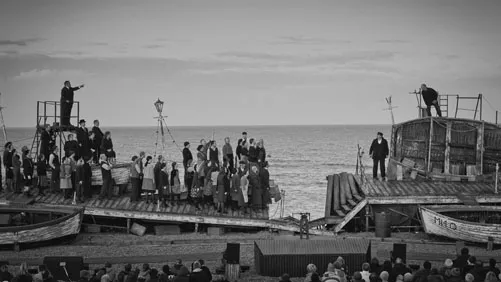
Figure 1Still from the Prologue in the Grimes on the Beach film, directed by Margaret Williams (Grimes on the Beach Films Ltd, 2013).
To somebody like me, who knows a lot more about theatre than about opera, this made spellbinding sense. Britten’s music had been liberated from a tightly wound musical algorithm, and offered a new life as a beautiful and original performance language. What was less explicable was that this was how the custodians of Britten’s legacy had chosen to celebrate the centenary of a composer who, from his teenage years onwards, was synonymous with merciless musicological rigour and compositional seriousness. How could they have let this happen?
One pessimistic view, which found its way into a number of reviews,1 implied that Pierre-Laurent Aimard, the Aldeburgh Festival’s artistic director, was simply echoing the noughties mania for blockbuster site-specific events: that Grimes on the Beach was just another link in a chain with the National Theatre of Wales at one end and Secret Cinema at the other. That, in other words, once somebody had suggested staging Peter Grimes on the very beach on which much of the opera’s action takes place, on paper a vintage centenary idea, it was going to go ahead regardless of what this dramatic reinsertion of Britten into the East Suffolk landscape revealed about his work. Regardless of whether it wrecked the work, even.
It would be naïve to discount the part played by novelty in a production that began with what might have been the most expensive establishing shot in the history of opera. A spitfire flyby along the line of the horizon announced that this would be a 1940s Grimes, rather than one set in the first half of the nineteenth century, as Britten intended. But this is the least interesting angle from which to approach the logistical backstory behind Grimes on the Beach. Better, surely, to accept Aimard’s suggestion2 that this was community opera, as much as a site-specific one. Such sentiments sound like they’re intended to be overheard by the Arts Council, but this one represents legitimate, joined-up engagement both with Britten, that pioneering creative producer, and with Peter Grimes. Britten’s return to his native coastline and community, and the resulting festival charged with the gung-ho, provincial-meets-professional energy best encapsulated by the title of his work for children, Let’s Make an Opera!, represent a lens through which much of his work should always be viewed. This applies most of all to Grimes, an opera about the insidious dynamics that inevitably unite a small-town community against an imaginative individual.
The temptation to see Grimes on the Beach as a community project, and to look for its origins and significance there, was heightened by its companion piece in the 2013 Aldeburgh Festival programme. The Borough was an intimate shard of immersive theatre created by Punchdrunk.3 Taking Grimes on the Beach’s literalism even further, The Borough extracted characters and storylines from Britten’s opera and placed them in settings all over Aldeburgh, from a fisherman’s hut on the beach, to a little cottage that played the part of Ellen Orford’s home, to the reedbeds on the edge of town. Audience members explored each location alone, with the help of a headphone commentary and a small army of extras, including – in the Britten tradition, and I mean that innocently – a number of small boys. The effect, experienced after Grimes on the Beach, was that the town of Aldeburgh (at the best of times a slightly unreal, too-perfect beach resort) became a huge stage set. It was difficult to tell the difference between performers and innocent tourists: is that woman in a vintage dress looking at me like that because she’s in character, or is she looking at me because I’m looking at her like I’m in character? It was the ultimate fulfilment, arguably, of Britten’s decision to create a festival in the town that gave him his first opera setting.
But when I saw The Borough the morning after Grimes on the Beach, it wasn’t community theatre I thought of so much as just: theatre. By picking up characters and themes from Britten’s opera, and dropping them into a reasonably cutting-edge work of contemporary performance, which relegated Britten’s composition to the status of incidental music,4 The Borough encouraged me to double-down on suspicions that had already begun to crystallise. Perhaps the perversely original take on Grimes that I’d experienced the night before, in which Britten’s music represented a feature of the drama rather than its origin, was in fact a justifiable response to the emphases of Britten’s performance text. A response rooted in the revelation that the opera still worked, better than ever actually, even as logistical challenges hammered away at the music. Perhaps the director Tim Albery and the team behind Grimes on the Beach had come to realise, whether consciously or subconsciously, that Britten’s achievement in his most famous opera is, primarily, theatrical rather than musical. And the right way to celebrate that was with two works of experimental theatre.
I left Suffolk increasingly confident that the impact of this performance event, perhaps the most significant of my life, was not so much the product of site-specific spectacle and community choreography as it was, quite simply, the work of Britten, Slater and the other artists there at the beginning, liberated from the opera house’s proscenium. Albery staged a play because Peter Grimes is actually, literally, a play – by contemporary standards of what is and isn’t theatre, anyway. Not in a way that means it isn’t also music-theatre. But it might just be as good a play as it is an opera. And it’s a great opera.
This is the case I will be making in this book, in order to justify its place in a series whose stated purpose is to interrogate ‘modern theatre’s best loved works’. That a Benjamin Britten who is illuminated by the bright lights of contemporary theatre, and the explosive transformations it has undergone in the last couple of decades in particular, deserves a place in theatre history that no critic has ever thought to give him. Because Peter Grimes is a performance text of such shattering originality and potency that, if it is staged in a way that gives its theatrical emphases the opportunity to face off against its music, it starts to look like a remarkable thing: a lost play, perhaps one of the twentieth century’s finest.
For lost it has been, to the theatre-going world, even as it has been elevated to a unique status in the operatic canon: the centenary year alone saw three separate major revivals staged in the UK. With contemporary performance having arrived at a place where Katie Mitchell is more likely to be found directing an opera in Aix than a play in Avignon, it feels rather archaic to talk of different Worlds. But it is precisely the post-modern, post-genre performance theatre innovations of recent decades that highlight the one arena in which an apartheid persists: theatre history. Accounts of European and American theatre in the twentieth century either ignore opera totally, as in Routledge’s gigantic Theatre Histories: An Introduction, in which ‘opera’ as a whole is afforded fewer than half the number of index references listed under ‘Peter Brook’, none of them referring to twentieth-century chapters; or they start to become interested from the moment when Philip Glass and Robert Wilson premiered Einstein on the Beach at Avignon rather than Aix, in 1976, and laid the groundwork for traditional distinctions to be subsumed within the unprecedentedly catholic category we now call avant-garde performance.
Most incomprehensible of all are narratives which recognise the post-genre future into which Einstein offered a portal, without then turning back and considering the 76 years of twentieth-century opera history that preceded it, wondering whether they too might represent part of the story of modern theatre. Historians and theatre critics are comfortable going back as far as Wagner, usually in order to erroneously deploy the word Gesamtkunstwerk, and might mention Berg’s Wozzeck in a wider discussion of German Expressionism, but after that it’s silence all the way through to the 1970s. To take one example, chosen because it’s so blandly representative, Michael Billington’s history of the twentieth-century British theatre, State of the Nation, doesn’t once mention Peter Grimes and reduces Benjamin Britten to a single footnote. Not only that, but the reference relates to Ronald Duncan. He’s a figure whose primary claim to fame in any multidisciplinary account of twentieth-century culture would be as one of Britain’s greatest composer’s most hapless librettist. But his part in Billington’s story is as an underrated playwright who, ‘having struck up a relationship with Benjamin Britten, who composed the incidental music for This Way to the Tomb … was invited to write the libretto for The Rape of Lucretia’ (Billington, 27).
It’s a bizarre situation, but one that’s easily explained. Mostly it’s the fault of theatre critics: for not leaving their comfort zones, and for not being more imaginative in applying the knowledge they have accrued to a greater range of artworks.5 My theatre historian’s assertion that most of the work of opera ‘comes out of’ the music reveals the likely roots of some of this reticence. Academics tend to pride themselves, in my experience, on what they know they don’t know as much as on what they do. A sizeable section of theatre scholars probably don’t know very much about music, on a theoretical level, so why should they apply themselves to a form of performance that originates in serious, difficult music?
Because critical engagement with music doesn’t have to be conventionally theoretical, that’s why. If the work represents pure, unmediated composition, then one can sympathise with academics hamstrung by their ignorance of musicological practice. But that’s not what opera music is; the score only ever exists as part of a multidisciplinary artwork. And the moment music responds to, intersects with or catalyses something else, whether that be movement or acting or singing or lighting, that’s the point at which anybody who knows anything about the other form has the right to stick their oar in. Because at that point music isn’t just music anymore, it’s dramatic art. That’s why non-musicologists are justified in critiquing film music, or indeed incidental music in the theatre (Britten composed a good deal of both before he wrote Grimes); why a critical vocabulary exists within both fields, rooted in film and performance theory6 respectively rather than musicology. So why the lack of crossover opera criticism? Because the composition in opera is often the work of a genius, rather than a technician? Please: to claim one can’t write critically about opera without a substantive grounding in musicological principles is akin to the discredited line of argument that one can’t interrogate Shakespeare without an expert knowledge of early modern linguistics and philosophy. This notion has been shredded by the hands-on, iconoclastic work of practitioners of Shakespeare in performance, which has revealed practical realities central to the meaning of the plays that would never have been discovered through the enth...
Table of contents
- Cover
- Half Title
- Series Information
- Title Page
- Copyright Page
- Dedication
- Table of Contents
- List of figures
- Acknowledgements
- 1 Grimes on the Beach
- 2 Opera as theatre
- 3 The Suffolk renaissance
- 4 ‘Of use to people’
- Bibliography
- Index
Trusted by 375,005 students
Access to over 1.5 million titles for a fair monthly price.
Study more efficiently using our study tools.
Frequently asked questions
Yes, you can cancel anytime from the Subscription tab in your account settings on the Perlego website. Your subscription will stay active until the end of your current billing period. Learn how to cancel your subscription
No, books cannot be downloaded as external files, such as PDFs, for use outside of Perlego. However, you can download books within the Perlego app for offline reading on mobile or tablet. Learn how to download books offline
Perlego offers two plans: Essential and Complete
- Essential is ideal for learners and professionals who enjoy exploring a wide range of subjects. Access the Essential Library with 800,000+ trusted titles and best-sellers across business, personal growth, and the humanities. Includes unlimited reading time and Standard Read Aloud voice.
- Complete: Perfect for advanced learners and researchers needing full, unrestricted access. Unlock 1.5M+ books across hundreds of subjects, including academic and specialized titles. The Complete Plan also includes advanced features like Premium Read Aloud and Research Assistant.
We are an online textbook subscription service, where you can get access to an entire online library for less than the price of a single book per month. With over 1.5 million books across 990+ topics, we’ve got you covered! Learn about our mission
Look out for the read-aloud symbol on your next book to see if you can listen to it. The read-aloud tool reads text aloud for you, highlighting the text as it is being read. You can pause it, speed it up and slow it down. Learn more about Read Aloud
Yes! You can use the Perlego app on both iOS and Android devices to read anytime, anywhere — even offline. Perfect for commutes or when you’re on the go.
Please note we cannot support devices running on iOS 13 and Android 7 or earlier. Learn more about using the app
Please note we cannot support devices running on iOS 13 and Android 7 or earlier. Learn more about using the app
Yes, you can access Benjamin Britten and Montagu Slater's Peter Grimes by Sam Kinchin-Smith in PDF and/or ePUB format, as well as other popular books in Media & Performing Arts & Opera Music. We have over 1.5 million books available in our catalogue for you to explore.