eBook - ePub
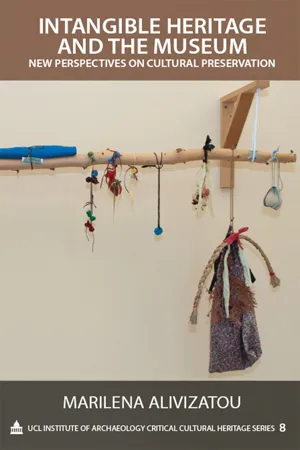
Intangible Heritage and the Museum
New Perspectives on Cultural Preservation
- 225 pages
- English
- ePUB (mobile friendly)
- Available on iOS & Android
eBook - ePub
About this book
In this comparative, international study Marilena Alivizatou investigates the relationship between museums and the new concept of "intangible heritage." She charts the rise of intangible heritage within the global sphere of UN cultural policy and explores its implications both in terms of international politics and with regard to museological practice and critical theory. Using a grounded ethnographic methodology, Alivizatou examines intangible heritage in the local complexities of museum and heritage work in Oceania, the Americas and Europe. This multi-sited, cross-cultural approach highlights key challenges currently faced by cultural institutions worldwide in understanding and presenting this form of heritage.
Information
Chapter 1 Intangible Heritage and the Museum |  |
Preserving material objects is not the only way to conserve a heritage.
—David Lowenthal (1985:384)
In October 2003, after almost three decades of international negotiations on how best to protect folk cultures and traditions (see Seitel 2001; Aikawa 2004, 2009), the General Conference of UNESCO adopted the Convention for the Safeguarding of Intangible Cultural Heritage. Largely drawing on Japanese and Korean post-Second World War laws as well as the structure and terminology of the 1972 Convention Concerning the Protection of World Cultural and Natural Heritage, the 2003 Convention brought intangible heritage into the international scene. In so doing it shifted interest from historical monuments, archaeological sites, and natural parks to living traditions, embodied skills, and oral expressions. Informed by an anthropological understanding of culture, this new concept of intangible heritage has come to encompass all those practices—including rituals, tales, performing arts, crafts, and ceremonies—that are transmitted orally from the past and act as symbols of identity in the present.
Thinking institutionally about cultural heritage in terms not only of a sensu stricto materiality but also of human knowledge, belief, and practice has been widely heralded as a more inclusive and people-oriented approach (see Matsuura 2004; Smith and Akagawa 2009). This has been further expressed in the widespread use of the term on an international level, but also in the active endorsement of the 2003 Convention and relevant programmes by states that had not been well represented in the World Heritage Convention of 1972—an instrument that has often been criticised as Eurocentric (Munjeri 2004, 2009). But the emergence of intangible heritage in the global scene has raised complex questions: Is the institutionalisation of culture as intangible heritage a hegemonic and universalising project? Does intangible heritage mask the bureaucratisation or “thingification” (Byrne 2009:229) of peoples’ lifeways? How is the dichotomy between the tangible and the intangible to be approached?
The aim of this book is to provide a critical examination of intangible heritage on both conceptual and practical levels. To this end, my work explores intangible heritage not only in the international sphere of cultural diplomacy, but also, via a more grounded approach, in the complexities of twenty-first-century heritage and museum practice. This is pursued through multi-sited fieldwork research (Marcus 1995) in order to investigate local negotiations of intangible heritage in specific museums and heritage institutions across the North and South. These are the National Museum of New Zealand Te Papa Tongarewa in Wellington, the Vanuatu Cultural Centre in Port Vila, the National Museum of the American Indian in Washington and New York, the Horniman Museum in London and the musée du quai Branly in Paris. Discussed widely as contemporary spaces of cultural representation and museological innovation (see Simpson 1996; Bolton 2003; Kreps 2003; Shelton 2003; Message 2006; Clifford 2007; de l’Etoile 2007a, 2007b; Phillips 2007; Price 2007, 2010), these five “zones of contact and conflict” (see Clifford 1997) provide unique insights to the above questions.
At the centre of this book is an examination of cultural preservation: the effort to protect, conserve, or safeguard the traces of past for the future, which constitutes a key narrative of modernity (Lowenthal 1985, 1998; Nora 1989; Smith 2006). Inherent in this is an underlying notion of authenticity, which implies that cultural heritage, either in the form of buildings, objects, or oral expressions, is an original manifestation of the past in the present and therefore needs to be preserved intact for future generations. This is particularly problematic for the area of oral culture, as it hints at processes of cultural stagnation and ossification. One of the objectives of my research then is to critically examine the idea of cultural preservation and explore new approaches to heritage authenticity and cultural transmission. By examining modern preservationism in the context of erasure and transformation, I argue for a more fluid and flexible understanding of culture, heritage, and traditions. The idea is to think beyond concepts of decay, salvage, and loss and engage with cultural change as a new heritage value. To this end, chapter 2 brings under scrutiny recent debates in heritage studies, public archaeology, and anthropology to problematise further the idea of a heritage of destruction and change.
A parallel aim is to question the idea of the museum as a repository of material culture, a space dedicated to the preservation and display of artefacts and specimens. Engaging with intangible heritage calls for a people-centred museology and provides a conceptual framework for rethinking contemporary museum work and the relation between the tangible and the intangible (see Kurin 2004a, 2004b; Svensson 2008; Kreps 2009). Whilst historically museums have been seen as temples of knowledge primarily concerned with collections of objects (Bennett 1995; Duncan 1995), a more recent critique has argued for a museological humanisation and civic reorientation (Kreps 2003, 2009; Ames 2006; Butler 2006; Smith 2006). In this context, intangible heritage emerges as a parallel framework for reimagining the museum, its collections and role as a public institution. This raises the issue of community or participatory museology (Karp et al. 1992; Peers and Brown 2003; Watson 2007), and brings up ideas of cultural inclusion and dialogue that are further problematised in the context of the five museums.
In the last decades, a period defined by Ruth Phillips as “the second museum age” (2005), museums have emerged as public and dialogic spaces, where practices of representation and interpretation are carefully planned and often shared. The participation of community groups in museum work has meant that oral histories and traditional knowledge and beliefs are gradually incorporated in official museum narratives, until recently the exclusive product of scientific explanations by museum professionals (see Cruickshank 1992; Whiteley 2002). As a consequence, the didactic voice of the modernist museum is replaced by notions of multivocality and dialogue that challenge ideas of linearity and objectivity (see Hooper-Greenhill 2000:151–153). Yet this hints at a new exclusivity inherent in the power of self-representation, as groups that had historically been marginalised are now actively involved in museum work (see Zimmerman 2010). Chapter 3, for example, explores issues of community empowerment in Te Papa Tongarewa’s Maori and community galleries. Similarly, chapter 5 investigates the narrative of the inaugural exhibitions produced by twenty-four Native American tribes at the National Museum of the American Indian. The celebratory tone of many of these exhibitions, combining local lore, oral history, and traditional belief, is increasingly criticised as unscientific and even propagandistic, hinting that grassroots voices of intangible heritage are often entangled in political narratives. This then invites a more critical examination of the relationship between museums and their communities (see Ames 1999; Boast 2011).
Since the adoption of the 2003 Convention, intangible heritage has been the subject of a significant academic dialogue (see Ruggles and Silverman 2009; Smith and Akagawa 2009; Lira and Amoeda 2010). Under scrutiny has come not only its emergence in the context of UNESCO (Nas 2002; Hafstein 2004, 2009; Alivizatou 2007, 2008a), but also its broader impact on actual cultural practices and practitioners (de Jong 2007; Hafstein and Bendix 2009). Valdimar Hafstein, for example, has examined its intellectual origins in folklore studies, anthropology research, and intellectual property debates, but also in the cultural preservation framework of Japan and Korea (2004). One of Hafstein’s main arguments is that selection and exclusion are key characteristics of intangible heritage. In resonance with Barbara Kirshenblatt-Gimblett (2004), he underlines the role of modern capitalism and cultural economies of tourism in the construction of a global context for intangible heritage (Hafstein 2009). Michael Brown has further problematised the 2003 Convention in relation to the broader debate on the ownership of cultural property (2005). Underlining the paradoxical situation of protecting local cultural expressions through international safeguarding measures, he raises the question of whether intangible heritage is a “resource of all of humanity” or belongs to its community of origins (2005:49), an idea that has also been discussed by Ferdinand de Jong in his examination of the heritagisation of the Kankurang masquerade in Senegal and Gambia (2007). Critical of UNESCO’s proclamation of the masquerade in 2005 as a Masterpiece of the Oral and Intangible Heritage of Humanity, de Jong explores how this new regime of visibility impacts on the actual performance by local communities. His critique forms part of a broader literature that problematises the impact of global heritage processes and is further explored in chapter 2 (see also Byrne 1995; Kreps 2003; Smith 2006; Butler 2007; de Jong and Rowlands 2007; Labadi and Long 2010; Joy 2011).
Building on this relatively recent academic dialogue, my research examines intangible heritage in the context of contemporary museology. As museums are moving towards a more dynamic engagement with communities and extend their activities beyond the preservation and display of collections, intangible heritage is gradually adopted as a new field of action. This creates space to examine how different museums engage with the intangible in their practice and how they perceive their preservation role with regards to living and not only material culture.
A MUSEOLOGY OF INTANGIBLE HERITAGE
Although intangible heritage is a relatively recent concept, museums and cultural bodies have long been concerned with the preservation of oral traditions and folk cultures. “The break marked by the disappearance of peasant culture” (Nora 1989:7) that followed the Industrial Revolution in nineteenth-century Western Europe meant that ways of life embedded in tradition and old custom were gradually abandoned. It is this break between past and present, the separation between the old and the new, that led to the foundation of modern sites of memory, spaces, events, and objects acting as mechanisms that perpetuate and preserve the memory of the past (Nora 1989). These sites of memory or lieux de mémoire—museums, archives, parades, registers, and commemorative ceremonies—marked the rise of modern historical consciousness, a collective awareness that the past is a separate entity and that certain aspects of it ought to be preserved for the future. New institutions were thus gradually founded to keep the memory of the past alive. The birth of the public museum in nineteenth-century Europe and North America is part of this project (Hooper-Greenhill 1992; Bennett 1995).
However, the museology of the past did not include only objects and specimens, but also broader lifeways and traditions. Skansen, in Sweden, is widely regarded as one of the first in a series of open-air museums built before the First World War to present, on the one hand, vernacular buildings and farmsteads and, on the other, rural and traditional ways of life, cultural practices, festivities, music, and crafts (Oliver 2001). Artur Hazelius (1833–1901), the founder of Skansen, lived at a time when large parts of the rural population of Sweden were moving to industrial zones and urban areas, and it was felt that Swedish peasant and folk culture (tangible and intangible) was disappearing. Skansen—with its rebuilt cottages and houses; the associated objects, furniture, and tools; but also the folk celebrations, festivities, and demonstrations—expressed a romanticised version of the past that was a marker of national identity and could provide future generations with a sense of roots and continuity. In this sense, it was the forerunner of open-air museums, institutions not only concerned with the preservation of artefacts and treasures, but also with the broader cultural and social environment in which they exist, including a sense of place and locality.
The idea that the past is embedded in space and cultural practice took further shape in the mid-twentieth century with the development of “ecomuseums.” Based on similar ideas of identity as being rooted in place and tradition, the rise of ecomuseums in France saw the transformation of old buildings and sites and deserted industrial facilities into cultural spaces concerned with preserving the memory of local communities. Conceptualised by Georges Henri Rivière, the propagator of the French nouvelle muséologie (1989), and museologist Hugues de Varine, ecomuseums shifted interest from museums for objects to museums for communities by emphasising the institution’s social responsibility and connection with local groups (Davis 1999). In 1971 the first ecomuseum was founded in Creusot-Montceau, in the French department of Bourgogne (see http://www.ecomusee-creusot-montceau.com). A central aim of the project was to connect different areas of the same territory and celebrate its nineteenth-century industrial past (Gob and Drouguet 2003:39). Of value were not so much the relics of the disused industrial sites as the spirit of the place, the habits, customs, and traditions of the community; in other words, expressions that bridge the tangible-intangible dichotomy (Boylan 2006). A fundamental prerequisite for the success of an ecomuseum in France was, thus, the participation of the local community that would sustain and inform its practice (Gob and Drouguet 2003:40). The development of ecomuseums in France and gradually around the world can be seen as a response to a museum practice inherited from the nineteenth century and primarily concerned with the display of collections for urban or elite audiences (see Bourdieu and Darbel 1989). In this context, several local museums and cultural centres representing Indigenous, ethnic, or minority groups were founded in the latter part of the twentieth century to represent communities that had been excluded from larger and more prominent cultural establishments (see Karp et al. 1992; James 2005).
The focus on community engagement and participation has been further reflected in the work museums undertook to connect with a wider and previously marginalised public. Shifting interest from objects to audiences was one of the key themes of the “new museology” movement in the 1990s (Vergo 1989; MacDonald 2006) and a central topic of the agenda on social inclusion (Sandell 2002). Museum and community partnerships vary enormously and may include consultation with local communities, local schools, and religious or ethnic groups as part of wider outreach, education, or exhibition projects (see Karp et al. 1992; Sandel 2002; Watson 2007). A significant part of the literature, however, is particularly concerned with partnerships between museums and what is widely referred to as “source communities” (see Clifford 1997; Peers and Brown 2003), the first owners and makers of museum pieces from outside Europe and for the last century the subject of many museums and exhibits (Ames 1992; Nederveen Pieterse 1997). James Clifford’s discussion of the museum as a “contact zone” has been a central theme in negotiating the relationship between museums and Indigenous groups (1997). Talking mostly about encounters between museums and American Indian groups, Clifford notes how museums are being transformed through partnerships with communities and further describes the museum as a site of conflict and negotiation. Similarly, Ruth Phillips, speaking from a Canadian perspective, explains how ideas of negotiation and dialogue are central features of this “second museum age” (2005).
The transformation of late nineteenth- and early twentieth-century museums from authoritative institutions to “contact zones” (Clifford 1997) or “interactive theatres” (Phillips 2005) largely took place within the social and political mobilisations that marked the end of the twentieth century, like the civil rights and the Indigenous peoples movements (Niezen 2003). In the field of heritage and museums, this led for example to the adoption of the Native American Grave Protection and Repatriation Act (NAGPRA) by the U.S. Senate in 1990, or the establishment in 1992 of the Canadian Task Force on museums, which underlined the need to respect and take into consideration the beliefs, opinions, and claims of Native groups, but also led to different controversies surrounding claims for repatriation (Simpson 1996; Hubert and Fforde 2005; Nash and Colwell-Chanthaphonh 2010). The 1992 Draft Declaration on the Rights of Indigenous People by the United Nations, which formed the basis for the development of the 2007 Declaration, further intensified claims of Native groups and communities over land and self-determination, leading several critics to challenge the foundations of Native cultural property arguments (see Kuper 2003).
The above developments had important ramifications in museum work. The participation of Native groups in the international human rights scene brought Indigenous preoccupations and concerns to the fore and led to the establishment of museum-like cultural centres run and funded by Indigenous communities around the world (Mead 1983; Clifford 1988; Stanley 1998, 2007; Hendry 2005; Coody Cooper and Sandoval 2006; Kasarherou 2007). As several critics have argued, most museums established in Africa, Asia, and the Pacific as part of colonial processes had little to do with the preoccupations and interests of local people (see Appadurai and Breckenridge 1992 and Bharucha 2000 for South Asia; Konare 1995 for West Africa; Bolton 2003 for Vanuatu; Kreps 2003 for Indonesia; McCarthy 2007 for New Zealand). With decolonisation, the museum as a colonial construct is gradually reinvented to serve local audiences, often inviting new ways for defining the institution, its functions, and its responsibilities (see Kreps 2011).
Against this backdrop, intangible heritage emerges as a postcolonial narrative of community development. Christina Kreps, for example, has related intangible heritage to the empowerment of Indigenous knowledge and the humanisation of museums (Kreps 2003, 2007, 2009), whereby voices and practices that had been historically overlooked now become central to the development of new museological paradigms of valuing and caring for the past. “Indigenous curation,” the preservation and interpretation of Indigenous collections by Indigenous peoples, emerges therefore as an expression of intangible heritage, which ultimately liberates culture from the oppressive, exclusive, and authoritarian articulations of Western museology (see Stanley 1998; Kreps 2003, 2009).
MULTI-SITED RESEARCH: MUSEUM ETHNOGRAPHY
Intangible heritage has thus been related to a postcolonial reinvention of museum practice centred on providing a space for cross-cultural communication. This creates a new context for a museology that is not only about the preservation of collections, but rather more ambitiously is also about the safeguarding of traditional knowledge and the expression of local identity. The question that is raise...
Table of contents
- Cover
- Half Title
- Title Page
- Copyright Page
- Dedication
- Table of Contents
- List of Illustrations
- Acknowledgments
- 1. Intangible Heritage and the Museum
- 2. Global Preservation and Beyond
- 3. From Artefacts to Communities: Participation and Contestation at Te Papa Tongarewa
- 4. At the Interface of Kastom and Development: The Case of the Vanuatu Cultural Centre
- 5. Intangible Heritage at the Living Memorial of Native Americans
- 6. Reinventing the Gift at the Horniman Museum
- 7. The Dialogue of Cultures, Laïcité, and Intangible Heritage at the quai Branly
- 8. Rethinking Cultural Preservation, Museum Curation, and Communities
- Notes
- Glossary
- References
- Index
- About the Author
Trusted by 375,005 students
Access to over 1.5 million titles for a fair monthly price.
Study more efficiently using our study tools.
Frequently asked questions
Yes, you can cancel anytime from the Subscription tab in your account settings on the Perlego website. Your subscription will stay active until the end of your current billing period. Learn how to cancel your subscription
No, books cannot be downloaded as external files, such as PDFs, for use outside of Perlego. However, you can download books within the Perlego app for offline reading on mobile or tablet. Learn how to download books offline
Perlego offers two plans: Essential and Complete
- Essential is ideal for learners and professionals who enjoy exploring a wide range of subjects. Access the Essential Library with 800,000+ trusted titles and best-sellers across business, personal growth, and the humanities. Includes unlimited reading time and Standard Read Aloud voice.
- Complete: Perfect for advanced learners and researchers needing full, unrestricted access. Unlock 1.5M+ books across hundreds of subjects, including academic and specialized titles. The Complete Plan also includes advanced features like Premium Read Aloud and Research Assistant.
We are an online textbook subscription service, where you can get access to an entire online library for less than the price of a single book per month. With over 1.5 million books across 990+ topics, we’ve got you covered! Learn about our mission
Look out for the read-aloud symbol on your next book to see if you can listen to it. The read-aloud tool reads text aloud for you, highlighting the text as it is being read. You can pause it, speed it up and slow it down. Learn more about Read Aloud
Yes! You can use the Perlego app on both iOS and Android devices to read anytime, anywhere — even offline. Perfect for commutes or when you’re on the go.
Please note we cannot support devices running on iOS 13 and Android 7 or earlier. Learn more about using the app
Please note we cannot support devices running on iOS 13 and Android 7 or earlier. Learn more about using the app
Yes, you can access Intangible Heritage and the Museum by Marilena Alivizatou in PDF and/or ePUB format, as well as other popular books in Art & Museum Studies. We have over 1.5 million books available in our catalogue for you to explore.