- 404 pages
- English
- ePUB (mobile friendly)
- Available on iOS & Android
eBook - ePub
About this book
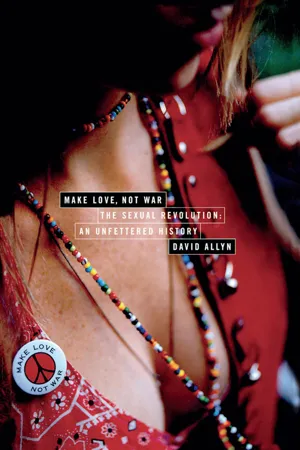
When Helen Gurley Brown's Sex and the Single Girl hit bookstores in 1962, the sexual revolution was launched and there was no turning back. Soon came the pill, the end of censorship, the advent of feminism, and the rise of commercial pornography. Our daily lives changed in an unprecedented time of sexual openness and experimentation. Make Love, Not War is the first serious treatment of the complicated events, ideas, and personalities that drove the sexual revolution forward. Based on first-hand accounts, diaries, interviews, and period research, it traces changes in private lives and public discourse from the fearful fifties to the first tremors of rebellion in the early sixties to the heady heyday of the revolution. Bringing a fresh perspective to the turbulence of these decades, David Allyn argues that the sexual revolutionaries of the '60s and '70s, by telling the truth about their own histories and desires, forced all Americans to re-examine the very meaning of freedom. Written with a historian's attention to nuance and a novelist's narrative drive, Make Love, Not War is a provocative, vivid, and thoughtful account of one of the most captivating episodes in American history. Also includes an 8-page insert.
CHAPTER 1
SINGLE GIRLS, DOUBLE STANDARD
WHEN HELEN GURLEY BROWN’S Sex and the Single Girl hit bookstores in 1962, the sexual revolution was launched and there was no turning back. Brown did something few other American women had dared to do: She gleefully admitted, in print, that she had lost her virginity before getting married. It was a wild confession, the kind of revelation that could destroy a woman’s reputation, cost her her closest friends, wreck her marriage. But Brown did more than admit to a single indiscretion, she hinted at a long history of casual contacts, and she extolled unmarried sex as a positive virtue. “Not having slept with the man you re going to marry I consider lunacy,” she wrote. Unrepentant and unashamed, Brown gently urged other women to follow her example. As she told those who might feel guilty about their erotic impulses, “[S]ex was here a long time before marriage. You inherited your proclivity for it. It isn’t some random piece of mischief you dreamed up because you’re a bad, wicked girl.”1
As Brown and her publisher hoped, Sex and the Single Girl proved just controversial enough to become a sensation. One reviewer called it “as tasteless a book as I have read” and warned that it showed “a thorough contempt for men,” who become “the marionettes” in an artful and immoral “manipulation.”2 From a literary standpoint, the book was simply atrocious. Tossing exclamation points right and left, Brown could barely write a single sentence that didn’t include a shriek of delight over rich men or expensive eyeliner. Most of the book’s advice to women — from makeup tips to cooking lessons — was numbingly conventional. But the public adored its breezy style, forthright manner, and pragmatic attitude about premarital romance. The book was an instant best-seller: 150,000 hardcover copies were sold the first year alone. Brown got $200,000 for the movie rights to the book — the second-highest figure that had ever been paid for a nonfiction book.
Helen Gurley Brown was an unlikely revolutionary. Born in Green Forest, Arkansas, in 1922, she was bred to be a proper Southern lady. Raised by her mother (her father died when Helen was only four), Helen Gurley prided herself on being a good daughter, always obeying the rules — or at least telling the truth when she didn’t. She was more bony than beautiful, suffered from severe acne as a teenager, and spent most of her youth caring for her older sister, who had polio. Helen performed well in school, but like most women in the forties and fifties, the only job she could find after graduation from college was secretarial. A firm believer in the American Dream, the young Gurley felt confident that if she were persistent enough, her literary talents would eventually be recognized. In the meantime, she took advantage of everything that working for wealthy, attractive men had to offer. Even though a company might frown on “intramural dating,” Gurley would later write in her book, she believed in workplace romance if there were “good material at hand.” If her boss was less than handsome, Gurley simply found a new one: “As long as we’re in more or less of a boom economy, it’s possible to change jobs easily.”3 After she’d held eighteen different secretarial jobs, Gurley’s talent for perky prose landed her a position as a copywriter for an advertising firm.
Gurley had discovered sex at an early age. When she was only eleven, she and a relative, four years older, tried to have intercourse and failed only because her vagina was too tight.
That was some hot and heavy summer, as you can imagine. I was eleven and he was 15. There’s nothing like a country boy who is 15 and horny. Yet I too felt — what would you call it — feelings, cravings, longings. And we once even tried it. But I, of course, was hermetically sealed, a tiny little person, Yd never been touched before, and his heart wasn’t in it.
At sixteen, she kissed a boy in the back of a car and had her first orgasm. Four years later she lost her virginity. “Everything was sealed over. I think I bled a little. But I did have an orgasm. I knew then that sex is a wonderful, delicious, exquisite thing … after that nothing ever got in the way of my thinking sex was fabulous.” The following day “the darling man went to a store and bought me earrings. He wanted me to marry him, but I said no. My mother was devastated.”4
At thirty-three, Gurley obtained a diaphragm and discovered the joys of sexual independence. After a string of affairs, she finally did marry in 1959. She was already thirty-seven, an old maid by the standards of the day. David Brown, her movie-producer husband, was the one who suggested she write an advice book for young women. He knew a financial opportunity when he saw one, and she knew that there was a large gap between what women did in private and what was said in public. She was appalled by a 1961 article in the Ladies’ Home Journal warning single women that they had two choices: to marry or remain absolutely chaste. Brown knew from her own experience that many single women were flouting public morals in their private lives. “Theoretically a ‘nice’ single woman has no sex life. What nonsense! She has a better sex life than most of her married friends. She need never be bored with one man per lifetime. Her choice of partners is endless and they seek her.”5 All a woman needed to fully enjoy single life was a little of Brown’s advice on fashion, decorating, and sex.
Bubbling with optimism, Sex and the Single Girl reflected the spirit of middle-class America during the heyday of Camelot. The economy booming, the misery of the Depression and World War II all but forgotten, America in the early sixties was a vibrant, energetic nation. Brown’s combination of coy femininity and pull-yourself-up-by-your-boot-straps ambition was practically a guaranteed success. In the early sixties, anything seemed possible — even the abolition of the age-old double standard.

The sexual double standard is as old as civilization itself. Among the Hebrews of the Middle East, monogamy was strictly enforced for women, while men often took concubines or multiple wives. When Sarah could not bear children for Abraham, he — with God’s blessing — simply took a maidservant as his mistress. According to Jewish lore, King Solomon had seven hundred wives and three hundred concubines. Jewish women were required to shave their heads so that they would not prove tempting to other men. According to the Old Testament, women who committed adultery were to be summarily stoned to death. In ancient Athens, men were free to have multiple partners (male or female), while women who were not professional prostitutes lived in virtual slavery. A married woman was not only the property of her husband, she was confined to the upper floors of her home and forbidden to appear in public without a veil. In Greek mythology, the most powerful and revered goddesses remained lifelong virgins. In Imperial Rome, the law was less harsh: A woman who committed adultery was banished from her home and never allowed to marry again. Although early Christians tried to introduce a single standard of sexual restraint for both men and women, they ended up — by glorifying Mary’s virginity and demonizing Eve’s eroticism — merely reinforcing the double standard and providing a new justification for the punishment of sexually active women.
Despite the fact that gender roles fluctuated throughout the Middle Ages, promiscuous women were consistently attacked and denounced by Church authorities. In the sixteenth and seventeenth centuries, many were burned at the stake as witches. Chastity belts and other devices served where the fear of punishment did not. Despite the Enlightenment and the scientific revolution, the double standard persisted into the modern era. While aristocratic women could afford to play by their own rules, Rousseau and other “modern” thinkers tended to be vocal opponents of female sexual freedom. After the bloodbath of the French Revolution, many observers in England and America blamed the loose morals of French women for the political mess in Paris.
In the nineteenth century, bourgeois notions of propriety and cleanliness lent new import to the notion of female purity. Victorian sensibilities required women to profess a total lack of sexual feeling. A middle-class woman was expected to tolerate her husband’s advances only for the sake of having children. Women were simply not supposed to enjoy sex. Since men were known to need sexual release, moralists urged them to visit brothels rather than defile their own wives. As a result, red-light districts flourished in nineteenth-century cities.6 As in ancient Athens, a woman who appeared on the street alone in the Victorian era was assumed to be a prostitute.
The double standard had several cruel implications for women. Not only did it mean an unmarried woman was supposed to be absolutely chaste, it meant a woman who had been raped was deemed unsuitable for marriage. Not infrequently, a girl who was raped would be pressured by her parents to marry the rapist. Women were often blamed for the assaults.7 The double standard also led to laws against birth control and abortion, on the grounds that they would encourage female promiscuity. In 1873, the U.S. government made it a crime to send birth control devices — or even information about such devices — through the mail.
In the nineteenth century and early twentieth, a few scattered social reformers tried to dismantle the double standard. But they were almost always dismissed as strange bohemians or dangerous radicals and their writings were often banned. Slowly, however, the double standard began to wane. Anthropologists showed that premarital promiscuity was happily encouraged in some primitive societies without any adverse effects. The vulcanization of rubber led to the invention of modern contraceptives. Marriage manuals encouraged husbands to attend to their wife’s sexual pleasure. In the 1910s and ’20s, working-class women discovered that money brought freedom. The economic vitality of the era encouraged a relaxed view of sex outside of marriage.8 But the double standard did not disappear. At the insistence of Catholic authorities, Hollywood drove home the moral that wanton women would ultimately be punished for their sins. In films like East Lynne (1931), Waterloo Bridge (1931), Grand Hotel (1932), Anna Karenina (1935), Jezebel (1938), and countless others, women were put in their place for expressing their sexual desires. When Mae West insisted on flaunting her sexuality onscreen and refused to abide by the dictates of censors, Paramount Pictures failed to renew her studio contract. As Sylvia Weil, who was born in 1910, remembers, “if it got around that a girl slept with a man before she was married, she was ruined. She would never find a good husband.” Women continued to face retribution for “unladylike” behavior, while society generally winked at the sexual antics of young men.9
Each new generation of young girls was indoctrinated with the same message: A woman’s virginity is her most precious commodity. As actress Dyan Cannon, born in 1937, recalls, “My dad used to tell me that if I let anyone touch me, anyone, they wouldn’t respect me and I would be considered a tramp.”10 In the 1950s, as Americans reveled in the “return to normalcy” after years of depression and war, the double standard was reaffirmed in books, movies, television shows, and popular magazines. American males were told that if they were healthy they should hunger for sex, while young women were advised to resist forcefully and demand a ring.11
“You have no idea how bad it was,” recalls Gloria Steinern, who grew up near Toledo, Ohio, in the thirties and forties. “There was always the fear that you might be punished for being sexual.” One author catalogued the rules that the mass media conveyed to young women:
The young miss, for example, must never take any real initiative in courtship … must not show any interest in one male when she is out with another … must never try to date a fellow who is going steady with another girl… must never go home with a man whom she has just met at a dance, lest he consider her “just a pickup” … must not act too intelligent when she’s with a boy because “boys don’t like you to be smart” … must never phone a fellow unless she is going steady with him or has some other legitimate excuse … must never be so forward with boys as to “cheapen her in a man’s eyes.”12
Failure to abide by these rules could lead to gossip, insult, and public humiliation.
With the emergence of professional psychoanalysis in the postwar period, the double standard acquired “scientific” legitimacy. Psychologists and psychiatrists claimed that women were not only less sexual than men, they were naturally masochistic. Helene Deutsch claimed that women were inevitably masochistic because they could experience full sexual arousal only by being dominated. Marie Bonaparte argued that women were masochistic because during conception the ovum must be “wounded” by the sperm.13 Meanwhile, other psychoanalysts insisted that women who experienced only clitoral orgasm were immature and unwell; mature women supposedly transferred their orgasmic sensations from the clitoris to the vagina. The vaginal orgasm, psychoanalysts maintained, was the only true orgasm. Such ideas caused many women to feel inadequate and inferior.
Most teenage girls in the fifties did not even know orgasms existed. “I didn’t know anything about orgasms,” one woman recalls.
The first time [we had sex] we were in his dorm room. It was fast — he came in and came out. It was a sharp, poignant pleasure that had no resolution … He would come in and then pull out and come into a handkerchief. I was always left hanging. I used to come back to my dorm and lie down on the floor and howl and pound the floor. But I didn’t really know why I was so frustrated. It felt so lonely.14
So long as the double standard was dominant, men and women were caught in a war of the sexes. Boys lusted after girls and tried to seduce them without getting trapped into marriage, while girls distrusted boys — often with good reason. “When I was a kid,” Penthouse publisher Bob Guccione remembers,
finding a girl who screwed was like finding gold. It was a great piece of news if you heard about a girl who screwed, because it was extraordinarily unusual for a girl to screw without a lot of problems — having to take her out, court her, spend money on her. When you did hear about one, she was inevitably the object of many a gang bang. I remember going to see a girl in Teaneck, New Jersey, and there were four or five carloads of guys, and we picked this dame up, drove her to the schoolyard, and one by one, twenty guys screwed her on the grass.
Ronald Jones, who was a student at Ohio State during the fifties, remembers one weekend at his fraternity house when “over a hundred guys had sex with the same woman.”15 Under the double standard, a woman who publicly expressed the slightest interest i...
Table of contents
- Cover
- Half Title
- Title Page
- Copyright Page
- Dedication
- Table of Contents
- Preface to the Paperback Edition
- Acknowledgments
- Introduction
- 1. Single Girls, Double Standard
- 2. Beatniks and Bathing Suits
- 3. The Pill: A Prescription for Equality
- 4. Love the One You’re With
- 5. Obscenity on Trial
- 6. Strangers in a Strange Land: The Harrad Experiment and Group Marriage
- 7. The Right to Marry: Loving v. Virginia
- 8. In Loco Parentis
- 9. Strange Bedfellows: Christian Clergy and the Sexual Revolution
- 10. Performing the Revolution
- 11. Sticky Fingers
- 12. Gay Liberation
- 13. The Golden Age of Sexual Science
- 14. Medicine and Morality
- 15. Why Do These Words Sound So Nasty?
- 16. (Id)eology: Herbert Marcuse, Norman O. Brown, and Fritz Perls
- 17. No Privacy Please: Group Sex in the Seventies
- 18. The Joy of Sales: The Commercialization of Sexual Freedom
- 19. Lesbian Liberation: Equal But Separate
- 20. Sexual Freedom on Demand
- 21. Counterrevolution and Crisis
- Epilogue
- Notes
- Selected Bibliography
- Index
Trusted by 375,005 students
Access to over 1.5 million titles for a fair monthly price.
Study more efficiently using our study tools.
Frequently asked questions
Yes, you can cancel anytime from the Subscription tab in your account settings on the Perlego website. Your subscription will stay active until the end of your current billing period. Learn how to cancel your subscription
No, books cannot be downloaded as external files, such as PDFs, for use outside of Perlego. However, you can download books within the Perlego app for offline reading on mobile or tablet. Learn how to download books offline
Perlego offers two plans: Essential and Complete
- Essential is ideal for learners and professionals who enjoy exploring a wide range of subjects. Access the Essential Library with 800,000+ trusted titles and best-sellers across business, personal growth, and the humanities. Includes unlimited reading time and Standard Read Aloud voice.
- Complete: Perfect for advanced learners and researchers needing full, unrestricted access. Unlock 1.5M+ books across hundreds of subjects, including academic and specialized titles. The Complete Plan also includes advanced features like Premium Read Aloud and Research Assistant.
We are an online textbook subscription service, where you can get access to an entire online library for less than the price of a single book per month. With over 1.5 million books across 990+ topics, we’ve got you covered! Learn about our mission
Look out for the read-aloud symbol on your next book to see if you can listen to it. The read-aloud tool reads text aloud for you, highlighting the text as it is being read. You can pause it, speed it up and slow it down. Learn more about Read Aloud
Yes! You can use the Perlego app on both iOS and Android devices to read anytime, anywhere — even offline. Perfect for commutes or when you’re on the go.
Please note we cannot support devices running on iOS 13 and Android 7 or earlier. Learn more about using the app
Please note we cannot support devices running on iOS 13 and Android 7 or earlier. Learn more about using the app
Yes, you can access Make Love, Not War by David Allyn in PDF and/or ePUB format, as well as other popular books in History & North American History. We have over 1.5 million books available in our catalogue for you to explore.