- 356 pages
- English
- ePUB (mobile friendly)
- Available on iOS & Android
eBook - ePub
About this book
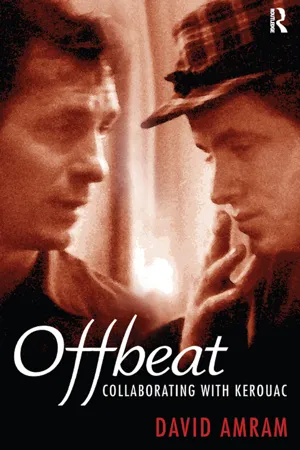
David Amram has been described as "the Renaissance man of American Music." His musical career has spanned participating with Jack Kerouac in the original jazz-poetry reading in 1957 in Greenwich Village to being honored as the first Composer-in-Residence for the New York Philharmonic and to playing in Farm Aid concerts. He's performed with an incredible variety of musical greats, such as Dizzy Gillespie, Thelonius Monk, Willie Nelson, and and Tito Puente, and he continues to compose and tour nationally. Now available in paperback, following the 50th anniversary of the publication of Kerouac's classic On The Road, Offbeat is the rollicking story of this legendary musician and his adventures with his close friend Jack Kerouac. Amram and Kerouac shared a relationship based on creativity, respect, and fun, and Offbeat offers the reader a full share of each. This wonderful memoir takes the reader from the coffee houses of New York to the San Francisco Opera House and into the making of the now-classic film Pull My Daisy. Offbeat is Amram's energetic and heartfelt account of Kerouac and the creative community of artists-including Allen Ginsberg, Gregory Corso, Langston Hughes, and Neal and Carolyn Cassady-that courageously explored their creative potential and, in doing so, changed American culture forever.
Information

Book One
Chapter 1
Children of the American Bop Night
Collaborating with Kerouac was as natural as breathing. That is because the breath and breadth of Jack’s rhythms were so natural that even the most stodgy musician or listener or reader could feel those rhythms and cadences, those breathless flowing phrases, the subtle use of dynamics that are fundamental to the oral (i.e., spoken) and aural (i.e., to be listened to) tradition of all musical and poetic forms of expression.
Whoa, you might say. Why such a long sentence? Because Jack himself spoke, wrote, improvised, and sang in long flowing phrases, like the music of Franz Schubert, George Gershwin, Hector Berlioz, Haydn, Charlie Parker, Lester Young, Billie Holiday, like the poetry of Walt Whitman, Dylan Thomas, Baudelaire, Céline, Langston Hughes, and other lyric artists whose work we both loved and admired.
The 1950s were the pinnacle years for great conversationalists and great rappers, the last generation to grow up reading voraciously, traveling by extension of the thumb, and trusting the Great Creator to get you to your destination. Part of the requirement of being a successful hitchhiker was to engage your patron saint of the moment, the person who picked you up, in conversations about anything and everything.
Storytelling was still practiced as a people-to-people activity. Television and the Internet were not yet born. Entertainment and communication came from the interaction of people with each other. Many of the greatest poets, authors, and jazz artists, whether reading or playing in public, could carry on for hours for an audience of one other person. Our expectations and goals were to achieve excellence, with the hope that once we did, someone out there would dig it.
“Just find one person and play for that person all night long, Dave,” Charlie Mingus told me in the fall of 1955, when I had just arrived in New York and was fortunate enough to be chosen by him to be in his quintet. “All you need is one person in your whole life to really be listening.”
Jack was one of those people who listened and observed as well as he wrote and performed. When Jack and I first began performing together in 1956, we would run across one another at BYOB parties, often held at painters’ lofts. The guests would bring wine, beer, Dr. Brown’s Black Cherry Soda, sometimes just paper cups, or potato chips, graham crackers, or a musical instrument, a new poem, a song, a monologue from Shakespeare, or Lord Buckley’s latest comedic-philosophical rap, or simply their unadorned selves, looking for romance, fun, excitement, and a chance to celebrate Friday and Saturday night, where you could stay up till dawn, because you didn’t have to go to your day job the next day.
This was the New York where Jack and I each felt most at home—an environment that was inclusive, informal, almost rural, temporarily created for a few hours in the midst of the vast sky-scrapered metropolis, where we miraculously found temporary cocoons of warmth and camaraderie. These party environments were like back porch Lukenbach, Texas, picking parties in the summer, or Lowell, Massachusetts, get-togethers over beer with Acadian accordions and singing of old songs, or the pubs of Dublin, Ireland, where unheralded natural poets celebrated the rising of the moon, or great jam sessions in the South, like the ones with Charlie Parker and Dizzy Gillespie in my basement apartment in 1951–52 in Washington, D.C., before I met Jack.
These informal, spontaneous gatherings were like magic. Years later, Jack talked about these New York all-night weekend bashes that we shared, but when he and I first performed together we hardly said a word to each other. Just as I was blessed to play with Thelonious Monk, Miles Davis, Bud Powell, and scores of other great musicians who never said much and let their music do the talking, Jack and I had that same musician’s ESP. It was an unspoken communication that came to us naturally. I would play while he read or improvised words, and I knew exactly what to do. We both knew how to listen, to lay back, to breathe together, to curb aggression and search for harmony, to tune into one another and surrender ourselves to the particular rhythm and pulse of the evening.
That rhythm and pulse was always connected to the Native American drum we both felt so strongly, the African drum that permeated all the great music of our time, the drum of the Middle East, and the soulful song-stories, prayers, and chants of the Catholic Church that Jack had in his bones and the Jewish liturgical wailing of ancient songs that reverberated in my unconscious. As soon as we were done performing, we would give each other a wink, a nod, or a smile, and become part of the party, flirting with young women and searching for food, drink, and adventure.
Several months after we had crossed paths many times, my weekend excursions to these parties temporarily came to a halt, and I began an eleven-week-long stint with my quartet at the Five Spot, a funky bar in the Bowery that became the hangout for painters like Franz Kline, Willem de Kooning, Joan Mitchell, Alfred Leslie (who later directed the film Pull My Daisy that Jack and I collaborated on), and Larry Rivers (who appeared in Pull My Daisy as a saxophone-playing railroad train conductor, modeled after Neal Cassady).
The Five Spot welcomed everyone—artists, moving men, postal workers, winos, office workers, and off-duty firemen—and you could get a huge pitcher of beer for 75 cents. My quartet was sometimes joined by as many as eighteen musicians (on the night when the whole Woody Herman Band sat in with us). Late at night, poets and actors would sometimes join us, reciting poetry or improvising verse with music. This was never planned. Our era was always in-clusive, not ex-clusive. Jazz was about sharing and spontaneity.
Jack was often there, and all of us in the quartet could always feel his presence the minute he arrived. We could telepathically feel his power as a listener, just as we could feel his ability to observe, reflected in his dark, brooding eyes. I remembered our great encounters at the weekend loft parties where we played together. On the Road was not yet published, and the terrible pressures of celebrity were still to come. Even though he often sat alone, like a wayward meditative Canadian lumberjack in his plaid red-checkered work shirt, he always exuded a special energy. He was that one special person Mingus alluded to, the one we always knew we could play for. We began to know one another as two fellow transplanted hicks, trying to relate to Golgothian New York City. Jack was from Lowell, Massachusetts, and I was brought up on a farm in Feasterville, Pennsylvania. Even though we had both seen a lot of the world, we still had the bond of being outsiders in New York City. Like so many of our friends, we were looked upon as offbeat characters, searching for hidden treasures that we knew we would find in our everyday lives, if we left ourselves open to appreciate everything that surrounded us.
Jack told me how being a football player had opened the doors for him to leave Lowell, go to an Eastern prep school, and be accepted at Columbia University, and I told Jack about my childhood growing up on a farm in Feasterville, Pennsylvania, always dreaming of becoming a musician. I described the trauma of moving to Washington, D.C., at the age of twelve, and deciding to become a musician and composer, the joy of my job as a part-time gym teacher at a French school, then being drafted into the army and beginning my travels around the world.
We found we shared a mutual interest in sports and speaking fractured French, which often annoyed the 4 A.M. stoned-out customers at Bickford’s greasy spoon, where we would congregate after the Five Spot closed, to eat hamburgers with fried onions and mayonnaise on English muffins, while we drank coffee and planned our conquest of New York.
A few months later, after my eleven-week engagement at the Five Spot was over, poet and drummer Howard Hart and San Francisco poet Philip Lamantia climbed up the six flights of stairs to my tiny apartment on Christopher Street, which was always open to guests, and told me of their idea to give a jazz-poetry reading in New York City.
“It will be the first one,” said Howard Hart, in his hyper-breathless style. “Jack said he’ll do it with us. He’ll be the MC, and you and he can do all that spontaneous stuff where you both make up rhymed scat-verses and accompany each other, and Philip and I will read from poems we’ve written out. We’ll give you carbon copies of our poems to look at. We can even rehearse, but I know you and Jack don’t need to. You guys already can do it naturally better than anyone else.”
When I read some typed copies of Howard’s and Philip’s poems, which Howard had brought with him, I understood why Jack wanted to do a planned reading with them. Their poems were lyrical, original, honest, touching, with brilliant flights of fancy, combined with contemporary sounds of everyday urban life.
“Where are we going to do it, and when?” I asked. “I don’t know if I’ll have much time to rehearse. I’m writing music for Joe Papp’s Free Shakespeare in Central Park, and working part-time in the post office, playing with my band and composing music too. I’ve always played with Jack spontaneously without ever planning anything.”
“Don’t worry,” said Howard. “It will happen when and where it’s supposed to happen, and we’ll all be there together.”
The next day we met with Jack at my sixth-floor walk-up. I could hear Jack bellowing as he climbed the stairs.
“Merde alors!” said Jack. “I’ve ascended the cherubic heights to join the lonely bell ringer up in the tower of St. Amram’s Synagogue. Get an elevator, Davey. These six flights will be responsible for your premature demise. A la santé and lechayim.” Jack pulled a bottle of Thunderbird wine from his red-checked lumber jacket, removed it from its soiled brown paper bag, and took an enormous gulp.
“We’ll make history, Davey. The mad poets and sainted musicians will make New York City become the new international shrine for Buddhalike meditation. All the jaded big-city Philistines will smile at one another as we lay our scatological tomes on their weary souls. Let’s play something for Philip and Howard to show these boys how Baudelaire and Erik Satie are reborn in Greenwich Village.”
I began playing the 12-bar blues, and Jack and I made up verses, played and scat-sang four-bar breaks, while Howard took a pair of wire brushes from his jacket and played drum parts on a phone book. Philip Lamantia watched us in amazement.
“My God, Jack. I wish everyone in San Francisco could see this. I didn’t know you could sing.”
“I can’t,” said Jack. “That’s the voice of the Holy Spirit coming through me. Like Stravinsky said about composing Sacré du Printemps: ‘I’m merely the vessel through which this new creation was given to the world.’”
“I see New York’s helping you to overcome your shyness and modesty,” said Philip, laughing.
“Naw, I’m serious, man,” said Jack. “When Davey and I start cooking, I feel like I’m flying. Like Charlie Parker. A bird in flight. He didn’t talk about it. He did it.”
“We’ll do it,” said Howard.
“I’ll drink to that,” said Jack. “Let’s get some more wine and go out to the Cafe Figaro and meet some beautiful gals. And we’ll discuss our plans to invade New York’s literary jungle, and overwhelm the masses with our spontaneous madness.”
We ambled down the six flights of stairs and headed towards the Cafe Figaro. We walked in silence for a few blocks. Jack turned to me as we crossed Sheridan Square.
“Did you ever feel you knew someone all your life when you met them?”
“Yes, Jack. I felt that with you, the first time we played together at one of those loft parties, but never would have said it.”
“You didn’t need to say it,” said Jack.
We walked to the Figaro and sat in the back room. I took out my horn, and we gave an impromptu improvised performance. Brooklyn Bernie, an old Village moving man, applauded and came over to our table.
“I’ll tell ya what, Dave. I’ll buy all you guys free coffee, sandwiches, and pastry if you’ll let me recite ‘The Rime of the Ancient Mariner’ with you, all right? Listen, Dave, you play the horn, like the sea sounds making the boat rock, and you other guys hum when I signal you. I always wanted to do this at the Figaro. This is my chance!”
Then he whispered confidentially, “There’s a bunch of bee-yoo-tiful young ladies from Barnard College and Mt. Holyoke College for Women sitting up in the front two tables by the window. They’re here to meet some real bohemian artists. What you guys are doin’ … no offense, but it’s too weird, it’s too far out, but when they hear me do ‘The Rime of the Ancient Mariner’ … they’ll flip out! And I’ll buy you all whatever you want.”
“I accept your kind offer,” said Philip. “I’ll have the apple turnover, a double espresso, and salmon platter.”
“I’ll have the same,” said Howard.
“I’m not hungry. I’m thirsty,” said Jack. “I’ll take a sip of whatever holy spirits are in that bottle I see in the side pocket of your coat.”
“I’m starving, Bernie,” I said. “I’ll have the vegetarian special plate, a tuna roll, a cappuccino, and toasted bagel with lox, onions, and cream cheese, with a side order of coleslaw and French fries.”
Brooklyn Bernie, the moving man, ordered us our feast. After we chowed down, Jack and I did a few impromptu numbers, punctuated by Jack taking loud slurps of Wild Turkey whiskey from Brooklyn Bernie’s brown-bagged bottle, before launching into his next improvised story-song-poem. Jack sat down and attacked my remaining coleslaw and French fries. Brooklyn Bernie took a huge belt from his near-empty bottle of Wild Turkey, cleared his throat, and climbed on top...
Table of contents
- Cover
- Title Page
- Copyright Page
- Table of Contents
- Foreword
- Preface
- Acknowledgments
- BOOK ONE
- BOOK TWO
- Epilogue: Now’s the Time
- Photo Section
- Index
- About the Author
Trusted by 375,005 students
Access to over 1.5 million titles for a fair monthly price.
Study more efficiently using our study tools.
Frequently asked questions
Yes, you can cancel anytime from the Subscription tab in your account settings on the Perlego website. Your subscription will stay active until the end of your current billing period. Learn how to cancel your subscription
No, books cannot be downloaded as external files, such as PDFs, for use outside of Perlego. However, you can download books within the Perlego app for offline reading on mobile or tablet. Learn how to download books offline
Perlego offers two plans: Essential and Complete
- Essential is ideal for learners and professionals who enjoy exploring a wide range of subjects. Access the Essential Library with 800,000+ trusted titles and best-sellers across business, personal growth, and the humanities. Includes unlimited reading time and Standard Read Aloud voice.
- Complete: Perfect for advanced learners and researchers needing full, unrestricted access. Unlock 1.5M+ books across hundreds of subjects, including academic and specialized titles. The Complete Plan also includes advanced features like Premium Read Aloud and Research Assistant.
We are an online textbook subscription service, where you can get access to an entire online library for less than the price of a single book per month. With over 1.5 million books across 990+ topics, we’ve got you covered! Learn about our mission
Look out for the read-aloud symbol on your next book to see if you can listen to it. The read-aloud tool reads text aloud for you, highlighting the text as it is being read. You can pause it, speed it up and slow it down. Learn more about Read Aloud
Yes! You can use the Perlego app on both iOS and Android devices to read anytime, anywhere — even offline. Perfect for commutes or when you’re on the go.
Please note we cannot support devices running on iOS 13 and Android 7 or earlier. Learn more about using the app
Please note we cannot support devices running on iOS 13 and Android 7 or earlier. Learn more about using the app
Yes, you can access Offbeat by David Amram in PDF and/or ePUB format, as well as other popular books in Media & Performing Arts & Music Biographies. We have over 1.5 million books available in our catalogue for you to explore.