- 316 pages
- English
- ePUB (mobile friendly)
- Available on iOS & Android
eBook - ePub
About this book
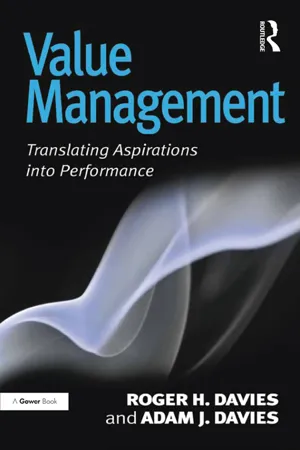
Change programmes in both private and public sectors have a poor record of delivering their intended value. The reasons given most often for their failure include lack of executive support or buy-in from key users, loose requirements definition, weak programme management, and plain wishful thinking. They rarely include technical limitations. Value Management puts forward the view that the true problem lies in failing to understand the causal links between the intended stakeholder outcomes and the actual programme outputs. Repeating the pattern of failure can be avoided by asking two questions: - Before implementation, what capabilities must a change programme deliver, when and in what order so as to cause intended value against a defined purpose with speed and certainty? - During and after implementation, what minor adjustments and/or major shifts are needed to be certain that the programme remains on purpose and on value? and two answers to be given: - Target, time and align change programmes to deliver maximum intended value to stakeholders - the baseline business case - track and respond to changes during and beyond implementation to ensure that the programme actually delivers or exceeds intended value - value realisation. The authors show how, by asking and answering these questions, direction and delivery of any programme can be clarified and greater economic value achieved.
Information
PART I
Problem
In Part I we first state the crucial role that value plays in the fundamental economic and business challenge; creating, distributing and sustaining wealth with diminishing resources. We assert the critical role of change programmes in achieving this imperative. Three common myths relating to delivering value from programmes are exposed. We describe parallel advances in technology, process and thinking that when used effectively together take away all excuses for failing to deliver value. We then define the Value Equation to provide a foundation for quantifying value and consider how it can be applied across several key perspectives. We discuss new ways of thinking in creating value and key skills and, finally, apply these thinking skills to define repeating patterns of failure which direct us to repeatable solutions.
CHAPTER 1
Critical Value
Objectives
After reading this chapter you will be able to:
• Recognise and avoid three myths related to creating value through change programmes
• Identify opportunities for applying advances in technology, processes and thinking to create value
The Economic Wake up
The Nightmare Story
You wake up in a cold sweat. That has to be the worst nightmare you have ever had. It is still clear in your mind. The Earth has warmed up so much that coastal defences around the world have been overwhelmed by the sea. The Thames barrier has been breached like a child’s sandcastle. Your new London apartment, which your insurance company refused to cover against flooding because it was built on a floodplain, is under water and you are loaded with debt from the heady days of cheap credit. Still dazed, your radio alarm bursts into life with the 06:00 news.
The top story covers latest research proving beyond doubt that the environmental cynics were right all the time, the calculations were wrong, global warming is a con trick; carbon emissions have no effect on global warming. In fact, it turns out that CO2 is good for the planet.
It also transpires that massive debt is the miracle to end recession and drives new, unfettered growth after all. The credit crunch was just a one-off aberration that will never happen again. Borrowing is back and it’s good for us. The Dickensian idea that what you spend must be in relation to the value that you create is dead. House prices are rising rapidly again. The Prime Minister announces that we are back to uninterrupted economic growth.
A great calm warms your entire body. You relax and plan the loan for that new 4 × 4 you promised yourself.
As I write this book, there is great speculation over the validity of dire global warming predictions. Leading academics have allegedly been manipulating data which has left a large credibility gap. Although for most scientists it seems highly unlikely that global warming is a myth, let’s just suppose that the Nightmare Story was true. Where would that actually leave the human race in respect of our economic and biological survival? The uncomfortable answer is, ‘largely the same’. Even if environmental issues disappeared, and ignoring human and ethical arguments, the resources needed for fuelling the growth to support exponentially rising populations and expectations of the new super economies are rapidly running out. Consequently, in purely economic terms, scarcity will result in reduced availability or cost increases to levels which render many existing business models unviable. The natural Law of ‘limits to growth’, defined by Donella Meadows1 dictates that propelling prosperity though unfettered consumption, with or without cheap credit, is unsustainable.
We cannot sustain increased prosperity using the current proportional level of resource consumption.
Developed countries are holding on to the hope that promised levels of income and pensions can be sustained with debt and a return to growth, whilst becoming increasingly uncompetitive against the major developing countries, notably China and India. If we add back the environmental truths and the economic risks of high levels of debt, we are faced with a new reality: either we learn to live with less wealth or we find ways to create wealth with fewer resources.
The first alternative is not practical, at least not without a fundamental shift in human nature. The history of the human race is one of endeavour to drive economic growth. Developing nations are determined to experience the benefits of growth and are now driving the pace. Creating more from less is the only option in the long term and for Western economies it is critical. If economics is the study of wants and needs, then the relationship between acquisition and the consumption of resources required to attain them is value. Ultimately, wealth is generated from value creation. Therefore if we are to continue to improve our standard of living, through economic growth with less resource, we need to create and manage value more skilfully.
Value is the measure of more for less.
The primary message of this book is a positive one: that it is perfectly possible to achieve growth with sustainable consumption of resources through precise targeting, timing and alignment of investment in people, process and technology. Programmes have a core role in this transition because they are the vehicle by which change, and more importantly intended outcomes from change, are realised. However, it is no longer enough to throw money at problems when most of the effort is dissipated in waste. This was never the solution but the futility was hidden by readily available money, energy and raw materials.
Another essential shift is for change programmes to be incorporated within ‘business as usual’ operations, which is now in itself the management of change, rather than the protector of stability. This means that changes to the business drivers and outcomes are no longer wishful figures in an archived business case, but daily tracked measures within a dynamic performance framework.
Value Management is the transition from wishful thinking to causal certainty.
Record of Failures
It is not hard to find instances of programme failure. In Britain alone, there are the jaw-dropping headline cases, such as the £12.7 billion IT overhaul of the NHS2 that has been riddled with technical issues and the London Olympics which has seen its original 2007 budget triple from £2.4 billion to £7.2 billion. It is feared that neither of these major programmes is likely to deliver anything like the benefits claimed. The more general picture is also one of programmes failing to realise the value upon which their approval was gained.
A large proportion of change programmes still fail to deliver expected benefits.
Although the failure to deliver value relates to all types of programme, because IT forms a major catalyst for change much research into the problem has centred on IT. There is a difference in opinion regarding the real extent of IT failure: some estimates suggest roughly a third of technology-related projects are unsuccessful,3 while a recent Standish Group Chaos report implies that only a third (32 per cent) of IT projects are successful.4 More specifically the Standish Group’s report for the 2009 period found that in addition to 44 per cent of projects being challenged in some fundamental way, 24 per cent were cancelled before they were completed, or never used. Less optimistic findings can also be found suggesting failure rates as high as 68 per cent.5 With regard to the impact on shareholders, research from Tata Consulting finds that 41 per cent of organisations failed to realise the expected ROI from their IT projects.6 The higher rates of failure bear out our own experience. The overall picture is one of unacceptable levels of failure.
Recognising that IT is critical to business and the economy as a whole, this failure prevents us from growing and sustaining wealth individually and globally. To put this cost into financial perspective, calculations by Roger Sessions of ObectWatch estimate that the annual world wide cost of IT failure is as high as US$6.2 trillion.7 This level of waste is just not sustainable, but also offers a massive opportunity.
Common Programme Value Myths
The Welfare Benefits Story
During the late 1990s the UK government was enthusiastic in exploiting opportunities for electronic government as a way of reducing burgeoning public sector costs. An area singled out for exploiting the new technologies was administration of the UK welfare benefits system. Benefits comprised some 70 types of welfare streams, called chimneys. Chimneys were managed using hugely expensive and inefficient manual processes. They were also run independently, despite the fact that one stream triggered one or more others. These links were manual and allowed for colossal error and fraud. For example, people on Income Support would be automatically eligible for Housing Benefit but when Income Support ceased so should the associated Housing Benefit, in principle. However, claimants would frequently continue to receive the benefit payments to which they were no longer entitled simply by failing to notify the appropriate authority. When the process eventually caught up, there was little or no way of retrieving the money, the responsibility being deemed to reside with the government. The Department of Health and Social Security (DHSS) quaintly referred to this loss as ‘leakage’.
The DHSS launched a Business Process Re-engineering (BPR) programme, the largest and most ambitious in Europe at the time, to transform the administration of the UK benefits system. The focus was directed on cost savings in running the system. Benchmark indicators of savings claimed in other major programmes were the principal justification. Consequently, elegant process maps and scenarios detailing every life event of all conceivable claimants were devised using the most sophisticated tools available. The programme was run diligently, in this case under PRINCE2™. However, no one questioned the validity of a narrow cost saving focus.
As the business case, using Value Management, was developed it became clear that the few millions potentially saved in process efficiencies were eclipsed by the billions lost in fraud and errors, which the new processes were not tackling. The final value model demonstrated that the financial case was not viable on operational cost savings alone and the programme was shelved, with the result that further futile spend was avoided but the opportunity to correct these flaws was lost.
There are three common myths related to creating value through change programmes which we will illustrate through the Welfare Benefits Story case study:
• Myth 1: value correlates with spend
• Myth 2: wishful thinking will do
• Myth 3: big bang implementation is best
Myth 1: Value Correlates with Spend
The first myth is that big changes demand big investments and, more dangerously, that big spend correlates directly to value. Whilst the first assumption can be true, the second most certainly is not. This is the stuff of spin where politicians boast about protecting spending on public services, such as health, education and policing. However, it is the outcomes from spend that need to be protected, and these cannot be guaranteed by the size of the spend itself. This message is, of course, highly contentious and we do not say this lightly. Paul Strassmann, a leading authority on the value of IT, has devoted much research to the correlation of spend in IT and ROI. Not only did this research expose a poor correlation between financial results and IT spend, but also in some cases increased spending on IT corresponded to reduced ROI.8 We will demonstrate that precise targeting, timing and alignment of investment is far more critical than the size of spend.
Myth 2: Wishful Thinking Will Do
This myth comes in various guises, such as ‘everyone else is doing this so we should too’, ‘the claimed savings of this fad are £x million so we can expect £y million in our case’ and ‘the benefits will follow automatically’. The Welfare Benefits Story above illustrates several manifestations of wishful thinking. The first concerns poor targeting and lack of precision in defining what value the change was intended to deliver, and to whom. For example, in this case the entire programme was initiated on the unsubstantiated premise that process efficiency was the most significant issue. This blinded the team from pursuing much greater potential outcomes from improved process effectiveness of integrating the chimneys. This common situation arises because effectiveness benefits, such as improved service and revenue generation, are generally more difficult to define and quantify than cost savings, typically involving simple headcount reduction. However, of the numerous strategic programmes to which we have applied Value Management, the achieved effectiveness benefits far outweighed cost savings in most cases.
The first problem concerns imprecise starting conditions.
The second problem relates to poor or misdirected assessment of the value status of the programme during and after implementation. In this example, the value opportunity for shifting emphasis from reducing headcount to addressing the integ...
Table of contents
- Cover Page
- Dedication
- Title Page
- Copyright Page
- Contents
- List of Figures
- List of Tables
- About the Authors
- Reviews for Value Management
- Foreword by Tim Marshall
- Foreword by Lode Snykers
- Preface
- Acknowledgements
- Contributors
- Review Team
- Executive Questions
- Introduction
- PART I PROBLEM
- PART II PRINCIPLES
- PART III PROCESS
- APPENDICES: PRECISION – ADVANCED TECHNIQUES AND TOOLS
- Value Management Toolset™
- Glossary of Terms
- Bibliography
- Index
Trusted by 375,005 students
Access to over 1.5 million titles for a fair monthly price.
Study more efficiently using our study tools.
Frequently asked questions
Yes, you can cancel anytime from the Subscription tab in your account settings on the Perlego website. Your subscription will stay active until the end of your current billing period. Learn how to cancel your subscription
No, books cannot be downloaded as external files, such as PDFs, for use outside of Perlego. However, you can download books within the Perlego app for offline reading on mobile or tablet. Learn how to download books offline
Perlego offers two plans: Essential and Complete
- Essential is ideal for learners and professionals who enjoy exploring a wide range of subjects. Access the Essential Library with 800,000+ trusted titles and best-sellers across business, personal growth, and the humanities. Includes unlimited reading time and Standard Read Aloud voice.
- Complete: Perfect for advanced learners and researchers needing full, unrestricted access. Unlock 1.5M+ books across hundreds of subjects, including academic and specialized titles. The Complete Plan also includes advanced features like Premium Read Aloud and Research Assistant.
We are an online textbook subscription service, where you can get access to an entire online library for less than the price of a single book per month. With over 1.5 million books across 990+ topics, we’ve got you covered! Learn about our mission
Look out for the read-aloud symbol on your next book to see if you can listen to it. The read-aloud tool reads text aloud for you, highlighting the text as it is being read. You can pause it, speed it up and slow it down. Learn more about Read Aloud
Yes! You can use the Perlego app on both iOS and Android devices to read anytime, anywhere — even offline. Perfect for commutes or when you’re on the go.
Please note we cannot support devices running on iOS 13 and Android 7 or earlier. Learn more about using the app
Please note we cannot support devices running on iOS 13 and Android 7 or earlier. Learn more about using the app
Yes, you can access Value Management by Roger H. Davies in PDF and/or ePUB format, as well as other popular books in Negocios y empresa & Negocios en general. We have over 1.5 million books available in our catalogue for you to explore.