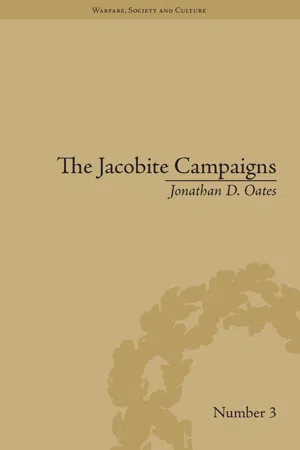
The military aspects of the Jacobite campaigns in eighteenth-century Britain are considered in this study. Taken from the viewpoint of those loyal to the Hanoverian Crown, the three mainland campaigns of 1715–6, 1719 and 1745–6 are examined, using research based on primary sources: memoirs, diaries, letters, newspapers and State papers.
- 256 pages
- English
- ePUB (mobile friendly)
- Available on iOS & Android
eBook - ePub
About this book
1 RAISING THE MEN
This chapter examines how Britain’s regular army was raised in the eighteenth century, surveying both why and how officers and men came to be in its ranks. There will be details about their training, weapons and equipment, uniforms and conditions of service. Finally their peacetime employment will be explored.
The infantry of the British army was made up of regiments/battalions (the terms are interchangeable in this period). Each was comprised of thirteen companies, including a grenadier company, made up of the regiment’s best men. The regiment was commanded by a colonel, then there would be a lieutenant colonel and a major. Each would also be the captain of one of the companies. The other companies would be led by a captain. Beneath the captain was a lieutenant and then an ensign (in a cavalry unit this most junior of officers was titled a cornet). Cavalry was divided into horse and dragoons (originally mounted infantry in the Civil Wars), but in practice there was little difference between the two arms. Regiments were formed into squadrons and troops. There were also the regiments of guards (both horse and foot), the monarch’s household troops, often stationed in and about London, and the artillery corps, the most recently recognized branch of the army, formed officially as the Royal Regiment of Artillery in 1716.1
Officers and men were often viewed as belonging to two separate spheres, and while this was not always the reality, we shall deal with them separately, noting the fact that the seeming chasm was often crossed.
Army commissions up to the rank of lieutenant colonel could be purchased and usually were – from 1660 to 1871, about two-thirds in total. The ensigncy was least expensive and a colonelcy the most; with select regiments, such as the Guards, having higher tariffs. However, the market in commissions was regulated. The royal warrant of 1720 set a tariff (£200 for an ensigncy, £9,000 for a colonel of horse, but prices were often higher; in 1740 the price of an ensigncy was over double the amount set), and also stated that an officer could only sell to another with a rank immediately beneath his own. Finally, the Crown had the right to approve any purchase, and the Georges took their role in this process very seriously. Children were barred from being commissioned, as was not uncommon before 1711 and not wholly unknown thereafter, with Lord George Lomax becoming an ensign in 1751, aged thirteen, while James Wolfe (172759) was fourteen when he became a lieutenant in 1741. From the 1720s, it was stated that an ensign should be aged between sixteen and twenty-one, but in the case of older NCOs being promoted, the upper age limit was waived.2
The purchase system has often been criticized, but it did ensure that men with independent means dominated the officer corps, rather than mercenaries and professionals. The latter were thought to be politically dangerous, as the army had been under Cromwell. It also meant that officers were bound over for good behaviour, because to be cashiered for misconduct resulted in the loss of their commission and of their investment. Finally, on retirement, a man could sell his commission and so have a fund which he could then invest for a pension.3 Henry Pelham, First Lord of the Treasury from 1743 to 1754, put it thus, ‘our liberties can never be in danger so long as they are entrusted to men of family and fortune’.4
Once there was a vacancy among the regiment’s officers, the officer below the rank of the vacancy would usually be offered first refusal, so if he had the funds available, he could buy it and then offer his now more junior commission to the next man on the ladder. Officers of the same rank were marked out in seniority by the length of time they had held their present commissions. So if there was a vacancy of major, the longest serving captain would be offered it first.5
Not all commissions had to be paid for. When an officer died or was cashiered, the officer immediately beneath this rank would be offered the vacancy for free. In wartime, when deaths in battle or on campaign were frequent, promotion was easier and more rapid. Sometimes deserving NCOs were put into these vacancies, and this was not uncommon in wartime. Feats of bravery sometimes led to promotion from the ranks. An example from our period is the case of Sergeant Terrence Molloy. In 1745, he was in command of Ruthven Barracks, which was threatened by a substantial Jacobite force. Refusing to surrender, the barracks held out and Molloy was made a lieutenant on Sir John Cope’s recommendation.6 In the period 1739–93, 598 NCOs were raised from the ranks to become officers, which was about 3 per cent of the total. Joshua Guest (16601747) enlisted in the ranks in 1685 and ended his career as a general.7
The other method was to enlist as a volunteer, as the fictional Tom Jones seems to have done. In this instance a young man accompanied the army at his own expense, but carried a musket and marched and fought in the ranks. He would, however, mess with the officers and would hope to pick up a free commission. In the 1800s, 4.5 per cent of commissions were taken by such gentlemen rankers, and perhaps the same figure is true of the eighteenth century.8
As important as money and seniority were for an officer wishing to ascend the career ladder, there was also the matter of ‘interest’, as there was in all aspects of life. In fact in order to be accepted as an officer in a regiment, a young man needed someone who could speak on his behalf to the regiment’s colonel. Samuel Bagshawe obtained his first commission because his family were clients of the powerful Cavendish family. Often, though, it was a case of the young man’s relations seeking help through a chain of individuals until locating one who could deal directly with the colonel in question. Or a commission broker could be negotiated with, though this was illegal.9
James Boswell sought help, though unsuccessfully, in obtaining a commission in the Guards in 1763. Lady Northumberland told him ‘I shall certainly, Sir, recommend you to Lord Granby in the strongest manner; and as the Blues are his own regiment, I should think that they will not interfere but allow him to do what he pleases’.10 John Kynaston, in 1704, was eager to become an officer and went to London, where new regiments were being raised. He recalled, ‘I apply’d myself to my friends in order to get a commission. I was recommended by two members of Parliament to James Craggs [a senior politician and close to Marlborough] and he was pleased to use his interest to the Duke of Marlborough and got me colours in the regiment of Foot’.11 The fictional elderly lieutenant in Tom Jones had his career hindered by ‘having no Friends amongst the Men in Power’ and also ‘had the Misfortune to incur the Displeasure of his Colonel’.12 Viscount Irwin (1691–1761), Lord Lieutenant of the East Riding of Yorkshire, wrote to the Duke of Newcastle (1693–1768), Secretary of State, in 1746 asking for him to assist one Storr with a possible military career, ‘speak a good word for him to the Duke of Bedford’, and asked him to assist his brother likewise. Irwin thought that he deserved a quid pro quo ‘considering the great expense and trouble I have been for the support of the cause’. Irwin had raised volunteer forces against the Jacobites in 1745 as we shall later note.13
Although this gave the colonel great powers over the prospects for promotion of those under him, they were not absolute, except when he was seeking officers for a wholly new regiment, which occurred at the outbreak of wars and rebellions. In other times, he had to submit all recommendations to the monarch. Commissions, except those of ensigns, could be sold only to serving officers. Colonels were expected to adhere to the principle of seniority as outlined above, so the junior captain could not be given the rank of major ahead of the more senior captains, unless none of the latter could afford the price. Appointing relations or sons of friends to vacant ensigncies was another matter, however, and could be done at will. Monarchs alone could promote above the rank of colonel.14
The king’s power over military patronage was not to be sniffed at, as Lord Hervey (1693–1743), a courtier, complained in 1736:
There was a great number of commissions in the army vacant, which the King [George II], from a natural dilatoriness of his temper, joined to a particular backwardness in giving, had postponed filling up all this winter, notwithstanding the frequent and pressing instances made to him by Sir Robert Walpole [the leading minister], who never received any other answers on these occasions form his Majesty, than ‘My God! It is time enough. I will fill them up at the end of the session.’
Hervey explained that the delays were because it was a case of the King ‘loving nobody well enough to have any pleasure in preferring them’.15
There was no official training for officers (except in the artillery), nor any educational standards to be required until 1801 when the Royal Military College at Sandhurst was established, and that was designed for the staff. Training was deemed to be ‘on the job’. But for the gunners, it was different. Technical knowledge was clearly crucial in this the most recently formed arm of the regulars. The Royal Military Academy at Woolwich was founded in 1741 to train officers of the artillery and engineers. Promotion in this instance was by seniority alone, commissions could not be purchased.16 Having said that, there were a number of drill books and instruction books for soldiers, the most famous being Humphrey Bland’s Treatise on Discipline. This was a manual explaining tactical drill, musketry fire and other essential aspects of the soldiers’ trade.
Although most officers were men of means, they were from a variety of backgrounds. Unlike Continental armies of the period, the British army was not dominated by the scions of the aristocracy, partly because there were so few of them in Britain. In 1780 it has been estimated that 24 per cent of army officers were noblemen, and they were concentrated in the guards regiments. Other officers were from the gentry (16 per cent in 1780) or, increasingly, from the sons of clergymen and the professional classes who had some spare cash. Many, too, were the sons of soldiers, such as James Wolfe, whose father and grandfather served in the army. This tradition of ‘army families’ developed in the years 1715–30.17 The officers in Tom Jones include ‘one of whom had been bred under an Attorney, and the other was Son to the Wife of a Nobleman’s Butler’.18 Officers were from all parts of Britain. In the American War of Independence, 42 per cent of British army officers were English, 27 per cent Scottish and 31 per cent Irish, though of the rank and file, 60 per cent were English, 24 per cent Scottish and 16 per cent Irish.19 There were also American and Huguenot officers among them, too.
We shall now turn to the rank and file of the army. Men joined the ranks as volunteers. There was no conscription in Britain until 1916. However, individual social and economic circumstances often bore heavily on a man’s decision to take the King’s shilling.
It has traditionally been often asserted that the army was filled with the desperate of Georgian society. It is certainly true that it was not uncommon for some men lounging in gaol to enlist. For example, in April 1704 it was noted that John Watson, imprisoned for debt in the Gatehouse prison in London, owing money to John Buckmaster, was to be discharged because he ‘has enlisted in the regiment of Colonel Thomas Handaside’.20 In 1696, Robert Dale was convicted, fined and ordered to stand in a pillory in Bloomsbury, then was to be gaoled for a month ‘unless he shall, in the meantime, voluntarily list himself to serve His Majesty as a soldier’.21 Another was John Quin, convicted before a Surrey Justice of the Peace (JP) in ...
Table of contents
- Cover
- Half Title
- Title Page
- Copyright Page
- Table of Contents
- Acknowledgments
- Introduction
- 1 Raising the Men
- 2 The Army on Campaign
- 3 The Battle
- 4 The Siege
- 5 The Formation of the Militia and Posse
- 6 The Formation of the Loyalist Volunteer Forces
- 7 The Militia and Volunteer Forces in Action
- Conclusion
- Notes
- Works Cited
- Index
Trusted by 375,005 students
Access to over 1.5 million titles for a fair monthly price.
Study more efficiently using our study tools.
Frequently asked questions
Yes, you can cancel anytime from the Subscription tab in your account settings on the Perlego website. Your subscription will stay active until the end of your current billing period. Learn how to cancel your subscription
No, books cannot be downloaded as external files, such as PDFs, for use outside of Perlego. However, you can download books within the Perlego app for offline reading on mobile or tablet. Learn how to download books offline
Perlego offers two plans: Essential and Complete
- Essential is ideal for learners and professionals who enjoy exploring a wide range of subjects. Access the Essential Library with 800,000+ trusted titles and best-sellers across business, personal growth, and the humanities. Includes unlimited reading time and Standard Read Aloud voice.
- Complete: Perfect for advanced learners and researchers needing full, unrestricted access. Unlock 1.5M+ books across hundreds of subjects, including academic and specialized titles. The Complete Plan also includes advanced features like Premium Read Aloud and Research Assistant.
We are an online textbook subscription service, where you can get access to an entire online library for less than the price of a single book per month. With over 1.5 million books across 990+ topics, we’ve got you covered! Learn about our mission
Look out for the read-aloud symbol on your next book to see if you can listen to it. The read-aloud tool reads text aloud for you, highlighting the text as it is being read. You can pause it, speed it up and slow it down. Learn more about Read Aloud
Yes! You can use the Perlego app on both iOS and Android devices to read anytime, anywhere — even offline. Perfect for commutes or when you’re on the go.
Please note we cannot support devices running on iOS 13 and Android 7 or earlier. Learn more about using the app
Please note we cannot support devices running on iOS 13 and Android 7 or earlier. Learn more about using the app
Yes, you can access The Jacobite Campaigns by Jonathan D Oates in PDF and/or ePUB format, as well as other popular books in History & British History. We have over 1.5 million books available in our catalogue for you to explore.