- 336 pages
- English
- ePUB (mobile friendly)
- Available on iOS & Android
eBook - ePub
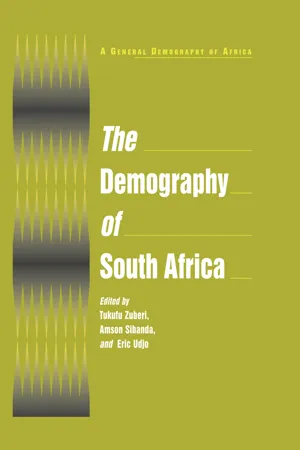
The Demography of South Africa
About this book
This groundbreaking study of South Africa provides a unique look at the interplay of demographic, social and economic processes in a society undergoing rapid change as a result of the collapse of apartheid. It uses data from the first post-apartheid census as the basis for analysis of fertility, mortality within the context of HIV/AIDS, migration, education, employment, and household structure. These census data are complemented by large-scale household surveys and data from a partial registration system to study the relationships among various demographic, economic, and social phenomena. For the first time the demographic consequences of both the longer-term impact of apartheid policies and the policies of the new South Africa are examined and compared. This comprehensive reference links the demographic behavior of South Africa's various population groups to social, economic, and political inequalities created by policies of separate and unequal development. Prepared under the auspices of the Population Studies Center at the University of Pennsylvania, it is an essential resource for all scholars and practitioners in the field.
Information
1. Population Statistics
Akil Kokayi Khalfani, Tukufu Zuberi, Sulaiman Bah, and Pali J. Lehohla
Population statistics measure the changing dynamics of a given population. Births, deaths, migration, the relative population size, composition, and distribution all play key roles in the formation of population statistics. Furthermore, a myriad of social, cultural, political, economic, and ecological factors have an impact on the outcomes of these measures. As we will see, statistical measurements can provide a snapshot of a population at a particular time and place, or a view of a relative population over time. However, these same statistics may say more about the politics, policies, or culture of those who produce and disseminate them than about the population being analyzed. One only has to look at the history of the field of statistics to gain an understanding of the potential dangers of using statistics and various statistical methods to describe and analyze a people (Zuberi 2001a).
Population statistics users consist of policymakers, scholars, businesses, and nongovernmental organizations (NGOs), to name a few. These users attempt to understand patterns or trends either in a segment of or in the total population. These trends may reveal information about various disease regimes (see Udjo and Bah on HIV/AIDS [chapters 4 and 5 in this volume]) or gaps in education (see Sibanda and Lehloenya [chapter 9 in this volume]) in a society. Furthermore, these statistics are often employed by the users to plan for growth or other changes in the composition or dispersal of the population (see Udjo on fertility and Zuberi and Sibanda on migration [chapters 2 and 10, respectively, in this volume]).
Our endeavor here is to examine the systems that provide a foundation for population statistics in South Africa. Population statistics are produced from limited but essential data sources—censuses, civil and vital registration systems (including population registries), and various surveys. We make use of two aspects of South African population statistics—the modern censuses and the civil and vital registration systems (including the population register).1 The South African government and certain NGOs have conducted numerous surveys, such as the October Household Surveys, and various Demographic and Health Surveys (DHS) and World Fertility Surveys (WFS)-type surveys, to assess the status of the population.2 Although these types of surveys are important contributors to population statistics, they will not be discussed in this chapter.3 We divide our examination into two sections. In the first section, we use a historical and sociological approach to look at the system of racial classification in South Africa's censuses from 1911 to 1996. In the second section, we analyze the systems of civil and vital registration used in South Africa.
Racial Classification and the Modern Census
Population enumerations in southern Africa began with the settlement of Dutch colonists at the Cape of Good Hope in 1652 (Zuberi and Khalfani 1999). These enumerations expanded in type and depth over the centuries as the colonists continued to migrate northward, consuming the territory of and impinging upon the rights of indigenous people. The modern census in South Africa began in 1911, after the formation of the Union of South Africa in 1910, and has continued to the present. One fact remains consistent throughout almost 350 years of enumeration in the region: administrators have racialized every population enumeration in South Africa by subclassifying the population into races. Thus, population statistics produced from their enumerations reflect the racialized agendas of the various administrations. In this section, we place South Africa's policies of legitimating racial classification in the context of official state policy. We examine the modern systems of racial classification in South African censuses from 1911 to 1996 as part of the state's population statistics program.4
The Meaning of Race
Census administrators and scholars have defined the boundaries of race as biological realities. In an important article, South African physical anthropologist Phillip V. Tobias concluded that the "concept of race is valid as long as we are dealing with groups of people; racial features are the average of a large number of individuals' features" (Tobias 1953: 122).5 From a policy perspective, Census Director C.W. Cousins argued, "One of the most vital questions to be faced in South Africa is whether the white population numerically and otherwise is to hold its own. Distinguished authorities have given a negative reply to the question, and it is clear that the answer, if certainty is possible, can only be secured from the recurring censuses" (Cousins 1923: vi). South African demographers, administrators, and physical anthropologists tended to accept the notion of race. However, unlike the demographers and administrators, anthropologists may not have been directly involved in providing scientific support for the government's racial classification in census enumeration (Tobias 1985; Dubow 1995). As Saul Dubow notes, "because the changed meaning of the term was registered indirectly rather than in an explicit theoretical sense, typological models of racial difference were not consistently dispensed with" (1995:106). We suggest that racial classification in population enumeration is a tradition of convenience, and that this tradition has been used to justify racial stratification.
Racial classification systems assume that race refers to groups of human beings characterized by common anthropometric measurements of skin color, hair type, eye color, or cranium size. When these criteria are not sufficient, common heredity is used as the determinative trait, despite wide ranges of physical traits within the groups. Such topological thinking is static and based on arbitrary categories that depend on the history of social relationships, as opposed to biological relationships (Jackson 2000). This type of thinking characterizes the history of racial classification in racially stratified societies like South Africa, and census-taking is one of the instruments that the South African state used to foster this stratification.
The process of racial classification in South Africa involved at least four facets of government—the legislature, the judiciary, the secretary of Internal Affairs, and the Classification Board. The legislature wrote and revised the statutes that dictated the classification process and standards. Many of these statutes were conflicting, unclear, and/or unspecific. In fact, van Wyk (1984) argues:
race (color, ethnicity) has had an almost incalculable effect on the law. Adding to the problem is the fact that "racial" provisions are more often than not to be found in obscure, even unlikely, pieces of subordinate legislations, (p. 387)
Later, he continues,
The conclusion seems to be well founded that a classification in terms of the Population Registration Act may cause a reflection on, but does not itself create or affect, personal status. A person's classification only becomes meaningful in relation to a particular statute. To put it in simple and more concrete terms: a White person in terms of the Population Registration Act need not be a White person for the purposes of the Immorality Act, the Prohibition of Mixed Marriages Act, or the Group Areas Act. (p. 400, emphasis added)
Whereas they may have only presented some confusion or frustration for Whites, the classifications affected the life-chances and quality of life for others (Davenport 1991; Pogrund 1990; van Wyk 1984). Where there was great confusion, the legislature sometimes drafted new laws or amendments to existing ones. Possibly understanding the complexity, importance, and confusion surrounding the racial classification process, the legislature gave the secretary of Internal Affairs the authority and responsibility to classify all individuals on the Union's population register.
The judiciary interpreted the various laws related to cases on racial classification brought before them for adjudication. The system of racial classification presented the judiciary with many challenges. However, the legislature established yet another intervening body—the Classification Board (USA 1950b: 283-87)—to review disputes about racial classification. This three-person panel, which included a judge or ex-judge of the South African Supreme Court, or a magistrate, was mandated to hear all requests for reclassification. This formal process allowed that "any person who considers himself aggrieved by his classification by the Director in terms of section five and any person who has any objection to the classification of any other person in terms of the said section, may at any time object in writing to the Director against that classification" (USA 1950b: 283 [section 11, subsection 1]).6 The importance here was that, "The decision as to a person's classification is, under the laws of this country, of cardinal importance to him since it affects his status in practically all fields of life, social, economic and political. An incorrect classification can in all of those fields have devastating effects upon the life of the person concerned" (Van Winsen 1974. as cited in van Wvk 1984: 404).
Racial classifications have developed along the dimensions of physical difference. The racial classification scheme employed in the Republic of South Africa used skin color and ancestry as the criteria. This was problematic in the case of European-origin populations, because, "it would appear that in defining a 'White,' the legislature was faced with the dilemma that descent would obviously not be a proper primary test in view of the fact that many Whites in South Africa are indeed from mixed stock; appearance and acceptance would remain as the only viable alternatives" (van Wyk 1984: 406, emphasis added) for determining that someone was "truly" White. "However, to keep the 'lineage' as pure as possible, persons who by their own admission identified themselves as of mixed or Colored descent, were ruled out, while others who could show that both their parents have been classified as White, were ruled in, regardless of the definition" (van Wyk 1984: 406). So theoretically, if a person's grandparent was mixed, but both of his or her parents had been classified as White, then that person (the grandchild) would be classified as White regardless of the other classification requirements. That is, even if the grandchild did not "look" White or was not normally considered to be White, as called for in the statute, she or he would be classified as White. Obviously, the biological ability to reproduce interracially is at odds with the social desire to maintain the boundaries of racial classification. Thus, the system of racial classification has been based on socially accepted or imposed criteria of difference, and biology has been necessarily irrelevant.
Race is an ascribed characteristic and, in theory, racial groups cannot change their racial identities. However, in reality, one racial group may assimilate into another; such has been the case with segments of the Hispanic and Asian populations in the United States (see Barringer, Gardner, and Levin 1993; Ignatiev 1995; McDaniel 1995; Zuberi 2001b). In South Africa, two years after Afrikaners, by way of the National Party, came to power in 1948, the government instituted the formal process for reclassification stated above. A.J. Christopher (1994: 104) notes that in the 1980s many people made use of this reclassification process. The outcome for that decade was that 3,455 Cape Coloreds changed their racial classification to White, and 1,827 Africans changed their racial classification to Colored. Watson poignantly illustrates the nature and problem of the social construction of race and racial classification in South Africa. He argues, "Races and the divisions which exist among them in South Africa reveal the hidden hands of nothing more elemental than the bureaucracy of Pretoria. If this is kept firmly in mind, there is no cause for bewilderment in the facts that brothers and sisters can belong to different races, that White adults can start life as Colored children, that men can live as Coloreds but work as Whites" (Watson 1970: xiii).
In the discussion about race, another important factor is often neglected, completely forgotten, or thought not to be an issue. Ethnicity should not be confused with race, because race is a distinctly different concept from ethnicity. The two types of group distinctions are used differently in society, especially in racially stratified ones (Hanchard 1994; Wade 1993; Zuberi 2001a). Generally, ethnic identity is a way of distinguishing culturally distinct members within a particular population. Thus, English, Dutch, Germans, French (Huguenots), and Afrikaners are ethnically or nationally different, yet all have been considered White, European, inhabitants, or Christians, within official South African governmental statistics (Zuberi and Khalfani 1999). We can refer to them as European-origin populations (Zuberi 2001a: 106-10).
How race is defined depends on the nature of the state. Racial classification is a social process used to direct social stratification. Thus, racially classifying the population is an effort for or against the processes of r...
Table of contents
- Cover
- Half Title
- Title
- Copyright
- Contents
- List of Tables, Figures, and Appendices
- Series Foreword
- Foreword
- Introduction
- 1. Population Statistics
- 2. Fertility Levels, Differentials, and Trends
- 3. Age at First Birth
- 4. An Examination of Recent Census and Survey Data on Mortality Within the Context of HIV/AIDS
- 5. HIV/AIDS in Light of Death Registration Data: In Search of Elusive Estimates
- 6. Parental Survival and Residential Patterns
- 7. Technical Appraisal of Official South African Life Tables
- 8. Racial Differences in Household Structure
- 9. Race and Gender Gaps in Education
- 10. Migration and Employment
- About the Editors and Contributors
- Index
Trusted by 375,005 students
Access to over 1.5 million titles for a fair monthly price.
Study more efficiently using our study tools.
Frequently asked questions
Yes, you can cancel anytime from the Subscription tab in your account settings on the Perlego website. Your subscription will stay active until the end of your current billing period. Learn how to cancel your subscription
No, books cannot be downloaded as external files, such as PDFs, for use outside of Perlego. However, you can download books within the Perlego app for offline reading on mobile or tablet. Learn how to download books offline
Perlego offers two plans: Essential and Complete
- Essential is ideal for learners and professionals who enjoy exploring a wide range of subjects. Access the Essential Library with 800,000+ trusted titles and best-sellers across business, personal growth, and the humanities. Includes unlimited reading time and Standard Read Aloud voice.
- Complete: Perfect for advanced learners and researchers needing full, unrestricted access. Unlock 1.5M+ books across hundreds of subjects, including academic and specialized titles. The Complete Plan also includes advanced features like Premium Read Aloud and Research Assistant.
We are an online textbook subscription service, where you can get access to an entire online library for less than the price of a single book per month. With over 1.5 million books across 990+ topics, we’ve got you covered! Learn about our mission
Look out for the read-aloud symbol on your next book to see if you can listen to it. The read-aloud tool reads text aloud for you, highlighting the text as it is being read. You can pause it, speed it up and slow it down. Learn more about Read Aloud
Yes! You can use the Perlego app on both iOS and Android devices to read anytime, anywhere — even offline. Perfect for commutes or when you’re on the go.
Please note we cannot support devices running on iOS 13 and Android 7 or earlier. Learn more about using the app
Please note we cannot support devices running on iOS 13 and Android 7 or earlier. Learn more about using the app
Yes, you can access The Demography of South Africa by Tukufu Zuberi,Amson Sibanda,Eric O. Udjo in PDF and/or ePUB format, as well as other popular books in Social Sciences & Business Mathematics. We have over 1.5 million books available in our catalogue for you to explore.