eBook - ePub
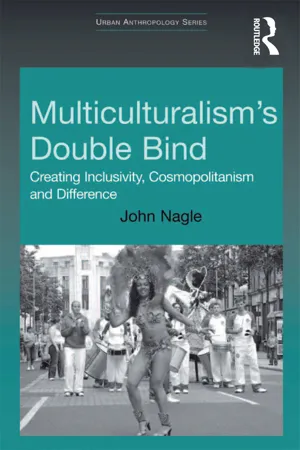
Multiculturalism's Double-Bind
Creating Inclusivity, Cosmopolitanism and Difference
- 208 pages
- English
- ePUB (mobile friendly)
- Available on iOS & Android
eBook - ePub
About this book
Using a rich array of ethnographic and archival data closely considering the Irish and the manner in which 'Irishness' was rendered inclusive, Multiculturalism's Double Bind demonstrates that multiculturalism can encourage cross-community political engagement in the global city. This book challenges the perceived wisdom that multiculturalism counteracts the opportunity for groups to move beyond their particularized constituency to build links and networks with other 'minority' groups. Theoretically informed and empirically grounded this volume will appeal to scholars across a range of disciplines, including migration and ethnicity, social and cultural anthropology, Irish studies and sociology.
Information
Chapter 1
The Global City, Community and Multiculturalism
The Global City, Community and Multiculturalism
As much as any other major international city, the contours of London have been profoundly formed and moulded by persistent waves of inward invasion and migration. Celts, Romans, Anglo-Saxons, Danes and Normans were all belligerent and formative invaders and settlers. Arriving later on were Jews in the thirteenth century; as many as 50,000 French Huguenots since the late eighteenth century; as well as Irish, Chinese, Italians and Poles (Anthias and Yuval-Davis 1992: 47). Dutch, German and the Mediterranean Sephardic and northeast European Ashkenazi Jews also arrived in number (Block 2006: 46). There has also been a ‘black’ presence in London since the sixteenth century and a South Asian presence since the eighteenth century (Hall 2000: 218).1
At present London is a city containing a population over eight million people in its metropolitan urban area. Census 2001 revealed that the ‘host’ white British population made up 58.2 per cent of the population, leaving just over 40 per cent (nearly 2.9 million) who are identified as belonging to various ‘ethnic groups’ (GLA 2005: 2). Figures from the Office of National Statistics (ONS) show that, as of 2006, London’s foreign-born population is 2,288,000 (representing 31 per cent of London’s population). These migrants have originally come from over 160 different countries. Census figures reveal that London’s ethnic minority population has continued to grow, from 2.14 million people in 1991 to 2.88 million in 2001. This figure is projected to rise. Using established measures of segregation, there are no ethnic segregation wards or ‘extreme polarized enclaves’ in London as of 2001. As we shall see, since the early 1980s politicians, and through the policies of local government authorities, ‘multiculturalism’ has often been lauded as an integral and even profitable part of the city’s identity. These actors have also promoted multiculturalism and cross-community relationships as a specific way to address issues of racism that impacted upon the city’s settler population.
For partly these reasons London is often called a ‘global’ or ‘world city’. Although theorists often determine a city’s membership of elite global cities in terms of its exalted position as a command centre in the world economy (e.g., Brenner 1998, Sassen 2001, Purcell 2003), others have also looked to how such cities are ‘fairly durable sources of new culture’ (Hannerz 1996: 43). Global cities are active producers of the symbols and ideas that move the world today. Global cities, due to their economic vitality, attract a disproportionate number of migrants. Alongside low paid migrants who come from the poorer parts of the globe seeking a better life, these cities also attract long term tourist types (such as international celebrities), the movers and shakers of the new economic order, who come to provide their expertise, and more modest professionals, such as budding actors and writers, as well as students and academics (Block 2006: 43). Block (2006: 43) argues that because of the scale and consistency of the migration they receive, ‘global cities are the sites of international and cosmopolitan cultures’. The multiplicity of lifestyles realized inside them are ‘drawn more from outside than inside the national culture’ (2006: 43); the cities have hence reached a point in their development that they are increasingly framed as de-nationalized in regard to lifestyle and point of reference. This representation of London as a ‘world city’ is thus a core way that London is marketed to tourists. ‘Visit London’, the official tourist website for London, brands ‘multicultural London’ thus: ‘London is a truly global city. Explore the culture of London’s diverse communities today and you’ll find a wealth of fascinating things to see and do’ (see <http://www.visitlondon.com/maps/multicultural_london/>).2
Global cities are places which are portrayed as containing an identifiably successful ‘multicultural’ image. Ethnic diversity is actively celebrated as part of the city’s self-conscious identity. People are attracted to the global city because it is here they can experience and partake in a rich array of identities and cultures. Forms of cross-cultural dialogue, mixture and exchange are particularly salient to the global city. Global cities are framed as sites of cosmopolitan and post-national citizenship, which offer their inhabitants an opportunity to go beyond the petty chauvinisms of competing nationalisms and ethnicities. Yet, such cities are also hosts of disputes concerning profound imbalances in power, welfare and status between groups. Such disparities, especially in terms of socioeconomic status, are revealed by the fact that a disproportionate number of London’s low paid workers are foreign-born thus creating a new ‘migrant division of labour’ (Holgersen and Haarstad 2009).
In this chapter I explore the relationship between global cities and multiculturalism in a specific way. In particular, on the one hand I explore the way in which ‘global cities’ may offer opportunities for new forms of cosmopolitan encapsulation and imagination. On the other hand, I also illuminate how ‘global cities’, mainly due to their size and the dislocated modes of living that characterize urban settings, create counter-demands for actors to search out ‘authentic’ communities and identities. The cultural forms and communities of ‘ethnic minorities’ are often much sought after because they are represented as ‘things’ that simultaneously provide excitement and security for the global city’s inhabitants. Providing ethnographic data, I go on to investigate the different actors who explore the cultural identities of others.
The Nation Rescaled: The Global City
To begin exploring the global city and its relationship to multiculturalism, it is important to first provide a working definition of such cities. I argue that in order to understand ‘global cities’ it is necessary to examine the linkage between modernization, globalization and the rescaling of the nation-state. This rescaling is seen in the way in which global cities are now the primary sites for coordinating transnational economic operations – and networks have been established among global cities involved in similar coordination functions.3 The fact that ‘global cities’ are more closely networked to other global cities – especially in terms of finance and banking – than the rest of the nation has led some theorists to speculate about the transnational rather than national character of global cities. Purcell (2003: 568), in particular, has argued that contemporary nature of global cities is evidence of the erosion of ‘the national scale as the privileged scale at which economic and political activity are organized’. As a consequence, Purcell continues, citizenship is being reoriented away from the nation as the predominant community. Recent shifts in the organization of capital accumulation have deprivileged the national scale. The intensification of the transnationalization of production and finance since the 1970s has expanded the ‘scale at which investment, production and information flows are functionally integrated’ (2003: 568) and global cities coordinate these transnational processes.
It is not only at a global scale that the discreteness of the nation-state is being reformulated; in an interlinked way the nation-state is simultaneously being downscaled to local and regional scales. This is especially true in regard to how more forms of political autonomy are handed over to global cities to ensure their global economic competitiveness. In this way, global cities are typically marked by a move away from centralized and bureaucratic forms of governance (Purcell 2003), to those featuring various forms of managerialism, privatization policies and thus the consolidation of the ‘mixed market’ in local public service provision, along with more networked governance arrangements. In London, for instance, since 2000 political power has been devolved to a citywide government, the Greater London Authority (GLA). The process of devolution, as states hand over forms of political and economic power at citywide and regional level, is also geared towards creating competitive regional spaces through institutional state forms that fit more closely the scalar structure of the changing economic geography of the area.4 In London, for instance, there has been talk of a shift from an ‘industrial’ to a ‘post-industrial city’, which represents a wholesale decline in manufacturing and its replacement with jobs in the business sector. As part of this change, there are also a huge number of redevelopment projects that often rely on constructing a branded localism and idea of ‘community’, designed to draw on ‘indigenous identities and histories’.
The combination of local and global scales of economic production in ‘global cities’ has led some theorists to speak of processes of ‘glocalisation’ (Swyngedouw, 1996), as the old model of economic activity coordinated and contained at national state scale is deteriorating. As Smith concedes: ‘in strictly economic terms, the power of most states organized at the national scale is eroding’ (Smith 2002: 433). In the most optimistic analyses ‘global cities’ are places where it is said citizenship is undergoing a process of reorientation such that the nation is no longer the primary community that defines political identity and political loyalty. Stripped loose from their one symbiotic relationship with the nation-state, global cities are increasingly important functional hubs in the world’s economic geography. In this synopsis, citizenship is being reterritorialized, meaning that the nation-state’s territorial sovereignty has been thrown open to question and contestation.
Taking this precise view, Purcell (2003) argues that the rescaling of the nation-state to allow the emergence of global cities provides potential to furnish new conceptions of identity unfettered by its subordination to the nation. For Purcell, the re-territorializing of state power not only challenges national sovereignty but it allows new progressive and multiple forms of post-national and cosmopolitan citizenship, including a greater focus on human rights and other transnational notions of rights and responsibilities (2003: 565). Sassen (2001: 32) similarly argues that ‘[g]lobalization and digitization have brought with them an incipient unbundling of the exclusive authority over territory and people we have long associated with the nation-state’, and that ‘the most strategic example of this unbundling is probably the global city, which has emerged as a partly denationalized platform for global capital and for the most diverse mix of people from all over the world’. Sassen continues by arguing that global cities provide ‘operational and conceptual openings for the participation of non-state actors in trans-boundary domains once exclusive to the national state’. These actors, she states, can include non-governmental organizations, first-nation peoples, anti-globalization activists, migrants and refugees.
The idea that global cities are places which provide opportunities to go beyond the confines of national identity to allow new forms of cosmopolitan citizenship is appealing. It summons up the hope that such places can engender a new post-race politics, where ethnic or national encapsulation are no longer defining fault lines running through the city. Yet rather than dissipating, race and ethnicity are central themes regarding how the ‘global city’ is branded as part of its self-image as vibrant, diverse and cosmopolitan. Ethnicity is also something that is generated to endow actors in the global city with a sense of roots and communal association in a place typically prone to individualism, dislocation and fractured living. ‘Multicultural’ forms of cross-community exchange, consequently, are promoted as inextricable parts of life in the global city.
Rather than limiting the analysis of multiculturalism and cross-cultural relations in the global city to the sphere of political economy, this chapter progresses by providing some ethnographic analysis. While anthropologists would agree that context (i.e. structural changes to the political economy) is important, they would also emphasize the crucial use of understanding what happens ‘on the ground’:
a crucial aspect of which is the subjective dimension, the ideas, models, projects, definitions, discourses etc that actors bring to bear on a situation, sometimes very hesitantly, often seeking to work with (or clarify) concepts that are difficult, opaque, elusive, and with multiple contested meanings (Grillo 2007: 981).
What ethnographic and anthropological research provides is the capacity to explore the ‘everyday’ ‘fuzzy’, ‘ambiguous’ and almost always complex ways that subjects understand, engage with, and actively use the ideas and resources which emerge from state-sponsored multiculturalism.
Putting Your Mind To It: Cosmopolitanism
One particular way to begin exploring the issues of multiculturalism and cosmopolitanism in the ‘global city’ is to look at how some people engage with the identities of groups they were not born into. During my fieldwork in London, I often noted how many multicultural initiatives were engendered to help non-members develop an appreciation of the cultures of minority groupings. Often these multicultural initiatives encouraged very inclusive experiences of the ethnic minority grouping. Ironically, these everyday encounters of ‘difference’ could potentially allow non-members the opportunity to engage in ‘alternative lifestyles’ and cultures, to even experience communitas, a momentary journey away from a routinized and mundane everyday life. It is pertinent here to provide two examples of what I mean.
***
An article in the Irish Post (2006a), an English-based newspaper for the Irish in Britain, enthusiastically provided a portrait of how contemporary Irishness could accommodate people who supposedly wanted to be Irish, even though their connection to the identity was slim. The article featured a man called Andrew Edwards, a Londoner who had changed his name to the Irish language version: Aindriu MacEadbhaird. Born in England with only very distant Irish roots, and a government worker at the UK Home Office, Andrew ‘was granted Irish citizenship through his wife … and has been busy embracing his new-found Irishness ever since’. ‘I feel Irish. I am learning the Irish flute, I go to the Irish centres in Hammersmith and Camden and I am reading up on the Famine,’5 stated Andrew. He continued to speak of his home in Hammersmith, west London, the location of a sizeable Irish population. ‘The Irish community in Hammersmith is a whole mixed community and some of them aren’t Irish at all. Everyone loves the Irish music and culture. I work in the Home Office and they were actually quite interested in my feelings of being Irish.’
***
It was a Wednesday night in November 2001. After the Irish songs and singing class had ended at the Irish Cultural Centre where I was conducting research in west London, the class members made the perennial, weekly, short dander to a nearby pub, punctuated only by goodbyes for those who decided to trudge home after a long day. Without discernible notice, in imperceptible degrees the persuasive pull of alcohol loosened lips, letting the conversation flow in relaxed, even rhythms of noisy banter which told of a group comfortable in mutual company. One of the women, a regular participant at class and pub alike, confessed to me that she had absolutely no genealogical links to Ireland. Before she had enrolled for Irish singing the woman was a regular at a London-Welsh Community Centre, partaking in Welsh choral singing. At first, she revealed, she felt alien in the Welsh Centre, believing she was impinging upon a culture she was neither born into nor immersed within; she had no tales of life as a child in the valleys of South Wales to retell, or a father who worked boy and man as a coal miner and played at fly half in rugby. The cultural inventory needed to denote her intrinsic understanding of what Welshness is, as far as she was concerned, was empty. I asked how she got over her ‘crisis of identity’; mimicking a Welsh accent she reminisced, ‘One of the tutors just come up to me and said, “Don’t worry, love, you can’t help not being Welsh. But the thing is, as long as you put your mind to it, you can be as Welsh as the rest of us”’.
***
These observations about how it is easy to become Welsh or Irish as long as you ‘put your mind to it’ are reminiscent of Hannerz’s observation about ‘cosmopolitanism’ in the global city. For Hannerz, ‘cosmopolitanism is a perspective, a state of mind’ (1996: 102). These people’s ability to form an identity that is ‘betwixt and between without being liminal … participating in many worlds, without becoming part of them’ (Friedman 1994: 204), could be seen as a ‘cosmopolitan’ outlook (Vertovec and Cohen 2002: 13–14). Their capacity to explore different cultures and even assume new identities marks them out as ‘migrants of identity’ (Rapport and Dawson 1998): people who possess the cultural and economic capital needed to consume and understand the unpredictability of different cultural settings (Chaney 2002). In this scenario, cosmopolitans are intellectual voyeurs, flâneurs, cultural tourists, migrants of identity consuming the ‘other’ whilst being incapable of forming commitments to places and social bonds (Featherstone 2002).
The idea of the cosmopolitan, in this sense, provides a classic theme in the global city. As we saw in the introduction, the global city has been framed by theorists as a place which affords an occasion for actors to imagine nascent identities that are not tied to the nation. For instance, Peter Berger (1977) wrote of New York City – an archetypal global city – as a place of ‘transcendence’, a metropolis which represents the literal embodiment of a vital human freedom. This freedom is enshrined in the ability of reinvention, in which actors can ‘transcend’ who they are by taking on brand new encapsulations. The very unpredictability of the global city, for Berger, eluded simple processes of comprehension adding to its bewilderment and excitement.
There are a range of issues which need to be explored further here. Why do ‘cosmopolitan’ actors feel the need to explore and even adopt different identities? Can cosmopolitanism be viewed as a positive process which facilitates progressive relations between members of different groups? Or does such an interest in the identities of other groups represent a form of ‘imperial cosmopolitanism’, in which privileged elites consume various ‘ethnic’ identities without the process challenging hierarchical relationships? Why are particular ethnicities distinctly inclusive and attractive? Furthermore, to what extent do groups encourage an inclusive experience of their cultural forms in order to accommodate non-members? We have asked many questions here, which we will attempt to address in the following sections.
Voluntary Community
In an attempt to explain the reasons underlying why actors are able to engage in new identities, Zygmunt Bauman (2001: 149), in particular, has argued that contemporary society has released us from many constraining features of old traditions, especially the ‘ascribed, inherited and inborn determination of social character’. We are now free as ‘liberated consumers’, he continues, to make our own choices regarding where we can feel ‘at home’. Such freedom allows us to seek out new contexts, forms of voluntary communities or what he calls ‘modes of togetherness’. Similarly, Lash and Urry (1987) note the contemporary preponderance for ‘new communities’, groups and networks which peo...
Table of contents
- Cover Page
- Title Page
- Copyright Page
- Contents
- List of Abbreviations
- Acknowledgements
- Introduction: Multiculturalism’s Double Bind
- 1 The Global City, Community and Multiculturalism
- 2 Mobilizing for Multiculturalism
- 3 The Village Hall: Multicultural Community Centres
- 4 The Carnival and Status Reversals: Multicultural Public Spectacles
- 5 Be Counted: Multicultural Census Campaigns
- 6 Multiculturalism’s ‘Indian Summer’ and the Second-Generation
- Conclusion: The Death of Multiculturalism: Redux
- Bibliography
- Index
Trusted by 375,005 students
Access to over 1.5 million titles for a fair monthly price.
Study more efficiently using our study tools.
Frequently asked questions
Yes, you can cancel anytime from the Subscription tab in your account settings on the Perlego website. Your subscription will stay active until the end of your current billing period. Learn how to cancel your subscription
No, books cannot be downloaded as external files, such as PDFs, for use outside of Perlego. However, you can download books within the Perlego app for offline reading on mobile or tablet. Learn how to download books offline
Perlego offers two plans: Essential and Complete
- Essential is ideal for learners and professionals who enjoy exploring a wide range of subjects. Access the Essential Library with 800,000+ trusted titles and best-sellers across business, personal growth, and the humanities. Includes unlimited reading time and Standard Read Aloud voice.
- Complete: Perfect for advanced learners and researchers needing full, unrestricted access. Unlock 1.5M+ books across hundreds of subjects, including academic and specialized titles. The Complete Plan also includes advanced features like Premium Read Aloud and Research Assistant.
We are an online textbook subscription service, where you can get access to an entire online library for less than the price of a single book per month. With over 1.5 million books across 990+ topics, we’ve got you covered! Learn about our mission
Look out for the read-aloud symbol on your next book to see if you can listen to it. The read-aloud tool reads text aloud for you, highlighting the text as it is being read. You can pause it, speed it up and slow it down. Learn more about Read Aloud
Yes! You can use the Perlego app on both iOS and Android devices to read anytime, anywhere — even offline. Perfect for commutes or when you’re on the go.
Please note we cannot support devices running on iOS 13 and Android 7 or earlier. Learn more about using the app
Please note we cannot support devices running on iOS 13 and Android 7 or earlier. Learn more about using the app
Yes, you can access Multiculturalism's Double-Bind by John Nagle in PDF and/or ePUB format, as well as other popular books in Social Sciences & Anthropology. We have over 1.5 million books available in our catalogue for you to explore.