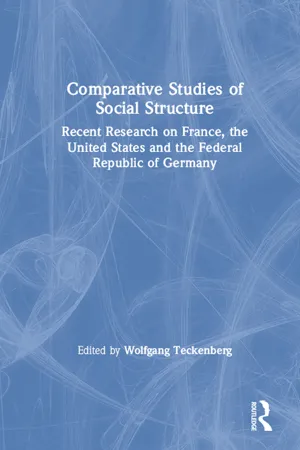
A collection of essays with the purpose of stimulate interest and provoke discussion and criticism, and so contributing to our understanding of the three very different societies of France, the USA and Germany. Each essay stands on its own, and it is the authors' intention to explain some of the differences between Germany and the United States in the first article. The second essay suggests that career mobility in France has more in common with social mobility in the United States than in Germany. The third essay, while not an explicitly comparative analysis, was included because it clearly shows the close links between the educational and occupational systems in Germany, a source of major differences with the United States, at least until the 1980s. The last section contains analyses of income attainment. Drawing on studies in the United States conducted by Erik O. Wright, the fourth essay compares the effects of education and position on income attainment. Since these can be construed as class effects, we were also curious about other types of potential positional and nonvertical income differences in a comparison of France, the United States, and the Federal Republic of Germany (the fifth essay). The concluding summary is very brief, giving only preliminary answers to the more detailed questions raised in the comparative empirical research projects.
eBook - ePub
Comparative Studies of Social Structure
Recent German Research on France, the United States and the Federal Republic
- 224 pages
- English
- ePUB (mobile friendly)
- Available on iOS & Android
eBook - ePub
Comparative Studies of Social Structure
Recent German Research on France, the United States and the Federal Republic
About this book
Trusted by 375,005 students
Access to over 1.5 million titles for a fair monthly price.
Study more efficiently using our study tools.
Information
Subtopic
Military & Maritime HistoryIndex
Social SciencesPart I
Mobiblity patterns in the Federal Republic and the United states
Intergenerational and Career Mobility in the Federal Republic and the United States
Wolfgang Teckenberg is an assistant professor in the Institute of Sociology at the University of Heidelberg. Peter Kappelhoff is an assistant professor in the Institute of Sociology at the University of Kiel.
At least since the appearance of Alexis de Tocqueville’s classic work on democracy in America, the United States has enjoyed the reputation of being the quintessential open society. Karl Marx and Friedrich Engels, and later, at the turn of the century, Werner Sombart also addressed questions on this theme, in particular with regard to the chances of a socialist labor movement developing in the United States. All stressed the importance of low social barriers, but also better pay and above all the better chances for advancement for American workers.1 In America, individual mobility seems to function as a surrogate for class formation and social and political conflict, an argument systematized by Hirschman in his book Exit, Voice, and Loyalty [1970].
This belief in high American mobility rates and in the myth of an open society was shattered once and for all, however, by the appearance of comparative mobility studies after World War II. The influential results of these early studies by Lipset and Zetterberg [1959] indicated that absolute mobility rates and in particular upward mobility from manual to nonmanual occupations were not distinctly greater in the United States than in the industrialized European countries. Mobility rates in the developed industrial countries seemed to converge as an effect of economic growth. But this view has its opponents as well. Dahren-dorf’s study [1963] on society and sociology in America (published under the title The Applied Enlightenment), which takes up the Lipset-Zetterberg theory in the Tocqueville tradition and abides by the claim that chances for mobility are still better in the United States, is equally interesting with regard to a comparison of American and German mobility structures.
As the quality of mobility studies improved and more advanced analytical methods were developed, the Lipset-Zetterberg thesis was modified, although its substance remained unrefuted. The version of Featherman, Jones, and Hauser [1975] is especially interesting; these authors emphasize the equality of relative mobility rates, with control for differences in economic development that give rise to differences in occupational structures and their growth rates.
Still, comparative mobility studies based on a strictly comparable and adequately differentiated occupational classification have been rare. Of the few that do exist we may mention the comparison of France, England, and Sweden by Erikson, Goldthorpe, and Portocarrero [1979, 1982, 1983] and the comparison of England with the United States by Erikson and Goldthorpe [1985]. Over and above the broad similarities in the extent of intergenerational mobility, significant differences in mobility patterns were also found (especially for the comparison of France, England, and Sweden).
If it is assumed that upward and downward mobility with regard to socioeconomic status constitutes the basic pattern of the mobility process in all industrial societies, it is not surprising that there should be a basic agreement on the existence of relative status inheritance among particular occupational groups at both ends of the status hierarchy and decreasing mobility densities with increasing socioeconomic distance. Given this basic agreement, which may alone be sufficient to account for about 90 percent of the overall variation in mobility tables, it seemed to us that it would be more useful to focus comparative mobility analyses primarily on possible differences that were ultimately derivable from differences in institutional structures. This perspective would then permit posing anew the question of the comparative openness of different societies, a topic that has received renewed attention in more recent discussion (with regard to economic development cf., e.g., Olson, [1982]).
What follows is a comparison of mobility structures for both intergenerational and career mobility between the United States and the Federal Republic of Germany. Our starting point was the second “Occupational Change in a Generation” (OCG) study from 1973, analyzed by Featherman and Hauser [1978]. We begin with an examination of economic development and the institutional structures relevant to mobility processes in the two countries (section 1). This section was also written for readers not so familiar with the educational and employment structures in West Germany.
Next, German statistics are presented on occupational classification, and the relative rankings of occupational groups in the two countries are compared (section 2). This is followed by a comparison of the basic mobility dimensions using a smallest space analysis (section 3). Section 4 looks at absolute mobility rates, differences in long-distance mobility, as well as the permeability of the barriers between manual and nonmanual occupations. Section 5 analyzes relative mobility patterns with different log linear models (common social fluidity, common patterns of mobility, and crossing parameters model). The essay will conclude with a summary and discussion of our results.
1. Institutional structures
1.1. Comparison of employment structures
A comparison of the respective sectoral structures (based on establishment classifications) of the economy in the Federal Republic of Germany and the United States shows a number of relatively stable differences over the course of time. Several sectoral disparities are especially marked, e.g., in 1972 the tertiary sector was much more pronounced in the United States than in Germany, where employment is mainly in diversified capital goods and consumer goods industries (steel, machinery, motor vehicles, electrical engineering, chemistry, and the plastics industry).
After an examination, the statistics of the International Labor Organization proved to be usable since they attempt to render the sectoral structures of industry comparable (Table 1). Occupational structures can be compared on the basis of the International Standard Classification of Occupations (ISCO) (see Table 2).
From the Yearbook of Labor Statistics we selected data that were closest in time to the surveys made for the United States (1973) and the Federal Republic (1982–84), to be analyzed below. As will be demonstrated, a comparison of survey data with such a time lapse between them is feasible for these two societies since a number of developments in the occupational and educational structure become manifest in the Federal Republic only after a ten-year lag.
Although the tertiary sector has indeed expanded in the ’70s in the Federal Republic, in particular as a consequence of the expansion of education during the Social Democratic government (1969–82), the features of postindustrial society are still discernible only in rudimentary form. Though the growth in employment in the service sector was almost 9% in the Federal Republic between 1973 and 1982 (according to OECD statistics), and was made possible by both absolute and relative diminutions mainly in the primary, but also in the secondary sector, in 1982 still only slightly more than half (51.8%) of all gainfully employed persons were employed in the tertiary sector [Scharpf 1984, 5].
In the United States, this proportion was 68%, with an increment of 27.1 % in the number of persons employed in the service sector since 1973, i.e., clearly higher than in the Federal Republic, and moreover not due to any notable absolute reduction in agricultural and industrial employment. Various authors have noted, on the positive side, that the privately run services, e.g., the postal system and the railroads, made for more flexibility and private initiative than the state-run services in the Federal Republic where the positional rights of state employees (Beamte) go hand in hand with claims to lifelong employment, a stable career (Laufbahn), and a secure retirement. The high degree of polarization of skills in the service sector is frequently named as a negative factor in the United States [Haller 1983, 232f.]. Other authors point in this context to a divided labor market in the tertiary sector as well, with good positions in administration and in management of the primary labor market going to college-educated white males, but unstable, low-paid office occupations and low-grade blue-collar jobs going mainly to women and blacks in the secondary segment [Montagna 1977, 70, section 13]. This creates chances for upward mobility in lower nonmanual occupations, accompanied, however, by a parallel downward mobility or the risk of dismissal.
FRG 1972 | USA 1973 | FRG 1983 | USA 1983 | |
|---|---|---|---|---|
Agriculture, forestry, fishing | 5.3 | 5.3 | 4.3 | 4.8 |
Mining and quarrying | 1.9 | 1.0 | 1.9 | 1.4 |
Manufacturing | 43.0 | 27.3 | 35.6 | 23.3 |
Electricity, gas, water | 1.1 | 1.9 | 1.3 | 2.0 |
Construction | 11.3 | 9.9 | 10.5 | 10.4 |
Wholesale and retail trade, restaurants, hotel | 10.0 | 17.9 | 10.9 | 18.9 |
Transport, storage, communications | 7.3 | 6.0 | 7.3 | 6.7 |
Financing, insurance, real estate, business services | 3.9 | 4.1 | 5.2 | 7.4 |
Community, social, and personal services | 16.1 | 22.0 | 21.4 | 21.7 |
Armed forces (US) | — | 4.0 | — | 2.4 |
Not classifiable, seeking work for the first time | — | 0.5 | 1.7 | 1.0 |
100 | 100 | 100 | 100 | |
Source: Yearbook of Labour Statistics. International Labour Office, Geneva section 2A, various years. | ||||
In the 1970s, there was in the United States a growth not only in professional services (e.g., the use of computers), but also in the share of both services to industry and consumer services, from copy shops and hairdressers to gourmet shops, i.e., mainly jobs accessible without very much prior training or previous occupational experience. At the same time, job security in this secondary segment of the service sector is not very high [Sengenberger 1984]. The data for 1973 cannot yet show this pattern for service workers.
Another interesting phenomenon is the tremendous increase in female employment in the United States in the recent period: 54% of all American women above the age of 16 were gainfully employed in 1984, compared with 38% in 1960—a figure corresponding to the number of gainfully employed German women in 1984 [Frankfurter Allgemeine Zeitung, July 17, 1985].
Table of contents
- Cover
- Half Title
- Title Page
- Copyright Page
- Table of Contents
- Preface
- PART I. MOBILITY PATTERNS IN THE FEDERAL REPUBLIC AND THE UNITED STATES
- PART II. CAREER MOBILITY IN FRANCE AND THE FEDERAL REPUBLIC
- PART III. INCOME ATTAINMENT IN THE FEDERAL
- References
- About the Editor
Frequently asked questions
Yes, you can cancel anytime from the Subscription tab in your account settings on the Perlego website. Your subscription will stay active until the end of your current billing period. Learn how to cancel your subscription
No, books cannot be downloaded as external files, such as PDFs, for use outside of Perlego. However, you can download books within the Perlego app for offline reading on mobile or tablet. Learn how to download books offline
Perlego offers two plans: Essential and Complete
- Essential is ideal for learners and professionals who enjoy exploring a wide range of subjects. Access the Essential Library with 800,000+ trusted titles and best-sellers across business, personal growth, and the humanities. Includes unlimited reading time and Standard Read Aloud voice.
- Complete: Perfect for advanced learners and researchers needing full, unrestricted access. Unlock 1.5M+ books across hundreds of subjects, including academic and specialized titles. The Complete Plan also includes advanced features like Premium Read Aloud and Research Assistant.
We are an online textbook subscription service, where you can get access to an entire online library for less than the price of a single book per month. With over 1.5 million books across 990+ topics, we’ve got you covered! Learn about our mission
Look out for the read-aloud symbol on your next book to see if you can listen to it. The read-aloud tool reads text aloud for you, highlighting the text as it is being read. You can pause it, speed it up and slow it down. Learn more about Read Aloud
Yes! You can use the Perlego app on both iOS and Android devices to read anytime, anywhere — even offline. Perfect for commutes or when you’re on the go.
Please note we cannot support devices running on iOS 13 and Android 7 or earlier. Learn more about using the app
Please note we cannot support devices running on iOS 13 and Android 7 or earlier. Learn more about using the app
Yes, you can access Comparative Studies of Social Structure by Wolfgang Teckenberg in PDF and/or ePUB format, as well as other popular books in Social Sciences & Military & Maritime History. We have over 1.5 million books available in our catalogue for you to explore.