- 224 pages
- English
- ePUB (mobile friendly)
- Available on iOS & Android
eBook - ePub
About this book
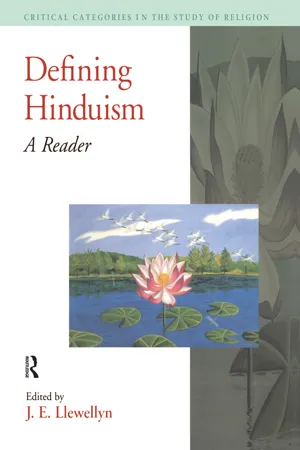
'Defining Hinduism' focuses on what Hinduism is, what it has been, and what some have argued it should be. The oldest of the world religions, Hinduism presents a complex pantheon and system of beliefs. Far from being unchanging, Hinduism has, like any faith of duration, evolved in response to changing cultural, political and ideological demands. The book brings together some of the leading scholars working on South Asian religions today.
Information
Part I
DEFINITIONS OF HINDUISM
ORIENTATION
We begin with two very different proposals for defining Hinduism by Wilhelm Halbfass and Julius J. Lipner. The thesis of “The Identity of the Veda and the Identity of Hinduism” is expressed at the beginning of the essay, when Wilhelm Halbfass describes the Vedas as “a focal point of Hindu self-understanding.” Halbfass earned his Ph.D. at the University of Gottingen and was a professor at the University of Pennsylania at the time of his death in 2000. His major works were on Indian philosophy (1988, 1991, 1992; see also Franco and Preisendanz 1997). The Vedas are the oldest Hindu texts, and belief in them has sometimes been identified as the litmus test of orthodoxy in the Hindu tradition. Yet Halbfass’s argument in this essay is still surprising because scholars long ago noted that most Hindus now and throughout history have not known the Vedas well. Despite acknowledging that problem, the author insists that the Vedas have provided Hinduism with “its most significant point of reference and departure, and with a basis of its tenuous continuity and identity.” Halbfass is particularly intent to maintain this claim against the critics of Orientalism, who argue that Hinduism is nothing but “a European invention.” Halbfass believes this position to be not only historically inaccurate but also “presumptuous,” with the current generation of western scholars patronizingly giving back to Indians the agency which an earlier generation of western scholars stripped from them. In the end, Halbfass concludes that “the idea of a comprehensive unity of the tradition, and of a common ground of orthodoxy, is inseparable from a vision of, and commitment to, the Vedic revelation.”
In addition to allegiance to the Vedas, “The Identity of the Veda and the Identity of Hinduism” also discusses dharma, something else that has been suggested as definitive of Hinduism. Dharma very nearly plays this role for Halbfass, too, since about it he writes, “We cannot reduce the meanings of dharma to one general principle; nor is there one single translation that would cover all its usages. Nevertheless, there is a coherence in this variety; it reflects the elusive, yet undeniable coherence of Hinduism itself, its peculiar unity-in-diversity.” It is significant that Halbfass stages his defense of dharma in response to critiques of Orientalist notions of Hinduism as casteist. The argument with which Halbfass takes issue says that traditional accounts of the beliefs and practices of all Hindus are actually only those of the Brahmans who were the Orientalists’ chief informants. The strong formulation of this claim is that the Brahmans hoodwinked the Orientalists into accepting a version of the Hindu “tradition” which they invented to give themselves power. It is against this backdrop that Halbfass asserts the centrality of the notion of dharma. It is significant that Halbfass confesses that the essays in his book “are primarily based upon philosophical and normative literature in Sanskrit, that is, on texts which were for the most part composed by Brahmins” (Halbfass 1991, 16). Clearly evidence based on such elite sources cannot effectively answer the charge that the Orientalist understanding of Hinduism was caste-biased.
When Wilhelm Halbfass describes the Vedas as the center of Hinduism, it is sometimes difficult to determine whether he is talking about a thing or about a process. In Julius Lipner’s essay, “Ancient Banyan: An Inquiry into the Meaning of ‘Hinduness,”’ the emphasis is clearly on a certain kind of process. Lipner, who obtained his Ph.D. from the University of London and is currently a reader at the University of Cambridge, has written several works about Indian thought (1986, 1994, 1997, 1999). Here he focuses on Hinduness rather than Hinduism, in an attempt to avoid a “closed construct” in favor of an “an open construct, that is, an intrinsically plural phenomenon.” At the beginning of the essay, before he has introduced his shift to Hinduness, Lipner describes Hinduism as “macrocosmically one though microcosmically many, a polycentric phenomenon imbued with the same life-sap, the boundaries and (micro)centers seeming to merge and overlap in a complexus of oscillating tensions.” In the context of this book, the best illustration of this complicated sounding idea is the arguments that Hindus have made about scripture. Lipner notes that it is not unusual to find later texts making the claim that they are the Vedas or are equal to the Vedas. These texts do not replace the Vedic canon, in Lipner’s reading, but establish themselves as “alternative forms of the originals.” So that what results is “a multicentrism of scriptural authority.” Unlike Halbfass’s essay, here the point is not that accepting the authority of the Vedas is a central tenet of Hinduism; rather, Lipner is merely using the Vedas as one example of a process which he maintains is characteristic of Hinduism. This polycentric Hinduism, Lipner says, is like the banyan tree, which has many apparent trunks, but no clearly identifiable center.
The primary conception of Hinduism against which Lipner is arguing in this essay is that of “extremist Hindu rightwing elements.” For them, “Hinduism” has a “fixed, non-negotiable meaning,” which is “divisive” and “religiopolitically preferential.” By contrast, Lipner’s Hinduism is marked by “an insightful aversion to dogmatism” and “a healthy dose of relativism.” Apparently this tolerance is not so great that it will allow for the narrowness of the Hindu right itself, for Lipner labels it “un-Hindu.” Ironically, there is no place for religious nationalism even under the capacious canopy of the banyan tree that is Lipner’s Hinduism.
1
THE IDEA OF THE VEDA AND THE IDENTITY OF HINDUISM
Introduction
Louis Renou has characterized the role of the Veda in traditional Hinduism in a memorable and familiar statement: Even in the most orthodox circles of Hinduism, reverence for the Veda was nothing more than a “tipping of the hat,” a traditional gesture of saluting an “idol” without any further commitment (Renou 1960, 2).1 Against incautious identifications of Vedic and Hindu religiosity, Renou invokes Max Weber’s observation that “the Vedas defy the dharma of Hinduism.”2
Indeed, the role the Veda has played in Indian tradition appears paradoxical, ambiguous, and no less elusive than the “teachings” of the Veda itself. There seems to be a blatant contradiction between the proclamations of its sacredness and authority, and its factual neglect by the Hindu tradition. While it is often invoked as the criterion of Hindu “orthodoxy,” its actual presence in Indian thought and life seems to be quite limited. Its oldest and supposedly most sacred sections, in particular the Rig Veda itself, have become most obscure and obsolete. For the “reality” of later Hinduism, they seem to be nothing more than a distant, barely recognizable echo of a different world.
The Vedic texts contain no Hindu dogma, no basis for a “creed” of Hinduism, no clear guidelines for the “Hindu way of life.” They offer only vague and questionable analogues to those ideas and ways of orientation that have become basic presuppositions of later Hinduism. It may suffice to recall here the cyclical worldview, the doctrine of karma and rebirth, the ethical principle of ahimsa and the soteriology of final liberation. For all of this, the oldest and most fundamental Vedic texts provide no clearly identifiable basis. The Hindu pantheon, the forms of worship and devotion, and the temple cult are not Vedic. The traditional “order of castes and stages of life” (varnashramadharma) is far removed from the Vedic beginnings. Regardless of all retrospective glorification of the Veda, even the “orthodox” core of the tradition, as represented by the exegetic Mimamsa and the Dharmashastra, follows largely un-Vedic ways of thought and is oriented around a projection or fiction of the Veda. This is also true for those philosophical systems of Hinduism whose “orthodoxy” is defined by their recognition of the authority of the Veda. While proclaiming the sanctity of the Veda, the Hindu tradition seems to be turning away from the Vedic ways of thought and life. The preservation and glorification of the text seem to coincide with its neglect and the obscuration of its meaning.
Renou himself says that the history of the Veda in India is ultimately a history of failure and loss, and that the recitation of the text, in particular the mantras, and the preservation of its phonetic identity, occurred at the expense of a living exegesis and appropriation. From an early time, the Veda ceased to be “a ferment of Indian religiosity”; in the end, the Vedic world was nothing but “a distant object” (Renou 1960, 77). Is this the final word on the role of the Veda in India? Are Vedism and Hinduism essentially different religions and worldviews, held together only by an ideology of continuity and correspondence? Is the Veda, which the Dharmashastra and the “orthodox” systems of Hindu philosophy present as a measure of orthodoxy, actually a projection and a fiction?
In addition to his research on the Veda as such, Renou has done much to document and explore the ways in which the Veda is present in the later Hindu tradition. His study Le destin du Veda dans I’lnde (“The Destiny of the Veda in India”) contains much useful information on the role of the Veda in post-Vedic India, such as the forms in which the Veda was preserved, the attitudes towards the Vedic word, and the application, interpretation, and critique of the Veda at various levels of religious life and philosophical reflection. Regardless of his statements on the merely ceremonial role of the Veda, Renou also refers to its “real extensions” in later Hinduism (Renou 1960, 3). Somewhat casually, he notes that the very essence of the Vedic world found its way, in a process of transformation, into “the living substance of Hindu practice and speculation” (Renou 1960, 77). What is the meaning of these “real extensions,” and how do they relate to the ceremonial gestures and retrospective projections? How can the statements concerning the real “transformation” of the Vedic world be reconciled with those about its loss and obscuration? Renou’s survey provides helpful clues, but not much explicit hermeneutic reflection concerning these questions.
What Renou calls “the destiny of the Veda in India” is a wide-ranging phenomenon of extraordinary complexity and ambiguity. His survey makes reference not only to the literary traditions of the Hindu sects, Tantrism, Dharmashastra, the Epics, Puranas, iconography, rituals, traditions of secular learning, methods of preserving the Vedic texts, techniques of recitation and memorization, Vedic schools and auxiliary sciences, Vedic commentatorial literature, and the “orthodox” systems of Hindu philosophy, but also to the anti-Vedic critique and polemics of the Buddhists, Jains, and Materialists. We are dealing with semantic as well as nonsemantic approaches, with ritual and magical usages of Vedic words and formulae, with myths and theories concerning the unity and totality of the Veda, with forms of archival preservation, with definitions and reinterpretations, and with comprehensive attempts to establish the Veda as the source and framework of the entire tradition. In spite of the growing distance and obscuration, an idea and vision of the Veda emerges not only as a focal point of Hindu self-understanding, and a center for the precarious unity and identity of the tradition, but also as a prototype for its inner variety and potential universality.
In dealing with the Veda, the Hindu tradition combines strict commitment to textual and phonetic details with an extraordinary freedom of speculation. In one sense, the Veda is the sum total of its words and sounds. In another sense, it can be summarized in a few “great sayings” (maha-vakya), or fundamental ideas. On the one hand, there is the idea that no single sound or syllable is dispensable. On the other hand, there is a persistent belief that this verbal multiplicity may be reduced to an original unity (such as the Rig Vedic akshara, van Buitenen 1959) or transcended towards one ultimate essence, that is, the brahman and its closest linguistic approximation, the om or pranava (Parpola 1981 and Svaminathan 1970/1972).
The orthodox traditionalists of the Mimamsa and of some related schools try to establish the Vedic texts as timeless, unalterable linguistic constellations, texts without divine or human author, and thus beyond the range of error and deception. They also try to demarcate once and for all the extent of genuine Vedic “revelation” (shruti), and to distinguish it from merely human and traditional additions or accretions. According to the most common definition, “revelation” in the strict sense comprises the Mantras and Brahmanas; that is, the collections of hymns and ritual formulae in the Rig, Yajur, and Sama Veda, together with their accompanying Brahmanas, Aranyakas, and Upanishads. While the status of the Atharvaveda remains somewhat precarious, more significant debates focus on the internal differentiation of the Vedic revelation, its modes of discourse, the different kinds of linguistic entities contained in it (vidhi, arthavada, mantra, namadheya), and the different types of meaning and levels of authority associated with its injunctive and factual statements.3
The theistic traditions, on the other hand, view the Vedas as the word of God, and as a stage in an open-ended process of revelation (Oberhammer 1974 and Heesterman 1974). In this view, they are susceptible to, and even call for, continued revisions, explications, adaptations, and other forms of divine supplementation and renewal. Furthermore, there is also room for the idea that the present Vedas are not the Veda per se, that is, its true and real archetype.4 The “real” and original Veda is thus contrasted with the extant Vedic texts and invoked against their “orthodox” and inflexible guardians, and a dynamic sense of tradition is brought into confrontation with a static and archival one.
The Veda as Text and Reality
Understanding the role of the Veda in Indian thought involves more than textual hermeneutics. It also involves what we may call the hermeneutics of an event. The different approaches to the Veda are not just different interpretations of a text, and commitment to the Veda is not only, and not even primarily, acceptance of a doctrine. In another and perhaps more fundamental sense, it means recognition of a primeval event, and a response to a fundamental reality. In the understanding of those who accept it, the Veda itself is beginning and opening par excellence. It not only speaks, in its own elusive fashion, about the origin and structure of the world and the foundations of society; it is also their real and normative manifestation and representation.
The language of the Veda is primeval reality. Bhartrhari says that the Veda is the “organizing principle” (vidhatr) of the world, that is, not only its “teacher” or principle of instruction (upadestr), but also its underlying cause and essence (prakrti, Bhartrhari 1977, 1, 10). This may be an extreme and somewhat unusual form of expression, but the basic viewpoint it articulates is by no means isolated. ...
Table of contents
- Cover
- Half Title
- Title
- Copyright
- Dedication
- Contents
- Acknowledgments
- Introduction: The Problem of Defining Hinduism
- PART I Definitions of Hinduism
- PART II Hinduism in the Precolonial Period
- PART III Hinduism in the Colonial Period and in Independent India
- PART IV Hinduism and Caste
- Bibliography
- Index of Authors
- Index of Subjects
Trusted by 375,005 students
Access to over 1.5 million titles for a fair monthly price.
Study more efficiently using our study tools.
Frequently asked questions
Yes, you can cancel anytime from the Subscription tab in your account settings on the Perlego website. Your subscription will stay active until the end of your current billing period. Learn how to cancel your subscription
No, books cannot be downloaded as external files, such as PDFs, for use outside of Perlego. However, you can download books within the Perlego app for offline reading on mobile or tablet. Learn how to download books offline
Perlego offers two plans: Essential and Complete
- Essential is ideal for learners and professionals who enjoy exploring a wide range of subjects. Access the Essential Library with 800,000+ trusted titles and best-sellers across business, personal growth, and the humanities. Includes unlimited reading time and Standard Read Aloud voice.
- Complete: Perfect for advanced learners and researchers needing full, unrestricted access. Unlock 1.5M+ books across hundreds of subjects, including academic and specialized titles. The Complete Plan also includes advanced features like Premium Read Aloud and Research Assistant.
We are an online textbook subscription service, where you can get access to an entire online library for less than the price of a single book per month. With over 1.5 million books across 990+ topics, we’ve got you covered! Learn about our mission
Look out for the read-aloud symbol on your next book to see if you can listen to it. The read-aloud tool reads text aloud for you, highlighting the text as it is being read. You can pause it, speed it up and slow it down. Learn more about Read Aloud
Yes! You can use the Perlego app on both iOS and Android devices to read anytime, anywhere — even offline. Perfect for commutes or when you’re on the go.
Please note we cannot support devices running on iOS 13 and Android 7 or earlier. Learn more about using the app
Please note we cannot support devices running on iOS 13 and Android 7 or earlier. Learn more about using the app
Yes, you can access Defining Hinduism by J. E. Llewellyn in PDF and/or ePUB format, as well as other popular books in Theology & Religion & Hinduism. We have over 1.5 million books available in our catalogue for you to explore.