This book provides a framework for guiding leaders to shift from linear, cause-effect thinking to an ecology of moral, intentional leadership, paying attention to how their actions are connected to others. Readers are encouraged to act in a determined, deliberate way to lead their employees, teams, and organizations to success.
The book is divided into three parts, opening with a narrative review of leadership literature, then discussing the activities of 11 leaders—including Pope Francis, Barack Obama, and Lee Kuan Yew—and developing a learning framework for real change. The author provides an enlightened, democratic model of leadership, helping readers to understand and utilize the core competencies of intentional leaders: interruption, presence, imagination, and action. A user-friendly structure, examples from diverse leaders, and end-of-chapter summaries encourage students to engage and experiment with traditional research and alternative theories.
This will be a useful tool for students of leadership, and peace and conflict studies, as well as practitioners and emerging leaders in the public, private, and not-for-profit sectors.
Part I Introduction and Narrative Review of the Literature
one Introducing the Topic of Intentional Leadership
One proverbial human adage that has remained with us over the ages is: “the road to hell is paved with good intentions.” On the one hand, this adage affirms that good intentions without action will take us to a place called “hell.” On the other hand, it also affirms that acting on our good intentions is no guarantee that we will achieve the intended results (i.e. what we meant to achieve). The reality of acting is such that there can be unintended consequences—some bad, and some pleasant surprises. And there is more. Ivan Illich (1968), an Austrian philosopher, social critic of contemporary Western institutions, and a Roman Catholic priest, went so far as to say “to hell with good intentions” (Illich, 1968, Para. 5). Within the context of his time, he questioned the good intentions of volunteer “mission vacations” among the poor Mexicans, “by well-off U.S. students” (Para. 3) from three fronts. First, he questioned the motives of those who come to do good among poor Mexicans while at the same time being blind “to much worse poverty at home” (Illich, 1968, Para. 3) and to the demands for social justice and freedom by African-Americans in their own country. Second, he questioned the motives of student-volunteers who were blind to their own pretentiousness in imposing their values and their benevolence in a foreign land. Third, he wondered if they were there to do good or simply to feel good about themselves that they had done something benevolent.
If acting or not acting on our good intentions can lead us to “hell,” if the very intentions of good intentioned people can be suspect, if we can be doing the “right” things for all the “wrong” reasons, this book takes up the challenge of addressing the topic of intentional leadership. This introductory chapter will address three questions. First, what does it mean to be an intentional leader? Second, why do we need to address this topic, and why now? Third, how do I go about the work of addressing intentional leadership in this volume?
The “Genesis” of Intentional Leadership
As a way of introducing the “what” of intentional leadership, allow me to share the “genesis” of my formulation of the activities of intentional leaders. The work and challenge of intentional leaders proposed in this book emerges from a story that I heard about 25 years ago, in a workshop on “Living Well,” and it is incumbent to offer credit where credit is due. The workshop was facilitated by Dr. Pierre Turgeon. As workshop facilitators come and go, I had the privilege of meeting this man once, and I am very grateful for the story he shared. Over time, his story has stayed with me as NEWS. Over time and as a method of teaching, in my telling and re-telling of different stories to students of leadership in my classes, I have also “embellished” Turgeon’s story (as we are naturally prone to doing with stories!) and personally named it my “Angel-Story.” What follows is an embellished version and my formulation of the activities of intentional leadership as they emerge from his story. These activities are shared in the hopes of offering a framework for what it means to lead intentionally.
Angel-Story: Out of the Mouth of Babes
Once upon a time, there was a man who was feeling stressed about events in his life. After dropping his daughter off at her kindergarten class on a cold wintry morning in Winnipeg, he was seen leaning against a wall inside the school and staring obliviously through the school windows. As he was deep into his own thoughts, he felt a tug by his pant-leg. Shifting his focus, he saw a little boy looking up at him with a bright smile on his face.
“You do something special today?” the boy asked—his eyes wide open.
Surprised at the question and not knowing what to say, this stressed man returned the question to the little boy: “You do something special?” with a particular emphasis on “You.” Without hesitation, and with a beaming smile, the little boy answered in a sing-song manner:
“I woke up!”
And as little children are accustomed to doing, he followed up his quick response with yet another question in the same sing-song manner: “And you know what?” No, the man replied.
“I put on my pants by myself you know…
And you know what?”
No.
“Mom said, it’s a brand-new day…” again in a sing-song fashion.
And, as if he intuitively felt the man’s stress, the little boy motioned:
“Come with me.”
He led the stressed man to the front door of the school and pointed to the snow outside, saying: “That’s me you know.” And he ran off.
Out of curiosity, the man went to the snow-filled ground where the boy had pointed and noticed that the boy had made a snow angel.
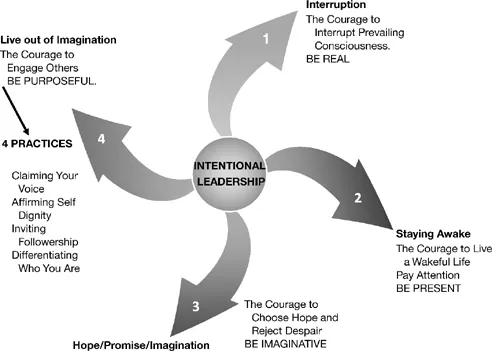
This story is a microcosm of a perspective that informs and forms my formulation of Intentional Leadership. We notice the interaction between three constituents of a story as suggested by Bruner (1986), namely (a) plight of a troubled person, (b) characters: little boy, troubled adult, mother, and (c) consciousness. It is as if the work of intentional leaders (like the little boy) is fundamentally to renew and change the consciousness of their followers while in the middle of their troubles and frustrations, and set something new in motion. Intentional leaders go about this work of renewal, change, and setting something new in motion, in four distinct ways. These include, the courage to interrupt their own consciousness and the prevailing consciousness of their followers (feeling our pants tugged and tugging the pants of others); the courage to stay awake, be present, and pay attention (I woke up!); the courage to imagine new possibilities (It’s a brand-new day); and the courage to act out of that imagination (You do something special today?). What is particularly curious and at the same time exciting is that these themes began to consistently shine through the activities of actors selected in this book—some of whom were in assigned positions of authority and others, not. Through my research into the topic of leadership, I discovered a consistent pattern of these four dimensions, and corresponding activities, that continue to inform and guide what I have defined as being central to the work of an intentional leader. The four dimensions and corresponding exemplary activities of intentional leadership are visualized in Figure 1.1.
A unique feature of thematically connecting the activities of intentional leadership to a story is that this formulation is limited to the boundaries of that story. At the same time, as anthropologists Bateson and Bateson (1987) suggested, stories do communicate a truth about relationships. In the “Metalogue: Why Do You Tell Stories?” this is the exchange between Gregory Bateson (GB) and his daughter, Mary Catherine Bateson (MCB).
FIGURE 1.1 Four Dimensions and Activities of Leading Intentionally.
Daughter: I want to know why you are always telling stories about yourself. And most of the stories you tell about me, in the metalogues and so on, aren’t true, they are just made up. And here I am, making up stories about you.
Father: Does a story have to have really happened in order to be true? No, I haven’t said that right. In order to communicate a truth about relationships, or in order to exemplify an idea.
(p. 34; emphasis in original)
To add to this messiness, MCB confesses that “most of the stories” her father tells about her are “just made up” and that the dialogue between “Father” and “Daughter” as referenced above, did not really happen. She admits that this was her father’s way of articulating his own thinking (Bateson and Bateson, 1987, p. 3) through the construction of this fictional dialogue, which she further re-defines as “Metalogues.”
In the exchange above, GB makes up his stories and MCB does the same. She admits that she too is making up stories about her Father. The Personal Narratives Group (1989) of feminist researchers add more fuel to the complexity of stories and story-telling, by claiming that when people talk about their lives, they “lie sometimes, forget a lot, exaggerate, become confused, and get things wrong” (p. 261). This, however, does not give them cause to dismiss the stories that are told, because they believe that story tellers “are revealing truths … they give us … truths of our experiences” (p. 261; emphasis in original). While stories (all stories?) are partial, incomplete, exaggerated, and confusing, these narrative researchers invite us to receive stories with a gift-receiving attitude. It is an attitude of receiving stories, with the intent of discovering their revealing truths.
At the same time, it cannot be ignored that while stories people tell are relative to their audience and their purpose for telling the story, listeners listen by editing the stories that are told. The listener edits and re-shapes stories that are being told, by how he or she listens, by the questions they ask, and by choosing to focus and elaborate certain parts of the story. Sometimes they engage in spinning alternative narratives. In short, listeners edit as they attempt to understand what the speaker is saying through their lenses and their frames of reference. This is a part of the transaction and the relationship between story-tellers and listeners. Story-tellers tell their stories with a particular purpose and an audience in mind. Their audiences, listeners, listen and edit stories that they hear, and they re-tell stories heard based on their edits.
This Metalogue and the relationship between story-tellers and listeners, raises an ongoing challenge between two ways of knowing, namely scientific knowing and narrative knowing. First, for purposes of verification, the “logico-scientific mind” (Bruner, 1986), for example, would be concerned with the question of whether a story really happened to ascertain its truthfulness. Consequently, to acknowledge that when humans talk about their lives they lie (sometimes), forget (a lot), exaggerate, are confused, and get things wrong (sometimes), is to admit that it will not be able to withstand the rigorous scientific process of verification which aspires to a standard of scientific objectivity. For GB, however, to dismiss what he said because he “lied” is to miss his point. The more significant question for him and the point for narrative researchers who engage in stories, story-telling, and narrative knowing (Polkinghorne, 1988), including the Angel-Story, can be captured in the following question: what “truths” does this Angel-Story intend to communicate about intentional leadership?
A revealing truth and a definition about what it means to be an intentional leader, as seen through the lens of the Angel-Story, is captured in this way. Within the context of the frustrations, irritations, and troubles of our times, intentional leadership (a truth) is defined as a deliberate process of engaging self and others to act out of the imagination that they can mutually influence a real change of heart. While carefully attending to the realities of their context and times, intentional leaders are formulated as acting on behalf of the possibility that there can be new beginnings. In short, interrupting prevailing consciousness and ways of doing things (feeling the tug on one’s own pants and tugging the pants of others), staying awake and being present (“I woke up!), choosing hope rather than despair or cynicism (“It’s a brand-new day!”), and acting out of imagination (“You do something special today?”), are foundational activities that enable intentional leaders to reciprocally engage with self and others to construct new and more sophisticated stories while knowing that their very storying is subject to editing. This leads me to address the following questions. Why do we need to address this topic and why now? Why concern ourselves with acting on behalf of the possibility that there can be new beginnings?
The Relevance of Intentional Leadership
We cannot remain unaware that our world today continues to be paved with the consequences of one dominant narrative: violence and reactions to violence with more violence. In the Foreword to the first World Report on Violence and Health, Nelson Mandela (2002) recalled that the “twentieth century will be remembered as a century marked by violence” (n.p.). In our twenty-first century, one intentional use of violence is exemplified through acts of terrorism that are instilling both fear and revenge in the minds and hearts of those who affect and are affected by the destructive actions of terrorists. Between 2006 and 2015, slightly over 190,000 human lives were l...
Table of contents
Cover
Half Title
Title Page
Copyright Page
Table of Contents
List of Figures
List of Tables
Foreword
Preface
Acknowledgements
Part I —Introduction and Narrative Review of the Literature
Part II—The Activities of Intentional Leaders
Part III —A Deutero-Learning Framework for a Change of Heart
Index
Trusted by 375,005 students
Access to over 1.5 million titles for a fair monthly price.
Study more efficiently using our study tools.
Frequently asked questions
Yes, you can cancel anytime from the Subscription tab in your account settings on the Perlego website. Your subscription will stay active until the end of your current billing period. Learn how to cancel your subscription
No, books cannot be downloaded as external files, such as PDFs, for use outside of Perlego. However, you can download books within the Perlego app for offline reading on mobile or tablet. Learn how to download books offline
Perlego offers two plans: Essential and Complete
Essential is ideal for learners and professionals who enjoy exploring a wide range of subjects. Access the Essential Library with 800,000+ trusted titles and best-sellers across business, personal growth, and the humanities. Includes unlimited reading time and Standard Read Aloud voice.
Complete: Perfect for advanced learners and researchers needing full, unrestricted access. Unlock 1.5M+ books across hundreds of subjects, including academic and specialized titles. The Complete Plan also includes advanced features like Premium Read Aloud and Research Assistant.
Both plans are available with monthly, semester, or annual billing cycles.
We are an online textbook subscription service, where you can get access to an entire online library for less than the price of a single book per month. With over 1.5 million books across 990+ topics, we’ve got you covered! Learn about our mission
Look out for the read-aloud symbol on your next book to see if you can listen to it. The read-aloud tool reads text aloud for you, highlighting the text as it is being read. You can pause it, speed it up and slow it down. Learn more about Read Aloud
Yes! You can use the Perlego app on both iOS and Android devices to read anytime, anywhere — even offline. Perfect for commutes or when you’re on the go. Please note we cannot support devices running on iOS 13 and Android 7 or earlier. Learn more about using the app
Yes, you can access Intentional Leadership by Stan Amaladas in PDF and/or ePUB format, as well as other popular books in Business & Business General. We have over 1.5 million books available in our catalogue for you to explore.