eBook - ePub
Philosophy of Education
- 202 pages
- English
- ePUB (mobile friendly)
- Available on iOS & Android
eBook - ePub
Philosophy of Education
About this book
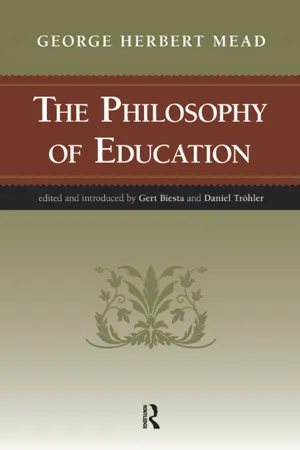
Never before published, this book features George Herbert Mead's illuminating lectures on the Philosophy of Education at the University of Chicago during the early 20th century. These lectures provide unique insight into Mead's educational thought and reveal how his early psychological writings on the social character of meaning and the social origin of reflective consciousness was central in the development of what Mead referred to as his social conception of education. The introduction to the book provides an overview of Mead's educational thought and places it against the wider social, intellectual, and historical background of modern educational concepts.
Information
LECTURE 1
[Education and the Intellectual Process of Community Life]
We wish to get at education from the point of view of the intellectual processes of the community,1 regarded as an essential part of the intellectual life of the group. We are interested therefore not only in the principles of teaching, but also in the effect of education upon thought itself.2
A word in justification of beginning with a study of primitive society rather than with our present age. The modern world started off with an inheritance of abstract ideas which it had received from Greece and Rome, and the first task of education was to assimilate the metaphysics of Aristotle’s philosophy. This was expressed 1) in the theology of the church; 2) in Roman Administration. These ideas were highly abstract, and for a long period the schools of Europe were engaged in becoming familiar with these abstract ideas. Medieval Europe was thus very much like a little child who is brought into his first contact with fractions. He is in the presence of symbols which have not arisen out of his own concrete experience, and which have to be handled by rule[s] which are foreign to his own experience. Both symbols and rules lie beyond his experience; the number in his arithmetic is not the same as the number in his concrete experience. This is much like Europe which in the Middle Ages stood in the presence of cultures inherited from the Greek and Roman civilization. It found it hard to receive and assimilate them because of their lack of relation to the experience of that day. There is here a contrast between the educational problem as it had existed in Greece and Rome and as it presented itself to Medieval Europe. It now made use of abstract ideas which had not been abstracted from the concrete experience of the people of Europe.3 [1|2]
Afterwards, our civilization having assimilated this method of the ancient world, along with its abstract ideas, advanced to a form which is in itself concerned with a body of highly technical ideas—a technical education. You will recall that the modern world began with Galileo who gave a new scientific method—a new way of conceiving of the physical world and a new technique in dealing with it.4 This new technique was decidedly practical as over against ancient science, which was altogether theoretical. They carried geometry as far as Euclid to whom there has been little addition since, and they advanced in astronomy to the beginnings of trigonometry, but there was no engineering in the ancient world. Greek science was not applied. The so-called “engines” of Archimedes are considered apocryphal. The ancients were singularly ignorant of the application of the simplest geometrical facts to life, as is shown in the writings of Josephus. But with Galileo, physical science came to be applied science very early. The successor of Galileo invented a clock. Thus with a new way of conceiving the physical world, there arises a new technique for controlling it, and education therefore became a technical matter. Of course, the practical applications did not proceed as rapidly at first as they have in more recent times.
This definite relation of education to specific callings which is characteristic of our modern times has closed our eyes largely to the intellectual processes of the community life, so that there is no recognized relationship between the body of ideas, say of law or engineering, and the methods by which these ideas are acquired. We have not realized that the body of ideas is itself affected by the manner of transmitting them. We have been concerned with the technique—the body of [2|3] ideas, and have considered the method of learning them relatively insignificant.
Contrast this with the attitude of a primitive people toward its ideas, as embodied in myths which we know are without question affected by the method of transmitting them. We recognize that a process of construction for purposes of presentation has largely affected the ideas involved in the material itself. This is true of initiation ceremonies, the materials of which have been largely determined by the very process of handing them down. We speak of the material as “traditional”—that is of a sort which is dependent upon the process of being handed down.
So we will view education, not only as a method of giving a body of facts to the rising generation, but we shall also consider the effect which the process of handing down has had on the material itself, as handed down from generation to generation. We know that our ideas are determined largely by the nature of language. If men had been compelled to communicate their ideas by means of gesture and pantomime, our thought processes would have been much more confined in their development. Our imagery in 1) would have been quite different and in 2) our judgments would never have been such as to admit of grammatical analysis, etc. Early philosophy, as among the Greeks, concerned itself largely with analysis of language, etc.
Wherein has the need of transmission changed the body of ideas themselves? How far has the body of ideas, which existed in the group consciousness, been affected by the fact that they have been transmitted from a mature generation to an immature, in such a way that it could assimilate them? How far have the ideas been affected by the necessities of language—by the method of presentation?
With Fiske we must recognize the im[3|4]portance of the period of prolonged infancy—that man does not have to become fixed in his habits from the very first.5 Hitherto we have not sufficiently recognized the effect of this period of infancy upon the materials to be acquired, cf. Israelites. We know that through necessities of the human family, vagrant man has become attached—has been placed. The center of this relationship is not the sexual attachment, but it centers in the child—the necessity of permanence, protection, providing, cooperation—and out of these necessities society has arisen.6
The earliest stage of society of which we know—the hunting stage—does not involve social activities necessarily. The pursuit and consumption of game may be quite an individual affair. So it required the social pressure of the little child to call the father in to divide. As soon as co-operation arises it is found to be for the sake of the child—the mother adapts herself to the needs of the child, and the father, even in the matriarchate, also recognizes its claims.
With agriculture we find the distinct stamp of family life.
This quarter we shall consider the relation of this attitude toward children in its effects upon the material of instruction. How far has the social situation precipitated an idea, and in 2) how far have these ideas been affected by the process of transmission—its very necessities. We may say that not only institutionally, politically, but intellectually as well—a little child has led them. (See Thomas’ Source Book for Social Origins, Part II, Mental Life and Education.)7
1. Underlined by hand in typescript.
2. Underlined by hand in typescript.
3. Underlined by hand in typescript.
4. Underlined by hand in typescript.
5. John Fiske, The meaning of infancy (Boston/New York: Houghton Mifflin Company, [1883] 1909).
6. Underlined by hand in typescript.
7. William I. Thomas, Source book for social origins: Ethnological materials, psychological standpoint, classified and annotated bibliographies for the interpretation of savage society (Chicago: The University of Chicago Press, 1909).
LECTURE 2
So-Called Education in Lower Animals Compared with Conscious Education in the Child
Yesterday we expressed our intention [4|5] to study the educational process from the point of view of more primitive society—that is education conceived of as an essential part of the social organization of the group.
Let us briefly consider the counterpart of this in the lower animal forms. One great advantage the human animal has over the so-called lower forms is the relatively long period of infancy. With the cat, dog, and horse, the period of dependence upon and association with the parent forms is much shorter than the like period in the case of the human form. Indeed some naturalists have given us quite a body of literature on “instruction” in the lower forms—as Long, Seton-Thompson, and others.1
They cite the example of the young fox which goes with the older form and acquires something of the skill of the older form and acquaintanceship with its habitat. But is this “instruction”? We are not able to say just what this process is in all details, but animal psychologists are pretty well agreed that the conduct of the parent form and the objects of the environment provide the stimuli which call out the tendencies already imbedded in the nervous system of the younger form itself. There is seemingly no admonition, no “instruction” given by the older form. There is no evidence, e.g., that the boxing of the ears of the kitten by its mother has the value of admonition, or correction. There seems to be no idea that the kitten should “copy” older forms. We have no evidence that there is any direction given, save what is involved in the environment and actual conduct of the older form.
What seems to take place is that the hunting instincts of the young fox become by this process attached to certain stimuli—rendered definite, and thus condition[5|6]ed by these stimuli. At first there is organization there, in the nervous system of the form, but it is not determined. The environment and conduct of elders, the stimuli, determine the expression of these instincts for hunting.
So with the instinct for avoiding in the young fox. In an age when man is his enemy, this instinct has become attached to the odor of man, but it is conceivable that in an environment of enemies other than man, this instinct for avoiding might become attached to a very different form. The organization of the nervous system is given but the stimulus is not yet determined.
There are some cases, however, in which the type of stimulus is completely determined from the first, e.g., as to food. But this is subject to modification after a disagreeable experience—as Morgan’s chick with its Cinnabar caterpillar.2
The term “imitation” has also been used to describe [the] process of animals in acquisition of certain habits—e.g., Thorndyke experimented to see if one cat could learn by “imitation” of the action of another how to escape from a cage, on seeing a trained cat free itself by pulling a string. He found that the second cat could not learn by “imitation”—it took just as long for it to learn to escape as it did the first cat. It had to learn by the trial and error process.3
So we conclude that there is no evidence that any animal can, by observation of another, recognize it as “copy” and set themselves definitely to reproduce the successful act, for from experiments we have also found out that monkeys also learn, not by the imitative method, but by the trial and error process.
So we conclude that as yet comparative psychology has not yet furnished any evidence that animals can learn by “imitation,” [6|7] as such. Whenever they seem to imitate, investigation shows that their actions are the result of some kind of previous training, such as they might indirectly pick up in a zoological garden, etc.
The animals have instincts, tendencies to react. These tendencies are in many cases not determined until the animal comes into a particular environment, which furnishes appropriate stimuli. Born in one habitat, one set of stimuli [might] operate to set off these tendencies, but in another habitat another set of stimuli might come to control. The instincts are therefore adjustable largely to the conditions in which the animal finds itself.
Education then, as far as the lower animals are concerned, is determined by the stimuli with which the animal comes in contact—stimuli to which his pre-adjusted instincts respond. There is no conscious education for the lower animals. Their environment and the conduct of the older forms determine the reactions of inborn instincts.
The human infant, in contrast, has a relatively long period in which the infant is dependent upon the parent form. So the period of plasticity which belongs to infancy continues for a much longer time than it does with the animal form. Plasticity may be defined as a condition in which the tendencies to act are comparatively fixed, but the stimuli which will set them off have not as yet been determined. The motor part is completely determined from the outset, but the sensory part awaits determination. The instincts are determined, but their stimuli are not yet determined. This is true to a surprising degree of all kinds of human behavior. The extent to which we are able to put together the various elements of acts, and by this combination constructing a new act, is very important. (Ill.)4 Writing is a [7|8] complex act, made up by the union of many simple parts. We cannot get control of these component parts, as such, so it is hard for one to disguise his handwriting. These component parts tend to go off of themselves, so we cannot directly control them, but we are able to secure the control of the entire series by attaching them to one object, now to another, as stimuli. (Ill.)5 The act of striking. The elements of the act are predetermined in the central nervous system, and so are the same for all persons, whether for the prizefighter, or the ordinary citizen assaulted in the streets. Though this striking process is itself determined, the stimuli, the conditions under which one shall strike are not determined, but vary indefinitely, e.g., what shall constitute an “insult”—a stimulus which sets free the striking reaction, may vary indefinitely according to the standard set by one’s social position, rank, etc.
Our instinctive, elemental movements are relatively few, although human conduct is very complex. This is due to the many combinations of stimuli which are possible, each calling forth an appropriate response. There is no limit to the differences of combinations and as a result to our various and manifold reactions, cf. alphabet.
This power to combine stimuli makes manifold conduct possible. We control our conduct by determining the objects to which we will respond—by constructing objects, by determination of stimuli. So we resent an insult only when it comes from one of our own, or of a higher class. It is only a mere passing sound, with no meaning otherwise for us.
We thus control our conduct through the conscious construction of those objects to which we will respond, and we train our children also to choose the stimuli for their acts. This is in contrast [8/9] to the animal. The odors which the fox learns to avoid—the stimuli to its acts, are determined for it unconsciously by the life of the parent form in the midst of [a] certain habitat. There is no consciousness of either teaching or learning with the lower animals. We may teach a dog not to take food from a certain place, but it is from fear of punishment, and not to be assumed that he constructs the food as the “property” of another.
The child on the other hand is not only taught to react properly, but also to construct the object towards which he acts—e.g., to recognize the money of another as belonging to, as the “property” of another. Thus the child learns why he acts, and why he does not, etc. There is with the child a conscious construction of the object as of “property.” As gold or silver the coin is there—but to conceive of it as the silver of John Smith, as something which John Smith alone controls, involves a social construction or determination of the stimulus. If everyone should disappear from a community, property would also disappear, because it is a social construct. This is likewise true of the constitution of the U.S. It is as real an object as the Rocky Mountains, but an object which is a social construct. Since we have it within our power to construct objects to which we will react, we have conscious control over our action. Not so the animal. It cannot construct its objects, so for it there is no property, no right or wrong, no conscious control, although we do find in the animal a type of intellectual behavior out of which this higher moral conduct develops. The power to construct the object is thus the key to conscious training.
The education of the lower animal forms is of a piece with that which the baby gets when it learns to avoid a candle [9|10] which has burned it.
Sometimes these stimuli are completely determined beforehand, as in the case of the moth—and determined to its own destruction.
But where the reactions are not yet attached to stimuli we have plasticity. This is in contrast with the lack of plasticity shown in the small ant whose fighting instinct is determined by the odor of the giant ant. If small ants are crushed, and the giant ant dipped in their odor, he will not fight and vice versa.
All the opportunity for adaptation...
Table of contents
- Cover Page
- Half Title Page
- Title Page
- Copyright Page
- Contents
- Introduction: George Herbert Mead and the Development of a Social Conception of Education
- Editing Principles
- George Herbert Mead's Lectures on Philosophy of Education
- Works Cited by Mead
- References
- Index
- About the Editors
Trusted by 375,005 students
Access to over 1.5 million titles for a fair monthly price.
Study more efficiently using our study tools.
Frequently asked questions
Yes, you can cancel anytime from the Subscription tab in your account settings on the Perlego website. Your subscription will stay active until the end of your current billing period. Learn how to cancel your subscription
No, books cannot be downloaded as external files, such as PDFs, for use outside of Perlego. However, you can download books within the Perlego app for offline reading on mobile or tablet. Learn how to download books offline
We are an online textbook subscription service, where you can get access to an entire online library for less than the price of a single book per month. With over 1.5 million books across 990+ topics, we’ve got you covered! Learn about our mission
Look out for the read-aloud symbol on your next book to see if you can listen to it. The read-aloud tool reads text aloud for you, highlighting the text as it is being read. You can pause it, speed it up and slow it down. Learn more about Read Aloud
Yes! You can use the Perlego app on both iOS and Android devices to read anytime, anywhere — even offline. Perfect for commutes or when you’re on the go.
Please note we cannot support devices running on iOS 13 and Android 7 or earlier. Learn more about using the app
Please note we cannot support devices running on iOS 13 and Android 7 or earlier. Learn more about using the app
Yes, you can access Philosophy of Education by George Herbert Mead,Gert J. J. Biesta,Daniel Trohler,Gert Biesta in PDF and/or ePUB format, as well as other popular books in Education & Education General. We have over 1.5 million books available in our catalogue for you to explore.