eBook - ePub
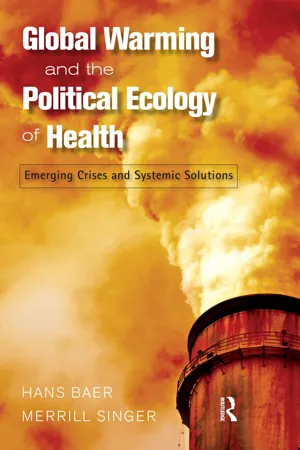
Global Warming and the Political Ecology of Health
Emerging Crises and Systemic Solutions
- 238 pages
- English
- ePUB (mobile friendly)
- Available on iOS & Android
eBook - ePub
Global Warming and the Political Ecology of Health
Emerging Crises and Systemic Solutions
About this book
In this groundbreaking, global analysis of the relationship between climate change and human health, Hans Baer and Merrill Singer inventory and critically analyze the diversity of significant and sometimes devastating health implications of global warming. Using a range of theoretical tools from anthropology, medicine, and environmental sciences, they present ecosyndemics as a new paradigm for understanding the relationship between environmental change and disease. They also go beyond the traditional concept of disease to examine changes in subsistence and settlement patterns, land-use, and lifeways, throwing the sociopolitical and economic dimensions of climate change into stark relief. Revealing the systemic structures of inequality underlying global warming, they also issue a call to action, arguing that fundamental changes in the world system are essential to the mitigation of an array of emerging health crises link to anthropogenic climate and environmental change.
Information
1
Global Warming
A Grave Contradiction of the Capitalist World System
After years of debating and gathering new information, climate and environmental scientists, with few exceptions, now agree that global warming is a grim reality, one that is largely due to human-related or anthropogenic activities. This is the view of bodies such as the Intergovernmental Panel on Climate Change (IPCC, a United Nations organization consisting of some 2,500 climate scientists around the world), the American Geophysical Union, the U.S. National Academy of Sciences, the Union of Concerned Scientists, and various international organizations. Global warming and its repercussions have become topics of increasing public awareness (Cox 2005:2). Recognition and concern about abrupt climate change has found its way into popular culture and even the mainstream media. In the United States, the generally sedate Public Broadcasting Service (PBS), which has come to rely heavily upon corporate funding and in the process has blunt its historically critical stance, ran a television special on November 2, 2005, titled “Global Warming: The Signs and the Science,” with the following message:
[H]uman activities are provoking an unprecedented era of atmospheric warming and climate change. We’re seeing more drought, more wildfires, more flooding, bigger storms and more variable weather. Tropical diseases are moving north, childhood respiratory illness is skyrocketing, and in the last three decades over 30 diseases new to science have emerged.
Feature stories are now regular fare on National Public Radio (NPR), but on more mainstream U.S. media as well.
Down under, in Australia, The Age, a liberal Melbourne-based newspaper, now regularly runs articles on the issue. The government-owned Australian Broadcasting Corporation (ABC) presents regular television newscasts and documentaries on global warming or climate change, stressing its impact on Australia and various regions of the country, particularly the southeastern portion, which has been adversely affected by a severe drought for about a decade.
Concern about global warming can be found at both ends of the political spectrum. The socialist left around the world has become increasingly vocal about the dangers to the planet and humanity as a result of global warming. At the same time, several evangelical Christian groups have joined in the chorus decrying global warming and proclaiming that it constitutes a violation of humanity’s stewardship over God’s creation.
In particular, at the popular level, Al Gore’s movie An Inconvenient Truth (see Gore 2006) and the The Stern Review, authored by former World Bank chief economist Nicholas Stern (2007), have helped to propel global warming/climate change into the public consciousness around the world. As a result, a growing number of business leaders, such as the CEO of British Petroleum, have come to embrace a form of “green capitalism” that asserts that while global warming poses a serious threat to the existing global economy, capitalism has the capacity to reform itself, adopt new forms of energy and environmentally sustainable technologies, and continue to sustain economic expansion and profit-making.
Despite broad concern voiced about global warming, leaders of several rapidly developing countries, particularly China and India, maintain that advocates calling for curtailment of greenhouse gases across the globe are engaging in a double standard that does not recognize the need for the developing world to undergo the same processes of industrialization and modernization that the developed countries have undergone. The late Anil Agarwal (n.d.a:6) argued that developed countries “have been emitting carbon dioxide in the Earth’s atmosphere for years before developing countries” and many poor people in the latter “will need their share of ecological space to increase what could be termed survival emissions.” As a result, people in developed countries will need to decrease their per capita greenhouse emissions, thereby permitting poor people in developing countries to increase theirs as they improve their material standard of living.
The Tipping Point in Public Awareness of Global Warming
Awareness and concern about global warming is not new. In 1896, the Swedish scientist Svante Arrhenius predicted that the burning of coal would double atmospheric carbon dioxide over the course of the next 3,000 years, resulting in an increase of about 9oF (5oC) in the average global temperature (Hardy 2003:55). In 1938, Guy Stewart Callender, an engineer with an amateur interest in climate issues, presented a lecture before the Royal Meterological Society in London in which he displayed various weather statistics that he interpreted as an indication that the earth’s temperature was increasing (Weart 2003:2).
A few climate scientists made similar assertions during the 1950s. Charles Keeling of the Scripps Institute of Oceanography reported the first direct measurements of changing carbon dioxide concentrations in the environment. He had measured carbon dioxide concentrations from a laboratory atop Mauna Loa in Hawaii, and detected a rise of carbon dioxide from 312 parts per million (ppm) in 1958 to 330 ppm in 1972. Roger Revelle lectured about the planet’s future in 1966 to students at Harvard University, one of whom was Al Gore, Jr., who became alarmed when he learned about Keeling’s evidence indicating a rising carbon dioxide rise in the atmosphere (Weart 2003:142). Gore famously went on to become a U.S. Congressman from Tennessee in 1977, a U.S. Senator in 1985, and later Vice President during the Bill Clinton administration (1993–2001). Some environmentalists and many climate scientists had expressed concern about global warming as far back as the 1970s, and the IPCC was formed in 1988. Over the next 15 years, there was a steady rise, year by year, in the extent of public, academic, and political discourse on global warming.
During the 1980s, concern about the atmosphere focused more on the dangers inherent in the depletion of the ozone layer that encircles the planet than on global warming. In 1985, 20 nations signed the Vienna Convention for the Protection of the Ozone Layer. This was followed by the Montreal Protocol on Substances That Deplete the Ozone Layer, which contributed to the reduction of chlorofluorocarbons (CFCs) in the stratosphere, and the World Conference on the Changing Atmosphere: Implications for Global Security, better known as the Toronto conference, in 1988. The latter event called on world governments to set strict targets for reducing greenhouse gas emissions (Weart 2003:154).
Ironically, the summer of 1988 also witnessed a series of record-breaking heat waves and droughts in many U.S. regions. In response, congressional hearings on planetary weather were held in Washington, DC, at which renowned climate scientist James E. Hansen, along with other scientists, testified that a century-long trend of global warming had resumed after a period of levelling off during the 1950s, 1960s, and early 1970s (Stevens 1999:131). At the hearings, Hansen stated “with 99 percent confidence” that the planet was undergoing a significant and long-term warming trend and suggested that the greenhouse effect was the culprit (quoted in Weart 2003:155). These developments prompted the environmental movement, which until then had only expressed passing concern about global warming, to take closer notice and ultimately to engage in greater action. Also in 1988 the World Meteorological Organization and other United Nations environmental agencies established the Intergovernmental Panel on Climate Change, a body that has played a key role in creating international awareness of the inescapable reality of global warming and its implications for both the environmental and humanity.
It appears that Gore was one of the first politicians to understand the seriousness of global warming and to publicly call for a reduction in greenhouses gas production. He also held congressional hearings on carbon dioxide emissions during the late 1970s. Despite his highly touted 1992 best seller Earth in the Balance: Ecology and the Human Spirit, in his capacity as vice president, Gore functioned as a rather muted voice on environmental matters, including on the issues of global warming. Furthermore, he did not particularly emphasize environmental issues generally, or the growing danger of global warming specifically, during his 2000 bid for the U.S. presidency. Nonetheless, as journalist David Remnick (2006) noted in a New Yorker essay:
In the 1992 campaign against Bill Clinton, George H. W. Bush mocked Gore as “ozone man” and claimed, “This guy is so far out in the environmental extreme we’ll be up to our necks in owls and outta work for every American.” In the 2000 campaign, George W. Bush cracked that Gore “likes electric cars. He just doesn’t like making electricity.” The younger Bush, . . . demanded that Gore “explain what he meant by some of the things” in his 1992 book, “Earth in the Balance”—and then unashamedly admitted that he had never read it. A book that the President did eventually read and endorse is a pulp science-fiction novel: “State of Fear,” by Michael Crichton. Bush was so excited by the story, which pictures global warming as a hoax perpetrated by power-mad environmentalists, that he invited the author to the Oval Office.
A few years into the beginning of the 21st century, however, a tipping point was reached in which many politicians and ordinary people came to believe that global warming is real and potentially threatening. The issue began appearing as a regular feature in the global mass media, and it showed up on government policy agendas in numerous countries. These dramatic changes even finally forced U.S. President George W. Bush and Australian Prime Minister John Howard, both of whom vigorously opposed their respective countries ratifying the Kyoto Protocol, to admit that global warming, or what they prefer to term “climate change,” is a reality. There appear to have been three driving engines behind these remarkable developments:
- A rapidly mounting body of scientific evidence from diverse disciplines (climatology, geology, virology, glaciology, etc.) all pointing to the same conclusion: that global warming was not only happening but doing so at a rapid pace and with growing effects;
- The image evidence, such as pictures of how much glaciers had retreated, and direct experience of the increasing number of severe storms and serious heat waves that began impacting people’s lives; and
- The emergence of increasing numbers of prominent spokespersons, scientists, environmental activists, and science-aware politicians, which brought global warming to the attention of the mass media.
Other factors, including the efforts of some social scientists, also contributed to the growing awareness that global warming constitutes a serious threat to the environment and, as a result, to humanity as well. Conversely, despite this heightened consciousness, we are still living in an era of continued denial by ultra-conservatives and business interests who profit enormously from the status quo, as well as public resistance to radical lifestyle changes needed personal sacrifices. Table 1 depicts our model of the stages of global warming recognition that encapsulates the preceding discussion.
Humanity as a whole has not yet entered the fifth stage of our model, namely panic, although some individuals may at times experience this response to global warming. Nevertheless, in the likely event that global warming’s impact on human societies and the planet will continue to worsen over the course of the next decade or two, such a scenario is very possible. Conversely, a potential alternative to the fifth stage of our model is Concerted Action, involving dramatic changes in global carbon emissions and related ameliorative efforts. Thus far, however, progress toward this alternative has been agonizingly slow. We explore this issue in some detail later in the book, but suffice it to say at this point that vested interests in “business-as-usual” play a very significant role in undercutting serious efforts to mitigate global warming.
We turn now to addressing a fundamental question that helps to clarify the nature of resistance to the grave seriousness of thorough-going global mitigation efforts, namely: what is driving anthropogenic global warming?
Table 1. The Stages of Global Warming Awareness
Stage | Characteristics |
1 Open Denial | Public attacks by special-interest groups and conservative pundits on those who call attention to global warming |
2 Waiting for Undeniable Proof | Questioning the data, arguing it is insufficient, and stressing that scientists don’t agree |
3 Eager Minimalism | Acceptance of the reality of global warming but calling for minimal actions (celebrated publicly a... |
Table of contents
- Cover
- Half Title
- Title Page
- Copyright Page
- Contents
- Introduction
- 1. Global Warming: A Grave Contradiction of the Capitalist World System
- 2. Lifeways in Peril: The Impact of Global Warming on Settlement Patterns and Human Perceptions of Climate
- 3. An Age of Weather Extremes: Consequences for Human Subsistence, Water, and Nutrition
- 4. A Disturbed Planet: Heat Stress, Pollutants, and Environmental Diseases
- 5. Agents of Suffering: The Spread of Waterborne and Vector-Borne Infections
- 6. Ecosyndemics: The Interaction of Changing Environment and Disease
- 7. Adaptation Versus Mitigation: Why Existing Climate Regimes and “Green Capitalism” Are Not Enough to Contain Global Warming
- 8. Toward a Healthier Planet: The Creation of a Democratic Ecosocialist World System
- References
- Index
- About the Authors
Trusted by 375,005 students
Access to over 1.5 million titles for a fair monthly price.
Study more efficiently using our study tools.
Frequently asked questions
Yes, you can cancel anytime from the Subscription tab in your account settings on the Perlego website. Your subscription will stay active until the end of your current billing period. Learn how to cancel your subscription
No, books cannot be downloaded as external files, such as PDFs, for use outside of Perlego. However, you can download books within the Perlego app for offline reading on mobile or tablet. Learn how to download books offline
We are an online textbook subscription service, where you can get access to an entire online library for less than the price of a single book per month. With over 1.5 million books across 990+ topics, we’ve got you covered! Learn about our mission
Look out for the read-aloud symbol on your next book to see if you can listen to it. The read-aloud tool reads text aloud for you, highlighting the text as it is being read. You can pause it, speed it up and slow it down. Learn more about Read Aloud
Yes! You can use the Perlego app on both iOS and Android devices to read anytime, anywhere — even offline. Perfect for commutes or when you’re on the go.
Please note we cannot support devices running on iOS 13 and Android 7 or earlier. Learn more about using the app
Please note we cannot support devices running on iOS 13 and Android 7 or earlier. Learn more about using the app
Yes, you can access Global Warming and the Political Ecology of Health by Hans Baer,Merrill Singer in PDF and/or ePUB format, as well as other popular books in Social Sciences & Global Warming & Climate Change. We have over 1.5 million books available in our catalogue for you to explore.