eBook - ePub
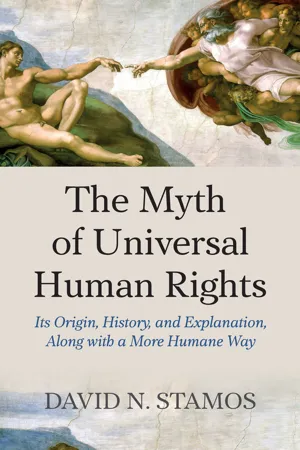
Myth of Universal Human Rights
Its Origin, History, and Explanation, Along with a More Humane Way
- 320 pages
- English
- ePUB (mobile friendly)
- Available on iOS & Android
eBook - ePub
Myth of Universal Human Rights
Its Origin, History, and Explanation, Along with a More Humane Way
About this book
In this groundbreaking and provocative new book, philosopher of science David N. Stamos challenges the current conceptions of human rights, and argues that the existence of universal human rights is a modern myth. Using an evolutionary analysis to support his claims, Stamos traces the origin of the myth from the English Levellers of 1640s London to our modern day. Theoretical defenses of the belief in human rights are critically examined, including defenses of nonconsensus concepts. In the final chapter Stamos develops a method of naturalized normative ethics, which he then applies to topics routinely dealt with in terms of human rights. In all of this Stamos hopes to show that there is a better way of dealing with matters of ethics and justice, a way that involves applying the whole of our evolved moral being, rather than only parts of it, and that is fiction-free.
Information
Chapter 1
Introduction
Truly, I say to you, a prophet is never accepted in his own country.
—Jesus (Luke 4: 24)
Problem, Audience, and Myth
OUR WORLD ABOUNDS IN HUMAN RIGHTS TALK. We routinely hear of individual human rights, such as the right to life, to property ownership, to freedom from torture, to freedom of religion, and more controversially to social welfare, to health care, to holidays with pay, to gay marriage, to having lots of children, to suicide, and even to being fat. We also routinely hear of group rights, such as women’s rights, gay rights, and aboriginal rights. The United Nations has the Universal Declaration of Human Rights, which was expanded into international human rights law, while state governments similarly declare human rights in their Constitutions, Bills, and Charters, as do Humanist Associations in their Manifestos. We have Human Rights Museums and routinely hear of recent human rights violations not only in places such as China and Zimbabwe but in our own backyard as well. We have human rights lawyers, Human Rights Commissions, Councils, and Tribunals, and organizations such as the American Civil Liberties Union. We have international watchdog organizations such as Amnesty International, Human Rights Watch, and Freedom House, which investigate human rights abuses and publish thick annual reports on human rights violations around the world. We even hear of captured terrorists who complain about the violation of their human rights (though their sincerity is doubtful). The overall impression is that human rights are written into our very DNA itself, as birthrights constituting part of human nature.
But do they actually exist? Are they real? Despite all the good intentions behind the universal human rights phenomenon (and they are formidable), these questions need to be asked and they need to be taken seriously. If universal human rights really do exist, then we should want to know the nature of their reality, if only to determine their scope. And if they do not exist, but people talk as if they do, then we should not want people appealing to fictions in matters so important as ethics and justice but should want to find a better way.
Talking about human rights as if they actually exist, as objective properties of human beings, is the majority view among believers in human rights. As the political scientist Tony Evans puts it in his book, The Politics of Human Rights (2005), “natural rights foundationalism continues to inform most mainstream ‘human rights talk’” (7). Accordingly, the consensus concept of universal human rights is the main focus of the book before you. But there is another approach, also examined in this book, that is the minority view among believers in human rights. Here the view is that universal human rights talk is simply an expression of normative values, a kind of shorthand for what people should think and do. In this case we should want to examine the values underlying the language to see if those values have a legitimate basis, and also to see if universal human rights talk is the proper vehicle for their expression, for it might after all be a kind of systematically misleading expression.
Either way, the majority or the minority, it is said that people “have” human rights. It is therefore legitimate to ask of both, “Where does the having come from and is it really having?” And given that the language of universal human rights constitutes the dominant moral discourse of our world today, the more general question of what people are talking about when they talk about universal human rights is one of the most important questions of our time and should not be ignored.
Immediately many will want to shift the focus to effects. They will want to focus on all the good that the universal human rights phenomenon has produced, such as reducing world hunger and improving the lot of minorities. One could just as easily argue that the widespread belief in universal human rights has produced a lot of harm, notably the creation of an international culture of entitlements and social justice the cost of which has run many countries to the brink of bankruptcy, such as Greece, Ireland, and Portugal, with the United States close behind. Whichever way one argues here, the debate does not seem to go anywhere. My focus is more basic, and actually more tractable. It is, primarily, the question of whether universal human rights are real in the first place. All else follows from that.
In this book it is argued that universal human rights are a myth, that they are not real. What is meant here by “myth” shall be clarified below. But first we need to specify the audience. Quite simply, this book should be of interest to anyone interested in the topic of human rights, and that is a great many people. On the one hand it includes many in the academic world, primarily in the fields of philosophy, law, politics, and history. Professional scholars should find the book attractive not only because it deals with human rights theory in an original, detailed, and interdisciplinary manner, but also because it provides detailed critical analyses of arguments on human rights by scholars that are well known in their respective fields, such as, to name a few, James Griffin’s (2008) defense of human rights (ethics), Charles Beitz’s (2009) defense of human rights (politics), Brian Tierney’s (1997) argument that the medieval Decretists were the first to have the concept (medieval studies), Tony Honoré’s (2002) argument that the Roman lawyer Ulpian was the first human rights lawyer (law), and Nicholas Wolterstorff’s (2008) argument that not only is the concept of human rights to be found in the Bible but the Bible gave the modern concept to the world (philosophy of religion).
Students should also find the book interesting, and useful. This is partly because the style maintained throughout the book is that of teaching while arguing, but also because the book provides students with the analytical and conceptual tools required for doing their own analyses of arguments on human rights that are not specifically analyzed in this book, whether they are dealing with claims that this or that premodern source has the modern consensus concept of universal human rights or are dealing with arguments defending the modern consensus concept, or some aspect of it, or a related concept of human rights. As the literature is enormous in terms of both theory and history, course directors should have no problem providing their students (both undergraduate and graduate) with essay topics and research projects. The final chapter of the book is also very useful for students, as it provides a unique method (that of a naturalized normative consensus) for dealing with matters of ethics and justice and provides six examples of applications that are routinely dealt with in terms of human rights.
Finally, the general educated public should find this book of great interest, not only because it is clear and informative and written in a relatively nontechnical style, but because the belief in human rights has pretty much gone global ever since World War II, such that the language of universal human rights dominates our moral discourse both domestically and internationally. The topic of human rights, then, is not a dry scholarly exercise, confined to specialists, such as the species problem in biology (the question of what a species is), but is a question that vitally concerns most people today. A distinction made by William James (1897, 3–4) in a very different context helps to emphasize this point. We may say that the belief in universal human rights is “live” for most people in that it animates them in a number of ways, it is “forced” in the sense that the pervasiveness of the belief means that we cannot avoid the question but have to make a decision one way or another, and it is “momentous” in the sense that the stakes are not insignificant but very high—we are talking about life, after all, and how it should be lived.
In other words, professional scholars do not have a monopoly here, students should not think that the scholarly world revolves around them on this topic (or any other), and the general public needs to realize just how complicated and nuanced the problem of universal human rights has become. Accordingly, the book is written in a style that is meant to be accessible to all three of these main audiences: not long-winded, highly abstract, and dripping with scholarly footnotes, and not simplified to the point of being boring and unchallenging to the knowledgeable and erudite. The book is written, instead, in a style that reaches out to all three audiences, a style that teaches and argues in a clear and forceful manner, a style that should appeal to all three audiences as long as each remains mindful of the needs of the other two. The content, moreover, is an original argument and is in fact much like a long case presented to an intelligent jury and a seasoned judge: a clear, meticulous, detailed, step-by-step case that in the end is intended to command the assent of every reasonable and rational person who believes in the principle of proof beyond a reasonable doubt. Though the thesis is hardly a politically correct one (a point of which I am abundantly aware), it has to be recognized that politics does not determine good scholarship and it is not wisdom to ignore evidence. In the very least, if one has a genuine desire for truth, knowledge, and justice, then one should be willing to follow the argument wherever it leads, to paraphrase Plato’s Socrates (Phaedo 107b, Republic 394d).
The term “myth” is used throughout the book in basically the normal way, but some elaboration is warranted right up front. For a start, there is a consensus concept of universal human rights and it is the main focus of the book. This concept is enshrined in key documents such as the American Declaration of Independence and the Universal Declaration of Human Rights and is held by the vast majority of people who believe in human rights. It is the concept of moral claims and entitlements that all humans have by virtue of being human. The belief based on this concept is an ontological belief, a belief about something that exists in the world, in this case something that humans have.
There are also non-ontological concepts of human rights, mentioned above as the minority view, which collectively may be called formal or functional concepts of human rights. Lacking the ontological content of the consensus concept, they retain its form and function. These concepts are usually found only among professional scholars and will be examined in the appropriate chapters. As non-ontological concepts lacking common currency, they might be said to be immune to the charge of myth. This is not necessarily true, as they are parasitic in various ways on the consensus concept. Indeed, the scholars who subscribe to them may be likened to the ancient Epicureans, who did not believe in the gods of their society (they had a radically different conception) but nevertheless piously practiced the sacrifices and ceremonies of the state religion (Summers 1995). At any rate, these finessed concepts of human rights raise separate problems and will be rejected for a number of reasons, partly because they are not explanations of, let alone defenses of, the consensus concept and belief, and partly because they fail to stand on their own.
The title of this book is a deliberate and unashamed imitation of The Myth of Mental Illness by the psychiatrist Thomas Szasz (1974). Szasz states his problem in terms of a conventional norm, namely, the majority of psychiatrists who “define their discipline in terms of nonexistent entities or substantives” (1). He argues that not only psychiatrists but also the general public have accepted the myth of mental illness in the sense of a “dogma” (xiii), one that has received the “imprimatur” (x) of the state.
To count as a myth, it should be noted, an alleged fact or story does not necessarily require state sanction, but it does require some degree of common currency in a community, if only for a short time. A myth must also have a beginning in time and place, such that myths may rightly be viewed as cultural artifacts. And myths, of course, have to be false. There is also something simple-minded about myths, which often seem to require a childish naïveté for belief in them, such as the Adam and Eve story. In the very least, mythological beliefs involve a serious lack of critical reasoning often combined with a dogmatic certainty that one is right, all of which should become obvious once the knowledge necessary to see through the myth becomes acquired. Myths, moreover, need not be about nonexistent objects or persons, such as the gods of ancient Greece or the demons of medieval Europe. They can also be about nonexistent properties and relations, such as the myth of King Tut’s curse (property) and the myth that masturbation causes blindness (relation). A myth can also simply be in the story itself, such as the myth that Christopher Columbus discovered America. Finally, we do not call a belief a myth if the belief is part of human nature, such as the belief that color is part of the world or that moral qualities are similarly out there, apart from minds.
In the case of human rights, the norm or common currency we are dealing with does not concern a specific discipline or profession. It does not even concern a specific group or society. Instead, it concerns a number of disciplines (philosophy, law, politics, history), a number of institutions (domestic and international), and the general public considered globally. It is the widespread belief that in addition to the well-known basic facts about human beings—their overall intelligence, their many kinds of consciousness, their language ability, their moral abilities, and so on—there is a set of further facts, moral facts that all and only human beings have, namely, human rights. (Again, there are other modern concepts of human rights, and a representative sample of them shall be dealt with in the book where appropriate, but none of them should be confused with the consensus concept.)
Returning to Szasz, his meaning of “myth” is problematic given his phrase “entities or substantives.” Clearly no psychiatrist ever thought of mental illness as an independent entity, but instead as a property, as something someone has. Likewise, we are not dealing with universal human rights as “entities or substantives,” but instead as properties that, it is argued, humans do not in fact possess. Since the supposed properties are clearly moral ones, the argument is similar in a sense to John Mackie’s argument against moral objectivism in Ethics: Inventing Right and Wrong (1977). Moral objectivism is the common belief that when we make a moral statement, such as that rape is wrong, we are not simply expressing how we feel or what we think someone ought not to do, but instead we are making a judgment about the act itself, that in addition to all the natural facts of the matter there is a further fact, the fact that rape is morally wrong. As Mackie puts it, “ordinary moral judgments include a claim to objectivity” (35), such that philosophical analyses of moral claims tend to overlook “the apparent authority of ethics” (33). It is therefore legitimate, says Mackie, to ask whether there really are such facts. His denial in turn is an “ontological thesis” (18), the thesis that in reality the world does not contain such facts. Thus his skepticism against moral objectivism is what he calls an “error theory” (35). The situation is similar, he says, to asking whether colors are really out there in the world. When we say, for example, “That shirt is red,” we typically think we are referring to a color fact out there in the world in addition to all the other facts involved. Today it is standard in science to say that color is not really out there in the world, that instead we automatically and unconsciously project color onto the world, that color exists only in our visual images.
Without necessarily subscribing to Mackie’s thesis in general, the skepticism against universal human rights defended in this book is similarly an “error theory”— or more accurately an “error proof”—the conclusion of which is that there are in fact no such objective properties, no such moral facts, and that those who think otherwise are guilty of projecting their belief onto the world, the human world. But it is also argued that the projection is not part of human nature (although human nature contributes to it), that instead it began roughly only a little more than 360 years ago, that it is a modern myth. In this sense the thesis of this book is not like Mackie’s but more like Szasz’s. At any rate, the case for it takes us right up to the final chapter.
The thesis is essentially negative, then, and many will view this book as pernicious or even as outright evil, in the very least as iconoclastic. I view the book, however, as ultimately positive, for in the final chapter, summarized below, it is argued that there is a much better way of dealing with matters of ethics and justice, a way that does not at all require an appeal to fictions.
It should be added that this book was not intended to be an exhaustive treatment of the subject. The quantity of literature on human rights is quite staggering, whether we are talking about concepts, theories, defenses, or histories. Emphatically, the point and purpose of this book is not to deal with it all. Instead, although a number of competing concepts, theories, defenses, and histories are explicitly dealt with, the primary purpose is to deal with the consensus concept and its history, the concept of human rights enshrined in numerous domestic and international documents, institutions, and agreements, which is also the concept that individuals around the world typically use when they talk about human rights and when they claim that their human rights have been violated.
To maintain that something is a myth and to provide a full explanation of that myth, whether as an error theory or as an error proof, one must accomplish three tasks. First, one has to prove, inasmuch as that is possible, that the myth is indeed false (given the difficulty of proving a universal existential negative, in the very least one has to show that there are no good reasons to believe the myth and plenty of good reasons not to). Second, one has to account for the origin and spread of the myth. Third and finally, in the case of living myths especially, one has to account for the persistence of the belief in the myth. These...
Table of contents
- Cover
- Half Title
- Title
- Copyright
- Dedication
- Contents
- Acknowledgments
- Preface
- Chapter 1: Introduction
- Chapter 2: Evolution and Universal Human Rights
- Chapter 3: Scholarly Defenses of Universal Human Rights
- Chapter 4: Getting the History of Human Rights Wrong
- Chapter 5: Getting the History of Human Rights Right
- Chapter 6: Explaining the Human Rights Epidemic
- Chapter 7: Evolution, Ethics, and Justice
- References
- Index
- About the Author
Trusted by 375,005 students
Access to over 1.5 million titles for a fair monthly price.
Study more efficiently using our study tools.
Frequently asked questions
Yes, you can cancel anytime from the Subscription tab in your account settings on the Perlego website. Your subscription will stay active until the end of your current billing period. Learn how to cancel your subscription
No, books cannot be downloaded as external files, such as PDFs, for use outside of Perlego. However, you can download books within the Perlego app for offline reading on mobile or tablet. Learn how to download books offline
We are an online textbook subscription service, where you can get access to an entire online library for less than the price of a single book per month. With over 1.5 million books across 990+ topics, we’ve got you covered! Learn about our mission
Look out for the read-aloud symbol on your next book to see if you can listen to it. The read-aloud tool reads text aloud for you, highlighting the text as it is being read. You can pause it, speed it up and slow it down. Learn more about Read Aloud
Yes! You can use the Perlego app on both iOS and Android devices to read anytime, anywhere — even offline. Perfect for commutes or when you’re on the go.
Please note we cannot support devices running on iOS 13 and Android 7 or earlier. Learn more about using the app
Please note we cannot support devices running on iOS 13 and Android 7 or earlier. Learn more about using the app
Yes, you can access Myth of Universal Human Rights by David N. Stamos in PDF and/or ePUB format, as well as other popular books in Philosophy & Ethics & Moral Philosophy. We have over 1.5 million books available in our catalogue for you to explore.