- 168 pages
- English
- ePUB (mobile friendly)
- Available on iOS & Android
eBook - ePub
About this book
What is archaeology, and why should we do it? Tom King, arguably the best-known heritage management consultant in the United States, answers the basic question of every introductory student from the unique perspective of one who actively uses archaeology for cultural resource management. Designed as a supplement for introduction to archaeology classes, this brief and breezy book runs the reader through the major principles of archaeology, using examples from the author's own field work and that of others. King shows how contemporary archaeology, as part of the larger cultural resource management endeavor, acts to help preserve and protect prehistoric and historic sites in the United States and elsewhere. Brief biographies of other CRM archaeologists help students envision career paths they might emulate. The bookends with an exploration of some of the thorny problems facing the contemporary archaeologist to help foster class discussion. An ideal ice-breaker for introductory college classes in archaeology, one that will get students engaged in the subject and thinking about its challenges.
Information
Chapter One
What’s This All About?
What Is Archaeology?
Archaeology is the study of the human past, using stuff.
Four important words here. First, archaeology is a study—a kind of research. Second, it's about human beings—not dinosaurs (that's paleontology) or rock formations (that's geology), but human beings. Third, it's about human beings in the past, not the present or future—though the "past" can be pretty recent, and we like to think what we study is relevant to the present and future. Finally, what we study is stuff—the things that people left behind, lost, abandoned, ate, walked around on, lived in, threw at each other, as well as the stuff that made up their bodies. We also study words written on paper, transcribed electronically, and spoken into our ears, and we examine the natural environment, but the unique focus of archaeology is on stuff, and what it can tell us.
Who Are You?
I assume you're reading this because you want to know something about archaeology Maybe you're a student; maybe you're interested in archaeology as a hobby; maybe you're thinking of doing it for a living.
Or maybe you're working in some other field—history or architecture or urban planning, perhaps—and have archaeologists as colleagues whose ways of thinking you need to figure out.
Or maybe you own a piece of property and are trying to develop it, or you work for a government agency and you've learned that you have archaeological sites to deal with. How, you wonder, do I do this?
Or maybe you just think—like about 87.5 percent of the population, at least in the United States—that archaeology is neat.
This book is designed to be the first one you read about archaeology—or maybe the only one. But it probably isn't. At the very least, you've undoubtedly read novels that feature archaeology or books and articles about past civilizations uncovered by archaeologists, and you've seen movies in which archaeologists find treasures from the past and have adventures doing it. You may have read quite a lot about archaeology, and about the results of archaeological research—perhaps in Egypt, or Central America, or the Andes. Or you may have worked on archaeological field projects, perhaps near your home, perhaps in other countries. If you have, a lot of what this book contains maybe old news. Or maybe not, for a couple of reasons.
For one thing, this book is about doing archaeology, not about its results. You may have read a lot about the archaeology of Israel, or China, or western Pennsylvania, and learned about the events, people, and cultures that archaeologists in those areas have reconstructed. That's great, but what this book is about is how archaeologists learn such things—how the study is done, and why it's done that way.
Second, each of us archaeologists—or people, for that matter—has a particular perspective, and mine may well be different from those of the authors you've read or the archaeologists you've worked with. Which brings me to the subtitle.
What Is Cultural Resource Management?
This book is subtitled "A Cultural Resource Management Perspective." What is "cultural resource management"?
I'll go into this in Chapter Five, but in a nutshell, "cultural resource management" (CRM) is a fancy term for trying to take care of what's important to people for cultural reasons—including archaeological sites, but also including old buildings, neighborhoods, songs, stories, dance forms, religious beliefs and practices—in the context of the modern world's laws, politics, governments, and economic forces. That's my definition, anyway; others use the term differently. Almost everybody who uses the term, though—and it's used this way mostly in the United States—uses it to include doing archaeology in connection with development and land use, under various national, state or provincial, tribal, and local laws. In other words, doing archaeology in places that are in danger of being bulldozed, flooded, bombed, plowed, or otherwise screwed up, or that are managed by government agencies. That's my perspective, which is a bit different from the perspective of someone who teaches archaeology in a university or works in a museum, though many people who do that kind of work also do "CRM."
Who Am I? Pothunter to Professional
I've been doing archaeology and CRM for close to fifty years, starting in my early teens as what archaeologists call a "pothunter." That term—a derogatory one—means someone without all the proper training and credentials who digs in archaeological sites to find stuff, which he or she then keeps or sells. Typically (but not universally) a pothunter doesn't use very good techniques, so he or she may destroy a lot of stuff, and the information represented by the stuff. Typically (but not universally) a pothunter doesn't take very good notes, or publish the results of what he or she does. Typically (but not universally) the stuff a pothunter digs up doesn't go to a museum or other public institution; the pothunter keeps it, sells it, trades it, or eventually throws it away.
In my case, it didn't take me long—because I'd been reading about archaeology since I was about five years old, and wanted to be an archaeologist when I grew up—to become an unusual pothunter in that I used pretty good field methods, kept notes, wrote reports on what I did, and put my stuff in a museum. This made me, in the eyes of most archaeologists, an "amateur archaeologist." I was more or less doing archaeology; I just wasn't getting paid to do it. From there I went on to get the formal education that you need to do archaeology professionally—eventually getting a PhD from the University of California, Riverside. The PhD was in anthropology not specifically archaeology, which is the way it works in the United States. In most of this country's academic institutions, archaeology is mostly organized as a subfield of anthropology—the general study of human beings and their culture, past and present. What is sometimes called "classical" archaeology, how-ever—generally focusing on the study of Greek, Roman, and other Mediterranean civilizations—is usually lumped together with history, art history, and other disciplines called the "humanities." In the colleges and universities of some countries, archaeology is a stand-alone discipline. But if you're doing archaeology in the United States, you're almost surely going to get your advanced degree in anthropology.
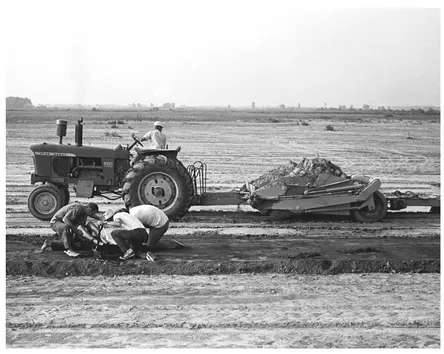
Figure 1. Salvage archaeology in Arkansas, 1970: The Keller Site—a village site over a thousand years old, with graves—is destroyed by agricultural land leveling while archaeologists from the Arkansas Archaeological Survey salvage what they can. Photo courtesy Arkansas Archaeological Survey.
While in college I began to make a living doing archaeology. The only jobs to be had in those days (the 1960s) were in "salvage archaeology"—excavating sites that were about to be destroyed by highways, dams, and other kinds of construction projects. This was interesting, often exciting, but pretty frustrating and saddening. We'd dig perhaps three or four percent of an ancient site—say, a 2,000-year-old California Indian village site or cemetery—and then the money and time would run out and the rest of the site would be bulldozed into oblivion. It hurt. So when President Lyndon Johnson signed the National Historic Preservation Act into law in 1966, and the National Environmental Policy Act was enacted in 1969, and the State of California followed up with the California Environmental Quality Act—all requiring that agencies of government figure out what damage their projects would do to the environment, including its cultural aspects, and try to mitigate that damage somehow—I got deeply involved in trying to make these laws work, for archaeological sites and other kinds of cultural resources. As a result, I was sort of present at the creation of CRM in the United States.
Over the years since, I've worked inside and outside government, in Washington, D.C., in California, in New York, in various other states, and in the island nations of Micronesia, occasionally doing archaeology in the field but more often negotiating agreements about how cultural resources would be managed, and writing the laws, regulations, standards, and guidelines that structure CRM. I've taken part in litigation, written books, and taught lots and lots of short courses around the country I've been especially involved in working with Indian tribes, Micronesian and Hawaiian communities, and other indigenous, low-income, and minority groups trying to take care of their cultural resources (not just archaeological sites). One thing I've learned and come to feel strongly about through all these years of practice is that people working in CRM have to be more than just archaeologists—or historians, architectural historians, or whatever else they're trained in school to be. They have to be prepared to deal responsibly with all kinds of cultural resources. That's a big part of my perspective, and something 111 harp on throughout this book.
But, this book is about archaeology first and foremost.
What Archaeology Is Not
There are some widely held misconceptions about archaeology. You may not believe any of these myths, but some people do, so we'd better knock them in the head before we get into the meat of the book.
Archaeology and Dinosaurs
Archaeology is not about the study of dinosaurs or other ancient beasties—unless they're somehow associated with humans, and dinosaurs aren't. Dinosaurs died out long, long before humans came along; the two didn't coexist. Or, of course, maybe they did and nobody's discovered that fact, so if you discover it you'll become really famous, but I wouldn't plan my career around such a discovery if I were you. If you want to study dinosaurs, or other fossil animals or plants for their own sake, you don't want to do archaeology, you want to do paleontology—a whole different field, though paleontologists and archaeologists use a lot of similar research methods in the field and laboratory.
Treasure and Tombs
Archaeologists are not treasure hunters, or vice-versa. Of course, it's possible to find treasure while doing archaeology, or to do archaeology in connection with a search for treasure (though that's controversial; more on that later). And it's a dishonest archaeologist who tells you he or she doesn't enjoy finding something really valuable, or beautiful, or otherwise desirable. But the goal of archaeology is not to find goodies. Archaeology is about learning things, figuring things out, and the bulk of what we find and study isn't treasure. Actually, it's mostly garbage; we study what people have thrown out or otherwise left behind.
Nor is archaeology about digging into tombs. We do dig into tombs, and other kinds of graves, but only for a purpose. Tombs and other graves contain a great deal of information about whoever's buried there and the culture of the people who buried them, so they are of great interest to many of us. My PhD dissertation was based on the study of three cemeteries, all about 1,500 years old, in California's Sierra Nevada foothills. So, yes, we do dig tombs and other graves, but we also dig houses and backyards and public buildings and industrial sites and religious sites and—more than anything else—garbage dumps. We dig where we can get the information we want for whatever it is we're trying to learn, and in CRM we dig mostly either to help figure out how to keep things from being destroyed, or to salvage stuff that will be destroyed if we don't get it out of the way. If for either of these reasons we have to dig a tomb, so be it, but exhuming dead bodies isn't our reason for digging. And in the last thirty years or so, we've gotten a lot more careful about trying, if we can, not to dig graves; instead we try to keep them where they are. We've gotten this way not because graves aren't interesting, and full of useful information, but because people descended from those buried in them—for example Indian tribes and Native Hawaiians—have let us know in no uncertain terms that they want their ancestors left alone. We've learned—most of us, anyway—to respect both the ancestors and their descendants.
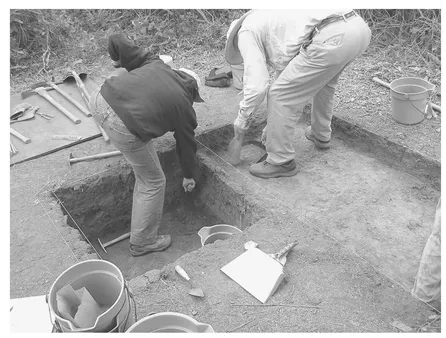
Figure 2. Up close and personal with dirt: an archaeological excavation in progress. Photo courtesy Rob Edwards, Cabrillo College Archaeological Technology Program.
The Archaeologist as Hero
As I write this, in 2004–5, the Indiana Jones movies are getting a bit faded, and Harrison Ford has moved on to more challenging roles, but I confess to still liking the image of the archaeologist as whip-wielding adventurer. Other archaeologists protest that the image is terribly inaccurate, and of course it is. None of us is as tough as Indy, and none of us has that many adventures. More importantly, none of us just goes out into the sand dunes or jungles and makes great discoveries; we work long and hard at it, and go through a whole lot of drudgery on the way to finding anything exciting. Most important of all, archaeology isn't really about finding specific exciting things. It's about piecing together little clues to develop a general picture of something that happened in the past, to answer some general question or set of questions. And it takes a lot of very careful searching and digging and recording—taking notes, making maps and plans, drawing pictures, taking photos. Virtually none of which you ever see Indy or his ilk doing. And there are things that Indy and characters like him do—grabbing skulls, yanking stuff out of the ground—that sets us all to grinding our teeth. But still, a lot of archaeologists took to wearing fedoras in the 1980s.
Varieties of Archaeology
Depending on an archaeologist's background, training, and interests, he or she may be called a classical archaeologist, an anthropological archaeologist, a historical archaeologist, an underwater archaeologist, or some other subspecies. Rather unhelpfully to the uninitiated, all may simply call themselves "archaeologists" unless pressed to explain which kind they are.
Classical Archaeologists work with the remains of such "classical" civilizations as those of Rome and Greece, and their academic training is usually in the humanities—art history, architectural history, classical languages, history.
Anthropological Archaeologists—the most common type in the United States—come out of university programs in anthropolo...
Table of contents
- Cover
- Half Title
- Dedication
- Title
- Copyright
- Contents
- Preface
- Acknowledgments
- Chapter 1 What's This All About?
- Chapter 2 Why Do Archaeology?
- Chapter 3 Principles and Practice
- Chapter 4 What's It Like? The Practice of Archaeological Research
- Chapter 5 Archaeology in Cultural Resource Management
- Chapter 6 Who Does What? Archaeological Roles in Cultural Resource Management and Beyond
- Chapter 7 Key Issues in Cultural Resource Management Archaeology
- Chapter 8 Conclusion: A View from My Backyard
- Appendix A Archaeology Related Web Sites: A Small and Unsystematic Sample
- Appendix B Some Cultural Resource Laws and International Standards
- Notes
- Glossary
- For Further Reading
- Index
- About the Author
Trusted by 375,005 students
Access to over 1.5 million titles for a fair monthly price.
Study more efficiently using our study tools.
Frequently asked questions
Yes, you can cancel anytime from the Subscription tab in your account settings on the Perlego website. Your subscription will stay active until the end of your current billing period. Learn how to cancel your subscription
No, books cannot be downloaded as external files, such as PDFs, for use outside of Perlego. However, you can download books within the Perlego app for offline reading on mobile or tablet. Learn how to download books offline
Perlego offers two plans: Essential and Complete
- Essential is ideal for learners and professionals who enjoy exploring a wide range of subjects. Access the Essential Library with 800,000+ trusted titles and best-sellers across business, personal growth, and the humanities. Includes unlimited reading time and Standard Read Aloud voice.
- Complete: Perfect for advanced learners and researchers needing full, unrestricted access. Unlock 1.5M+ books across hundreds of subjects, including academic and specialized titles. The Complete Plan also includes advanced features like Premium Read Aloud and Research Assistant.
We are an online textbook subscription service, where you can get access to an entire online library for less than the price of a single book per month. With over 1.5 million books across 990+ topics, we’ve got you covered! Learn about our mission
Look out for the read-aloud symbol on your next book to see if you can listen to it. The read-aloud tool reads text aloud for you, highlighting the text as it is being read. You can pause it, speed it up and slow it down. Learn more about Read Aloud
Yes! You can use the Perlego app on both iOS and Android devices to read anytime, anywhere — even offline. Perfect for commutes or when you’re on the go.
Please note we cannot support devices running on iOS 13 and Android 7 or earlier. Learn more about using the app
Please note we cannot support devices running on iOS 13 and Android 7 or earlier. Learn more about using the app
Yes, you can access Doing Archaeology by Thomas F King in PDF and/or ePUB format, as well as other popular books in Social Sciences & Historic Preservation in Architecture. We have over 1.5 million books available in our catalogue for you to explore.