Doors
  1. 412 pages
  2. English
  3. ePUB (mobile friendly)
  4. Available on iOS & Android
eBook - ePub

About this book

In Doors: History, Repair and Conservation, readers are guided through the function, history, development, care, repair and conservation of doors by chapter authors who are experts in their field. This book offers depth and range of detail from dating and archaeology right through to the surveying, recording, engineering and curation of the door, its furniture and the part of the building into which it is set.

Doors vary from basic designs to exceptional and intricate masterpieces of craftmanship. Whether wood, stone, metal or glass, throughout history doors have been vital barriers against weather and intruders, providing those inside with protection, privacy and comfort. Split into three sections, this book covers history, development, identification and dating of doors, maintenance and engineering of doors and door openings, and materials of doors, their furniture openings and surrounds. Throughout the book the authors provide detailed photographs, drawings, techniques and methodologies and the latest research available.

Doors is the first major reference work devoted to the understanding of doors and doorways and the issues surrounding their repair and conservation. This comprehensive, highly-illustrated, full-colour study will provide professionals, students and academics with a complete overview of door conservation that will inform both research and practice for years to come.

Frequently asked questions

Yes, you can cancel anytime from the Subscription tab in your account settings on the Perlego website. Your subscription will stay active until the end of your current billing period. Learn how to cancel your subscription.
No, books cannot be downloaded as external files, such as PDFs, for use outside of Perlego. However, you can download books within the Perlego app for offline reading on mobile or tablet. Learn more here.
Perlego offers two plans: Essential and Complete
  • Essential is ideal for learners and professionals who enjoy exploring a wide range of subjects. Access the Essential Library with 800,000+ trusted titles and best-sellers across business, personal growth, and the humanities. Includes unlimited reading time and Standard Read Aloud voice.
  • Complete: Perfect for advanced learners and researchers needing full, unrestricted access. Unlock 1.4M+ books across hundreds of subjects, including academic and specialized titles. The Complete Plan also includes advanced features like Premium Read Aloud and Research Assistant.
Both plans are available with monthly, semester, or annual billing cycles.
We are an online textbook subscription service, where you can get access to an entire online library for less than the price of a single book per month. With over 1 million books across 1000+ topics, we’ve got you covered! Learn more here.
Look out for the read-aloud symbol on your next book to see if you can listen to it. The read-aloud tool reads text aloud for you, highlighting the text as it is being read. You can pause it, speed it up and slow it down. Learn more here.
Yes! You can use the Perlego app on both iOS or Android devices to read anytime, anywhere — even offline. Perfect for commutes or when you’re on the go.
Please note we cannot support devices running on iOS 13 and Android 7 or earlier. Learn more about using the app.
Yes, you can access Doors by Michael Tutton, James Campbell, Michael Tutton,James W.P. Campbell,James Campbell, Michael Tutton, James W.P. Campbell in PDF and/or ePUB format, as well as other popular books in Architecture & Architecture General. We have over one million books available in our catalogue for you to explore.

Information

Publisher
Routledge
Year
2020
Print ISBN
9781138121157
eBook ISBN
9781317309390

Part One

image

HISTORY, DEVELOPMENT, IDENTIFICATION AND DATING

1

AN INTRODUCTION TO THE DEVELOPMENT OF THE DOOR AND ITS DECORATION FROM ITS BEGINNINGS TO THE END OF THE MIDDLE AGES

image
Michael Tutton
ALL buildings have entrances with, in most cases, a moveable barrier or a door for closing or blocking it for security and comfort. Almost everyone opens and closes doors and passes through doorways, portals or entrances many times each day. Many are ordinary and mundane but many are a cause for celebration. Some are a mark of status which achieve exceptional standards of intricacy and craftsmanship in their making and decoration. Doors can be simple barriers for privacy and comfort whilst others form secure barriers against adverse weather or unwanted intruders. They are normally made of wood or timber. However, early doors, before the technology for making timber framed and panelled rectangular constructions was developed, or where appropriate materials were not available, such early barriers were not doors at all. Rather they were hangings of woven fabric or animal skins; the closest barrier to a conventional door would have been a woven wattlework screen of hazel rods or similar. These barriers would have covered openings of various shapes and sizes and the rectangular door opening is almost certainly dependent on, or posterior to, the invention of the door proper.1
Many Medieval doors were heavily decorated with ironwork, metal gates and doors are not uncommon and stone doors are known from antiquity and the Middle Ages. Many doors and portals tell a deep seated story, particularly those associated with religious buildings. What follows is a brief outline, a diverse compendium of examples and some evocations of histories and connections. No account of such a long period can hope to be comprehensive. These are a personal selection mainly from Europe, and for every door or portal mentioned there stand many thousands of others that equally deserve their place.

ANCIENT DOORS

Stone doors

Stone doors, as opposed to stone portals, surrounds or doorcases, are most common in the Middle East and often associated with tombs. Although it might be supposed that stone doors are very ancient, the surviving examples all date from the Greco-Roman world. Earlier civilisations used timber doors (discussed below). Stone doors were particularly common in Jordon and the Middle East where a number of examples survive.
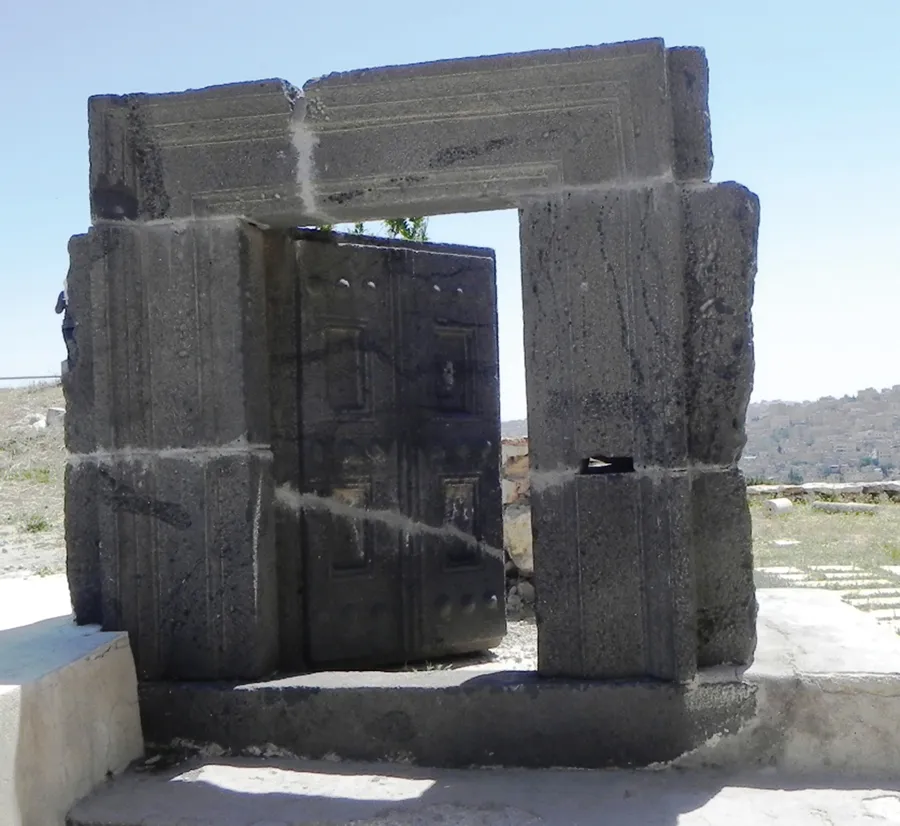
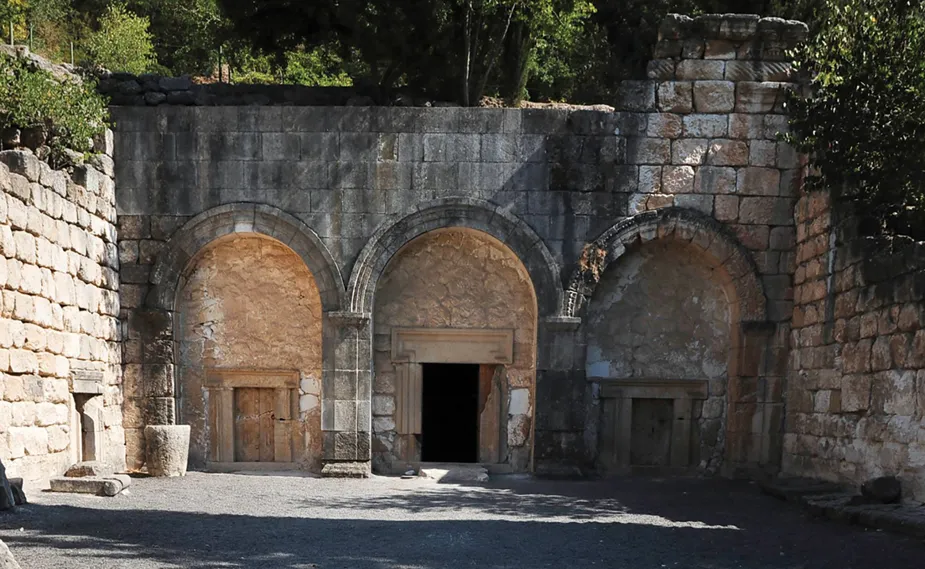
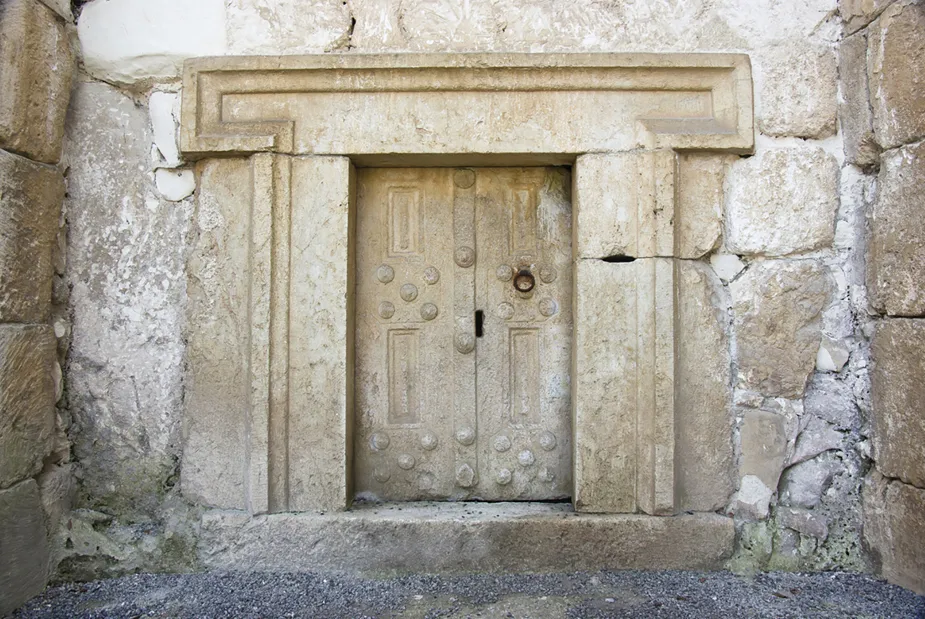
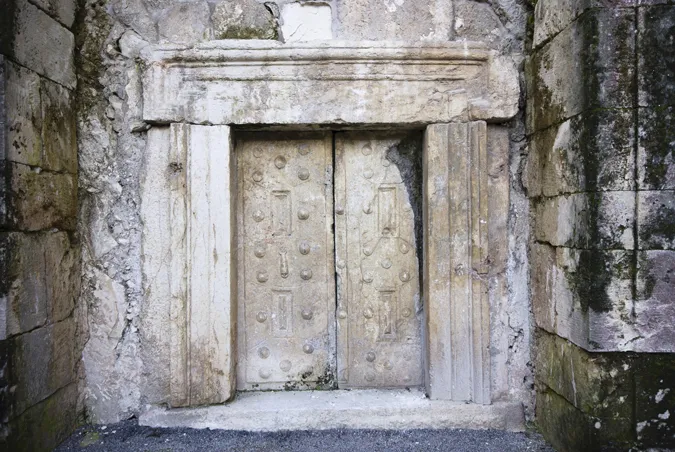
The archaeological museum in Irbid, Jordan boasts a ā€˜Greek’ stone door, possibly dating from the Hellenic period when the city, then called Arabella, was a major trading centre. The door and its portal, now seperated from its host building which probably no longer exists, stands in the courtyard of the museum (Figure 1.1). Another very similar door and portal exists at the Citadel, Amman, made from basalt or black granite (Figure 1.2). Again this has been re-erected away from its original location as it was surely an entrance to an underground tomb. The pattern of these doors with false studs or buttons and fielded panels is similar to the several stone doors of the second–fourth century necropolis at Beit She’arim in Lower Galilee, Israel (Figure 1.3, Figure 1.4, Figure 1.5). Here two entrances to the subterranean complexes, the Cave of the Coffins and the Cave of Rabbi Yehuda HaNasi, both comprise blind arcades of Roman arches on pilasters each of three bays. At the Cave of the Coffins, in each bay is a doorway, the central one is approximately of average height, at c.1.8 m, and now has a pair of timber doors (Figure 1.3). The flanking two are smaller at about 1.3 m high and each is a solid slab of stone (Figure 1.4). At the Cave of Rabbi Yehuda HaNasi the central portal has a pair of stone doors (Figure 1.5), to the left the smaller door stands open whilst to the right there is no doorway; it has either been removed and the opening walled up to form a blind arch, or it never existed. Throughout this vast site, which is a UNESCO World Heritage Site, there are some thirty or so other cave systems many with similar stone doors.
Image
1.1 Ancient Greek door at Dar Al-Saraya/Altal museum, in Irbid, Jordan. (Mohd Khawaja, Flickr, Creative Commons: CC BY-NC-ND 2.0)
Image
1.2 Black basalt door and portal exhibited at The Citadel, Amman, Jordan. (Nilesh Korgaokar via Flickr)
Image
1.3 Beit She’arim, Lower Galilee, Israel. Cave of the Coffins, second–fourth century. (Rafael Ben Ari Dreamstime.com)
Image
1.4 Beit She’arim, right-hand door, approximately 1.3 m high, Cave of the Coffins. (Asafta Dreamstime.com)
Image
1.5 Beit She’arim, central pair of doors, approximately 1.8 m high, Cave of Rabbi Yehuda HaNasi. (Asafta Dreamstime.com)
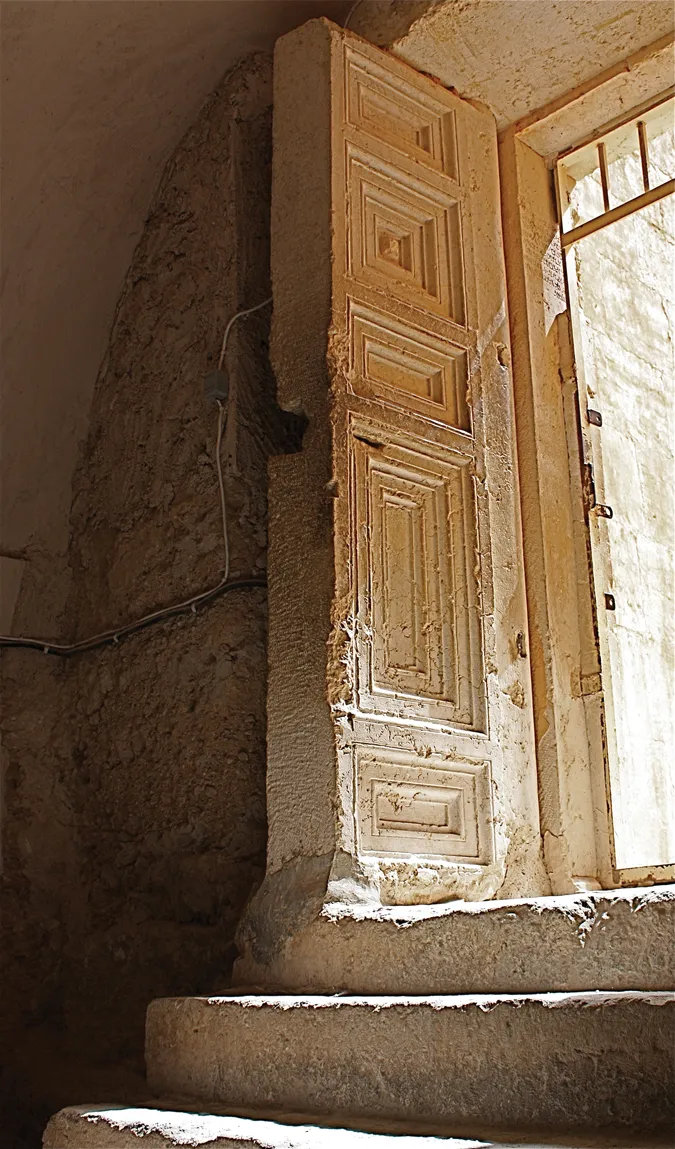
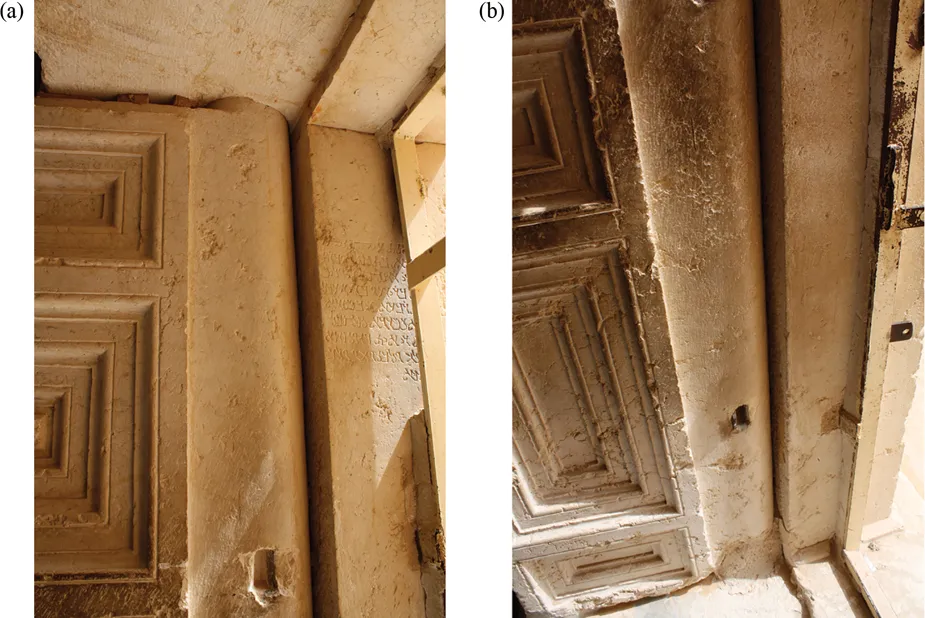
The doors to the hypogea in the Valley of the Tombs at Palmyra, Syria are much more architectural in their treatment, with deeply coffered panels (Figures 1.6 and 1.7). The most notable is the Hypogeum of the Three Brothers, notable for the internal frescoes as much as the doors. The cornice over the door is richly carved and at its base is an incised inscription which continues down onto the lintel. This records that the hypogeum was established in 160 AD by three brothers MalĆØ, Saadi and Naamain who built it as a commercial enterprise.2 The doors are now fixed open with an external metal grille for security. The similarity of these stone doors to eighteenth-century neoclassical panelled doors is striking and leads to interesting questions as to the extent they reflected timber doors at the time or were simply an invention of the sculptors.
Image
1.6 Hypogeum of the Three Brothers, Palmyra, Syria, 160 AD. Note the mortar at the base, which prevents the door swinging. (Michael Tutton)
Image
1.7 Hypogeum of the Three Brothers, Palmyra, Syria. (a) The upper pintle sunk into the upper beam or lintel. (b) The lower pintle sunk into the threshold but now pointed up with mortar where it is possibly damaged. (Michael Tutton)
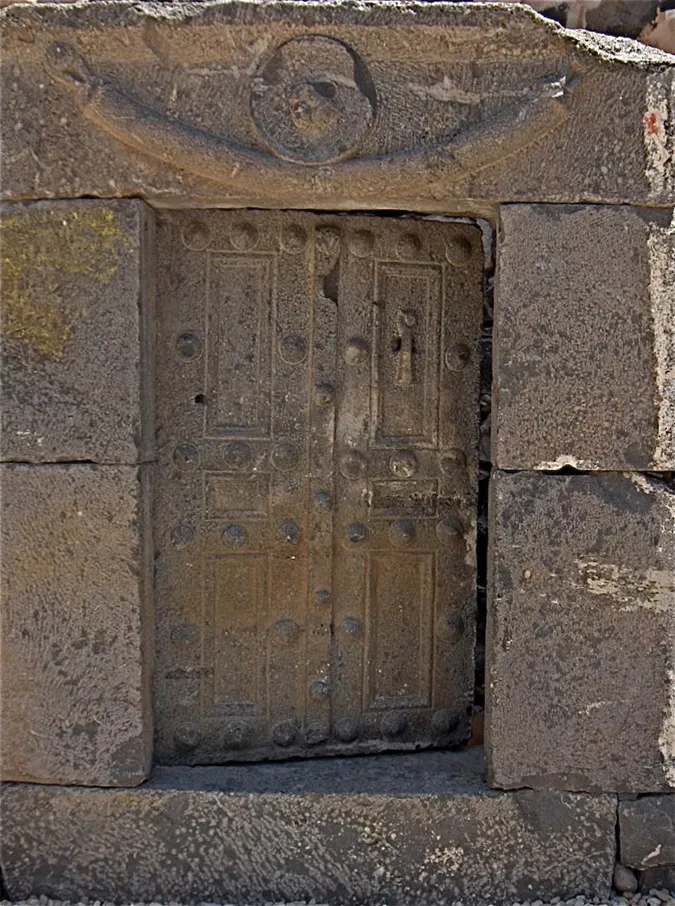
At the Dead City of Jerada, Syria, on the cusp of late antiquity and the early Middle Ages, is a watch-tower with a small door at its base reminiscent of those described above from Jordan and Israel (Figures 1.8 and 1.9). This dates to the fifth or sixth century and the lintel is said to bear the Roman or Byzantine imperial escutcheon,3 although this is not visible in the illustration. Dead Cities are so named because the trade and prosperity they relied on dwindled after the seventh to eighth centuries and the population moved away abandoning their stout and r...

Table of contents

  1. Cover
  2. Half Title
  3. Title Page
  4. Copyright Page
  5. Table of Contents
  6. Contributors
  7. Acknowledgements
  8. Preface
  9. Introduction
  10. Part One: History, development, identification and dating
  11. Part Two: Design and engineering
  12. Part Three: Conservation and repair
  13. Glossary
  14. Bibliography
  15. Index