- 174 pages
- English
- ePUB (mobile friendly)
- Available on iOS & Android
eBook - ePub
About this book
This book provides an overview of religion in Japan, from ancient times to the present. It also emphasizes the cultural and attitudinal manifestations of religion in Japan, withough neglecting dates and places.
Information
1
introduction
THE JAPANESE WAY
This book is an introduction to the religion and religious life of the Japanese. It is not an introduction to any particular religion but to a particular cultural tradition within which religious values and forms of expression have played an important role. Of course, specific religions such as Buddhism or Shinto are crucial to that tradition, and we will want to pay close attention to them as distinct elements within the larger picture; but our primary concern will remain the nature and variety of Japanese religion in general.
This book takes seriously the fact that any religion is lived out by specific human beings in a specific cultural, historical tradition. It also takes seriously the fact that the religion of a culture (like Japan) cannot merely be defined by the institutionalized religions that in great part make it up; “religion” is present wherever religious values or experience function. Religious values and experience, in turn, function in the depths of human consciousness and attitudes oriented toward what is sacred and ultimately real. Such values are not necessarily found only in the institutional religions, nor are they always defined and instilled by those religions, though they may certainly be influenced by them. Much modern, apparently nonreligious or secular literature, for example, may well express the human quest to come to terms with existence. Such values and issues can only be called religious or spiritual in some larger sense. Similarly, a Japanese landscape painting, though containing no explicit religious theme, may well express religious (spiritual) values and ideals, and thereby be called a form of religious art. Even a Japanese social custom, such as bowing to one another, is a ritual gesture sacred and meaningful to the Japanese.
The religion of a culture, in short, need not only be sought in the religions of that culture, but also in other key cultural forms (for example, literature, art, and social customs). In fact, wherever one finds these deepest values expressed, one can find “religion”; wherever paradigms—fundamental ways of perceiving and making sense out of existence—appear to be functioning, religion can be found.
A “cultural perspective” takes this understanding of the religious dimension in a culture like Japan seriously. Therefore it not only discusses the religions in and of themselves, but is also concerned with the influences those religions have on the larger culture and society. Moreover, it occasionally focuses on apparently nonreligious cultural forms to show religion taking place outside the religions.
Each chapter in this book, therefore, tries to be sensitive to this complexity of religion as actually lived out in human lives and human culture in Japan. The chapters of Part I, as a survey or panorama of Japanese religion, tend to focus on the religions of Japan in a historical context, although they suggest places outside those religions where one might find religion as well. Part II, an analysis of specific types of religious expression in Japan, emphasizes religious ideas as they permeate a variety of cultural or social patterns—for example, social structures, artistic form, a generalized worldview, and ritual.
Interestingly enough, the Japanese themselves have an understanding of religion which correlates nicely with our notion of religion in cultural perspective. Though the Japanese have a word for institutionalized religion (shukyo), that word is a rather recent development based, in part, on the influence of Western ideas about “religion.” Much more deeply ingrained in Japan is the idea of religion or the religious life as any path or way (do, michi) that seeks spiritual depth and follows a spiritual discipline. The word do is the Japanese pronunciation of the Chinese word Tao, Way, The Great Path down which all that exists is moving, and any lesser path which ultimately harmonizes with it.
In Japanese, in fact, the major religions have been understood and called do or “ways” of religious significance: Shinto is kami-no-michi or shinto, the “way of the gods”; Buddhism is butsudo, the “way of the buddhas”; Taoism is onmyodo, the “way of yin and yang”; and Confucianism is judo, the “way of the gentleman”. Beyond the major religions, however, other paths or practices have also been called “way”; for example, karatedo (the “way of the empty hand”) and chado (the “way of tea”). In these cases, seemingly nonreligious practices and traditions are named ways and thereby carry religious meaning.
These and other ways in Japan carry religious meaning insofar as they seek to open human life to higher or deeper levels of spiritual awareness through particular practices and disciplines, and to help humans, individually and collectively, live as authentically as possible. They are religious insofar as they press human experience and meaning beyond the mundane level of day-to-day existence and seek to create a life lived in accord with some notion of a more sacred reality. Such ways are made up of particular forms, expressions, and practices that have a history and tradition and that help provide both meaning and direction to the lives of those involved.
Religion or religious life understood as “way” has an additional advantage—it emphasizes that religion is, indeed, religious life, that is, something lived out in human existence and not some abstract philosophy of life or mere belief system about reality. This life is, moreover, lived in community and culture, that is, in the specific context of a particular history, culture, and community. Although ultimately, of course, individuals are the locus of religious life, individual life cannot be separated from the communal, cultural, and historical contexts within which it is lived. A way of life that has religious significance is both individual and collective; it is shaped by personal experience as well as by the experience of the larger community.
One cautionary note may be needed at this point: The idea of distinct ways within Japanese religion should not be taken to indicate mutually exclusive beliefs and practices forming smaller or larger isolated religious traditions. As we have mentioned already and will stress throughout, the religions of Japan often merge in actual life. One can find Shinto elements in a Buddhist service or Confucian studies taking place in a Buddhist monastery. Shinto or Buddhist elements are also found in what otherwise seem nonreligious cultural forms or philosophies (such as bushido, the “way of the warrior”).
Perhaps it is best to consider the various ways as strands within a larger rope called “Japanese religion” or the “Japanese way”—a rope that extends from prehistoric time up to this very day. The rope is not everywhere and always the same. The strands change and shift along its length, and the rope is flexible and changing. Nonetheless it is identifiable as the Japanese way. In fact, some have argued that this rope is itself the fundamental religion of Japan, and the strands that make it up are so many support systems to a larger religion called nihondo, the “way of Japan.” Such an appeal to an overarching “civil religion” has some merit, but it can easily be overemphasized to the exclusion of the unique importance and specificity of the distinctive ways as particular religious modes of life.
Our task in this book is to try to indicate the ways that form the strands of Japanese religion, and to indicate how they constitute a unique way of life that has religious significance.
2
moments and memories: an imaginary tour
The twentieth-century novelist Mishima Yukio* , with tongue in cheek, once described a room, called the “Japanese reality room,” that was to serve an important training function for young Japanese writers. With a mere push of a button, the room could reproduce the total atmosphere and set of associations related to any theme important to Japanese perception. The button “rain over Japan,” for example, would reproduce not only the atmosphere of a steamy, rainy day but also the related associations of sentimental melancholy, sorrowful occasions, and tears.
We might wish for such a room in this context. We could push a button labeled “religion in Japan” and sit back to enjoy a panorama of moments and memories suggestive of the range and atmosphere of the various “ways,” or beliefs and practices of spiritual significance, that have made up Japanese religion. In a darkened Buddhist temple we might catch the smell of incense lingering in the air or feel the mysterious presence of serene and silent statues of Buddha. At a Shinto shrine we might hear the strange but provocative sounds of music played on ancient instruments or see the postured, gentle dance of young girls doing kagura (sacred dance). In a Zen meditation hall we might feel the charged stillness of monks in silent meditation or hear the gongs and bells that punctuate the chanting. At a religious festival in some small village we might experience the presence of kami (“gods”) as the sacred gohei stick is waved over our heads in purification, or taste the festival rice cakes and sake (rice wine) that inevitably play their part in the festivities. At Mt. Fuji we might hear the quiet tread of pilgrim feet climbing the mountain or feel the rare and sacred atmosphere of the mountaintop. At the Zen temple Ryoanji in Kyoto we would be struck silent by the awesome emptiness of the famous stone garden.
These and countless more are the sights and sounds, the tastes and smells, of Japanese religion. Each of them carries its own meaning but implies a whole range of associated memories and meanings. Each of them implies not only a “way” that weaves experience and expression into some meaningful “world” but also a history of tradition and practice that, when taken together, constitute the totality of religion in Japan.
Unfortunately, our reality room cannot be quite so vivid. The next best thing might be an imaginary tour—much as we would take if we went to Japan as tourists looking for religion. An imaginary tour not only allows us to do things we might not otherwise be able to do, but it also brings us face to face with primary images and central paradigms of Japanese religion. It allows us to roam rather freely in time and space, stopping here and there to let moments and memories work on us and open our understanding.
In a happy coincidence, such a tour will put us on one important path of Japanese religious life, that of the wandering ascetic, the itinerant priest, or the traveling pilgrim whose wandering in itself carries religious meaning. Like the religious wanderer, we can seek out a sacred geography in which the power and the ghosts of a sacred past are experienced and one’s life is restored and renewed. We can seek out both moments and memories of Japanese religion and whet our appetite for more.
TOKYO
Our tour begins in Tokyo, the heart of a modern, industrialized nation living what many would claim is a fully secularized existence based on the “religions” of technological materialism and democratic humanism. From the bustling airport to the brightly lit Ginza area of downtown Tokyo, little suggests the presence of religious awareness. A closer look may, however, uncover what we are searching for. There are, in fact, literal and figurative islands of religiousness in what seems a sea of secularity, islands that then reach out with invisible peninsulas into the daily life of the Japanese.
One such island in Tokyo is Meiji Shrine, surrounded by elaborate gardens and wooded areas. Although a relatively new shrine (1921), and unique in enshrining the spirit of the Meiji period emperor (Mutsuhito, 1852–1912) and his consort, this manifestation of Shinto implies a whole range of important religious symbols and meaning. Behind this particular shrine lies a uniquely Japanese religious awareness called the “way of the kami” (kami-no-michi), or Shinto.
If we are fortunate enough to visit the shrine on some major festival day, such as New Year’s or Children’s Day, we find activity at its height, for Shinto is bound up closely with festivals and ritual. Shinto has consistently been more an orthopraxis (right practice) than an orthodoxy (right beliefs) and more a right attitude or sensitivity than a right thought or conceptual understanding. Ritual or right practice helps order a world permeated by sacred, numinous power(s) (kami). It brings kami into presence, honors and celebrates that presence, seeks its blessings, and renews life.
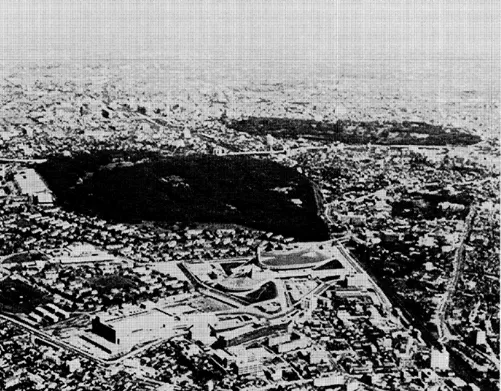
The shrine and its surrounding area is a holy ground marked off by the large sacred gates (torii). Within the grounds, in a special building, the kami is enshrined. To visit the shrine as a believer is to leave the mundane world, to come into the presence of kami, and then to return to the world purified of the defilements of mind and body.
Particular kami within this polytheistic religion have specific functions, and specific festivals and rituals serve special needs. However, in general, the notion of right practice seeking purification and celebrating the vital forces of life permeates the Japanese religious sensibility and the whole of Japanese life. From the ancient mythic accounts of the actions of the original kami in creating the world to the ritual invocation of kami to bless a new oil tanker, from the most sacred ceremonies of the great Shinto shrines to a sense of proper social order and etiquette, the concern for right practice, purification, and life-celebration is evident. This religious awareness and form is deeply ingrained in the Japanese tradition. It is not merely confined to some particular historical tradition called Shinto; it permeates and influences the deepest values and smallest details of Japanese life, even a contemporary life of apparent secularity.
Two particular examples of this, as one looks more closely at Tokyo, are the care given to scenic gardens and the sense of order and cleanliness that pervades Japanese life, even in a large city. These patterns are in part an extension of the following Shinto elements.
For traditional Japan the kami are most evident and primarily manifested in the natural world, especially those more awesome aspects such as particular trees, majestic mountains, stone, or the sun. Perhaps even more important, mythic accounts of creation reflect an ancient feeling that the Japanese islands were created by the gods in the image of paradise—a paradise on earth, as it were, from which there was no subsequent “fall.” This kind of awareness suggests a clearly religious appropriation of nature and a subsequent care for its importance to human life. Although other religious and nonreligious factors certainly play a part in the appreciation of gardens and nature, the Shinto connection is perhaps most fundamental historically and religiously. Nature, in its awesome power and beauty, is the manifestation of divine power. The power of kami is immanent in this paradisal world of nature. Humanity responds in adoration, supplication, and celebration, seeking to live harmoniously the way of the kami.
The place where kami reside must be clean and pure, for in a real sense order and cleanliness are next to godliness in Japan. In Shinto, the principles of light and ordered harmony far outweigh any principles of darkness and chaos. The pure, simple, sincere, clean, and tranquil take precedence over the crowded, chaotic, or dark mysteries of life. This religious awareness manifests itself in a Shinto aesthetic that permeates the whole of Japanese sensibility and culture—an aesthetic that seeks harmonious blending with the beauty and simplicity of nature and emphasizes the pure, the clean, the tranquil, and the natural character of things.
The Meiji Shrine is, however, a large and obvious Shinto presence in the bustling modern city. Smalle...
Table of contents
- Cover
- Title Page
- Copyright Page
- Table of Contents
- Foreword
- Preface
- Part 1 A Panorama of Japanese Religion
- Part 2 Specific Patterns in the Religion of Japan
- Appendix: Brief Summaries of Major Japanese Religious Traditions
- Glossary
- Bibliography
- Index
Trusted by 375,005 students
Access to over 1.5 million titles for a fair monthly price.
Study more efficiently using our study tools.
Frequently asked questions
Yes, you can cancel anytime from the Subscription tab in your account settings on the Perlego website. Your subscription will stay active until the end of your current billing period. Learn how to cancel your subscription
No, books cannot be downloaded as external files, such as PDFs, for use outside of Perlego. However, you can download books within the Perlego app for offline reading on mobile or tablet. Learn how to download books offline
Perlego offers two plans: Essential and Complete
- Essential is ideal for learners and professionals who enjoy exploring a wide range of subjects. Access the Essential Library with 800,000+ trusted titles and best-sellers across business, personal growth, and the humanities. Includes unlimited reading time and Standard Read Aloud voice.
- Complete: Perfect for advanced learners and researchers needing full, unrestricted access. Unlock 1.5M+ books across hundreds of subjects, including academic and specialized titles. The Complete Plan also includes advanced features like Premium Read Aloud and Research Assistant.
We are an online textbook subscription service, where you can get access to an entire online library for less than the price of a single book per month. With over 1.5 million books across 990+ topics, we’ve got you covered! Learn about our mission
Look out for the read-aloud symbol on your next book to see if you can listen to it. The read-aloud tool reads text aloud for you, highlighting the text as it is being read. You can pause it, speed it up and slow it down. Learn more about Read Aloud
Yes! You can use the Perlego app on both iOS and Android devices to read anytime, anywhere — even offline. Perfect for commutes or when you’re on the go.
Please note we cannot support devices running on iOS 13 and Android 7 or earlier. Learn more about using the app
Please note we cannot support devices running on iOS 13 and Android 7 or earlier. Learn more about using the app
Yes, you can access Japanese Religion by Robert Ellwood,Richard Pilgrim in PDF and/or ePUB format, as well as other popular books in Theology & Religion & Japanese History. We have over 1.5 million books available in our catalogue for you to explore.