eBook - ePub
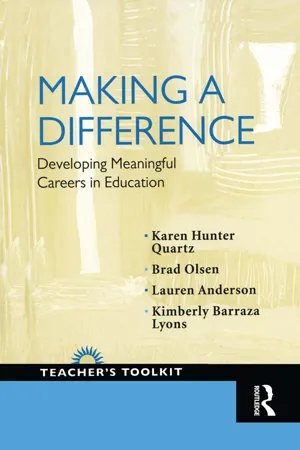
Making a Difference
Developing Meaningful Careers in Education
- 168 pages
- English
- ePUB (mobile friendly)
- Available on iOS & Android
eBook - ePub
Making a Difference
Developing Meaningful Careers in Education
About this book
Our culture and media often simplify the choice educators face-stay in or leave classroom teaching. Written for teachers and other educational professionals, this book dispels this simple dichotomy by representing the range of responses and career pathways that enable educators to make a difference. Based on interviews with hundreds of change-minded educators, the authors share career stories and insights against a backdrop that maps out the complexities, roles, and structures that define professional advancement in education. All of the teachers in this book have taught in challenging urban contexts, fought hard to exercise their professional autonomy and responsibility to serve students well, navigated social networks of educators, friends, and family who buoy or dampen their reform spirit, and remain committed to changing society through schooling. Their stories are as instructive as they are inspiring and offer roadmaps for the current generation of change-minded educators.
Information

CHAPTER ONE
THE LANDSCAPE OF CAREERS IN EDUCATION

• Teaching Traditions
• A Vast Array of Opportunities
• A New Generation of Educators
• Career Cycles
• Conclusion
EACH FALL, the University of California at Los Angeles’s (UCLA) Teacher Education Program welcomes 170 new novice teachers—each eager to join the education profession. From 2001 to 2004, we surveyed 383 incoming students and asked about their career plans. Three-quarters of these new recruits said they expected their professional role to extend beyond the classroom. One-fifth did not even expect to be in the classroom within five years of graduating from the program. What they expected to be doing, however, was far from clear for most of them. Despite their uncertainty, there was a high degree of consensus among this group that whatever they did, wherever they went, their work and actions would make a difference in the world. Some talked of becoming principals, some of starting schools, some of running for office. Most, however, seemed to have only a vague or tentative plan for their futures—one that started with teaching.
Planning for the future is, of course, wrought with uncertainty. Where life takes any of us, and why, is a process that depends on our own individual efficacy and our own decisions, but also on factors and circumstances beyond our control. As one teacher put it, there are “myriad institutional forces that shape you into something else.” These forces push and pull us in different ways—some apparent, some hidden from view. Salary schedules, for example, often guide career decisions because money is a powerful and highly visible marker of social value in our culture. Educators are often lured out of the classroom because of the corresponding boost in status and monetary reward. Other forces are more subtle, like the commonly held view that high-achieving or ambitious individuals are “too smart” or “too talented” to be teachers for long. Few say this out loud, but our research revealed how this tradition of teaching as low-status work affected the career decisions of many teachers, some of whom were cherry-picked out of the classroom for seemingly “more important” or “more intellectual” work. We also heard many stories of teachers who fought hard against this expectation and proudly stayed rooted in the classroom. By sharing teachers’ experiences with the pushes and pulls of the education profession, we hope that readers will be able to make sense of their own careers and purposely steer themselves in fulfilling directions.

There are “myriad institutional forces that shape you into something else.”
This chapter sets the stage for the book’s core chapters—2, 3, and 4—where we share the stories of seven educators and their career development, specifically their struggles to exercise professional autonomy, build supportive social networks, and make a difference. These seven stories are part of our larger study of more than a thousand educators in their first through tenth year of the profession. To understand the context of these careers, we first contrast two teaching traditions to characterize and distinguish the change-minded identity shared among the educators we studied. Second, we provide a brief overview of our longitudinal data in order to map out the vast array of opportunities and career pathways available to these change-minded educators. This data leads to a discussion of the changing nature of the educational workforce and the next generation of teachers. We close the chapter with a brief overview of the literature on career cycles in order to also recognize the powerful role that time, maturation, and life circumstances play in career development.
TEACHING TRADITIONS
Like most professions, teaching has a strong tradition that in large part defines its social value and significance. Rarely, however, is this tradition of teaching associated with powerful political or intellectual work. Put simply, teaching is not considered a high-status occupation in the United States. The reasons for this are many and varied. Teaching has long been a solid middle-class job with a union behind it that has historically affiliated more with manufacturing and labor unions than professional associations (Murphy 1990). Its salary structure, being front-loaded and mostly horizontal (meaning that a twenty-year veteran teacher does not make significantly more than a first-year beginner), is at odds with many other professions that offer rapidly increasing levels of status, pay, and autonomy (Lortie 1975). Lack of respect for teaching has a long and well-documented history in the United States and many other countries. This history recounts the feminization of the teaching workforce, its link to childcare, the commonsense notion that anyone can teach—and do so on a temporary basis—and the resultant low pay and low status (Apple 1985; Herbst 1989; Lortie 1975; Tyack 1974). Introduce yourself as a teacher at a party and you will likely experience the telltale smile that says, “Oh, how nice that you work with children,” implying in many cases that working with children is less important, less intellectual, and less prestigious than working with adults.
Cross-Reference For a related discussion of society’s perception of the teaching profession, see Book 1, Chapter 1.
In recent years, however, concerted efforts have been made to professionalize teaching and challenge the traditional conception that anyone can teach—that little specialized knowledge and preparation are required of teachers (Darling-Hammond and Bransford 2007; Darling-Hammond 1997, 2000; Shulman 1986). Although many outside the profession continue to hold teaching in relatively low esteem, educators and education researchers have increasingly turned toward conceptions of teaching as meaningful, difficult, professional work that deepens and grows over a decades-long tenure. This new tradition of viewing teaching as a challenging and distinguished profession is symbolized by efforts such as the National Board of Professional Teaching Standards and the many professional organizations that support advances in teaching and learning.
Focus point
Most of the educators we studied align with this new tradition, yet with a twist. In addition to teaching professionals, they view themselves as social reformers or activists. Their motivations for entering the teaching profession stand in stark contrast to reasons traditionally cited for doing so. More than three decades ago, Lortie (1975) identified “material benefits” and “time compatibility” as frequently cited reasons for entering teaching. Many people still view teaching—long identified as “women’s work”—as a career that allows them maximal flexibility to raise a family or pursue other interests, given that the work day ends early, and teachers’ summers are typically free. When we surveyed novice teachers at UCLA’s Teacher Education Program, however, we found that job security as well as the school calendar and hours were not at all the “potent recruitment resource” that Lortie once found. The relative lack of importance these novice educators placed on material benefits and time compatibility perhaps reflected their young age and idealism. However, a survey of educators with a few years of teaching under their belts revealed a similar trend.
For example, when asked why they stay in the profession of education, eight out of ten fifth-year educators surveyed responded that changing the world and furthering social justice were either extremely or very important reasons for staying in teaching; and 81 percent similarly responded that they stayed because they were attached to the kids and the community. About two-thirds of those teachers also cited a commitment to working in a low-income community as an extremely or very important reason for staying in education. In contrast, just over a third cited job security, and less than half cited the school calendar and work hours as extremely or very important reasons for staying.
These professionals appeal to the rich tradition of educators as powerful agents of change.
Our interpretation of these reported reasons for teaching is that “changing the world and furthering social justice” provides for the teachers in our study a powerful alternative frame for defining one’s social value and status. In contrast to the relative lack of monetary reward and the traditional conception of teaching as low-status work, change-minded educators rely on a different view. They connect themselves to a collective identity that offers an alternative reward system rooted in a long and noble history of education as the very foundation of our political system. As Thomas Jefferson argued more than two centuries ago, public schooling holds the key to our democracy, preparing citizens to be “guardians of their own liberty.” Today, an increasing number of teachers identify themselves as change-minded educators and invoke this and other democratic aims of schooling. They seek to eradicate the inequitable conditions and outcomes of American education and view their work as influencing the broader social and political economy. These professionals appeal to the rich tradition of educators as powerful agents of change—in contrast with compliant women who care for and educate children to be dutiful citizens. This change-minded, equity-oriented, activist perspective is the one held by many of those who enter UCLA’s Teacher Education Program, including the seven teachers profiled in the coming chapters.
A VAST ARRAY OF OPPORTUNITIES
Let us turn now to the actual career pathways of the 1,084 educators we studied. All of these educators began their journey at UCLA in a social-justice–oriented, urban teacher education program. The program, an intensive two-year preservice program leading to state certification and a master’s degree in education, works to specifically prepare its participants for careers in urban high-poverty schools (Oakes 1996; Olsen et al. 2005; Quartz and TEP Research Group 2003). Similar to the teacher workforce nationwide, the vast majority of graduates of UCLA’s Teacher Education Program are women, but they are a younger and more ethnically diverse group than is generally seen in teacher education programs: only 35 percent are white, 25 percent are Hispanic, 6 percent are African American, and 32 percent are Asian. This demographic profile is significant given the growing “demographic divide” between increasingly diverse student populations and a still overwhelmingly white middle-class teaching force. Most of the program’s teaching candidates are also graduates of selective undergraduate institutions, and many grew up in the same type of urban communities in which they seek to serve as educators. For the most part, these individuals entered teaching looking for a challenging career that would enable them to make a difference in the lives of children and the future of low-income communities. They sought out a career in teaching with an eye toward changing the world through education, and they entered UCLA’s Teacher Education Program at least in part because of the social justice philosophy it espouses.
Each spring for six years, we sent surveys to these program graduates in order to track their career retention and movement. The surveys included information regarding the factors that keep teachers teaching and push and pull them away from the classroom—allowing for a deeper understanding of the motivations behind teachers’ professional decisions. Additional surveys were also administered to participants just prior to entering and exiting UCLA’s program, in order to better track the perceptions and intentions of teachers just starting preparation and employment as teachers. Data collected as part of this longitudinal study helps us paint a portrait of one population of well-prepared educators working in urban schools and provide a backdrop ...
Table of contents
- Cover
- Half Title
- Title Page
- Copyright Page
- Table of Contents
- Series Foreword
- Acknowledgments
- Introduction
- 1 The Landscape of Careers in Education
- 2 Exercising Professional Autonomy
- 3 Building Social Networks
- 4 Making a Difference
- 5 The Dream Job
- Appendix: UCLA’s Longitudinal Study of Urban Educators
- References
- Index
- About the Authors
Trusted by 375,005 students
Access to over 1.5 million titles for a fair monthly price.
Study more efficiently using our study tools.
Frequently asked questions
Yes, you can cancel anytime from the Subscription tab in your account settings on the Perlego website. Your subscription will stay active until the end of your current billing period. Learn how to cancel your subscription
No, books cannot be downloaded as external files, such as PDFs, for use outside of Perlego. However, you can download books within the Perlego app for offline reading on mobile or tablet. Learn how to download books offline
Perlego offers two plans: Essential and Complete
- Essential is ideal for learners and professionals who enjoy exploring a wide range of subjects. Access the Essential Library with 800,000+ trusted titles and best-sellers across business, personal growth, and the humanities. Includes unlimited reading time and Standard Read Aloud voice.
- Complete: Perfect for advanced learners and researchers needing full, unrestricted access. Unlock 1.5M+ books across hundreds of subjects, including academic and specialized titles. The Complete Plan also includes advanced features like Premium Read Aloud and Research Assistant.
We are an online textbook subscription service, where you can get access to an entire online library for less than the price of a single book per month. With over 1.5 million books across 990+ topics, we’ve got you covered! Learn about our mission
Look out for the read-aloud symbol on your next book to see if you can listen to it. The read-aloud tool reads text aloud for you, highlighting the text as it is being read. You can pause it, speed it up and slow it down. Learn more about Read Aloud
Yes! You can use the Perlego app on both iOS and Android devices to read anytime, anywhere — even offline. Perfect for commutes or when you’re on the go.
Please note we cannot support devices running on iOS 13 and Android 7 or earlier. Learn more about using the app
Please note we cannot support devices running on iOS 13 and Android 7 or earlier. Learn more about using the app
Yes, you can access Making a Difference by Karen Hunter Quartz,Brad Olsen,Lauren Anderson,Kimberly Barraza Lyons,Karen Hunter-Quartz,Kimberly Barraza-Lyons in PDF and/or ePUB format, as well as other popular books in Education & Education General. We have over 1.5 million books available in our catalogue for you to explore.