eBook - ePub
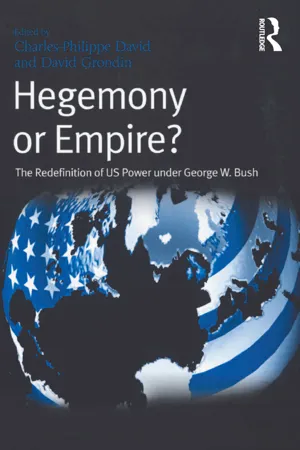
Hegemony or Empire?
The Redefinition of US Power under George W. Bush
- 256 pages
- English
- ePUB (mobile friendly)
- Available on iOS & Android
eBook - ePub
Hegemony or Empire?
The Redefinition of US Power under George W. Bush
About this book
American power has been subjected to extensive analysis since September 11, 2001. While there is no consensus on the state of US hegemony or even on the precise meaning of the term, it is clear that under George W. Bush the US has not only remained the 'lone superpower' but has increased its global military supremacy. At the same time, the US has become more dependent on its economic, financial and geopolitical relationships with the rest of the world than at any other time in its history, markedly since the events of 9/11. The distinguished scholars in this volume critically interpret US hegemony from a range of theoretical and topical perspectives. They discuss the idea of empire in the age of globalization, critique the Bush doctrine, analyze the ideologies underpinning a new American imperialism and examine the influence of neo-conservatism on US foreign and domestic policy.
Information
Representations of American Hegemony/Empire: The Global and Domestic Implications of US Redefinition of Power
Chapter 1
Theory Wars of Choice: Hidden Casualties in the ‘Debate’ Between Hegemony and Empire
For analyses of world politics since the George W. Bush administration’s overthrow of the Taliban in Afghanistan and of Saddam Hussein in Iraq, the main hypothesis to be tested and if possible rejected is that the moment is one in which an old world order is dying and a new world order is being born. Thus it is easy to imagine a few of the key debates in advance. Some will argue for the signal importance of 9/11. Others will argue that the changes were obvious or nascent or incipient before the attacks on New York and Washington. Still others will argue that none of what we proclaim to be new is in fact new save at the margins, and certainly not in how power is being wielded and for what objectives. And though it won’t be a main question among students of international relations, you can also imagine the argument turned on its head. We are witnessing a radical transformation in the American political economy, what Walter Dean Burnham calls with reference to earlier moments, the 1890s and 1930s, a ‘critical realignment’.1 Answering questions such as these correctly or even asking the right questions hinges on an adequate understanding of the institutions that make up the contemporary world system. The problem is that many journalists, scholars and activists have gotten it more wrong than right in lining up against the new, so-called American ‘wars of choice’. Consider the confusion that emerges in discussions of something called empire and something else called hegemony. There are at least two kinds of analytical errors in current writings. One is the routine treatment of the two terms as synonyms, ignoring or ignorant of the work, starting with Immanuel Wallerstein, that shows how these two modes of international domination are different from one another.2 Another, though, is a mistake that those who recognize the basic difference sometimes make. That mistake is to imagine that one mode of hierarchy is at work but not the other, although they are really coexisting, weaker and stronger tendencies in world politics.
Liberalism, Exceptionalism and Racism
At least two problems or blind spots affect the understanding of America’s experience or practice of empire. One is the problem of exceptionalism – a standard way of viewing or narrating or thinking about the American experience.3 American exceptionalism assumes the deep structural autonomy of that experience, that American history is unlike and unconnected with all others. Exceptionalism grounds, shapes and frames all the varieties of accounts purporting to prove American enterprise to be anything but agents of empire, of America being empire’s antithesis, about the US acquiring an empire late or, as many political scientists are beginning to claim now, America is an empire but one that is unique in the annals of world politics.
The second blind spot is with respect to the power and robustness of beliefs about the naturalness of hierarchy to which Americans but not only Americans subscribe – more and less coherent ideologies that assign collective identities and places in an inegalitarian order on the basis of characteristics that people are purportedly ‘born with’ or ‘inherit’ or ‘pass on’ to their offspring.4 Gender, ethnicity, nationality and even religion have served as grounds for exclusion in American political life, but no identity has mattered more than race in determining and justifying hierarchy. Thus, for the scholars who founded the discipline of international relations in the US at the turn of the twentieth century, the so-called races were fundamental or constitutive units of analysis. They treated the terms ‘international relations’ and ‘interracial relations’ as synonyms. Critics of the hierarchies built on the basis of skin color or facial features and the alleged inferior and superior abilities of such differently marked bodies coined a new term in the 1930s to characterize such practices. They called it ‘racism’, a variant on a term used first in the 1910s, ‘racialism’.
Racism is American exceptionalism’s Achilles heel, the great contradiction at the heart of the ‘storybook truth’ about a country that Louis Hartz, the Harvard University political theorist and author of The Liberal Tradition in America (1955), imagined as ‘eternally different from everyone else’.5 A kindred contradiction runs through the work of those who today unselfconsciously reproduce Hartz’s views in their accounts of a uniquely liberal and benign hegemonic order built by Americans after World War II – the one threatened by George W. Bush ‘unbound’.6
Knowledge of the Ancestors
Empire and race (or what we might now say, a bit more critically, race formation or race-making) were widely understood as thoroughly intertwined problems by those scholars back at the turn of the twentieth century who began to call what they wrote and taught ‘international relations’. They argued that the most pressing issues of the day demanded new interdisciplinary forms of knowledge. The men central to founding the field, raising funds for chairs and building departments and programs understood themselves as focused primarily on accounting for the dynamics of imperialism and nationalism. They sought practical strategies for better ways of administering territories and uplifting backward races, using what were seen as the progressive tools of racial science. The professors at the American Political Science Association and in their journals and book reviews depicted themselves as occupying a new intellectual space by right of the failure of the international legal scholars and antiquo-historians to deal adequately with the problems posed by empire. New race development and eugenics advocates vied and intersected with practitioners of rassenpolitik and with visionaries who predicted the inevitability of war between the Anglo-Saxons and one or more competing racial alignments.
The House That Exceptionalism Built
Exceptionalism is a narrative strategy that works to erase these realities of the centrality of empire and race formation to the so-called American experience. So, for instance, today white supremacy is not generally discussed either as a historical identity of the American state or an ideological commitment on which international relations is founded. Nor is empire understood as the context that gives rise to this specialized field of knowledge. To be a professional in international relations in the United States today means adopting a particular disciplinary identity constructed in the 1950s and 1960s that rests on a certain willful forgetting. By the 1980s, Michael Doyle, the Columbia University professor and advisor to United Nations Secretary General Kofi Annan, could claim that the discipline of political science in the United States had never shown much interest in empire and imperialism – even if its first organized subfield, also forgotten, was on comparative colonial administration. From the early 1990s critical margins of the field, Roxanne Doty insisted that it was less than thirty years earlier that a handful of other similarly positioned theorists first began to consider the role of race in world politics. She was their heir.7 In truth, the lineage goes back a century or more.
The American intellectual historian, Thomas Bender, captures the irony in a moment when scholars like Hartz were constructing their exceptionalist accounts of America as a place apart while America’s leaders oversaw the projection of power that is now talked about in terms of hegemony. Intellectuals after World War II, he says,
were both explicitly aware of the new global position and responsibilities of the US, as they wrote. Yet so strong was the notion of American difference and autonomy that they looked inward, implying an American history unlike and unconnected with all others, even as they suggested the existence of a world economic system beyond the ken of the historical actors in their histories.8
Today, some younger, critical historians in foreign policy studies and diplomatic history recognize exceptionalism as one more intellectual construction of the Cold War. The rivalry with the Soviet Union goes far to explain the turn to imagining an America as ‘different from other state actors and remain[ing] fundamentally apart from the historical relationships and processes that surround it and shape the nature of states and peoples with which it interacts’.9 They might even concede that the long and unbroken history of American conquest and empire is denied or begins to be denied as part of the ideological struggle with communism. And they wouldn’t be wrong.
Arguments about the Cold War origins of American exceptionalism give us only half the story, however. Most Cold War and post–Cold War historians of diplomacy and theorists of international relations continue to ignore racism when writing about transformations in the twentieth-century world order. The retreat or checkered course of white supremacy is not reducible to a story about America’s containment of the Soviet Union, and it will not do to argue that the Cold War brought about white supremacy’s end, as if it were the little extra push that liberalism needed for its redemption. The truth is, Cold War logics and imperatives often buttressed the forces of white supremacy globally.10
Racism is a problem analytically separate from the problem of the Cold War, in the same way that the so-called end of empire or spread of the norms of decolonization and national self-determination are distinct from the Cold War. And both – decolonization and the partial defeat handed white supremacy – shaped the course of the twentieth century as much as the wars in Europe and the US–Soviet rivalry. This fact though goes unnoticed, especially in American IR theory, for reasons I have discussed.
From Empire to Hegemony to … Empire?
Political science, historical sociology, international relations, and diplomatic history in the US have inherited and reproduced two analytical problems from the Cold War era, mistakes that have taken professors down a wrong path, although there are also some clues picked up along the way that promise a way out. One problem is the impoverished understanding of comparative empire building in place of some earlier, more sophisticated analyses of the interrelationships among late nineteenth-century processes of expansion, Jim Crow building and race development theory and practice. What was once known has been forgotten, and in its place is enshrined the relatively new, Cold War idea that America has never had an empire or else that America’s version is ‘empire lite’.
The second problem is the one identified by the writer Toni Morrison in her remarkable ‘Black Matters’, the first of her three 1990 Massey Lectures.11 She analyzed the turn after World War II in the US to ignoring race. She calls it ‘a graceful, even generous liberal gesture’. Postwar generations had been conditioned not to notice, she says. Morrison was writing about postwar literary critics and their silence about race and racism in the history of letters, the construction of literary canons and the criticisms worth making about the canonical texts. We can, however, easily extend the argument beyond the English and American Literature departments where, coincidentally, the study of empire has migrated. Theorizing in American departments of international relations after World War II involved a great deal of ‘recoding’. Much of this work is itself a kind of escape from knowledge. The return in the 1960s of an old idea, hegemony, is something from the era that is worth holding on to, however.12
Hegemony, Not Empire; Leadership, Not Domination
The first thing to note is that graduate students-turned professors in the US in the 1970s and 1980s who are teaching the canon in international relations now treat hegemony as a new theoretical concept. It is not, as the following editorial from the London Times in 1860 attests: ‘No doubt it is a glorious ambition which drives Prussia to assert her claim to the leadership, or as that land of professors phrases it, the ‘hegemony’ of the Germanic Confederation’.13 American scholars of foreign policy and inter-American relations in the 1920s conventionally described North America as exercising hegemony over the Caribbean. Great Britain exercised ‘world hegemony’ until around the time of World War I. And by 1937, according to the Austrian-Jewish émigré historian of City College, Hans Kohn, the growing power and industrial might of Japan, ‘which seem to threaten the economic and political hegemony of the white races, have been discussed in many studies’.14
Among professors of international relations today the idea of hegemony most often refers to the hierarchical order among rival great powers.15 To reproduce one frequently cited definition, hegemony is ‘a situation in which one state is powerful enough to maintain the essential rules governing interstate relations, and willing to do so’.16 This idea of an order ...
Table of contents
- Cover Page
- Title Page
- Copyright Page
- Contents
- List of Figures
- List of Contributors
- Preface
- Introduction Coming to Terms with America’s Liberal Hegemony/Empire
- Part 1 Representations of American Hegemony/Empire: The Global and Domestic Implications of US Redefinition of Power
- Part 2 Perceptions of American Hegemony: The US Redeployment of Power and its Regional Implications
- Conclusion Revisiting US Hegemony/Empire
- Index
Trusted by 375,005 students
Access to over 1.5 million titles for a fair monthly price.
Study more efficiently using our study tools.
Frequently asked questions
Yes, you can cancel anytime from the Subscription tab in your account settings on the Perlego website. Your subscription will stay active until the end of your current billing period. Learn how to cancel your subscription
No, books cannot be downloaded as external files, such as PDFs, for use outside of Perlego. However, you can download books within the Perlego app for offline reading on mobile or tablet. Learn how to download books offline
Perlego offers two plans: Essential and Complete
- Essential is ideal for learners and professionals who enjoy exploring a wide range of subjects. Access the Essential Library with 800,000+ trusted titles and best-sellers across business, personal growth, and the humanities. Includes unlimited reading time and Standard Read Aloud voice.
- Complete: Perfect for advanced learners and researchers needing full, unrestricted access. Unlock 1.5M+ books across hundreds of subjects, including academic and specialized titles. The Complete Plan also includes advanced features like Premium Read Aloud and Research Assistant.
We are an online textbook subscription service, where you can get access to an entire online library for less than the price of a single book per month. With over 1.5 million books across 990+ topics, we’ve got you covered! Learn about our mission
Look out for the read-aloud symbol on your next book to see if you can listen to it. The read-aloud tool reads text aloud for you, highlighting the text as it is being read. You can pause it, speed it up and slow it down. Learn more about Read Aloud
Yes! You can use the Perlego app on both iOS and Android devices to read anytime, anywhere — even offline. Perfect for commutes or when you’re on the go.
Please note we cannot support devices running on iOS 13 and Android 7 or earlier. Learn more about using the app
Please note we cannot support devices running on iOS 13 and Android 7 or earlier. Learn more about using the app
Yes, you can access Hegemony or Empire? by David Grondin, Charles-Philippe David in PDF and/or ePUB format, as well as other popular books in Politics & International Relations & National Security. We have over 1.5 million books available in our catalogue for you to explore.