- 244 pages
- English
- ePUB (mobile friendly)
- Available on iOS & Android
eBook - ePub
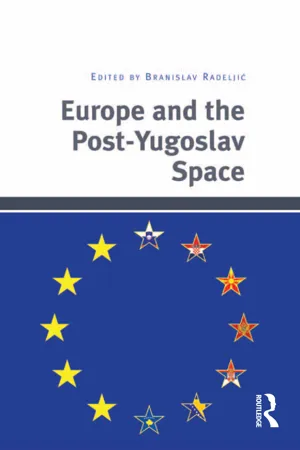
Europe and the Post-Yugoslav Space
About this book
Charting the path from intervention to integration Europe and the Post-Yugoslav Space examines the role of Europeanization on the development of the countries of the former Yugoslavia. Slovenia, Croatia, Macedonia, Montenegro, Serbia, Bosnia and Herzegovina and Kosovo may have a shared history but their experiences, views and attitudes to European integration vary dramatically. Opinion within each state is often equally as keenly divided as to the benefits of active membership. The debate within each country and their comparative differences in approach provide fascinating case studies on the importance and relevance of the EU and the effectiveness of Europeanization. A wide range of contributors with significant experience gained within the EU as well as their country of origin use their expert understanding of the language and cultures of the countries concerned to provide detailed and rich insights into the troubled history and potential of the post-Yugoslav space.
Information
Chapter 1
Europe and the Post-Yugoslav Space: From Intervention to Integration
Branislav Radeljić
The Socialist Federal Republic of Yugoslavia (SFRY) ceased to exist on 15 January 1992 when the Member States of the then European Community (EC) and the present European Union (EU) agreed to grant independence to all the Yugoslav republics that, in their view, satisfied certain conditions with regard to democracy, the rule of law, the rights of ethnic and national groups, the inviolability of borders, security and regional stability, and so on. The decision to recognize Slovenia and Croatia on 15 January, followed by recognition of Bosnia and Herzegovina on 7 April 1992 and the Former Yugoslav Republic of Macedonia in 1995 was the result of the courageous statement of Jacques Poos, European Community representative, delivered at the EC’s Foreign Affairs Council of Ministers in June 1991, that ‘the hour of Europe’ had come and ‘[i]f one problem can be solved by the Europeans, it is the Yugoslav problem. This is a European country and it is not up to the Americans. It is not up to anyone else’ (Poos cited in Smith 1996: 1).
This chapter offers an overview of the dynamics characterizing European involvement in the (post-)Yugoslav space, through intervention and then integration. While in some cases European policies managed to provide an opportunity for a straightforward path towards EU membership (in the case of Slovenia and, to a significantly lesser extent, Croatia), in some others European involvement has been much more problematic and uncertain, without clear strategies and responses from the locals, thus risking creating further divisions between the EU and the rest of the Yugoslav space.
From Intervention to Integration
The outbreak of the Yugoslav state crisis, the consequent wars, European Union policies and the future of the post-Yugoslav space have received enormous attention in the literature. Questions focusing on what went wrong with the SFRY, why its disintegration was so violent, whether the adopted policies were the right ones and what should be done in order to avoid similar scenarios in the future have emerged over time, generating diverse interpretations and conclusions. In fact, various literature reviews have tried to classify the existing arguments, based on their accountability and relevance for deeper understanding of Yugoslavia’s collapse, and to identify some additional aspects in need of examination (Dragović-Soso 2007, Gow 1997, Jović 2001, Kent 1997, Nakarada 2008, Radeljić 2012, Ramet 2005, Stokes et al. 1996).
The first European intervention in Yugoslavia resulted in the collapse of the Yugoslav federation. The decision to recognize Slovenia and, more importantly, Croatia, meant that the war was then transferred to Bosnia and Herzegovina. With regard to the European Union’s initial approach, one author assessed the performance of its leaders as highly immature:
However much the EC leaders liked to think in the long term – charting the future of a continent like master mariners setting forth on the great ocean – the leaders of the Twelve proved remarkably lacking in foresight when it came to anticipating events in the Balkans. Not only were they taken by surprise by the flare-up of fighting in Slovenia, but they refused to be distracted from each fresh outbreak of violence to consider the big picture. For instance, already in July 1991 the government of Bosnia and Herzegovina was so alarmed by the scale of the fighting along its north-western borders inside Croatia and the involvement of JNA and militias based in Bosnia that it asked the EC to engage in preventive diplomacy … The Twelve displayed sovereign contempt for Sarajevo’s attempt to distract them from their central preoccupation … Buffeted by the high tide of history, the Twelve continued according to routines better suited to calmer waters. (Almond 1994: 242–3)
Simultaneously with the continuation of the fighting in Yugoslavia, the 1993 Copenhagen European Council addressed the relations between the Community and the countries of Central and Eastern Europe and endorsed a set of criteria to be satisfied if they wanted to become members of the EU (EU Council 1993).1 This was a clear encouragement and an open call for a new region to try to integrate into European structures and it was logical that such an experience would strongly affect the post-Yugoslav space as well. Consequently, in February 1996, the EU adopted a Regional Approach to the countries of South East Europe and, in April 1997, the Council established the political and economic conditions to be fulfilled by these countries. Later, following the second European intervention in the post-SFRY space (this time as part of NATO’s action to save Kosovo), the launch of the Stability Pact for South Eastern Europe in 1999 (replaced by the Regional Cooperation Council in 2008), the Reconstruction Agency in 2000, and the Stabilisation and Association Process in 2001, were to serve as the main instruments to consolidate regional stability and cohesion.
Since then, European Union officials have continued to use various occasions to confirm their commitment to the post-Yugoslav states or, as has been heard more often, to the Western Balkans, an EU neologism that excludes Slovenia (for understandable reasons) and includes Albania. For example, in Thessaloniki in 2003, they underlined that ‘[t]he future of the Balkans is within the European Union’, but of course, such a direction would be conditional on the fulfilment of the same requirements that applied to the Central European states (EU Council 2003). Similarly, in 2008, the Europeans confirmed their standpoint: ‘The future of the Western Balkans lies in the EU. The EU stresses the importance of peace, stability and security in this part of Europe, and welcomes all efforts of the Western Balkan countries to come closer to the EU, meeting the necessary conditions. The Western Balkans have the potential to accelerate their course towards eventual EU membership, provided they pursue the path of reform and reconciliation, and meet the necessary conditions. The EU will assist them in this endeavor’ (European Commission 2008a: 21).
It can be argued that the EU has heavily relied on enlargement as its most celebrated foreign policy tool to penetrate the post-Yugoslav space. While in some cases such an approach has produced significant results, in others it has often been stuck between the EU’s conditionality clauses and the applicants’ willingness to comply. As witnessed, not all post-Yugoslav states have perceived and welcomed the processes of democratization and Europeanization in the same way, although fully aware of possible benefits. While some of them have progressed from signing the Stabilisation and Association Agreement (SAA) to joining the EU, via various adjustments and liberalization plans, others have seriously struggled to pursue the necessary reforms and modify their systems in order to secure candidate status and eventual membership in the EU.
The Progress of the Post-Yugoslav States
Slovenia
Back in the late 1970s the European Parliament hosted some lengthy debates about the Yugoslav federation that clearly confirmed the European Community’s appreciation for Slovenia’s economic advancement. Due to its location and human capital, the republic might have become an ‘experimental zone of big interest for the Community’ to test whether its new technical norms would be applicable across other Yugoslav areas in the future (European Parliament 1977). The economic as well as other links between the Europeans and the Slovenes were further strengthened throughout the 1980s. As one study correctly puts it, ‘[f]avorable economic prospects and the positive inducements of joining Europe helped to shape a pluralist orientation on the part of elites and masses and, ultimately, to crate and reinforce democratic attitudes in the long run’ (Boduszyński 2010: 116).
The growing disagreement with the Yugoslav authorities culminated in 1989 when the Slovene Parliament amended the republic’s constitution confirming Slovenia’s right to secede from the SFRY and welcoming political pluralism. In April 1990, in the first free, multi-party, elections, Milan Kučan, a liberal communist advocating democratization and Europeanization of Slovenia, was elected as president. Eight months later, in a referendum on independence, a clear majority of Slovenes confirmed their dissatisfaction with the Yugoslav federation, its leadership and system. The proclamation of independence on 25 June 1991 and the consequent Ten-Day War, also referred to as the Slovenian Independence War, provided the Slovenes with an opportunity to insist even more on the importance of concepts such as democracy, freedom and human rights. Slovenia’s pro-European leadership, while already supported by various state and non-state actors, perceived international recognition of independence as the only way forward. At this point, being pro-European meant being pro-democracy and pro-modernization, two aspects Yugoslavia was seriously struggling with.
Once independence had been achieved, a strong incentive for European Union accession gained its full relevance amongst Slovenia’s authorities and the public: ‘Slovenia’s leaders relentlessly pursued the goal of EU integration so that, after a while, a seemingly unshakable social consensus existed on the imperative of EU membership to assure stability, democracy and prosperity in Slovenia. By the mid-1990s the public, for its part, was under no illusions about the drawbacks of membership’ (Boduszyński 2010: 128). In fact, after President Kučan’s visit to Brussels in March 1992, the Council authorized the European Commission to negotiate a Cooperation Agreement with Slovenia, a Financial Protocol and an Agreement on Transport (European Commission 1992: 284–5). Later, Slovenia signed the Association Agreement and applied for EU membership in 1996, which, in Kučan’s view, confirmed that the country ‘has gone a long way towards fulfilling the expectations of its citizens at the 1990 plebiscite and the declaration of independence … that Slovenia would take its place in Euro-Atlantic institutions’ (Kučan 1996).
According to the 1997 European Commission assessment of Slovenia’s application for EU membership, the country’s accession was ‘seen as part of an historic process, in which the countries of Central and Eastern Europe overcome the division of the continent’ (European Commission 1997a: 5). With regard to the fulfilment of the political criteria, Slovenia already ‘present[ed] the characteristics of a democracy with stable institutions guaranteeing the rule of law, human rights and respect for and protection of minorities’ (European Commission 1997a: 115). With regard to the economic criteria, the Commission described Slovenia as ‘a functioning market economy’ that ‘should be able to cope with competitive pressure and market forces within the Union in the medium term, provided that rigidities in the economy are reduced’ (European Commission 1997a). The report pointed out areas requiring improvement (administration, energy, environment, employment, internal market, social affairs), but still confidently recommended the opening of negotiations for Slovenia’s EU membership.
The accession process was formally launched in March 1998 and the following reports acknowledged that Slovenia was taking the Copenhagen criteria seriously and that it actually ‘demonstrated impressive progress across most sectors of the acquis’ (European Commission 1999: 71). Even reforms that were initially lagging behind, such as in agricultural, environmental, judicial and public administration sectors, were pursued. Thus, the Europeans were pleased to see that Slovenes were committed to the previously established objectives and each of the following reports clearly expressed appreciation for their performance. In fact, the 2002 report concluded: ‘Bearing in mind the progress achieved since the [1997] Opinion, the level of alignment and administrative capacity that Slovenia has achieved at this point in time, and its track record in implementing the commitments it has made in the negotiations, the Commission considers that Slovenia will be able to assume the obligations of membership in accordance with the envisaged timeframe’ (European Commission 2002b: 121).
Slovenia joined the European Union and NATO in 2004 and the Euro area in 2007. In fact, the country’s six-month presidency of the EU in 2008 was a clear confirmation of ‘Slovenia’s European credentials and its notable maturity on the international scene’ (Gow and Carmichael 2010: 244). More importantly, the programme of the presidency, entitled Si.nergija za Evropo/Si.nergy for Europe, paid significant attention to the European future of the Western Balkans:
Two key achievements of the Presidency were the completion of a network of Stabilisation and Association Agreements with all the countries of the region except Kosovo, and the start of dialogue on visa liberalisation and the presentation of roadmaps for visa liberalisation for all countries of the region (except Kosovo). The commitment was reaffirmed to strengthen and speed up the EU integration process of these countries and, building on the achievements to date, to draw up individual roadmaps for them. (EU Council 2008c: 18)
Following the presidency of the EU, the National Assembly of the Republic of Slovenia adopted a Declaration on the Western Balkans in 2010, confirming Slovenia’s commitment to cooperation and development in the region, which would eventually become a full part of Euro-Atlantic structures. Such an explicit commitment has managed to convince the Brussels administration of Slovenia’s readiness to encourage and strengthen regional cooperation in this part of Europe and thus consolidated the country’s relevance for European politics. Equally important is the impression that the Slovenes themselves have reached the point where they are not exclusively perceived by some in the region as the ones who helped dismember the Yugoslav state but as those whose rapid progress represents the model to follow.
Croatia
The first multi-party elections in Croatia were held in April 1990 and won by the previously established Croatian Democratic Union. Its founder, Franjo Tudjman, a great advocate of Croatian interests, became president. The newly introduced constitution, apart from providing the republic with a right to secede from the SFRY, presented Croatia as the statehood of Croats. As a response to this, the ethnic Serbs decided to establish their own separatist entity within Croatia, the Republic of Serbian Krajina. Following the referendum on independence of Croatia organized in May 1991, in which a large majority of voters supported secession, and the consequent declaration of independence in June 1991, the tensions between the local Serbs and Croats increased and led to the outbreak of war.
European Community involvement consisted of criticizing the Serbian side: ‘It is a deeply misguided policy on the part of the Serbian irregulars to try to solve the problems they expect to encounter in a new constitutional order through military means. It is even more disconcerting that it can no longer be denied that elements of the Yugoslav People’s Army are lending their active support to the Serbian side’ (EPC 1991a). The main objective of the EC Conference of Yugoslavia, launched in The Hague in September under the chairmanship of Lord Carrington, former British Foreign Minister, was to bring peace to all in Yugoslavia and discuss the future of the federation and its peoples. However, his efforts and those of Cyrus Vance, the former US Secretary of State, were of little help. As one of numerous declarations on the SFRY in this period observed, the Europeans were ‘particularly disturbed by reports of continued attacks on civilian targets by elements of the federal armed forces and by both Serbian and Croatian irregular forces. The continuation of military activities in Croatia threatens to extend the armed confrontation to other regions of Yugoslavia’ (EPC 1991b). The Europeans continued to condemn the escalation of ethnic intolerance and aggressive nationalism and in December they drafted the Guidelines on the Recognition of New States in Eastern Europe and in the Soviet Union.
The European decision to recognize the independence of Slovenia and Croatia on 15 January 1992 eased the position of the Slovenes, but not that of the Croats, Bosniaks and Serbs. Officials were naïve to believe that the recognition and consequent efforts of the EC monitoring mission and United Nations (UN) peacekeeping forces, together with the active participation of all parties concerned, were going to generate almost immediate settlement of the crisis. However, parallel to the fighting, the new Croatian authorities cultivated their relations with the West, mainly to secure support for their actions. The Tudjman regime, while relying on significant support from the Catholic Church (both in Croatia and abroad), diaspora communities and the international media, tried to convince the West of Croatia’s commitment to liberal and pro-Western orientation, and this is why some governments did not object to his nationalistic policies, which at various points were reminiscent of the ones pursued by the Serbian leadership.
The end of the Croatian War of Independence in 1995 was accompanied by disappointing economic performance, growing unemployment rates, external criticism and pressure, and thus general international isolation of Croatia from Euro-Atlantic integration. Based on the constitution, regional cooperation was considered illegal: ‘It is prohibited to initiate any procedure for the association of the Republic of Croatia into alliances with other states if such association leads, or might lead, to a renewal of a South Slav state community or to any Balkan state form of any kind’ (Article 141 (2)).
Understandably, even the strong supporters of Croatia’s independence began to criticize the anti-democratic aspect of the Tudjman regi...
Table of contents
- Cover Page
- Title Page
- Copyright Page
- Contents
- List of Tables
- Notes on Contributors
- Preface and Acknowledgements
- List of Abbreviations
- 1 Europe and the Post-Yugoslav Space: From Intervention to Integration
- 2 Returning to Europe: Post-Yugoslav Europeanization of Slovenia and the Balkan Other
- 3 Expanded Accession Conditionality: The European Union’s Leverage on Refugee Return to Croatia
- 4 The EU in the Republic of Macedonia: An Active Player, a Framework for Integration or Both?
- 5 Montenegro and the EU: Changing Contexts, Changing Roles
- 6 From Deep-Seated Animosity to Principled Disagreement: A Comparative Analysis of Party-Based Euroscepticism in Serbia
- 7 Bosnia and Herzegovina in the EU Integration Process: A Carrot-and-Stick Marathon
- 8 Democratization in Kosovo: The Role of International Institutions
- 9 The Future of the Post-Yugoslav Space
- Index
Trusted by 375,005 students
Access to over 1.5 million titles for a fair monthly price.
Study more efficiently using our study tools.
Frequently asked questions
Yes, you can cancel anytime from the Subscription tab in your account settings on the Perlego website. Your subscription will stay active until the end of your current billing period. Learn how to cancel your subscription
No, books cannot be downloaded as external files, such as PDFs, for use outside of Perlego. However, you can download books within the Perlego app for offline reading on mobile or tablet. Learn how to download books offline
Perlego offers two plans: Essential and Complete
- Essential is ideal for learners and professionals who enjoy exploring a wide range of subjects. Access the Essential Library with 800,000+ trusted titles and best-sellers across business, personal growth, and the humanities. Includes unlimited reading time and Standard Read Aloud voice.
- Complete: Perfect for advanced learners and researchers needing full, unrestricted access. Unlock 1.5M+ books across hundreds of subjects, including academic and specialized titles. The Complete Plan also includes advanced features like Premium Read Aloud and Research Assistant.
We are an online textbook subscription service, where you can get access to an entire online library for less than the price of a single book per month. With over 1.5 million books across 990+ topics, we’ve got you covered! Learn about our mission
Look out for the read-aloud symbol on your next book to see if you can listen to it. The read-aloud tool reads text aloud for you, highlighting the text as it is being read. You can pause it, speed it up and slow it down. Learn more about Read Aloud
Yes! You can use the Perlego app on both iOS and Android devices to read anytime, anywhere — even offline. Perfect for commutes or when you’re on the go.
Please note we cannot support devices running on iOS 13 and Android 7 or earlier. Learn more about using the app
Please note we cannot support devices running on iOS 13 and Android 7 or earlier. Learn more about using the app
Yes, you can access Europe and the Post-Yugoslav Space by Branislav Radeljic in PDF and/or ePUB format, as well as other popular books in Sciences physiques & Politique. We have over 1.5 million books available in our catalogue for you to explore.