![]()
Chapter 1
Introduction
Uncertainty has been a phenomenon featuring in many academic investigations, and is at the core of many theories explaining behaviours and observations in business. Almost a century of research has highlighted the importance of uncertainty in various areas in our lives. Uncertainty impacts decision making, enables us to develop trust with friends and family and establish stable relationships, and impacts our experience of fairness at work and the interpretation and meaning of language and words. Uncertainty is related to all experimental measurements, surrounding any prediction into the future and thus the development of economies in general. Andrzej Koźmiński stated in 2015 that “Uncertainty is the price we have to pay for freedom” and thus put it at the core of the challenges in most, if not all, parts of our lives.
Uncertainty triggered my interest from the very start of my research activity, although in the beginning this manifested itself more as annoyance and frustration. As a Ph.D. student focusing on a topic that integrated mechanical engineering, management and decision making, my first task was to review the literature in these fields to integrate different insights and findings. I found it difficult, to say the least, to make head or tail of these writings. The understandings of uncertainty between the different fields were ill-aligned and even contradictory. However, the more I read about it, the more this issue stimulated my interest.
Different Fields – Different Viewpoints
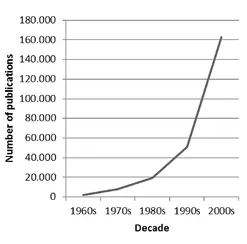
Other scholars agree with this assessment and repeatedly highlight the large scope for interesting debates. John Mackey, a researcher in the field of music, wrote “Uncertainty should continue to be seen as an exciting challenge” and Sasha Grishin, a researcher in the history of art, agrees: “uncertainty [is] a liberating force”. New and exciting research is being published on uncertainty on a regular basis, shedding light on the concept from different viewpoints and in different empirical settings. Doing a keyword search on academic databases such as Scopus shows the increasing role uncertainty plays in the academic literature over recent decades. This includes papers in conferences, academic journals and books. The number of publications1 has increased almost 100-fold over a period of 40 years from, 1,839 in the 1960s to 162,637 in the 2000s (see also Figure 1.1). Thus the chances are that a scholar is racking their brains about the issue right now, while you are reading this book (it might even be me).
So, What Is Uncertainty, and What Is It Not?
My intrinsic understanding of what uncertainty is (before I had read any academic articles about it) relates it to a general lack of knowledge. If I don’t know (enough) about a problem or area, I feel uncertain about it. When I am not sure about the leaving or arrival times of a train, I am uncertain as to when I will be at a friend’s house – and I might express this uncertainty by saying “around 5 o’clock” or “ 5ish”. Similarly, in organisations, the number of sales in 5 or 10 years’ time is uncertain.
FIGURE 1.1 ACADEMIC PUBLICATIONS ON UNCERTAINTY
However, in many languages other than English, this understanding is not that clear. In fact, many of these languages have multiple words for the concept of uncertainty. In German, for example, uncertainty can be Unsicherheit, Ungewissheit and Unbestimmtheit, each meaning different things. Unsicherheit literally translates as a situation of not being sure. This means that there can be some variation as to the true value. I might arrive between quarter to 5 and quarter-past at my friend’s house, for example. But at least we know a ballpark figure, just with some possible variation around it. In contrast, Ungewissheit refers to knowledge that we cannot derive logically. This term would apply to the future sales of a company. Innovations and changes in the market and economy might derive any prediction about future sales wrong. Third, Unbestimmtheit typically applies to measurements. Heisenberg’s uncertainty principle translates to German as the Unbestimmheitsrelation2 . Similar variations and differentiations can be found in other languages3.
What do the Experts have to Say?
The variation is reflected in the academic literature4. Similar to the meaning arising from the different translations of uncertainty into German, there are also three different understandings in the academic literature. The first set of definitions describes uncertainty as a completely controllable phenomenon and the task of research is to find suitable approaches to model and simulate this uncertainty. This is similar to the German word Unsicherheit because there is a general understanding about the situation or problem which gives us a ballpark figure, but not a definite and clear answer. Researchers falling into this category typically seek to describe uncertainty probabilistically through repetitive observations and trials. The basic assumption is that uncertainty needs to be controlled and that modelling it offers suitable means for identifying most likely outcomes as well as best-case and worst case scenarios.
Take for example the water level of a river such as the Elbe in Germany. Say you needed to estimate this water level because you want to set up a business of tourist boats and the depth of the water impacts whether you can operate your ships. The average water level of the Elbe is about 1.98 m but is highly variable from season to season. In extreme cases these fluctuations can give water levels of down to 0.3 m (measured during the low water of 1954) and up to 9.4 (during the flood in 2002).5 Despite the large variability and complexity of influences, it is (theoretically) possible to build a model that considers factors such as temperature, precipitation and the river discharge. The model can show the Elbe’s water levels.6 This makes it possible to prepare and plan for the uncertainty and take action accordingly.
The second set of definitions describes uncertainty as a phenomenon that cannot be controlled but can be influenced. As such, uncertainty is the absence of information or the difference between the information someone has and the information they need. This gap can be reduced. If I am uncertain as to the actual length of the river Elbe, I can look it up. I can reduce my uncertainty by collecting further information. This definition also suggests that uncertainty is something negative and unwanted. When I am uncertain, I feel panicked and insecure and I want to get away from this situation and become certain. I want to acquire enough knowledge that I will not come into situations of being uncertain – or at least not often.
The third set of definitions sees uncertainty as a completely uncontrollable phenomenon. We can model uncertainty and simulate outcomes, but the resulting predictions are fundamentally flawed. There is some unknown variable – luck, destiny or something else – that changes plans and predictions. I can measure uncertainty but I cannot influence or control it. As such, some situations are inherently more uncertain than others.
For example, consider the difference between an orchestra player and a jazz musician. Both are very skilled musicians and yet they use their skills in very different ways, and one way to look at this is through the lens of uncertainty. Uncertainty can give the freedom to create and be creative. An orchestra player would probably perceive little uncertainty as to the music they will be playing because the piece would be agreed with the rest of the orchestra and the rhythm and speed would be determined by the conductor. In contrast, jazz includes improvisations, a sequence of music that is created spontaneously and is thus uncertain, yet the result is often very fascinating and much loved by the audience.
How Does this Fit Together?
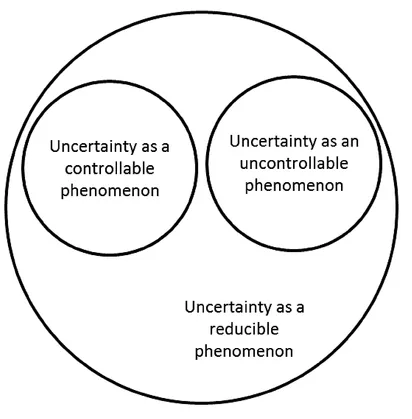
Uncertainty can mean quite different things to different people – and this difference in definition can lead to quite different research outcomes. So what definition is applicable in the context of behaviour and organisations? Looking at the definitions a little closer, it seems they are not as incompatible as they first appear. Depicting them as a Venn diagram looks something like Figure 1.2.
Imagine you would like to start a new hobby, something you have never done before – say knitting. You have no experience in it and thus face uncertainty: What needles are you to use? What techniques are there? What can and cannot be knitted? You can reduce that uncertainty by finding information about how best to approach knitting – find tutorial videos online or find a local interest group – or by practicing. The uncertainty is not a completely uncontrollable phenomenon for you because you can try to reduce it. In this example, uncertainty seems to be a reducible phenomenon.
Similarly when an organisation – say a manufacturer of cars – starts to engage a new valve supplier, they face uncertainty. Will the new supplier deliver the requested quality? Will the deliveries be on time? Do they have alternative and self-serving motives? Part of this uncertainty can be reduced. The car manufacturer can look into the supplier’s history, contact previous or other existing customers and gather information about the new provider. The uncertainty can be reduced, but only to a point. Some uncertainty will remain in this situation. For example, it will not be possible to completely ascertain the supplier’s motives or their future level of cooperation. Again, uncertainty seems to be a reducible phenomenon rather than a completely controllable or completely uncontrollable one.
FIGURE 1.2 DEFINITIONS OF UNCERTAINTY
Uncertainty and Risk
Many of the discussions I have had over the years, and in fact many of the discussions between researchers in this field, evolve around the difference between uncertainty in comparison to risk. There are many other related concepts – ambiguity, complexity, imprecision, inexperience, contradicting opinions and so on – but the comparison between uncertainty and risk is the most frequent and probably also the oldest of the discussions.
So what is the difference between uncertainty and risk? When am I risking something as opposed to … – what is the verb of uncertainty? The difference can be found exactly in this: the something. I risk something. I risk my life when I cycle without a helmet, I risk losing money when I gamble, I risk being late to a meeting. I cannot uncertain7 these things. This means in risk there is an impact on something. We can then make our decisions or take appropriate actions depending on the severity of this impact and the frequency with which these risk events happen.
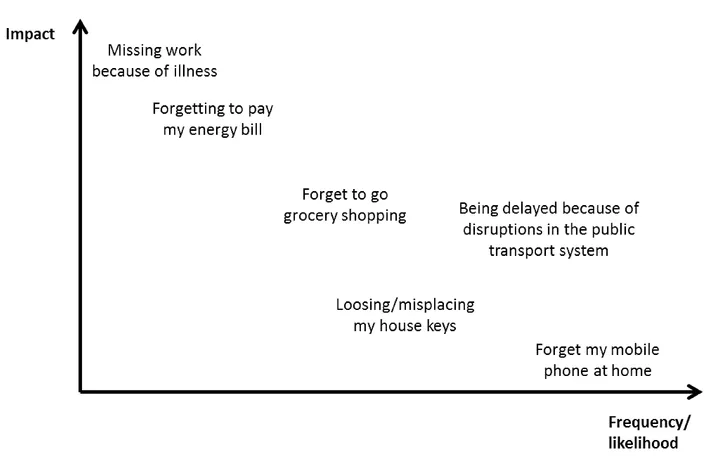
Look for example at the graph in Figure 1.3. I listed some of the risk events in my life. Quite a boring life, you may think, though I would call it a risk-managed life. In any case, in the graph you can see that some risk events in my life have a higher frequency than others. They can also have different levels of impact on my life which vary according to how dependent I am on them. For example, it happens quite regularly that I forget my mobile phone (at home, at work, etc.) and when I do, the impact on my life is relatively low because I can also communicate via other tools. In contrast, if I miss work because I am ill, I find this rather annoying and the impact is quite high. But it also happens quite rarely. You may choose to make a map like this for your own life. If you identify a risk event with a high frequency and a high impact, this is where risk management becomes a crucial tool. In this case, you may want to read one of the many books on risk management or alternatively contact your insurance broker for some help.
In this text I will be looking at uncertainty, and I hope through the course of this book it will become clear why I chose this focus over risk. I can summarise these reasons in two points. First, I find uncertainty a very exciting and interesting research area. Its importance has been highlighted by numerous authors and research fields and reading up on new findings is always fascinating to me. Second, uncertainty has received much less focused research interest. There are numerous books on risk management: a search on Amazon finds almost 95,000 titles. Uncertainty is a much less explored research area, and this has raised my curiosity and enthusiasm about this topic.
FIGURE 1.3 RISK EVENTS IN MY LIFE
Uncertainty, Knowledge and Information
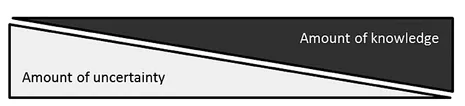
Uncertainty as I understand it and will explore it in this book is a lack of knowledge – there is something relevant that we do not know, or we do not know it exactly. Thus uncertainty relates directly to existing knowledge – the more knowledge I have about a topic, the less uncertain I am about it. Conversely, the less I know about something, the more uncertain I am. Uncertainty and knowledge are negatively correlated. Figure 1.4 depicts that graphically.
FIGURE 1.4 AMOUNT OF UNCERTAINTY VS AMOUNT OF KNOWLEDGE
Researchers call this the uncertainty cone. It represents different amounts of uncertainty depending on the amount of available knowledge. The uncertainty c...