Growing Compact: Urban Form, Density and Sustainability explores and unravels the phenomena, links and benefits between density, compactness and the sustainability of cities. It looks at the socio-climatic implications of density and takes a more holistic approach to sustainable urbanism by understanding the correlations between the social, economic and environmental dimensions of the city, and the challenges and opportunities with density. The book presents contributions from internationally well-known scholars, thinkers and practitioners whose theoretical and practical works address city planning, urban and architectural design for density and sustainability at various levels, including challenges in building resilience against climate change and natural disasters, capacity and integration for growth and adaptability, ageing, community and security, vegetation, food production, compact resource systems and regeneration.
eBook - ePub
Growing Compact
Urban Form, Density and Sustainability
- 390 pages
- English
- ePUB (mobile friendly)
- Available on iOS & Android
eBook - ePub
Growing Compact
Urban Form, Density and Sustainability
About this book
Information
Part I
Framing the question
Unravelling the link between density,
sustainability and compact cities
sustainability and compact cities
Chapter 2
Urban lifelines to achieve climate resiliency
Summary
This chapter proposes a set of urban design principles – defined as ‘urban lifelines’ – to respond to the climate challenges of the twenty-first century. Increased density, if unplanned, can result in greater congestion, pollution and gird-locked cities. With urban lifelines, compact and connected multi-use nodes can support the ecosystem functions of water, food, energy and waste recycling and provide mobility and safe harbour for resilience to climate change.
Resilience to climate change includes protection of populations from natural disasters, such as hurricanes, tsunamis and earthquakes. It also includes mitigation and adaptation measures for longer-term risks of global warming and sea-level rise through actions that reduce carbon emissions.
Human settlements, land consumption and megacities have changed the geological, hydrological and meteorological conditions of regions and localities. Building on food plains has removed the effectiveness of the natural landscape to absorb and limit flooding. The heat island effect has raised ambient air temperatures around cities. Urban canyons retain air pollution to levels harmful to human health. Wasteful water consumption has depleted local aquifers, accelerating drought and soil loss.
Severe weather attributed to global climate change has disrupted cities and regions at rates and scales not previously imagined. The harm is due in part to urban design, or lack of it. Cities have located or expanded into areas exposed to natural hazards, earthquake-prone zones and floodplains. As cities grow in size and density, the risk to life safety and health increases. This creates a single challenge for urban design for the twenty-first century.
New urban design principles are needed to respond to climate change
Cities evolve from the planned and unplanned confluence of commerce, population, resources, governance and culture. Where cities develop slowly over decades and centuries, city growth can evolve patterns scaled to their natural surrounds. Where development occurs rapidly – for example, the explosion of new megacities of the late twentieth century or rapid rebuilding following a natural disaster – vital connections to natural and cultural conditions are often disrupted or lost, outpacing the best of plans. System designs to handle traffic, water, waste and other city services are overwhelmed.
Urban design principles define the form of cities. Some principles are cultural, defining formal elements of style, scale and character of the public realm. Some principles are functional, reflecting requirements of transport, infrastructure and construction. The theory and practice of urban design represent the collective mix of these principles and standards that support the beauty, health, safety and liveability of civic life (Watson et al., 2003).
The geologic and hydrologic history of a place is written in its natural landscape of mountains, valleys, watercourses, soil and vegetation, the result of millions of years of adaptation to a specific regime of climate and weather. The indigenous and vernacular architecture of a region has traditionally reflected a practical response to climate and local resources. The wisdom of place and bioclimatic design is often lost or ignored in industrialized architecture. In the best instances, buildings represent ingenious strategies of ‘design with climate’, to utilize the resource of the natural climate by sitting, orientation and construction (Watson and Labs, 1983).
In the 1990s, concepts of sustainability emerged from the United Nations Rio Earth Summit. Sustainable design principles extended the mandate of urban and architectural design, setting goals for energy and resource conservation through building codes and incentive programmes in cities across the world (Van der Heijden, 2014).
In the present century, climate disruption is evident in global weather trends, warming and pollution of the atmosphere and oceans, extreme weather events, altered vegetative zones, storm and precipitation patterns, and sea-level rise. Climate change mitigation defines actions to reduce or eliminate global greenhouse gases (GHG) that contribute to global warming. Climate adaptation defines actions to build capacities to survive and thrive in changing climate and resource conditions. Addressing climate change involves new design principles and practices to plan and manage human settlements (adaptive measures), while reducing GHG by energy conservation, renewable resource and new ‘low carbon’ technologies (mitigation measures) (UNEP, 2015).
Natural weather events become hazards as a result of human actions
By 2050 the urban population is estimated to be 6.3 billion worldwide, nearly doubling the 3.5 billion urban dwellers in 2010. More than 60 per cent of the area projected to be urban by mid-century has yet to be built. Much of the growth is expected in small and medium-sized cities, while the number of megacities also grows apace (Convention on Biological Diversity, 2012).
Living in cities can result in living increasingly at risk. A total of 370 million people currently live in cities in earthquake-prone areas; 310 million live in cities with a high probability of tropical cyclones. If present urbanization trends continue unabated in vulnerable locations, the population at risk of earthquakes and cyclones will more than double by 2050 (Brecht et al., 2013, p. 37).
Natural hazards – storms, floods, wildfires, tornadoes, earthquakes – result from naturally occurring processes. They pose the risk of disaster depending upon the location, construction and management of human settlements. Secondary impacts, accidents and disruptions may result from natural disasters: a ruptured gas line in an earthquake, a building fire in an electric storm, or a power outage after a wind storm. All have to be assessed by urban designers, engineers and architects in meeting the life safety and public health requirements in design of building and urban infrastructure.
The Center for Research on the Epidemiology of Disasters (CRED, 2015) defnes a disaster as, ‘a situation or event which overwhelms local capacity, necessitating a request to a national or international level for external assistance; [or] an unforeseen and often sudden event that causes great damage, destruction, and human suffering’.
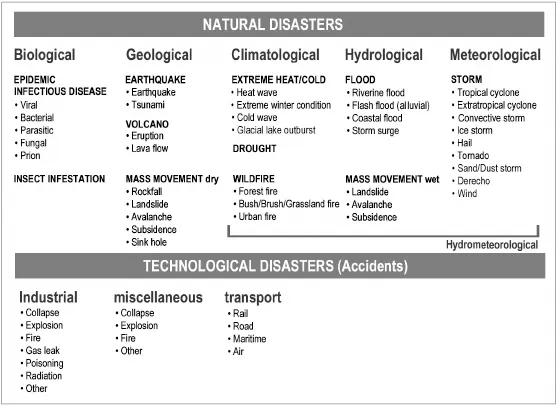
Table 2.1 Classification of natural disasters
Source: compiled from Guha-Sapir et al. (2015).
Table 2.1 indicates the range and types of declared natural disasters since the 1900s documented by CRED. They are listed under the disciplines that support the science and design measures to respond to the hazards.
CRED data (EM-DAT) does not record the chronic risks that may result from longer-trend global warming, snowmelt, precipitation and drought, or sea-level rise. These represent possible future conditions and hazards that may result from incremental climate change. Risks may include nuisance flooding, extreme heat that exacerbates urban heat island, air and water pollution, and increase in insect-borne disease vectors. Both ‘heat’ and ‘flood’ are among the most critical liabilities to be considered in resilient design of buildings, infrastructure and urban lifeline systems.
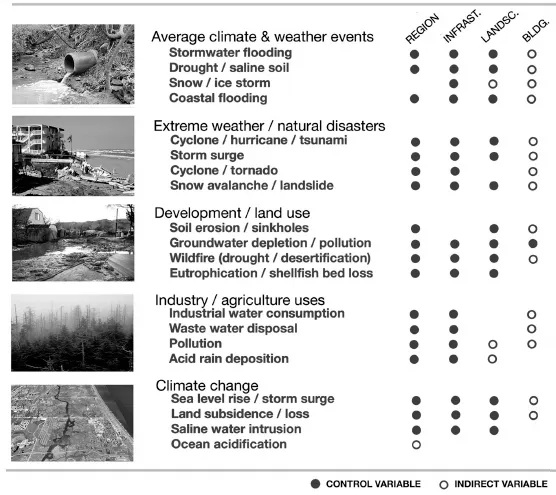
Watson and Adams (2011) provide an analysis of environmental risks that are influenced by urban design at regional, city and local building scales. In all cases, effective measures require design measures beyond the single building scale. Resiliency has to be achieved at urban design and regional scales (Table 2.2).
Table 2.2 Scale of impacts of climate change. Variables indicate the scale of design required to address the associated risks (Region, Infrastructure, Landscape, Building)
Source: Watson and Adams (2011).
Mitigation and adaptation are necessary and mutually supporting strategies
Cities produce 70 per cent of anthropogenic global carbon dioxide emissions. The 50 largest cities together emit 2,600 megatons of carbon dioxide (NASA Earth Observatory, 2015). Existing buildings’ average energy use accounts for 45 per cent of urban carbon emissions (C40 Cities/ARUP, 2015).
Urban design can reduce greenhouse gas emissions and natural hazard risks. Lall and Decihmann (2009) make the case that economic vitality is required to support the investment in resilient urban design, but that investment can be sustained by well-managed cities along with increase in population and density. The average productivity of cities increases from 4 to 20 per cent with each doubling of the metropolitan population. Creating economic opportunities of scale and diversity of means and capacities provide the resources to reduce urban vulnerabilities. Junghams and Dorsch (2015) detail a broad range of the increasing range of financing innovations that support low-carbon and climate-resilient development.
The requirements of sustainable development – living by means of investments that conserve resources and the capacity to assure an enduring future – are changing, well beyond what was considered ‘sustainable’ when the concept first emerged in the early 1990s. Ignoring future temperature increases impelled by global warming could mean that a building designed using historic weather data for any given location will become unaffordable or unusable. They will require more energy to cool and experience longer periods of overheating when their HVAC systems do not meet the comfort conditions required for safe and healthy occupancy.
Climate change mitigation and adaptation require that regions, cities and buildings operate with less energy and less carbon emissions. At the same time, urban design has to provide the means and measures for healthy functioning of environmental systems, water, waste, vegetation and soil that tempers climate extremes and provides natural resource benefits. Elmqvist et al. (2013) provide a summary of urban risks to biodiversity and ecosystem services, due to population increase and urban sprawl and congestion:
1. Urban areas are expanding faster than urban populations. If current trends continue, between 2000 and 2030 urban land cover is expected to triple, while urban populations are expected to nearly double.
2. Urban areas modify their local and regional climate through the...
Table of contents
- Cover Page
- Half Title
- Title Page
- Copyright Page
- Table of Contents
- List of figures
- List of tables
- List of contributors
- Acknowledgements
- Foreword
- Introduction
- PART I Framing the question: unravelling the link between density, sustainability and compact cities
- PART II Quality of living and social dimensions relating to environmental sustainability
- PART III Compact resource management, greening and integration with urban form
- PART IV Design systems and structural approaches impacting density and sustainability
- PART V Policies, guidelines, methods and decision making relating to development for density and sustainability
- Index
Trusted by 375,005 students
Access to over 1.5 million titles for a fair monthly price.
Study more efficiently using our study tools.
Frequently asked questions
Yes, you can cancel anytime from the Subscription tab in your account settings on the Perlego website. Your subscription will stay active until the end of your current billing period. Learn how to cancel your subscription
No, books cannot be downloaded as external files, such as PDFs, for use outside of Perlego. However, you can download books within the Perlego app for offline reading on mobile or tablet. Learn how to download books offline
Perlego offers two plans: Essential and Complete
- Essential is ideal for learners and professionals who enjoy exploring a wide range of subjects. Access the Essential Library with 800,000+ trusted titles and best-sellers across business, personal growth, and the humanities. Includes unlimited reading time and Standard Read Aloud voice.
- Complete: Perfect for advanced learners and researchers needing full, unrestricted access. Unlock 1.5M+ books across hundreds of subjects, including academic and specialized titles. The Complete Plan also includes advanced features like Premium Read Aloud and Research Assistant.
We are an online textbook subscription service, where you can get access to an entire online library for less than the price of a single book per month. With over 1.5 million books across 990+ topics, we’ve got you covered! Learn about our mission
Look out for the read-aloud symbol on your next book to see if you can listen to it. The read-aloud tool reads text aloud for you, highlighting the text as it is being read. You can pause it, speed it up and slow it down. Learn more about Read Aloud
Yes! You can use the Perlego app on both iOS and Android devices to read anytime, anywhere — even offline. Perfect for commutes or when you’re on the go.
Please note we cannot support devices running on iOS 13 and Android 7 or earlier. Learn more about using the app
Please note we cannot support devices running on iOS 13 and Android 7 or earlier. Learn more about using the app
Yes, you can access Growing Compact by Joo Hwa P. Bay, Steffen Lehmann, Joo Hwa P. Bay,Steffen Lehmann in PDF and/or ePUB format, as well as other popular books in Architecture & Architecture General. We have over 1.5 million books available in our catalogue for you to explore.